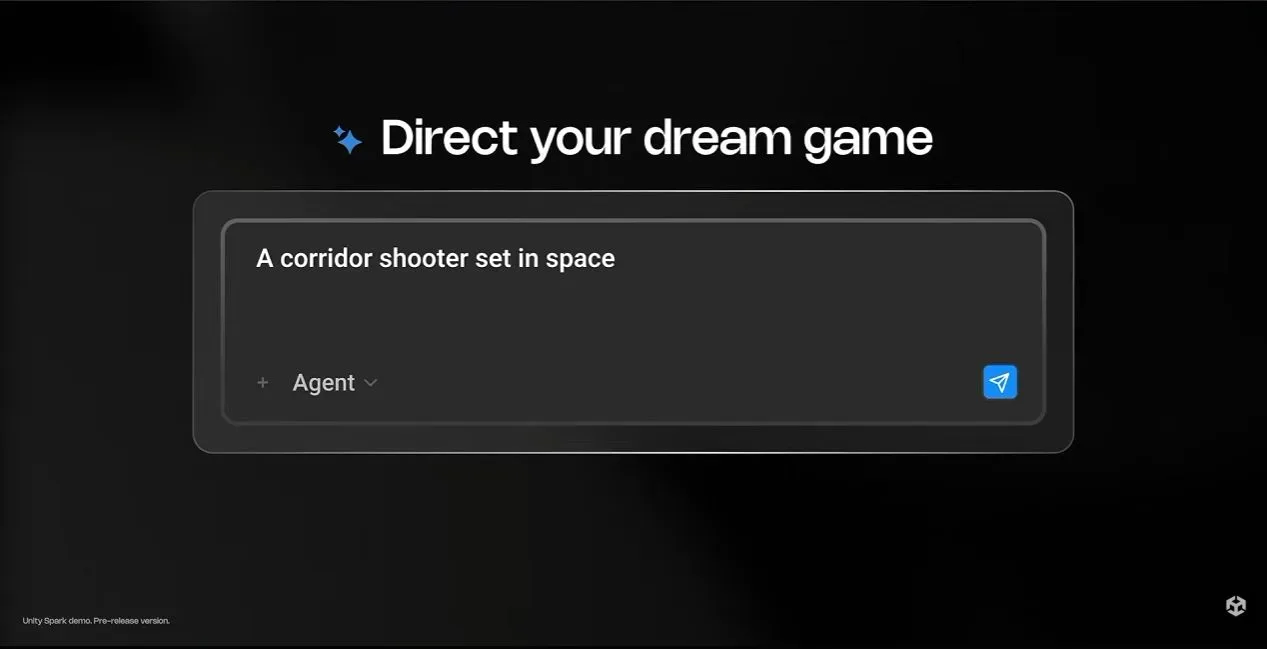
Unity has put a strikingly ambitious pitch behind Spark: a browser-based way for people to make and share games together, with no previous Unity or game-development experience required. The upcoming tool is framed around AI-assisted creation, conversational prompts, ready-made assets and the ability to direct a project without beginning from an empty scene or learning every conventional production workflow.
That proposition is easy to understand. Game tools can be intimidating, and the distance between “I have an idea” and “there is a playable build” is enormous. But the promotional example used to sell Spark has become an unusually effective illustration of the limits of that promise. In the video, two fictional collaborators build a small science-fiction shooter called Space Corridor. The resulting game is not merely simple; it appears designed around the most familiar possible ingredients: a futuristic soldier, a blue interior environment, drones, an alien opponent and basic shooting.
For a platform positioning itself as a path toward a person’s “dream game,” that choice matters. A demo is not just a technical proof of concept. It is an answer to a basic question from prospective creators: what kind of work will this tool help me make? Space Corridor’s answer looks far less inspiring than Unity Spark’s broad creative language suggests.
What Unity Spark is claiming to do
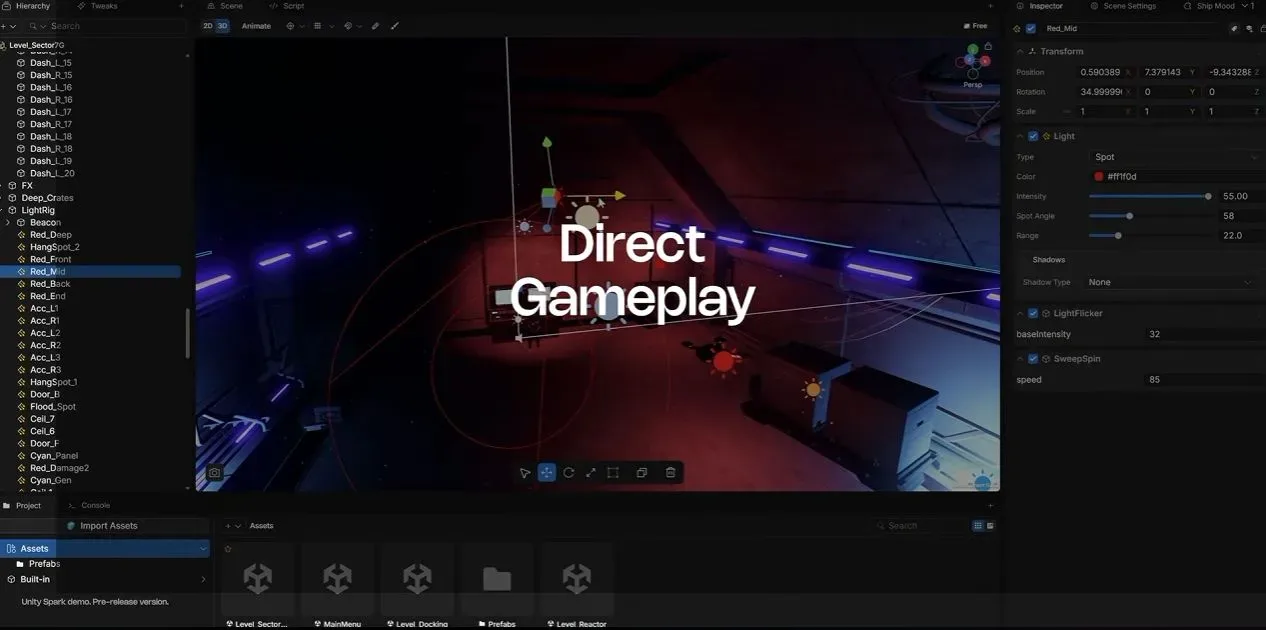
Spark is presented as a collaborative in-browser game-making environment. The video depicts users conversing in a chat-like interface, entering short requests, selecting supplied assets and changing a project as the system responds. It also presents tool creation as a prompt-driven process: a request for controls over lighting presets produces a panel with options including bright work lights, a power-failure-style blackout and a warmer setting labeled “Shore Leave.”
That distinction is worth making because “vibe coding” is not a formal technical term with one settled definition. In this context, it describes directing software through natural-language requests rather than manually writing every line of code or configuring every system through traditional editor panels. The user describes an intended outcome; the AI system generates or arranges some portion of the implementation.
It can be a useful interface idea. Plain-language requests may lower the barrier to prototyping, especially for someone who does not know a game engine’s terminology. A quick prompt can also help a team test whether a rough concept is worth developing further. But an accessible interface does not remove the underlying design decisions. Someone still has to decide what the player does, why each encounter matters, how feedback communicates success or failure, whether controls feel coherent, and whether the art, animation, sound and systems support the intended experience.
Spark’s own presentation appears to acknowledge part of that reality. Rapid shots of flowcharts, task lists and numerous asset descriptions imply that a finished project still has many moving parts. That is not a failure of the tool; it is simply what game development is. The friction comes from pairing that apparent complexity with messaging that makes creation look as immediate as a few cheerful prompts.
Space Corridor is the unfortunate centerpiece
The trailer begins with Theo asking Mari whether she has tried Unity Spark to make the game she has always wanted. Mari’s core prompt is a “corridor shooter set in space.” Spark then recommends artist-created assets for a Station K-7 holdout corridor, including an environment, player character and cover props. A space-soldier character appears in a large blue interior under the title Space Corridor.
Related coverage includes Unity Spark's Space Corridor Trailer Has Become a Showcase for AI Game-Making Skepticism.
The collaborators add a drone, replace it with an alien, then request that the enemy explode when shot. Later, they ask for lighting-preset controls. The presentation also shows the player character performing a melee action against a drone. On paper, these are examples of iteration: add a threat, change a threat, adjust an effect, make a tool and revise the playable action.
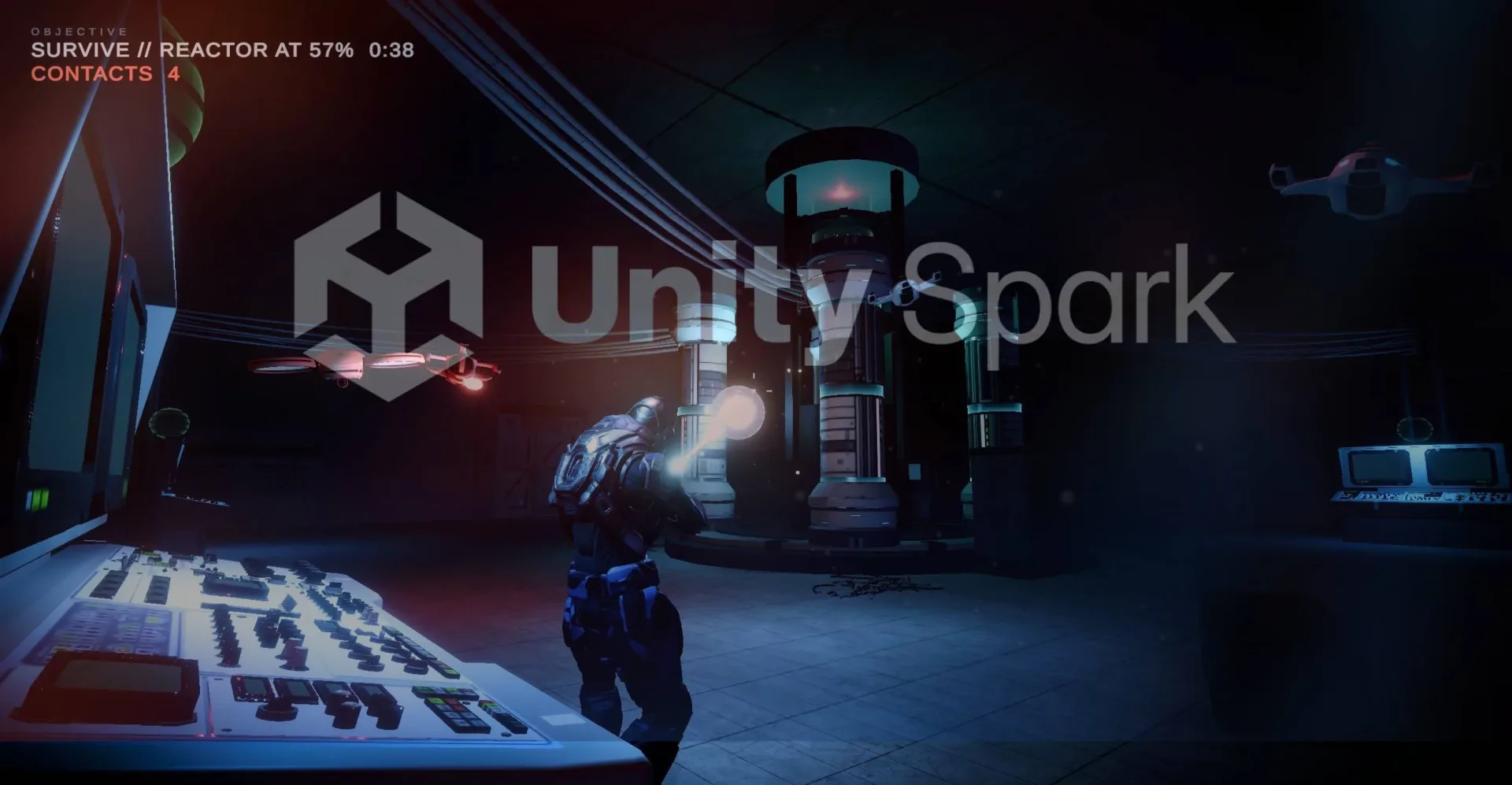
In practice, the demonstration creates a problem for the product’s central fantasy. The showcased vision remains generic at every major point. Its setting is broad science fiction. Its avatar is a familiar armored fighter. Its enemies are a drone and a grey alien. Its action is shooting in enclosed rooms. The trailer’s footage also makes the animation, combat response and lighting look rudimentary, while the requested explosion does not visibly occur in the depicted moment.
None of that means a tiny prototype must look like a commercial release. Prototypes are supposed to be incomplete. The trouble is that Unity has chosen this prototype as the polished argument for a major new creation workflow. If the best showcase is an almost comically plain shooter, viewers can reasonably ask whether Spark is helping people discover their ideas or merely helping them assemble recognizable components faster.
Assets are ingredients, not authorship
The demonstration’s asset recommendation is also central to the debate. Spark identifies assets as artist-created, and that is an important detail: the shown workflow is not only about generating material from scratch. It is also about selecting and combining a library of existing work within a project.
Asset libraries have long been a normal part of game production. They can save time on placeholders, provide building blocks for small teams and let creators focus effort where it matters most. There is nothing inherently lesser about using them. The question is what the creator adds through selection, modification, mechanics, structure and presentation.
A stock environment can become memorable when it serves a distinctive objective. An ordinary enemy can become compelling through behavior, timing, audio cues, escalation and placement. A lighting control can be meaningful when light changes navigation, danger, mood or story. Simply putting a soldier, corridor and drone together does not automatically supply those connections.
This is why the language around AI-assisted creation deserves precision. Generating a functional scene is not the same as solving game design. A game is a set of relationships: player input creates an action; the action causes a response; the response teaches the player something; the next choice becomes more interesting because of what came before. Spark may eventually speed up portions of that process, but the trailer does not establish that prompts alone will produce the judgment needed to make those relationships work.
Sharing a build and selling a game are different achievements
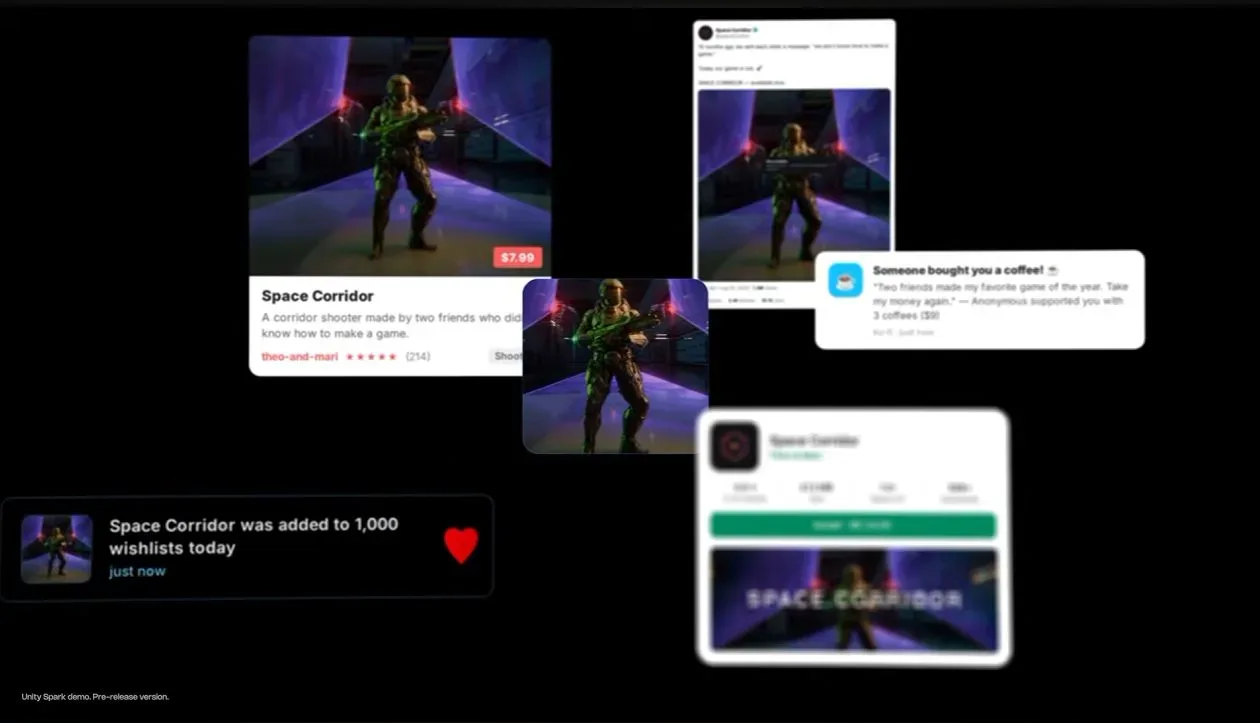
After Mari and Theo declare Space Corridor ready, the trailer shifts into a fantasy of immediate success. The fictional game is shown with 1,000 wishlists in a day, a $7.99 price, five stars from 214 reviews and a Ko-fi contribution praising the two friends’ work. Their chat celebrates that they did not know how to make a game and now have one released.
The sequence is clearly intended to make creation feel achievable, and that emotional goal is understandable. The ability to share an early project with friends can be genuinely valuable. It can invite feedback, create momentum and make learning less lonely. A browser-first collaboration space may be particularly appealing for that reason.
Yet the jump from a basic prototype to a praised, paid release is doing considerable rhetorical work. Publishing a project is not the same thing as making it ready for an audience. At minimum, a public game must give players a comprehensible reason to engage with it, communicate what is happening, behave reliably enough for its purpose and offer something beyond its raw ingredients. The trailer’s made-up reception skips past all of those questions.
That is especially unfortunate because an honest demo could have been stronger. Spark does not need to promise a straight line from six words to a commercial success story. It could show a creator using a rough generated start as a learning tool, then spending time refining controls, behavior and a small but specific idea. That would still be approachable while treating game-making as a craft rather than a slot machine that converts enthusiasm into wishlists.
The playable sample makes the sales pitch harder
Space Corridor is playable in a browser even as Unity Spark itself is listed as coming soon with a waitlist. The available sample reportedly lasts around five minutes. Rather than taking place in one continuous corridor, it puts the player through three small sealed rooms, where drones appear in waves while a timer counts down before the player is sent out an airlock.
The playable existence of the demo is significant. It shifts the discussion beyond a montage of selected clips and toward the actual shape of the advertised result. A trailer can cut rapidly between systems, but a playable build makes the loop visible: what repeats, what changes, what reacts and how long the premise can sustain attention. For a tool built around lowering the distance between an idea and a game, that is precisely the standard people will apply.
The wider practical implication is not that inexperienced creators should be mocked for making simple games. Everyone begins somewhere, and a five-minute shooter can be a useful learning exercise. The issue is that product marketing has placed this particular result at the center of a much bigger claim about creativity. Spark’s first impression would be more persuasive if it showed beginners gaining understanding and agency rather than pushing a project across an imagined finish line.
There is also a valuable distinction between automation and direction. Automation reduces repetitive work: setting up a starting scene, placing temporary objects or exposing simple controls. Direction determines purpose: deciding which details deserve attention, which ideas should be removed and which player feelings the project should pursue. The former can be accelerated; the latter remains the difficult, personal work. For more coverage of the business and tools shaping games, follow our games industry coverage.
What Spark still needs to demonstrate
Unity Spark may yet prove useful when it reaches users. The claims currently shown suggest potential benefits: lower initial barriers, collaborative creation in a browser, quick asset discovery, prompt-driven experimentation and the ability to build custom editing tools. Those are meaningful goals, particularly if the platform helps new creators understand what is being changed rather than concealing every decision behind a chat box.
But the Space Corridor campaign leaves a clearer lesson than it likely intended. Fast assembly is not creative identity. A visible asset library is not an artistic vision. A prompt is not a design document. And a “Share” button cannot substitute for the work that makes players care once they arrive.
The sensible measure for Spark, when it is available, will not be whether it can produce another generic room full of enemies on command. It will be whether users can take an initial, assisted prototype and meaningfully transform it: revise behavior, make understandable choices, build a recognizable point of view and learn enough to make the next version better. Until the marketing shows that path, Space Corridor will remain a cautionary showcase—less a dream game than a reminder that the hardest parts of making one cannot be wished into existence.