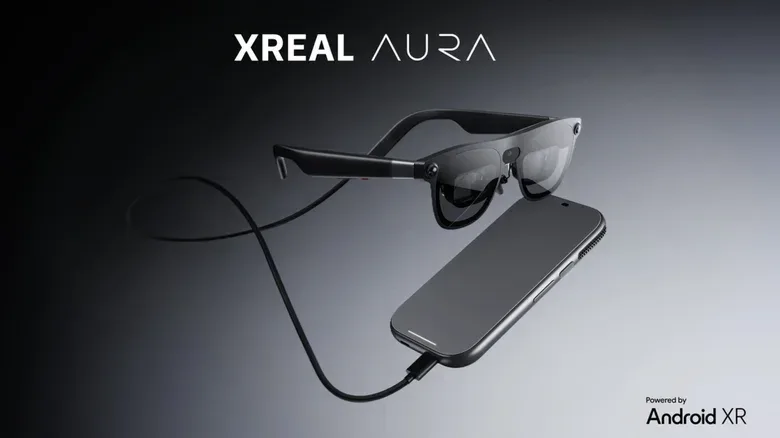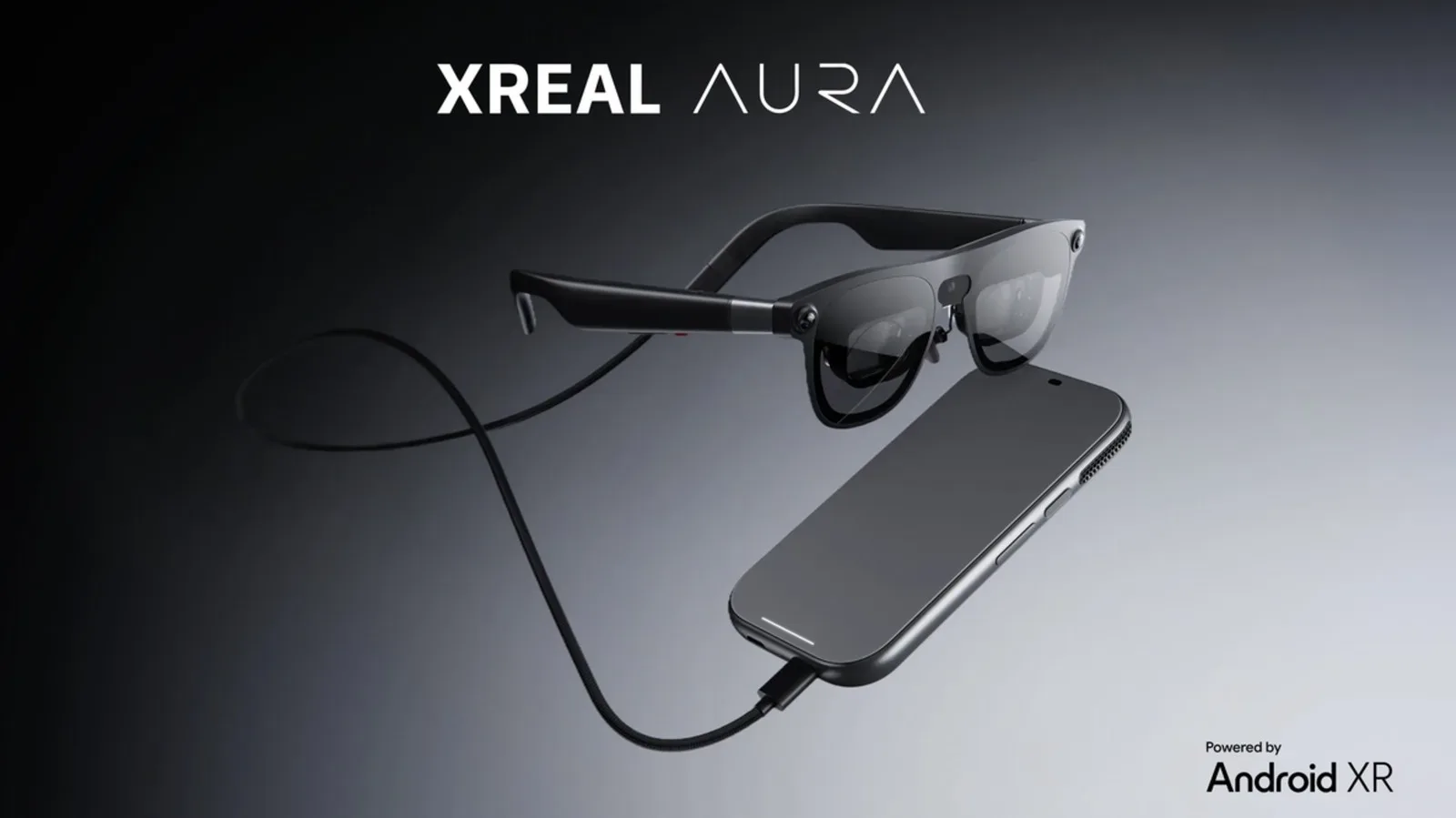
Xreal’s Aura smartglasses are now available to order, bringing a gaming-capable spatial-computing device built around Android XR to market. The Aura is described as the first wired glasses platform to use the XR operating system developed by Google and Samsung, pairing that software with Qualcomm’s Snapdragon Reality Elite chip.
For players, the headline is less about replacing a conventional game console and more about creating a personal virtual workspace that can contain native XR software alongside connected devices. The glasses can accept a laptop or PC gaming handheld over USB-C, while Xreal says those external screens can sit in the same spatial workspace as the Aura’s built-in apps. Native XR games including Cubism and Fallout: Factions are among the experiences identified for the platform.
The device is launching with reduced prices for both configurations. The 12GB RAM and 256GB storage model costs $1,099 through December, down from its usual $1,279 price. The 16GB RAM and 512GB storage version is priced at $1,299 for the rest of 2026 rather than its ordinary $1,499. Shipping is expected to begin in the middle of November.
What the Aura hardware is trying to balance
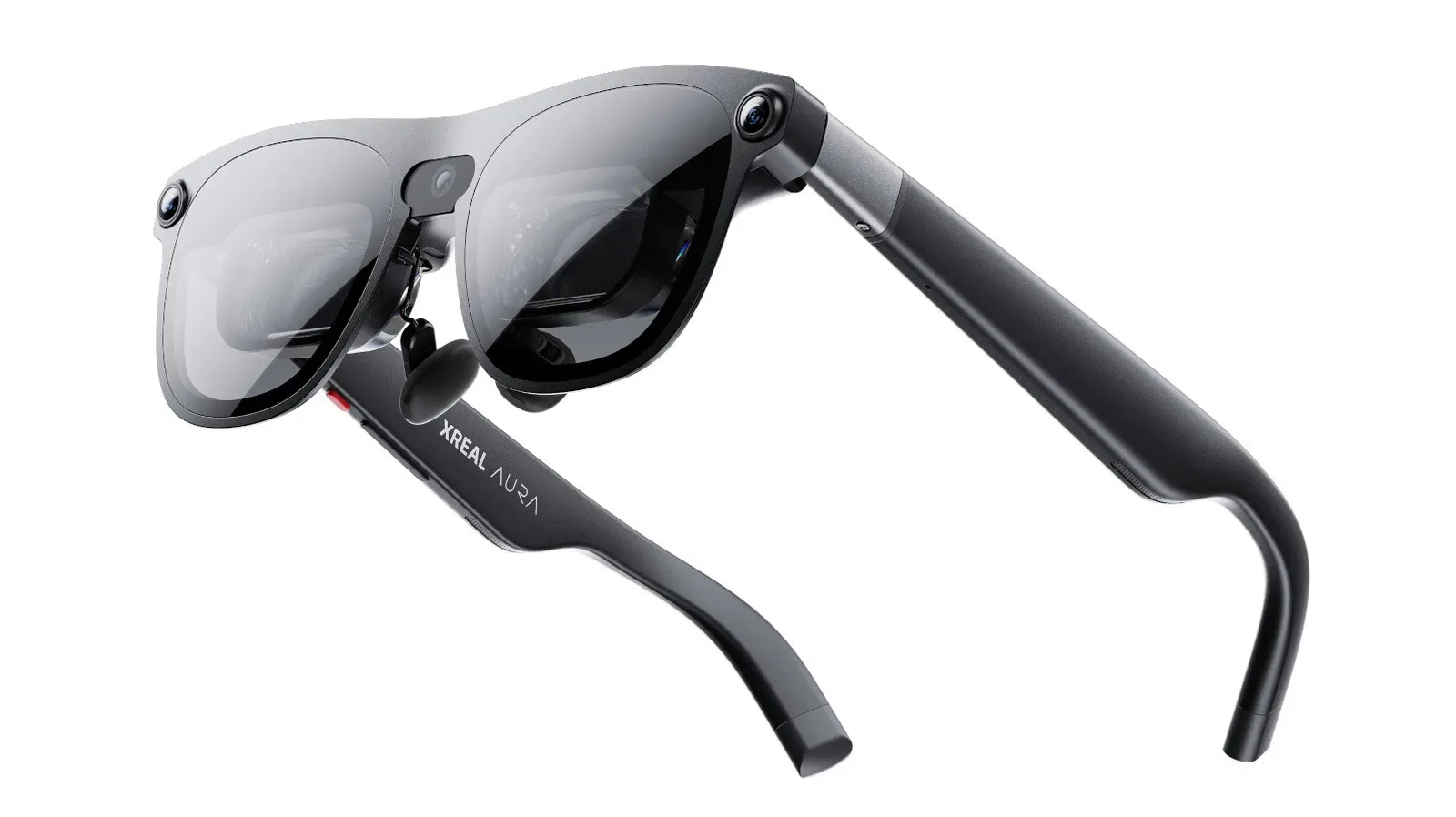
Smartglasses have an unusually difficult design problem: they need display hardware, speakers, processing power, controls and a battery arrangement, but are worn directly on a person’s face. Xreal’s solution separates some of the bulk. The glasses themselves weigh under 95 grams and are said to resemble a somewhat thicker normal pair of spectacles. Battery and compute duties move to a tethered external puck.
That tradeoff is important. Moving components away from the glasses can help keep the head-worn portion lighter, but it also means Aura use involves managing a connected device rather than simply putting on a self-contained headset. The puck incorporates a trackpad and fingerprint sensor, giving it a role beyond power and processing. It is part controller, part security component and part companion hardware.
The display specification is a 70-degree field of view, with Micro-OLED panels providing 1200p resolution at up to 120Hz. Field of view refers to how much of a wearer’s vision is occupied by the digital display. It is not a direct measure of image quality, but it helps describe the apparent size of the virtual viewing area. A 120Hz refresh rate means the display can update as many as 120 times per second, a figure that is relevant for fluid movement in games and for general interface responsiveness.
Micro-OLED is a display technology that uses very small OLED panels, a format suited to devices that position screens close to the eyes. The provided specifications establish the resolution and refresh-rate targets, but they do not by themselves answer questions such as how every game will perform, the size of virtual screens a wearer may prefer, or the comfort of prolonged sessions. Those practical results will depend on the software being run and, when a connected PC or handheld is involved, the attached hardware as well.
Android XR puts apps and AI at the center
Aura’s other defining feature is Android XR. XR, short for extended reality, is a broad label for computing experiences that use virtual digital content in a spatial environment. In Aura’s case, Xreal is positioning the software as a common layer for work, entertainment, gaming and AI-assisted activities instead of a narrowly single-purpose display accessory.
The device is expected to include 150 dedicated XR experiences at launch, alongside conventional Google Play apps. That distinction matters: dedicated XR experiences are made to take advantage of the spatial interface, whereas standard apps are the familiar day-to-day Android software that expands what can be used in the environment. The breadth of the app library may be one of Aura’s clearest practical attractions, although buyers should still separate the availability of Android apps from the number of applications specifically designed around XR interaction.
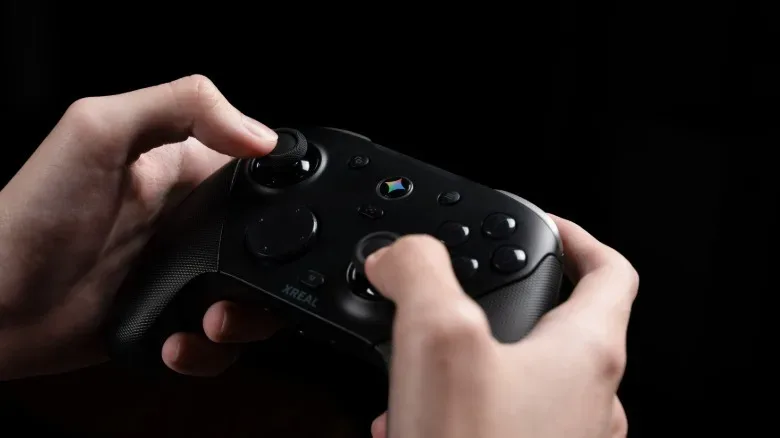
Gemini is integrated into the operating system. Xreal and GameSir have also worked on a controller made specifically for Aura, with a dedicated Gemini button that can summon Google’s chatbot while playing. The function is an example of how AI is being treated as a system-level tool rather than solely an app opened before or after a game.
Whether players find that useful will likely come down to the task. A quick conversational prompt may be convenient when planning something, looking for help, or moving between entertainment and productivity. In the middle of an action-heavy game, however, a separate button does not automatically make interaction frictionless. The presence of the feature is significant because it makes Gemini readily accessible from the gaming controller, not because it guarantees a particular in-game advantage.
Gaming options: native XR, controller support and USB-C devices
The known XR game selection includes Cubism, a puzzle game, and Fallout: Factions, a virtual adaptation of the Fallout tabletop game. These are useful early examples because they suggest Aura is not being framed exclusively around flat-screen games viewed on a virtual monitor. There is room for experiences designed for the spatial platform itself.
At the same time, USB-C compatibility with laptops and PC gaming handhelds gives the Aura a more familiar gaming role: a private display environment for an existing device. The glasses do not turn an external machine into a native Android XR game system; rather, the connected device appears in the Aura’s spatial workspace alongside its built-in software. For someone who already uses a handheld PC, that may be the more immediately understandable use case.
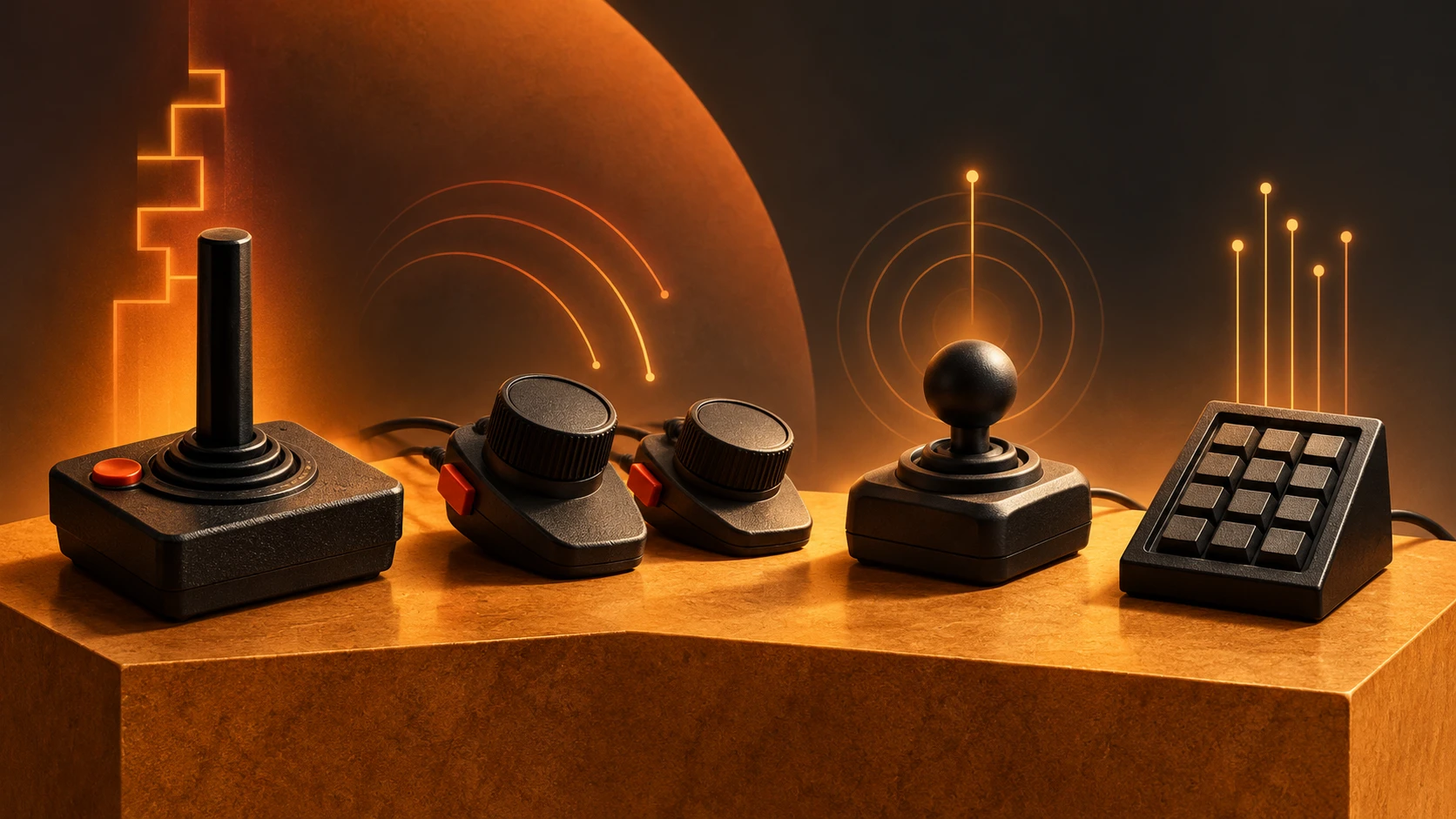
The setup also points to a continuing truth about portable game hardware: controls remain as important as screens. The purpose-built GameSir controller is one option, while connected laptops and handhelds retain their own input arrangements. For a reminder of how control schemes have repeatedly shaped the way games are played, see this look at Atari controller history, from joysticks to paddles. Aura’s trackpad-equipped puck and Gemini-enabled gamepad are modern variations on that same interface question, even if their uses are far broader than a classic console controller.
Xreal has additionally announced a wireless portable keyboard. This supports the company’s argument that Aura is intended for work as well as gaming, and it gives users a potential input method for text-heavy apps or productivity tasks. No claim should be made that the keyboard is necessary for gaming: its apparent role is to round out the larger computing setup.
Audio and the realities of an open-ear design
Aura uses built-in open-ear speakers tuned by Bose. Open-ear audio generally means sound is delivered without sealing the ear canal in the manner of in-ear headphones. In theory, that kind of design can better preserve awareness of the surrounding environment; it is also a different proposition from isolated headphone listening. The supplied information identifies Bose’s tuning role, but does not establish performance in noisy surroundings, sound leakage, microphone behavior or how well audio will suit individual games.
That uncertainty applies to much of the category. On paper, the Aura’s display figures, light sub-95g glasses unit, wireless keyboard option, Android app access and external-device support lay out a notably broad ambition. But a buyer’s priority could vary sharply. A player who wants a virtual screen for a PC gaming handheld will assess the cable-and-puck arrangement differently from someone focused on dedicated XR games, AI functions or a portable work environment.
Which configuration is discounted, and for how long?
- 12GB RAM / 256GB storage: $1,099 through December; ordinary price is $1,279.
- 16GB RAM / 512GB storage: $1,299 for the remainder of 2026; ordinary price is $1,499.
- Shipping: expected to start in mid-November.
The pricing structure gives the higher-capacity version the larger dollar reduction, though the best choice depends on whether the extra memory and storage are meaningful for a buyer’s planned apps and files. The provided details do not specify storage requirements for particular XR experiences, so there is no basis to recommend one configuration universally.
More broadly, Aura is a conspicuous early test of Android XR as a wired smartglasses platform. Its design does not hide every compromise: a separate puck is explicitly part of the package. Yet the same decision helps support a glasses unit intended to remain relatively light while accommodating 120Hz Micro-OLED displays, open-ear audio, Android XR software and a set of gaming and productivity accessories. For players curious about spatial computing, the most concrete proposition is straightforward: native XR titles and Android apps on one side, a USB-C path for laptops and PC gaming handhelds on the other.