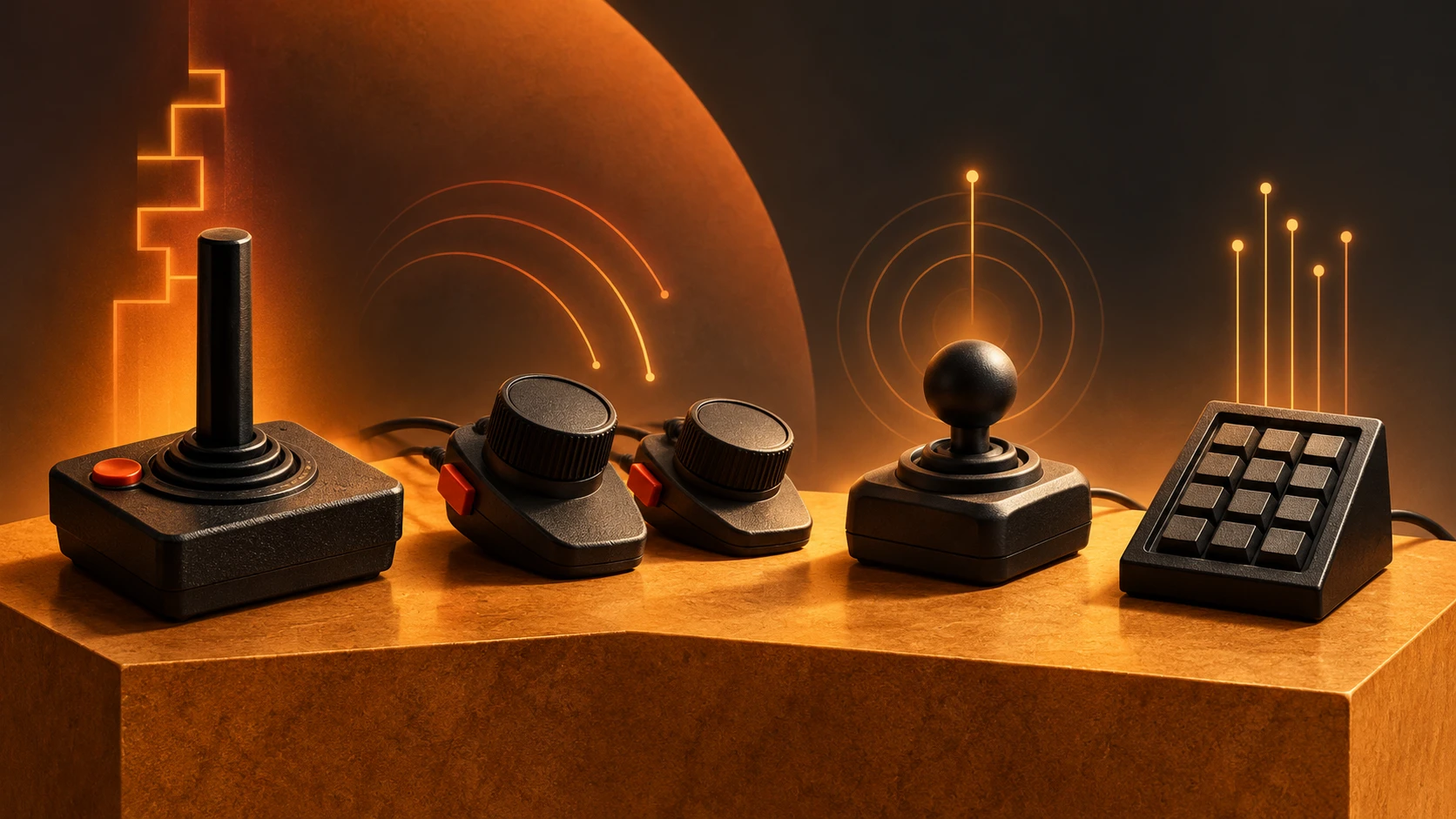
A Controller Is an Interface, Not a Shape
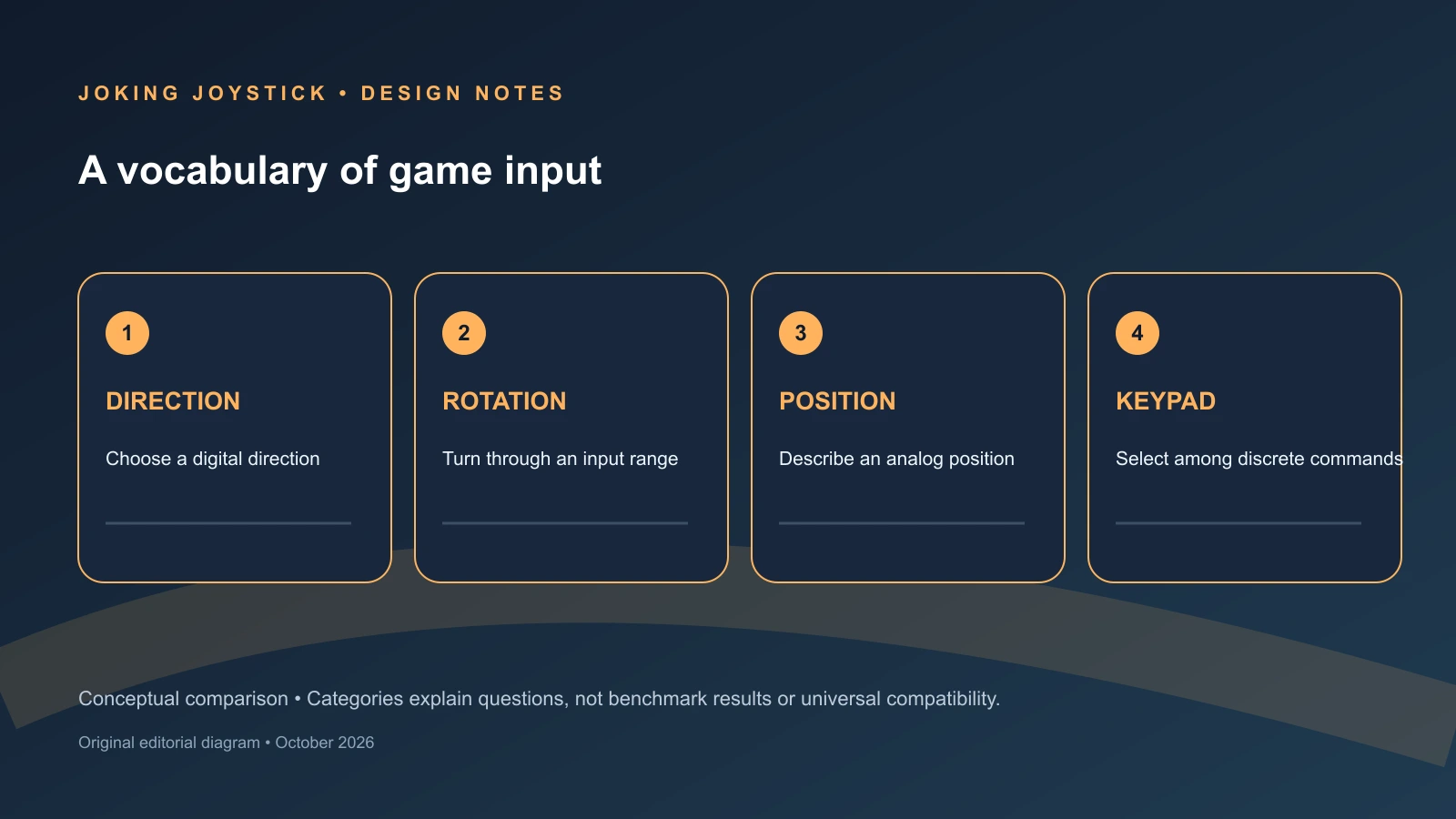
A controller is easiest to understand at the point where a human action becomes information that a console can read. A stick may be pushed, a paddle may be turned, a key may be pressed, or a button may be held. None of those actions is yet a game command. Hardware translates the action into an electrical condition, and software interprets that condition as movement, selection, firing, steering, or a system function.
This distinction is essential to Atari’s controller history because similar-looking devices can use different electrical systems, while visibly different devices can expose comparable actions. A handle with a button may contain directional switches, a potentiometer, or a more complex arrangement. A keypad and a group of function buttons may look alike but can be scanned or wired differently. Shape is useful for describing what a player sees. It is not enough to describe what the console receives.
The first category is digital directional input. A digital control produces discrete switch states rather than a continuous measurement of physical position. A joystick can change one condition when pushed upward, another when pushed left, and so on. More than one directional switch may be active at once, allowing diagonal combinations when the hardware and software recognize them. The console is not necessarily being told the stick’s exact angle or distance from its resting position. It is being given a set of on-or-off conditions.
Analog input supplies a different kind of information. A potentiometer can produce a variable electrical value as its shaft moves through a range. The receiving circuitry can distinguish positions between the two ends of travel, within the limits of the design and the software that samples the value. This does not automatically make an analog controller more accurate or more useful. It means that the input contains a variable position rather than only a collection of directional states. Atari’s paddles and the 5200 joystick provide separate examples of this principle.
Key-matrix input changes the vocabulary again. A set of keys can be arranged across shared rows and columns, allowing a system to scan combinations instead of assigning a completely independent wire to every key. The exact arrangement must be established from the relevant schematic or service description. A controller’s possession of several keys does not, by itself, prove that it uses a matrix, nor does the presence of a matrix establish text-entry capability.
Overlays belong to a related but separate layer. An overlay can label the same physical key positions differently for different games. It helps the player understand the current control scheme, but it does not alter the electrical arrangement. Software still has to read the available signals and decide what each key or combination means. The overlay is therefore an interpretive aid, not a new input circuit.
Protocol input describes a further step in which a console selects, scans, or decodes controller information rather than merely observing a fixed set of independent switch lines. The Jaguar’s controller port uses row selection and returned input lines to scan controller data. The Lynx’s ComLynx, by contrast, is a multiplayer communication link, not the Lynx’s local controller interface. The local Lynx joystick and buttons should therefore be discussed separately from ComLynx.
These distinctions also prevent a common historical mistake: treating a connector as a complete specification. Two plugs may look alike while assigning their pins differently, expecting different voltage ranges, or relying on different software conventions. Conversely, two controllers can have different shapes while presenting a game with a similar directional and button vocabulary. Compatibility is consequently a claim about specified hardware, software, and sometimes a particular console revision. It does not follow automatically from a matching connector, a familiar number of pins, or a similar shell.
The history examined here follows these changing translations rather than a general company biography. The 2600 begins with switch-based joysticks and expands into paddles, driving controllers, and keyboard-oriented accessories. The 5200 combines analog movement with a numeric keypad and additional select controls. The 7800 raises questions about two-button operation, older software expectations, and regional controller designs. The Lynx treats orientation and repeated access to controls as handheld design problems. The Jaguar uses a keypad-equipped controller whose signals are scanned and routed through an expansion system.
Modern products add more layers. An official recreation may preserve the appearance and broad function of an earlier controller without establishing identical internal construction. A current handheld may offer sticks, buttons, a touchscreen, an operating system, an emulator, and per-game mappings. In that environment, “the controller” can mean the physical control, the software profile, or the entire path between a finger and a simulated console input.
The evidence must be divided in the same way. Original service documentation can establish how Atari described an assembly, which parts it listed, and how it organized a repair or wiring diagram. Developer references can explain scanning behavior and expansion routing. A manufacturer’s current product page can establish what a modern product claims about itself. A measured fact would require a documented test of an identified unit. An editorial inference can connect documented facts, but it should remain an inference rather than being presented as a statement Atari itself made.
This is particularly important for claims about comfort, reliability, accuracy, responsiveness, superiority, historical firsts, universal compatibility, and performance. The documents used here establish input categories and hardware relationships. They do not, without additional evidence, prove that one controller felt better, lasted longer, or outperformed another. The useful question is narrower: what information did each interface make available, and what did software have to do with it?
The 2600 Joystick: Four Directions, One Fire Signal and a Reused Interface
The 2600 joystick is often remembered as a compact black handle with a single red button. Technically, it is more useful to regard it as a group of directional switches and a fire-button switch connected to the console’s controller interface. Moving the stick changes the states associated with up, down, left, and right. Pressing the fire button changes another state. The console reads those conditions, and the game decides what they mean at that moment.
This arrangement suits software built around discrete directional choices. A game can test whether the player is pressing left or right, moving up or down, or combining directions. It does not need to know the exact physical angle of the stick. The interface supplies a limited vocabulary of switch states, and the cartridge turns those states into movement, aiming, selection, or another action. The controller’s physical travel and the electrical information it reports are related, but they are not the same thing.
The 2600 field-service manual treats the joystick as a serviceable assembly. That is useful evidence because it describes the controller as part of an electrical and mechanical system rather than merely as an icon of early console design. The service documentation provides the document-level basis for discussing the joystick, its control functions, and the controller connection. It also separately indexes paddle, driving-controller, and keyboard-controller sections, showing that Atari treated those as distinct categories rather than interchangeable versions of one accessory.
Model labels require the same care. CX10 and CX40 names are associated with documented Atari joystick variants, but neither name should become a shortcut for every joystick sold for the system. Hardware revisions, later packaging, regional substitutions, reproductions, and third-party products can share broad visual traits without sharing every internal detail. When a source identifies a particular model, the article should use that model name. When it does not, “2600 joystick” is safer than assigning a precise number.
The controller connection itself deserves attention, but not inflated terminology. The 2600 used a defined console-to-controller interface. The field-service manual’s separate controller sections provide the basis for treating that connection as an electrical interface rather than merely as a connector shape. Later hardware and accessories reused physically similar connections, but that does not establish a formal, universal standard. A similar plug can invite a compatibility question; it cannot answer the question on its own.
The distinction matters because a connector carries expectations as well as conductors. A system may expect a switch to connect a line in one way, a potentiometer to present a changing value, or an accessory to provide a different combination of signals. A later product may use a physically similar connector while assigning a pin a different function. Even when the electrical arrangement is compatible, software may still need to know that a particular accessory is present and supported.
The 2600 joystick therefore sits at the intersection of hardware and software. The physical controller supplies directional and fire states. The console exposes those states to the game. The cartridge determines whether a press means movement, a shot, a menu choice, or something else. A controller port provides a path for information; it does not dictate the complete behavior of every cartridge connected to it.
This also explains why the joystick should not be described as an analog control merely because the player’s hand moves through physical space. A stick can have intermediate mechanical positions while its switches report only discrete conditions. The important contrast is with a potentiometer-equipped paddle, where movement changes an electrical value across a range. The two devices may both be moved left and right, but they do not supply the same kind of data.
Later 2600 Jr. packaging and regional substitutions should be handled as documented cases rather than folded into one universal story. A new shell or bundle can preserve the familiar joystick concept while changing the product context. A photograph can establish appearance. A package can establish what was sold together. A service manual or schematic is stronger evidence for electrical behavior. These sources answer different questions and should not be made to prove more than they contain.
Atari’s current CX40+ belongs to a separate historical layer. Atari describes the wired product as a DB9 controller with a red fire button, rubberized stick, and orange directional ring. Those are current manufacturer descriptions of the recreation. They do not establish that the modern unit has the same internal construction, switch characteristics, or behavior as any particular original joystick.
Atari also makes current compatibility claims for named products and systems. Those claims should remain attached to the products and systems Atari identifies. They should not be generalized to every third-party DB9 accessory or every game running on every Atari console. The correct conclusion is more modest and more useful: the 2600 joystick established a recognizable Atari controller-port design that was later reused by other hardware, while compatibility remained a matter for specific electrical and software arrangements.
The joystick’s historical significance is consequently not that it became a universal controller standard. It is that it made a clear design choice. A player’s movement was reduced to a small set of switch states, and a game could respond to those states quickly and predictably within its own software model. Later Atari devices would add variable values, symbolic keys, duplicated buttons, regional layouts, and scanned controller data. The 2600 joystick provides the baseline against which those changes can be understood.
Paddles and Driving Controllers: When Turning Became the Input
The 2600 controller family is not limited to the joystick’s directional switches. Atari’s paddle introduced a variable electrical value, while the driving controller occupied a separately documented category. Both belong to the broader history of rotary action, but they should not be collapsed into one generic “wheel” or “rotary” interface. The available service documentation supports a precise statement about the paddle and a more cautious distinction for the driving controller.
The documented paddle uses a 1-megohm potentiometer and a spring-loaded push-to-make switch. Turning the paddle changes the potentiometer’s electrical value across a bounded range. Pressing the button supplies a separate switch condition. The same hand-held device therefore presents two kinds of information: a variable position and a discrete press.
That combination changes the relationship between the player and the game. A joystick gives the software a set of directional conditions. A paddle gives it a changing value that can be mapped to horizontal position, aiming, timing, steering, or another variable chosen by the program. The value does not dictate the game design. It becomes meaningful only when the cartridge reads it and assigns a role to the range.
The paddle’s variable output should not be turned into a claim about superiority. Analog information is different from digital switch information; it is not automatically more precise, more responsive, or more appropriate. A game built around a changing position may need a paddle’s input model, while a game built around directional states may not. The useful historical point is that Atari offered another translation of hand movement, not that it solved every control problem.
The field-service material states that two game paddles connect to each I/O plug. That describes the physical arrangement, not the behavior of every game. A console may have access to multiple paddle signals while a particular cartridge reads only some of them or assigns them in a particular way. Player count and software support must therefore be established from the documentation for the individual game. They should not be inferred from the connector alone.
The bounded nature of the paddle also matters. Its shaft moves through a defined range rather than communicating an unlimited number of turns. The electrical value corresponds to a position within that range. “Rotary” by itself is too broad a description because it says how the hand moves without explaining what the console receives or how far the control is intended to travel.
Atari separately documented the driving controller, so it should not be assumed identical to the paddle. That is the supported distinction. Without the exact driving-controller schematic or service passage in view, the article should not add claims about its specific mechanical construction, continuous rotation, intended game genres, precision, or performance. The name indicates a separate Atari controller category; it does not authorize a complete technical description by inference.
| Controller | Primary information | Additional control | What the documentation supports |
|---|---|---|---|
| Joystick | Discrete directional switch states | Fire-button switch | A switch-based directional interface |
| Paddle | Variable potentiometer value | Spring-loaded pushbutton | A 1-megohm potentiometer and push-to-make switch |
| Driving controller | Separate Atari rotary category | Not generalized here | It should not be assumed identical to the paddle |
This comparison is about information, not feel. The service manual can establish the paddle’s electrical component and button construction. It can establish that Atari separately indexed the driving controller. It cannot establish that players preferred one device, that one was more durable, or that one delivered better results in a particular game.
The game-design consequences are nevertheless significant. A joystick-based program can repeatedly test switch states and move an object in directional steps. A paddle-based program can sample a changing value and use it to place or steer an object across a range. A program written for one input model does not automatically understand the other. The controller’s hardware capability and the game’s supported control scheme are separate facts joined by software.
This is also why the paddle should not be described as a generic early analog gamepad. It provides a particular kind of variable input: a single bounded rotational value accompanied by a button. It does not automatically provide two-dimensional analog movement, and it should not be treated as equivalent to the 5200’s joystick assembly. The later system uses potentiometers in a different compound controller with a keypad and multiple buttons.
Modern CX30+ paddles belong to a later recreation story. Atari’s current product information can establish the product name and the company’s stated compatibility. The original field-service documentation remains the principal evidence for the original paddle’s potentiometer and switch. Similar appearance or branding does not prove identical construction, and the electrical description of one generation should not be extended to every later Atari paddle without a source.
The broader lesson is that “turning” is not a technical specification. A bounded paddle, a separately documented driving controller, and a joystick all involve a hand moving through physical space, but they translate that action differently. Preserving the distinction makes the 2600 account more accurate while avoiding unsupported claims about durability, popularity, precision, or game-specific exclusivity.
Keypads, Overlays and the 2600’s Unusual Side Roads
The joystick and paddle are the best-known 2600 controllers, but the field-service documentation also identifies a keyboard controller as a separate accessory category. That entry matters because it shows that Atari’s controller vocabulary was not limited to directional movement, rotary position, and a single fire button. The system could also be discussed in terms of a key-oriented control surface, even though the available evidence here does not establish how widely the accessory was used or how many games supported it.
A keypad changes the kind of question a game asks the player. A joystick naturally supplies directional states. A keypad supplies symbolic selections, numbers, or game-specific functions. The difference is not simply that one device has more buttons. Software must be written to detect the relevant inputs and assign meanings to them. If a cartridge does not read the keypad’s signals, the extra physical keys do not automatically expand the game’s controls.
The terms used for these accessories should remain distinct. A keyboard controller is a hardware category. A keypad is an arrangement of keys, often with a smaller symbolic set than a full computer keyboard. An overlay is a printed or molded guide that labels physical keys for a particular game. A function-button group may provide game or system commands without being a keypad. These terms describe different layers of the interface.
The 2600 field-service manual identifies the keyboard-controller category. Its specific electrical implementation should be described only from the relevant schematic; otherwise, any matrix-input explanation should remain general. The existence of a keyboard-controller entry does not, by itself, prove a particular row-and-column arrangement. Nor does it establish that the accessory was a full computer keyboard or that it necessarily provided text entry.
Overlays are useful because they demonstrate how software can redefine a fixed physical layout. The same key positions can carry different labels from one game to another. The overlay helps the player understand the current control scheme, but it does not change the underlying switch arrangement. The program still has to detect the available inputs and interpret them. The overlay is therefore an interpretive layer joining the physical device to the game’s instructions.
This relationship is different from a modern controller profile, but the principle is familiar. A modern gamepad may assign one physical button to different actions in different games. The 2600 accessory could use a physical overlay to make a game-specific vocabulary visible. In both cases, the player’s understanding depends on an agreement between hardware and software. The printed labels are useful only because the program has been written to give those positions defined meanings.
The presence of multiple keys should not be mistaken for general-purpose computing input. A controller can contain several buttons without offering the character range, scanning method, software support, or feedback associated with a computer keyboard. The 2600 evidence establishes a distinct keyboard-controller category. It does not justify claims about market prevalence, sales, keyboard completeness, or automatic text entry.
The comparison with the 5200 makes the distinction even more important. The 5200 controller integrated a numeric keypad alongside an analog joystick, fire buttons, and select controls. That later design should not be described as the 2600 keyboard controller transplanted into a new shell. The two systems document different controller arrangements, and the 5200’s keypad is part of a compound interface designed around analog movement and additional functions.
A compound controller changes the player’s available vocabulary without making every game equally complex. A keypad can provide symbolic choices, but only software written to read those choices can use them. A joystick can remain the primary movement device while the keypad handles selection or secondary actions. An overlay can make those assignments visible. The physical presence of the keypad creates possibilities; the cartridge determines which possibilities are active.
This is the same division between hardware and software seen with paddles. A paddle supplies a variable value, but a game must sample and interpret it. A keyboard controller supplies key states, but a game must detect and assign them. The accessory and the cartridge form a system. Neither the connector nor the number of physical controls proves what a particular title supports.
The 2600 keyboard controller is therefore best understood as a side road in the console’s input history, not as an overlooked replacement for the joystick. It shows Atari recognizing that games could ask for symbolic selections as well as direction and firing. It also demonstrates why controller history cannot be written from shell shapes alone. A keypad’s important feature is not merely that it has keys, but that those keys expose a different class of information to software.
The evidence remains deliberately bounded. Atari’s field-service manual confirms the separate hardware category. It does not establish that the keyboard controller was widely adopted, that it was common in retail bundles, or that a specific number of games supported it. Those claims would require individual software manuals, package documentation, catalogs, or contemporary reports. Without that evidence, the responsible conclusion is narrower: the 2600 ecosystem included a documented keyboard-controller path, and its significance lies in expanding the kinds of symbolic input the software could be designed to recognize.
Seen alongside the joystick and paddle, the accessory completes a useful three-part picture. The joystick translates movement into discrete directional states. The paddle translates bounded rotation into a variable value plus a button. The keyboard controller represents a key-oriented interface whose exact electrical behavior must be taken from its schematic, while its software meaning depends on the program and, where applicable, an overlay. Atari’s later systems would combine and reorganize these ideas, but the 2600 already contained more than one answer to the question of how a player should communicate with a game.
Atari 5200: Analog Movement Meets a Numeric Keypad
The Atari 5200 controller is easiest to misunderstand when it is described as an improved version of the 2600 joystick. It contains a joystick, but that joystick is only one part of a compound input device. The standard controller combines analog joystick movement, a 12-button keypad, four physical fire buttons arranged as two top and two bottom buttons, and three select buttons: Start, Pause and Reset. Each of those areas represents a different kind of interaction between the player, the controller, the console and the software.
The distinction begins with the joystick. A 2600 joystick presents the console with discrete switch states: a direction is either engaged or not engaged. The 5200 joystick instead uses horizontal and vertical potentiometer assemblies. Moving the stick changes the electrical values associated with those two axes. The system can then read a position along each axis rather than receiving only a small collection of on-or-off directional conditions.
That does not automatically make the 5200 stick more accurate, more responsive or better suited to every game. It means that the controller reports a different kind of information. The hardware supplies variable horizontal and vertical values; software decides how to interpret them. A game can turn those values into movement, steering, aiming, cursor motion or another action. It can also impose thresholds, ignore part of the available range, or treat a variable position as a set of practical directions. The controller’s electrical capability and the game’s use of it are separate questions.
The service documentation identifies the joystick and its potentiometer assemblies as distinct parts of the controller. That terminology is significant because it shows that Atari was not describing the stick as a disguised four-way switch. The axis circuits were part of the controller’s defined construction. The same documentation also lists the keypad, fire-button and select-button assemblies separately, making the controller a collection of coordinated subsystems rather than one undifferentiated control surface.
The numeric keypad adds a second major input system. It contains twelve numbered keys whose signals are handled through shared keypad lines. The documented controller connection separates keypad signals from the horizontal and vertical potentiometer signals. The console therefore receives different categories of information from different portions of the same hand-held unit. A key press is not simply another joystick direction, and an axis value is not merely another keypad state.
That arrangement gave games a symbolic vocabulary. A numbered key could select a weapon, choose a menu item, change a player configuration, activate a command or perform an action defined by the cartridge. The physical key did not possess a universal game meaning. Its role came from the software and from the overlay or instructions that explained the particular control scheme.
Overlays made this relationship visible. A printed overlay could sit above or around the keypad and identify what the numbers meant in one game. The underlying electrical arrangement remained the same, but the player-facing vocabulary changed. One cartridge could turn the keys into a set of weapon or movement choices while another could use them for menu navigation or game-state commands. The overlay was therefore an interpretive layer, not a new circuit.
The presence of a keypad should not be confused with text entry. The documented 5200 controller is a game controller with a twelve-button matrix. Nothing in that description establishes that it functioned as a full computer keyboard or that its keys automatically provided general-purpose text input. A keypad expands the set of available symbolic states only when the console and software are prepared to scan and interpret them.
The controller’s fire controls are more numerous than the shorthand description “two fire buttons” suggests. The hardware has four physical fire buttons: two on the top and two on the bottom. They are arranged as duplicated left and right positions. The service description establishes that physical arrangement but does not, by itself, establish Atari’s design rationale or the meaning assigned to each button by every game. A title may treat paired buttons as equivalent, distinguish them, or use only some of them.
Start, Pause and Reset form a third functional group. These are the three select buttons documented for the controller. They are not merely additional action buttons hidden beside the keypad. Their names describe system or game-state functions, although an individual title can determine how and when those inputs are acted upon. Bringing them onto the controller makes the device a compact control station: movement, symbolic selection, action and basic state control are all available without reaching for a separate console switch.
The pin categories help explain why describing the 5200 as having “a joystick port” is too vague. The documented connection includes horizontal and vertical potentiometer signals, keypad row and column lines, side-button inputs, and ground or power categories. Those lines serve different purposes and must be understood together with the console circuitry and the software’s input assumptions. A connector’s existence does not by itself reveal how every attached control is read.
Model qualification is especially important when discussing four-port and two-port 5200 systems. Atari documented separate four-port and two-port console revisions. The difference in port count tells us that the hardware configurations were not identical in physical arrangement, but port count alone does not establish different controller signaling or different software input semantics. Any claim about revision-specific wiring or behavior requires documentation for the particular revision rather than an inference from the number of sockets.
That qualification prevents a common error: treating every 5200 as though one service diagram answers every question about every model. The controller assemblies may share substantial design features, but a description of one console revision should not silently become a claim about all others. The correct historical approach is to identify the model context, then distinguish what the controller itself contains from what the console does with the signals.
The 5200 also demonstrates why “analog” and “digital” are not complete descriptions of a controller. Its joystick uses variable axis values, but the same device includes discrete fire buttons, select buttons and a scanned keypad. The player experiences one object, while the console receives several input types. Calling the controller analog is technically useful for the joystick, but incomplete for the whole interface.
That compound design affected game instructions as well. A title using the joystick had to explain how movement was interpreted. A title using the keypad had to identify the relevant numbers, often through an overlay. A title using the select buttons had to define the relationship between Start, Pause and Reset and the game’s own state. The controller did not impose one universal control grammar. It offered a set of mechanisms from which each game could construct its own grammar.
The 5200 therefore occupies an important position in Atari’s input history. It did not merely add a second button to a familiar joystick. It combined variable movement, symbolic selection, duplicated action controls and system functions in one controller. Its design made the distinction between physical input and software interpretation unusually visible. A potentiometer produced a changing value, a keypad produced a selected matrix position, and buttons produced discrete states; the cartridge determined what those signals meant.
The service manuals establish the 5200 controller’s assemblies and signal categories. The supported historical conclusion is narrower than a comfort or reliability verdict: the 5200 treated the controller as a multi-part input system, and its analog stick was only one component of that system.
Atari 7800 North America: The Pro-Line Problem Is More Complicated Than a One-Button/Two-Button Story
The controller commonly associated with North American 7800 systems is often reduced to a simple contrast: the 2600 had one fire button, while the 7800 had two. That summary identifies a visible difference, but it leaves out the more important relationship among physical controls, electrical signals and software assumptions. The 7800’s interface had to support its own games while remaining connected to an Atari environment shaped by earlier software and simpler controller expectations.
The Pro-Line controller presents a directional control and two fire-button functions. The second button expands the action vocabulary available to a game without requiring one of the directional inputs to be reassigned. That is a capability, not a universal control scheme. A cartridge may use the two buttons for different actions, treat them as equivalent, ignore one, or employ them only in particular situations. The presence of a button does not prove that every title gave it an independent role.
This distinction matters because a controller’s physical form, its electrical output and a game’s interpretation are not the same thing. A two-button housing does not, on its own, establish the precise signals presented at the connector. Those signals do not, on their own, establish how a particular game responds. And a game’s response does not necessarily describe every revision or regional version of the hardware.
The 7800’s relationship with 2600 software makes that layered structure especially important. The later console existed alongside a substantial body of software whose control assumptions came from the earlier system. A 7800 interface therefore had to exist in a context where simpler directional-and-fire expectations remained relevant. At the same time, software written for the 7800 could make use of a broader controller vocabulary. The result was continuity and compromise rather than a complete break.
Older software could be designed around a limited set of inputs. It did not automatically gain new actions merely because a newer controller offered another button. Conversely, a 7800 game could be written to distinguish the additional fire function. The important historical question is not whether the controller was “really” a one-button or two-button device, but which signals were available and which ones a particular program chose to read.
Atari’s technical archive preserves separate 7800 developer, keyboard and source-code materials. Those documents are more useful for investigating controller assumptions than a generalized statement that the Pro-Line “worked” in a particular way. Any conclusion about software-facing inputs should remain tied to the named document or software context.
The Pro-Line’s two-button arrangement should therefore be described as an interface capability. It provided two physical action controls, but it did not dictate a single universal game design. One game could use one button for firing and the other for jumping. Another could assign them to different weapons or menu operations. A third might make them equivalent for convenience or use only one. These are software decisions built on a documented hardware arrangement.
Regional variation makes it unsafe to treat the Pro-Line as the only 7800 answer. The North American configuration should be identified as the Pro-Line controller commonly associated with North American systems, unless a specific manual, package or developer document establishes the exact bundle being discussed. That wording avoids turning a common association into a claim that every North American package contained the same controller.
It also prevents a casual equivalence between the North American controller and the European CX78-style pad. Both may provide directional input and two fire-button functions, but similar game actions do not prove identical construction or wiring. A handle-style joystick and a pad-shaped controller can expose related controls while belonging to different regional product histories. Shape is evidence of shape; it is not proof of electrical identity.
Atari’s current CX78+ product description must be kept separate from this original North American discussion. The company describes the modern controller as having two fire buttons and a removable thumbstick, and identifies its historical reference as the European version of the Atari 7800 released in 1987. That description establishes how Atari presents the modern recreation and its regional reference point. It does not show that every original 7800 bundle used the CX78 design or that the European and North American controllers were electrically identical.
Current Atari support material also makes compatibility claims for named modern controllers and original Atari hardware. Those claims should be attributed to Atari and kept attached to the products and systems they name. They do not establish that every accessory using a similar DB9 connector works with every Atari console, nor do they provide a complete history of all regional bundles and revisions. Connector resemblance is not a substitute for a documented compatibility statement.
The same caution applies to 2600 compatibility. If a source documents that a controller or console supports original 2600 hardware, that is a claim about the specified product and system. It should not be expanded into a universal statement about every game, controller revision or third-party accessory. A software title may use only a subset of the available inputs, and a console revision may have qualifications not visible in a product summary.
The North American 7800 story is therefore more complicated than a one-button/two-button comparison. The Pro-Line configuration commonly associated with North American systems supplied two fire-button functions within a directional controller. The 7800 had to place that richer input possibility alongside older software expectations. Individual cartridges then determined whether the second button mattered and what it meant.
That layered account is more historically useful than declaring the Pro-Line a total break from the 2600 or merely a familiar joystick with an extra button. It shows how controller history is shaped by coexistence. New hardware can add signals without erasing old software assumptions. A console can support a richer interface while still needing to accommodate an earlier control vocabulary.
The available evidence establishes a controller configuration whose two-button capability had to be interpreted within a larger Atari software and hardware context. It does not establish universal comfort, identical North American bundles, or player preference.
Regional 7800 Interfaces: PAL, Europe and the CX78 Qualification
The Atari 7800’s controller history cannot be reconstructed from one photograph or one North American package. Regional documentation records more than one physical answer to the problem of directional and action input. The European and PAL evidence should therefore remain separate from the North American Pro-Line discussion, with every statement tied to the manual, package or product description that supports it.
In the PAL owner’s manual reproduced by Atari7800.org, the system includes two joypad controllers. The manual describes each controller as having two fire buttons and a thumb pad rather than a handle-style joystick. That is evidence for the particular regional manual represented by the scan, not proof that every PAL territory, European bundle, or 7800 sold outside North America used exactly the same controller package.
The words “PAL,” “European,” “1987” and “worldwide” describe different scopes. PAL identifies a television-standard context, not a complete retail history. Europe contains multiple markets and distribution arrangements. A date attached to one European product description does not automatically establish the date of every related console or accessory. A careful account keeps those qualifications visible rather than turning one surviving manual into a universal regional rule.
The documented joypad is physically distinct from a handle-style joystick. Its thumb pad sits on a broader front surface, while the two fire buttons are presented as part of the pad layout. That difference is historically meaningful because it shows that the 7800 family was not represented by one fixed controller shape. It is not evidence that the pad was more comfortable, more popular or preferred by European players. Those would be separate claims requiring separate evidence.
The manual’s two-fire-button description also needs to remain at the level the source establishes. It shows that the documented joypad provided two such controls. It does not prove that every game used both buttons independently, that the electrical arrangement matched the North American Pro-Line, or that all PAL software assigned the same functions to them. Physical button count describes the available interface, not the complete software grammar.
Atari’s current CX78+ page describes the modern product as based on the gamepad included with the European Atari 7800 released in 1987. This is a manufacturer’s current historical description, and it gives the modern recreation a specific regional reference. It should not be used to claim that every original European or PAL package included the same controller, or that a European design replaced the joystick throughout the world.
The distinction between the modern CX78+ and original regional hardware should remain explicit. Atari’s product page establishes features that the company chooses to describe, including two fire buttons and a removable thumbstick. It does not establish identical internal construction, identical materials, or complete electrical equivalence with every original controller. A modern recreation can preserve a visible arrangement while introducing a different manufacturing and compatibility context.
The PAL manual is evidence of a documented bundle, not a complete survey of regional sales. It can support the statement that the manual examined here describes a system with two joypads, each with two fire buttons and a thumb pad. It cannot, without additional packaging or catalog evidence, establish what every PAL market received, whether later bundles changed, or whether retailers substituted other controllers.
Further evidence may exist in Atari’s technical archive, including developer material, hardware records and regional documentation. Those sources could clarify whether a physical regional distinction corresponded to a different wiring arrangement or whether the same input signals were presented through different shells. Until a source answers that question, the article should not infer electrical identity from similar button counts or from a connector that appears familiar.
The same rule applies to possible connections with the late 2600 Jr. If a regional product history is included, it should be supported by primary or institutional evidence that identifies the relevant model and controller. Similar branding or a related shape is not enough to establish that two systems used the same interface. A short, well-supported connection is preferable to a broad but speculative continuity claim.
Regional documentation also limits how modern compatibility statements should be interpreted. Atari’s current support material may state that named modern controllers work with original 2600 and 7800 hardware. That is a present-day manufacturer claim concerning particular products. It does not prove that every original European pad, North American Pro-Line, later 2600 Jr. accessory or third-party controller is interchangeable across all systems.
The CX78 qualification is therefore valuable precisely because it is narrow. The manual reproduced by Atari7800.org documents a particular PAL package with two joypads, two fire buttons per controller and a thumb pad. Atari’s current product page describes the CX78+ as based on a European 7800 gamepad associated with a 1987 release. Together, those sources establish a regional controller history without proving universal packaging, player preference or electrical identity.
Placed beside the Pro-Line, the CX78-style controller demonstrates continuity without uniformity. Both configurations provide directional input and two fire-button functions, but the evidence does not justify collapsing them into one controller. Their physical forms, regional documentation and historical descriptions should remain distinct. The broader lesson is that a console family can share a software identity while presenting different physical interfaces in different markets.
That lesson also explains why a controller history needs more than a chronology of product names. A name can refer to a shape, a bundle, a current recreation or a regional association. The technical question is what the documented controller contains and how the system and software use it. In the 7800’s case, the answer varies according to the exact manual and market under discussion.
This section describes the regional evidence available for particular products and documents, not comfort, reliability or measured performance. It does not establish that one 7800 controller was preferred, that PAL and NTSC interfaces were identical, or that the CX78 replaced the joystick worldwide. Its purpose is to preserve distinctions that a single universal 7800 controller story would erase.
Lynx: Reversible Controls and a Handheld That Treated Orientation as an Input Problem
The Atari Lynx made controller placement part of the handheld hardware problem. A console controller can sit beside a fixed television, while a handheld carries its display and controls together. The player may hold it left-handed or right-handed, flip the unit, or use a portrait orientation. The relationship among screen, buttons and hands can therefore change during play. Lynx input design addressed that relationship through its control layout and software-supported display orientations.
The Lynx hardware reference identifies a four-switch joystick, two pairs of fire buttons, Pause, Option 1 and Option 2. The directional control is a discrete switch arrangement rather than an analog stick. The duplicated fire-button sets are electrically paired, giving the handheld action controls on more than one side. Those facts establish the hardware arrangement; they do not, by themselves, establish every reason Atari chose it.
The reference documents left-handed, right-handed and portrait display orientations. The original Lynx manual also describes Option and Pause combinations associated with functions such as restarting and flipping the screen. These details show that orientation was not merely a matter of physically turning the case. Software had to change how the display was presented, and the player had to use the available buttons to invoke or control that behavior.
The duplicated fire-button sets support access from different orientations; the cited hardware reference documents the arrangement but does not establish Atari’s design rationale. It is reasonable to connect the paired controls with the practical problem of reaching action buttons after changing the device’s orientation, but the source does not authorize a stronger statement that Atari designed them for one specific purpose or that every game treated the two sides identically.
Nor does the existence of orientation modes prove that every game supported every orientation. Hardware can provide a general capability while software uses only part of it. One title may respond to a screen-flip command, another may assume a fixed presentation, and another may use the Option buttons for entirely different functions. The correct historical claim is that the Lynx documented multiple orientations and supplied controls associated with them, not that every cartridge delivered the same experience in each position.
Pause and the two Option buttons broaden the Lynx input vocabulary beyond movement and firing. Pause can affect the current game state, while Option 1 and Option 2 can select game modes or invoke title-specific commands. The original manual’s button combinations are important because they document system-level behavior, but they should not be treated as universal meanings for every game. As on other Atari systems, the physical input exists independently from the software interpretation attached to it.
The Lynx can therefore be understood as a layered handheld interface. Four directional switches supply movement states. Two electrically paired fire-button sets provide action access from different sides. Pause and Option buttons handle state or selection functions. Software determines how the display changes, which controls are active, and whether a title supports a particular orientation. The handheld’s input problem is not simply “add a joystick to a portable”; it is coordinate the controls with a display that can change its relationship to the player.
ComLynx belongs in the surrounding hardware history, but it is not the Lynx’s local controller interface. ComLynx is a multiplayer communication link. It connects Lynx systems so that they can exchange game information, while each player continues to use the local joystick and buttons on their own unit. The hardware reference describes ComLynx as a shipped wired link and distinguishes it from an earlier infrared communication concept.
That separation prevents two different meanings of interface from being conflated. The local controls translate a player’s physical actions into input for one Lynx. ComLynx provides a communication path between systems. Both can participate in multiplayer play, but one is a controller system and the other is a data link. A communication interface should not be described as a controller protocol simply because it is part of the same multiplayer setup.
The infrared distinction also limits claims about accessories. The research does not establish the release of proposed infrared or wireless controller products. A concept or earlier communication idea may be useful context, but it must be labeled as proposed or discussed rather than presented as shipped hardware. The same rule applies to any accessory whose existence is inferred from a technical reference without a documented retail release.
Reversibility also does not mean that the Lynx abandoned conventional directional input. Its joystick remains a four-switch control. What changes is the physical relationship between that control, the fire buttons and the screen. The handheld’s software and hardware work together to make the display and controls meaningful after the unit is turned or flipped.
This makes Lynx input historically distinct from the 5200’s compound controller. The 5200 gathered analog axes, a keypad, fire buttons and select controls into one console controller. The Lynx addressed a different problem: the entire control surface could change orientation along with the display. Its answer involved paired action buttons, documented screen modes and system controls that could trigger or manage the change.
ComLynx adds another useful contrast. It shows that not every signal path associated with a game system belongs to the controller. A console can have local switch inputs and a separate communication link. Treating both as “protocol input” would blur their functions. The local Lynx controls are the player interface; ComLynx is a multiplayer connection. The distinction becomes even more important when compared with Jaguar controller scanning, where the controller port itself is a row-addressed input system.
The available evidence therefore supports a bounded description. Lynx hardware includes a four-switch joystick, two electrically paired fire-button sets, Pause and Option buttons, and documented left-handed, right-handed and portrait orientations. ComLynx is a shipped wired multiplayer link, distinct from local controller input. The manual documents relevant button combinations, while individual games determine how fully they use the available orientation and option behavior.
Jaguar: A Keypad Controller Uses Row-Addressed Scanning
The Atari Jaguar controller is more than a larger version of the familiar joystick-and-button arrangement. Its face combines a directional pad, three primary fire buttons, a numeric keypad and auxiliary controls. The keypad includes numbered and symbol keys, while the additional buttons give software more positions to assign. To the player, the result can look like an unusually crowded gamepad. To the console, it is an input device whose states are selected and read through an addressed process.
The directional pad supplies discrete movement inputs. The fire, auxiliary and keypad buttons supply additional switch states. A game may use those positions for weapon selection, menu choices, special actions or commands defined by its own instructions. The presence of a key does not establish a universal meaning: software still determines which positions it reads and how it interprets them. In that respect, the Jaguar continues Atari’s earlier interest in controllers that supplied more than movement and one fire signal.
What distinguishes the Jaguar arrangement is the way the console selects portions of the controller information. The developer reference describes four controller-selection outputs and six input lines. The console selects a row, then observes the returned state before moving to another row. The process remains based on electrical switch conditions, but those conditions are organized through scanning rather than being exposed as one permanently separate input line for every button.
This is best described as a row-addressed controller interface or a scanned controller interface. The word “bus” may be used only as a descriptive metaphor for shared, addressed routing; it is not Atari’s terminology and does not establish that the Jaguar employed a contemporary standardized serial bus. The console supplies a selection condition, the controller presents the relevant group of states, and the system repeats the process for the available rows.
That distinction matters when considering expansion. An arrangement made from permanently exposed switch lines could, in principle, be extended by wiring additional inputs to the expected places. A scanned arrangement must preserve the relationship between selection and response. An adapter cannot simply connect several controllers in parallel and expect the console to identify which device produced a particular state. It must route controller positions in a way that remains compatible with the console’s scanning process.
The Jaguar four-player adapter does this by expanding one console controller port to four controller sockets. The developer documentation describes how controller positions are routed through the adapter. The result is not four entirely independent ports appearing at the console. It is an expanded arrangement in which the console’s existing selection process addresses the connected controller positions. The same documentation describes the possibility of using two adapters to provide eight controller positions.
That figure does not mean that every Jaguar game supported eight players. The adapter makes additional controller positions available to the input architecture. Software must still recognize those positions, organize them into player slots and provide rules for the number of participants. Hardware expansion and game support are separate layers. A port can expose more possible positions than an individual title uses.
The adapter also demonstrates why expansion behavior matters when advanced controllers are discussed. The developer reference states that features such as rumble, force feedback and analog/digital selection are not available through the four-player adapter’s normal routing behavior. The adapter’s job is to route controller positions through the established scanning arrangement; it does not automatically preserve every possible feature of a controller connected through a direct path.
The rotary-controller question requires the same care. The Jaguar developer reference documents a “Tempest” rotary-controller type and describes its readout pattern. That documentation establishes a controller type recognized by the interface. It does not establish that Atari sold an official retail rotary controller. A software option, a developer-supported controller type and a commercially released Atari accessory are different kinds of evidence.
Unless a primary Tempest 2000 manual or Atari developer document establishes more, the game-specific claim should remain limited. The safest conclusion is that the Jaguar documentation describes a rotary-controller type and its readout behavior, but the available evidence does not establish an official Atari retail rotary controller. A menu option or protocol provision can indicate an expected mode without proving that the corresponding hardware was sold by Atari.
Jaguar controller scanning should also be kept separate from Lynx communication. ComLynx was a shipped wired multiplayer communication link for Lynx systems, not the Lynx’s local controller interface. The Jaguar’s row-addressed controller port and four-player adapter describe a different problem: selecting and routing local controller data. Similar language about shared signals or communication does not establish a released Lynx-to-Jaguar controller product.
Seen this way, the Jaguar controller joins a broad physical control surface to an addressed input method. Its keypad recalls Atari’s earlier interest in symbolic commands, but it is not simply a 5200 keypad placed beside a joystick. Its port behavior organizes controller states through row selection, and its expansion hardware must preserve that organization while routing multiple controller positions.
The resulting input layer has several responsibilities. The controller provides switches and keys. The console selects and reads groups of states. The adapter routes those groups among several positions. The game interprets the states as players, actions, menus or optional control modes. Advanced features may depend on the path by which a controller is connected. The Jaguar therefore represents a move away from treating the controller connection as merely a bundle of permanently exposed lines, without requiring the unsupported claim that it used a modern serial bus.
The Official Re-creations: When Atari Rebuilds the Input Layer
Current Atari products form a separate chapter in controller history because they revisit earlier input categories without being original-period hardware. Their names and shapes recall the 2600 joystick, paddle and European-style 7800 pad. Their modern consoles also add layers that did not exist in the original systems, including emulation, HDMI output, wireless adapters, USB receivers and USB-C charging. Historical resemblance is therefore a reference point, not proof of identical construction or behavior.
The wired CX40+
Atari describes the wired CX40+ as a DB9 recreation of the familiar joystick form. Its current product description identifies an original-size red fire button, a rubberized joystick and an orange directional ring. Those are manufacturer-described physical features of the modern product and connect it visually to the CX40 tradition. They do not establish that its internal switch assemblies, electrical tolerances or response characteristics are identical to an original controller.
The DB9 connector is a compatibility detail that requires equally precise wording. Atari’s current support material states that the CX40+ and CX30+ use DB9 connectors and are compatible with original Atari hardware. That is a manufacturer claim about those named products. It should not be expanded into a rule that every Atari-branded or third-party DB9 accessory works with every Atari system. A connector shape identifies a mechanical interface, not necessarily the complete electrical or software relationship.
The wireless CX40+
The wireless CX40+ adds another layer between the player’s hand and the console. Atari describes the product as operating with DB9 and USB-A adapters and identifies USB-C charging. The original wired joystick presented its switch states through a cable and connector. The modern recreation instead involves a controller, a wireless link, a receiving adapter and a target console or device. Each part has a defined role, so the wireless version should not be described as an original joystick with its cable simply removed.
Atari’s stated compatibility claims for the wireless CX40+ include the 2600+, 7800+, original 2600 and original 7800. Those claims should remain tied to the exact product and systems named. They do not establish compatibility with every Atari console, every accessory, every cartridge or every third-party DB9 device. They also do not establish identical behavior to an original wired CX40. The wireless adapter and charging system are part of the current product’s input path.
The CX30+ paddles
The CX30+ revisits the paddle category rather than the joystick category. That distinction matters because the original paddle used variable resistance and a push-to-make switch, while a joystick represented direction through discrete switch states. A modern paddle product can preserve the historical control concept without proving that its internal potentiometer, range, wiring or electrical response duplicates the original. Current product information belongs to the modern recreation; the field-service documentation remains the evidence for the earlier paddle’s construction.
The paddle’s historical meaning also depends on software. A console may be able to read a variable control, but a game must be written to interpret it. The same is true of a modern recreation. A compatibility statement for the CX30+ should not be converted into a claim that every original or modern title supports paddles, that every paddle game uses the control in the same way, or that all later Atari paddle designs share one electrical implementation.
The CX78+ Gamepad
Atari describes the CX78+ as a modern gamepad with two fire buttons and a removable thumbstick. Its historical reference is the European Atari 7800 gamepad, which Atari’s current product page associates with the European 7800 released in 1987. That reference is regional and specific. It should not be used to claim that every original 7800 bundle used the CX78 form or that the European pad and North American Pro-Line were electrically identical.
The modern CX78+ illustrates the difference between preserving a control category and preserving a historical implementation. Its two fire buttons and pad-shaped layout recall the earlier interface. The product description does not establish that its internal components, connector behavior or materials duplicate the original. Atari’s current compatibility claims include the 2600+, original 2600 and original 7800 hardware. Those claims apply to the named product and systems; they do not establish universal compatibility with all Atari machines or software.
The Atari 2600+
Atari describes the 2600+ as a modern product that uses emulation technology. The available documentation does not establish that it uses original 2600 electronics. That distinction matters because a modern console can reproduce a cartridge and controller relationship through processing, firmware and video hardware rather than through the original console’s circuitry.
The 2600+ is associated with the 2600 cartridge and controller ecosystem, but cartridge support, controller support and accessory support are separate questions. A statement about one should not silently be extended to the others. A current console may accept a named modern controller or a documented original controller while not supporting every historical accessory or every electrical variation.
The Atari 7800+
Atari’s support material states that the 7800+ uses emulation technology and that its hardware is 80 percent of the original size. Those are current manufacturer descriptions of the modern console. The reduced-size qualification belongs to the 7800+ itself, not to the original 7800, and should not be used to imply that the modern system reproduces the original hardware architecture.
Features such as HDMI output, widescreen presentation and cartridge support should remain tied to the relevant modern product documentation. They should not be generalized to original 7800 consoles. Likewise, a current 7800+ compatibility statement does not prove that all original cartridges, controllers, paddles or other accessories work. Each claim belongs to the model and feature for which Atari documents it.
Across these products, Atari is rebuilding recognizable input categories while adding modern transport and processing layers. The wired CX40+ retains a familiar physical vocabulary. The wireless CX40+ inserts radio, adapters and charging. The CX30+ revisits variable rotary control. The CX78+ revisits a regional two-button pad. The 2600+ and 7800+ place those controller relationships inside emulation-based modern consoles.
The comparison is therefore categorical rather than absolute. Joystick, paddle and European-style pad remain identifiable control types, but identical internals, universal accessory compatibility and identical performance are not established by resemblance or branding. Atari’s current products are historically meaningful because they make selected older input categories available again while demonstrating how much additional hardware and software now lies between the player and the game.
Conclusion
Atari's controller history is most useful when the visible object and the information it supplies are considered together. A familiar shape can conceal a different electrical arrangement, while similar signals can be presented through quite different controls. Neither resemblance nor a shared connector settles what a particular game will recognize. That is why a historical comparison needs to keep the physical action, the transmitted state and the software response separate. Each is part of the interface, but evidence about one does not automatically establish the others. The resulting history has room for several successful approaches without treating them as steps toward a single inevitable design.
This perspective also changes how old and new products can be compared. A recreation can preserve a recognizable gesture while adding a new path between the player and the software. That is a meaningful relationship, but it is not a reason to assume identical construction or universal compatibility. Equally, an original accessory can reveal a distinctive design problem without becoming the best answer for every title. The value of the comparison lies in understanding those choices on their own terms. Documentation establishes the available mechanisms; interpretation explains why their differences matter. Keeping that boundary clear makes Atari's input history richer than a ranking of preferred shapes and more precise than a simple count of buttons.
Related hardware searches
These are Amazon US search links. Check the exact model, compatibility, condition, seller, warranty, regional fit, price and availability before buying.
Affiliate disclosure: As an Amazon Associate, Joking Joystick earns from qualifying purchases. Search results do not guarantee stock or price.