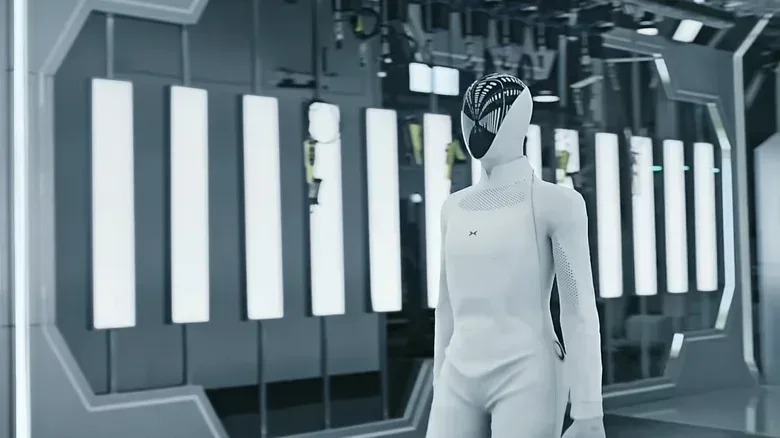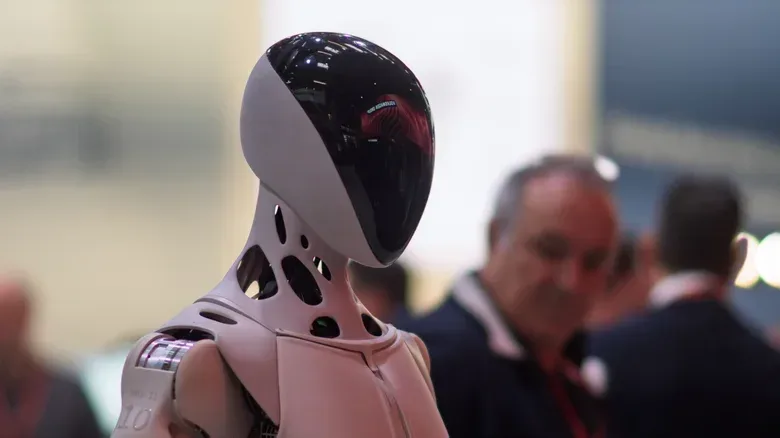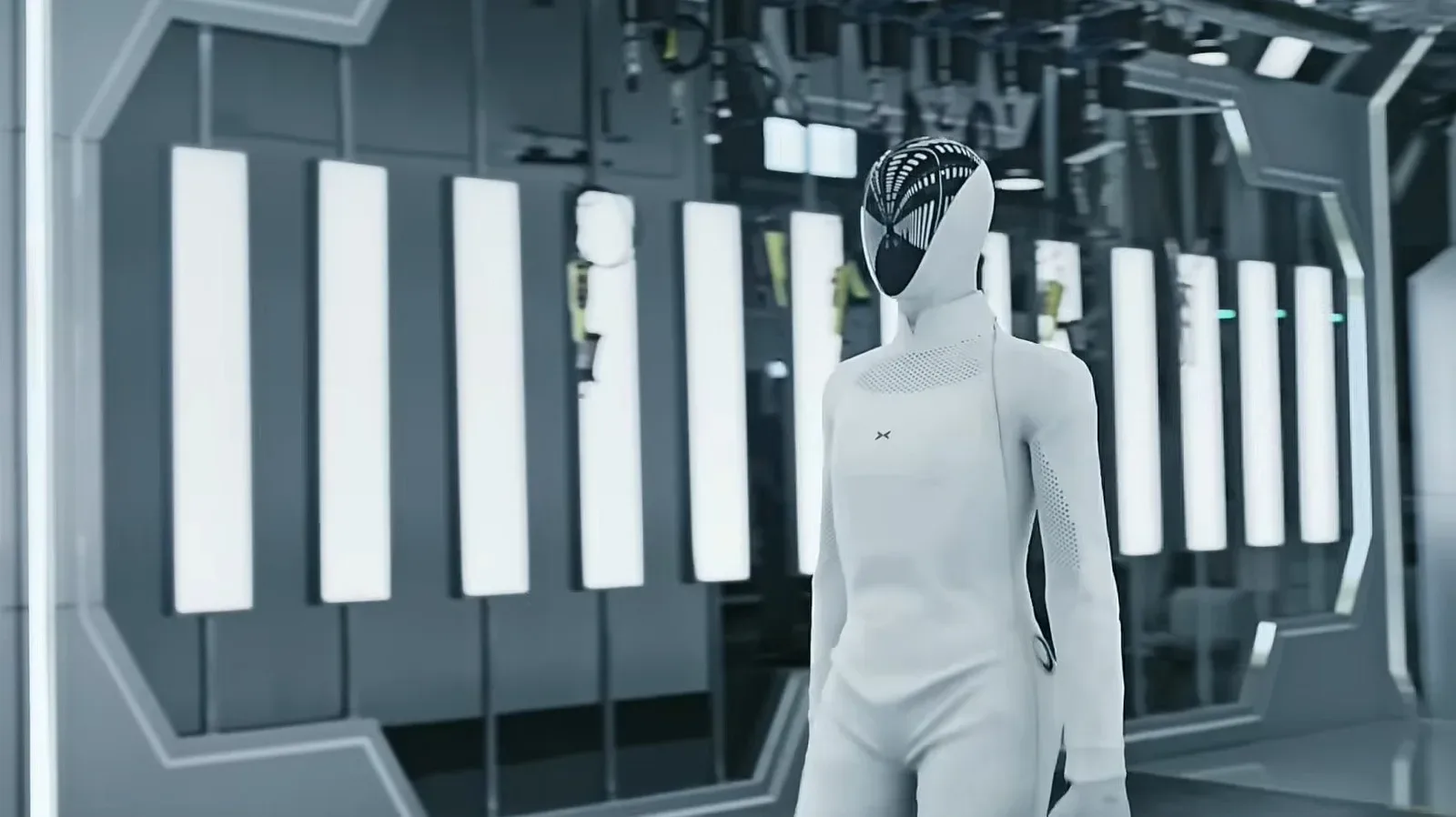
XPENG’s newest employee apparently skipped the awkward first-day small talk and went straight for a walk. The electric-vehicle maker says its Iron humanoid robot autonomously walked off a newly operational production line after assembly, marking a public milestone in the company’s plan to mass-produce the machine by the end of the year.
Iron even received a staff badge from XPENG chairman and CEO He Xiaopeng, which is a charming bit of workplace theatre—and, thankfully, considerably cheaper than a pizza party. Yet the badge is not the important part. The notable claim is that XPENG now has a production line operating for a humanoid robot, and says more than 80% of that line’s core processes are automated.
That does not mean Iron has proven it can thrive through a full day of useful work. A robot completing an autonomous walk after assembly is an eye-catching demonstration of basic integration: its body, motors, sensors, control systems and power systems were sufficiently functional to move under its own control. But it is not, by itself, evidence of reliable customer interaction, safe object handling, long-duration operation or repeatable performance across thousands of units.
Those distinctions may sound fussy, but they are the whole game. In humanoid robotics, walking out of the factory is a milestone. Delivering useful work without a human quietly rescuing the situation when a visitor asks an unexpected question is the boss fight.
A factory milestone, not a finished proof of work
XPENG says it is bringing quality systems from its automotive operations into robot production. That is a meaningful ambition because building a technically impressive prototype and building consistent products at volume are very different tasks.
Automated core processes can help standardize assembly and checks, potentially reducing variation between units as production rises. For a humanoid, consistency matters well beyond cosmetics. Small differences in joint calibration, sensor placement, wiring or mechanical fit may affect how a machine balances, grasps objects and interprets its environment. A line designed to repeatedly assemble and verify those components is therefore an important part of any serious production plan.
Still, key details have not been provided. XPENG has not disclosed the line’s present output, nor how much pre-walk testing Iron completed before its factory exit. The company’s stated objective remains mass production later in the year, which places the event in the category of progress toward a target rather than confirmation that large-scale manufacturing has already arrived.
“Today’s step is small, but XPENG is building the production lines for an entirely new product category,” He Xiaopeng said.
That framing is sensible. A production line is infrastructure for a product category, not a guarantee that the product is ready for every task people may imagine. Humanoid-robot announcements can blur those ideas because a human-shaped machine is naturally easy to project hopes, fears and very specific sci-fi expectations onto. The practical question is much less cinematic: can it complete an assigned job, safely and repeatedly, in a real environment?
Iron’s proposed first roles are deliberately close to home
XPENG has outlined an initial deployment strategy that puts Iron in its own stores and campuses. The planned responsibilities include reception, guided tours and sales assistance. This is a logical place to begin. Company-controlled spaces can be prepared for the robot, tasks can be constrained, staff can be nearby and feedback can be gathered before broader deployment.
Those roles are also a useful test of whether a humanoid body earns its keep. A receptionist or guide must navigate spaces designed around people, communicate with visitors and cope with the occasional unscripted interaction. Sales assistance adds another layer: a robot may have access to information, but a customer encounter is not a multiple-choice quiz. People change the subject, ask vague questions, interrupt, misunderstand and sometimes need help rather than a polished demo.
XPENG plans deliveries in China and overseas markets in 2027. No US availability or price has been specified. Until those details emerge, Iron is best understood as a planned commercial platform with an initial deployment path, rather than a product prospective buyers can meaningfully compare on purchase terms.
Starting with XPENG’s own locations gives the company an opportunity to discover the unglamorous issues that determine whether public-facing robots are useful: charging schedules, handoffs to human staff, maintenance, navigation around clutter, visitor comfort and recovery procedures when an interaction does not go as planned. These operational questions do not make for as dramatic a video as a humanoid striding down a factory floor, but they decide whether a robot becomes an everyday tool or a very expensive lobby ornament.
What 76 degrees of freedom actually means
XPENG says Iron has 76 degrees of freedom across its body, including 21 in each hand. In robotics, a degree of freedom is an independently controllable way a system can move. A bending elbow, a rotating wrist or a finger joint can each contribute degrees of freedom.
More degrees of freedom can give a robot more options for positioning its limbs, maintaining balance and manipulating objects. The 21 degrees of freedom in each hand are especially relevant to tasks involving human-made spaces and tools, where doors, product displays and everyday objects are designed for hands rather than simplified industrial grippers.
However, articulation is capability potential, not an automatic measure of competence. A highly articulated hand needs suitable sensing, control and software to use that movement effectively. It must know where an object is, estimate how firmly to hold it, avoid dropping or crushing it and adjust when the object shifts. The same is true of the body: many joints may enable flexible walking, but the robot still needs to balance safely and navigate an unpredictable floor.
That is why a humanoid’s specifications should be read as an explanation of what motions its hardware may support, not a report card for all the tasks it can perform. A long list of movable joints is promising; reliable behavior in public is the harder measurement.
Onboard AI can reduce delay, but numbers are not behavior
Iron uses three Turing AI chips that XPENG says can provide up to 2,250 trillion operations per second. A trillion operations per second is commonly abbreviated as TOPS, a measure of computational throughput. It can be useful for describing the amount of processing hardware available, particularly for AI workloads.
XPENG says this computing power allows Iron to run its AI model onboard and handle complex tasks without a remote operator. Onboard processing means the robot processes information on the machine itself rather than needing to send every decision to distant computing infrastructure. In principle, this can reduce latency—the delay between sensing something and reacting to it. Lower delay matters when a machine has to keep its balance, respond to movement nearby or control its hands around objects.
But TOPS should not be mistaken for an all-purpose intelligence score. The headline number does not reveal how well a robot recognizes a shopper’s intent, how it handles unclear language, whether it recovers from an error, or how safely it reacts to an unexpected obstruction. Those are system-level questions involving hardware, models, training, sensors, controls, testing and task design.
Readers who follow AI hardware may recognize the broader lesson from other computing stories: specifications matter, but practical performance depends on how the entire system is built and used. That applies just as much to a robot as it does to software tools such as AI-assisted diagnostics across desktop platforms. The distinction is simply more immediate when the system has legs and is sharing a showroom with people.
Safety claims need real-world validation
XPENG says Iron’s outer structure was designed to be flexible with safety in mind. This is particularly important for a robot intended to operate around customers. Human-facing service spaces are not fenced factory cells: people may approach closely, move unpredictably, carry items, bring children along or simply stand exactly where the robot hoped to walk.
A flexible exterior may be one useful design choice, but it is not a complete public-safety case. The available information does not include an independent safety evaluation. It also does not spell out how Iron detects proximity, limits force, responds to contact, pauses or shuts down during faults, or handles a fall. Those details are central to assessing a machine that could be used in stores and campuses.
This is not a criticism unique to XPENG. It is a basic standard for the whole category. Public-facing robots should be judged not merely on whether they can perform a planned routine, but on whether they can behave conservatively when the world stops following that routine.
The humanoid race is moving from demos toward repeatable assignments
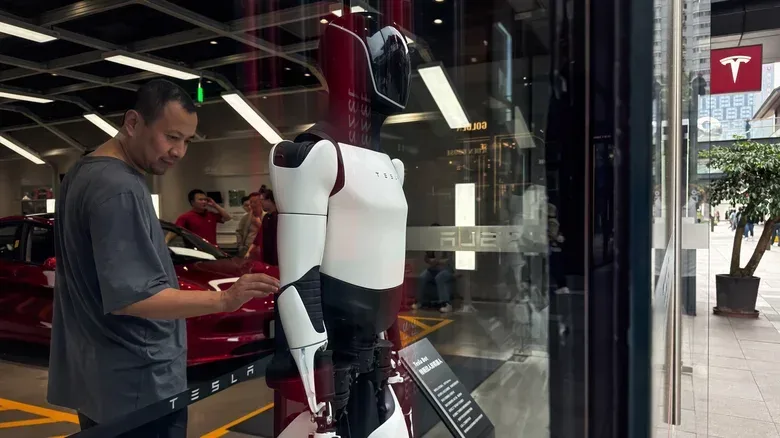
XPENG is not alone in looking to apply automotive manufacturing and AI expertise to humanoid robots. Tesla has said it would convert Model S and Model X production lines for Optimus, and has described preparations for larger-scale robot production. Neither company has yet supplied enough evidence to settle any contest for broad humanoid leadership.
Other companies have demonstrated that production quantities are starting to move beyond one-off prototypes. Figure reported in April that it had produced more than 350 Figure 03 robots and demonstrated a pace of one robot per hour. Those machines were allocated to internal development and data collection, so that total should not be interpreted as 350 customer deliveries.
The more grounded benchmark is what a robot accomplishes after leaving the production floor. BMW has said Figure’s earlier Figure 02 inserted sheet-metal parts for welding at its Spartanburg plant. That was a defined, repetitive assignment rather than an autonomous robot building an entire vehicle. Over ten months, the work supported production of more than 30,000 BMW X3s.
That example clarifies the near-term opportunity and the limitation. Humanoids do not need to solve every problem in a factory to be valuable. A robot that repeatedly performs one useful task in a human-built environment can matter. At the same time, a narrow assignment is not proof of general-purpose labor. It is proof that carefully scoped deployment can produce real value.
Iron’s factory walk is therefore worth watching as a manufacturing signal, not treating as a final verdict. XPENG has laid out a path from an automated assembly line to its own stores and campuses, followed by planned 2027 deliveries in China and overseas markets. The milestones that matter next are less theatrical: sustained output, consistent quality, independently credible safety evidence and robots that can make themselves useful when real people refuse to follow the script.