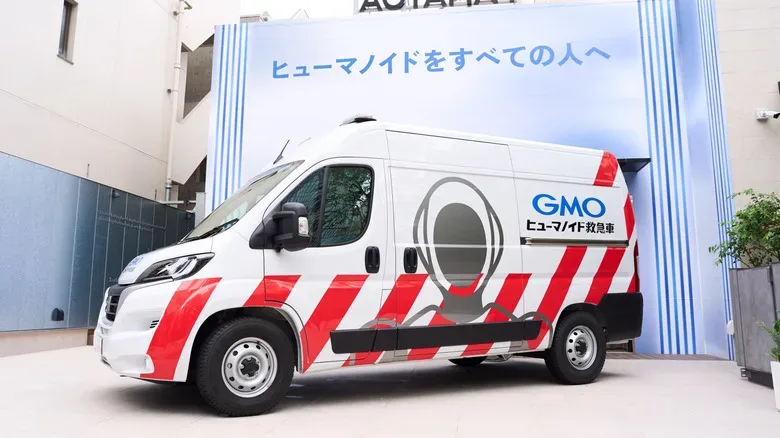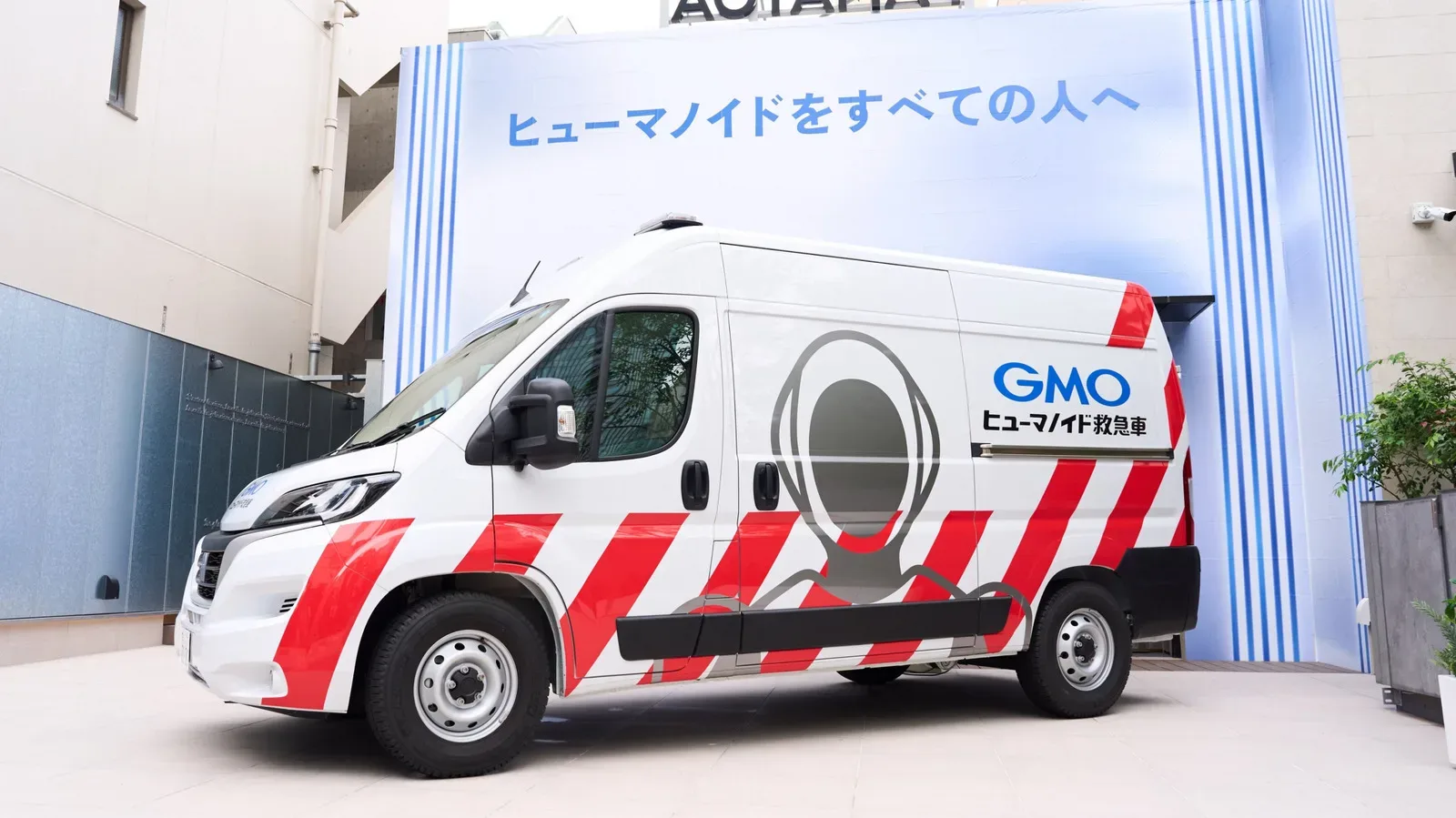
Humanoid robots are beginning to acquire an unglamorous but necessary part of working life: a maintenance callout van. GMO Internet Group has introduced what it describes as Japan’s first “humanoid ambulance,” a vehicle intended to travel to deployed robots that have stopped functioning and return them to service with as little downtime as possible.
The name is deliberately theatrical, but the operating idea is practical. Rather than treating a disabled humanoid as a machine that must always be shipped away and repaired later, the van takes repair capability to the robot’s location. It is equipped with diagnostic gear, spare components, tools and engineers. Crucially, it also carries a spare humanoid robot. When a roadside fix is not possible, the replacement unit can be put to work while the malfunctioning machine is taken back to GMO’s Humanoid Lab in Shibuya, Tokyo.
That makes this less an ambulance in the medical sense than a combined field-service van, swap-out system and transport solution. Still, the purple roof lights and large “Humanoid Ambulance” lettering leave no doubt that the vehicle was built to make the concept visible. Its interior and exterior were designed by Yasumichi Morita of Tokyo firm GLAMOROUS, drawing visual inspiration from emergency vehicles around the world.
A response service, not a rescue line for every robot
The vehicle is initially limited in both scale and scope. There is one ambulance based at GMO’s Tokyo headquarters, and it will support humanoids deployed by GMO AI & Robotics Trading, also known as GMO AIR. Dispatches will be considered individually rather than automatically covering every humanoid robot that suffers a failure in Tokyo.
That limitation matters. The van is not evidence that Japan now has a citywide public emergency network for robots. It is a service layer around a particular supplier’s machines and deployments. GMO AIR does not manufacture the humanoids itself; it resells hardware made by Unitree and other manufacturers, then provides services around those machines. The ambulance is therefore part of a wider proposition: purchasing or leasing a robot is only one piece of the arrangement, while deployment, continuity and repair are the ongoing operational questions.
For businesses considering humanoids, that distinction may be more meaningful than the van’s eye-catching appearance. A robot that can perform a useful task but sits idle after a fault is a problem for the operator. A robot that can be diagnosed on location, repaired with available parts, or temporarily replaced gives the operator a clearer path back to normal service.
What the backup robot changes
The spare humanoid is the key element of the plan. Field technicians can often diagnose a fault, but diagnosis does not guarantee that the machine can resume work immediately. The issue could require a component that is not available, a more controlled repair environment, or a longer inspection. In that situation, the standard alternative is to accept an interruption while the robot is transported away.
GMO’s model aims to substitute another machine at the worksite instead. This is commonly called a swap-out or replacement-unit approach: the failed equipment leaves the site, but the job does not necessarily have to wait for it to return. The practical benefit is not that the original robot is somehow healed instantly. It is that the service can potentially continue with another unit.
Related coverage includes GMO’s Humanoid Ambulance Brings On-Site Robot Repairs to Tokyo.
That is especially relevant to work in which the robot is attached to a scheduled process. GMO AIR is involved in a trial of Unitree-built humanoids working as baggage handlers at Haneda airport alongside JAL Ground Service, a program running through 2028. In a setting where tasks are tied to operational flow, an unplanned loss of a machine can be more disruptive than the machine’s individual repair bill. A replacement robot does not eliminate every complication, but it could reduce the period in which a deployment lacks its assigned hardware.
There is an important distinction between a spare machine and a spare worker. The ambulance holds the former. Whether the replacement can take over smoothly still depends on factors not detailed publicly here, including the task configuration and the status of the specific deployment. The core promise is continuity of hardware availability, not a claim that every fault can be resolved with no operational adjustment.
Field repair is about reducing downtime
Downtime is the time during which equipment cannot do the job it was meant to perform. In a robot deployment, downtime begins when the machine becomes unavailable and ends when it returns to work or a replacement assumes the task. The ambulance is built around reducing that gap.
GMO says the idea followed experience with damaged humanoids that needed to be sent away for repair, causing service disruption. The mobile unit responds directly to that weakness. Engineers and equipment can travel to the failed robot; some problems may be fixed where the robot stopped; and, if they cannot, a backup unit provides another option before the broken machine begins its trip to the repair base.
This arrangement also produces information. Each incident requires technicians to see how a particular machine failed in an actual deployment rather than in a lab. Over time, field-repair work can show which components are most often needed, what equipment belongs in the van, which issues are suitable for on-site intervention and when a replacement is the more sensible response. GMO AIR engineer Shota Takizawa framed the service as something that will be needed as humanoids become more widespread. For now, it is a way of building that kind of operational knowledge before the number of deployed machines becomes much larger.
That emphasis on repair capability has a useful parallel with technology preservation, even though the goals are different. The work behind the PS2 MechaCon security-chip dump shows how much technical continuity can depend on understanding a small but essential part of a larger system. In GMO’s case, the concern is not preserving a legacy console but keeping working robots available in the present. In both cases, however, access to expertise, diagnostics and replaceable hardware determines whether a complex device becomes a dead end or remains useful.
The flashy vehicle is also a public signal
The phrase “humanoid ambulance” and the emergency-vehicle styling make the project easy to understand at a glance. That branding should not be mistaken for a statement that robots receive the same emergency treatment as people. The van is a specialized commercial maintenance vehicle. Its lights, design language and name communicate urgency around machine failures, while also turning an otherwise back-office support function into a visible symbol of a robot-service business.
That visibility appears intentional. Humanoid robots attract attention because they resemble people in silhouette and movement, but a successful deployment depends heavily on less dramatic systems: maintenance schedules, spare parts, trained technicians, transport and a clear decision about when to repair versus replace. The ambulance spotlights those support systems instead of presenting the humanoid as a self-sufficient product that can simply be left to operate indefinitely.
It is also a notably grounded answer to a very specific adoption concern. Businesses can ask what happens after a robot stops working in the middle of its assigned job. GMO’s answer is not merely “contact support.” It is a vehicle, a technician team, tools, parts and a second robot available for substitution. Whether that model proves cost-effective at greater scale remains unaddressed, but the problem it is intended to solve is clear.
How this fits Japan’s longer-term robotics ambitions
Japan published an AI Robotics Strategy in April with a goal of capturing more than 30% of the global robot market and building a domestic industry of roughly $135 billion by 2040. A single purple-lit van plainly will not decide whether those targets are met. It does, however, point at a type of infrastructure that may become increasingly relevant if large numbers of robots are placed in workplaces.
Robotics growth is not solely a matter of building more capable bodies and software. Equipment deployed outside a controlled facility must be supported after installation. That support can include response procedures, maintenance capacity, replacement inventory and people who can assess problems safely and effectively. GMO’s plan is narrowly focused on its own supported humanoids, but it illustrates how a robot economy may create service roles around the machines as well as demand for the machines themselves.
The airport baggage-handling trial provides a concrete setting for that thinking. It is not a broad claim that humanoids have already become standard airport infrastructure. It is a trial involving Unitree machines, GMO AIR and JAL Ground Service, scheduled to continue through 2028. The mobile service vehicle gives GMO AIR a way to address failures among deployments it supports while learning what sustained use asks of its repair operation.
What the ambulance does—and does not—represent
- It is a mobile maintenance resource: The van contains diagnostics, tools, spare parts and engineers for on-site robot response.
- It can provide a replacement unit: If a failed humanoid cannot be repaired at its location, a spare robot can be substituted and the damaged unit taken to the Shibuya repair base.
- It has limited initial coverage: One vehicle is stationed at GMO’s Tokyo headquarters and supports GMO AIR-deployed humanoids on a case-by-case basis.
- It is not a universal public robot emergency service: The available information does not indicate coverage for every brand, owner or robot in the city.
- It does not make failures disappear: The service is designed to manage failures and shorten disruption, not to guarantee that every issue receives an instant on-site fix.
The most revealing part of the project may be its acceptance of a basic reality: humanoid robots, like other working equipment, will eventually need repairs. The novelty is not that machines break. It is that GMO is giving robot downtime a dedicated response vehicle, with a backup body ready to report for duty if the first one cannot.