How to Count a Console Generation
Before comparing Xbox and PlayStation, it is necessary to decide what “sales” means. A console generation is often presented as a race between two numbers, but those numbers may describe different events. One may count hardware shipped from a factory into a distribution channel; another may count purchases reported by a manufacturer; a third may be an analyst’s estimate of consumer ownership. The figures can all be useful, but they do not answer the same question.
A launch date is the date a product became available in a specified market, not necessarily the date of its announcement, first shipment or worldwide release. Regional launches matter because the two companies rarely entered every territory simultaneously. A console might have several months of sales in one region before appearing in another, while shortages, pricing and local software support could produce very different results. “Launched in 2020” is therefore less precise than “launched on November 10, 2020 in the stated markets.”
A model family is the group of related hardware sold as one generation or platform. It does not mean every model performs identically. Xbox Series X and Xbox Series S are members of the same Series family but target different performance levels. A disc-equipped PlayStation 5 and its digital model also share a generation while differing in configuration. Earlier generations likewise gained slim revisions, redesigned internals and altered storage arrangements. Unless a source separates those variants, a generation total normally describes the family rather than a particular chassis.
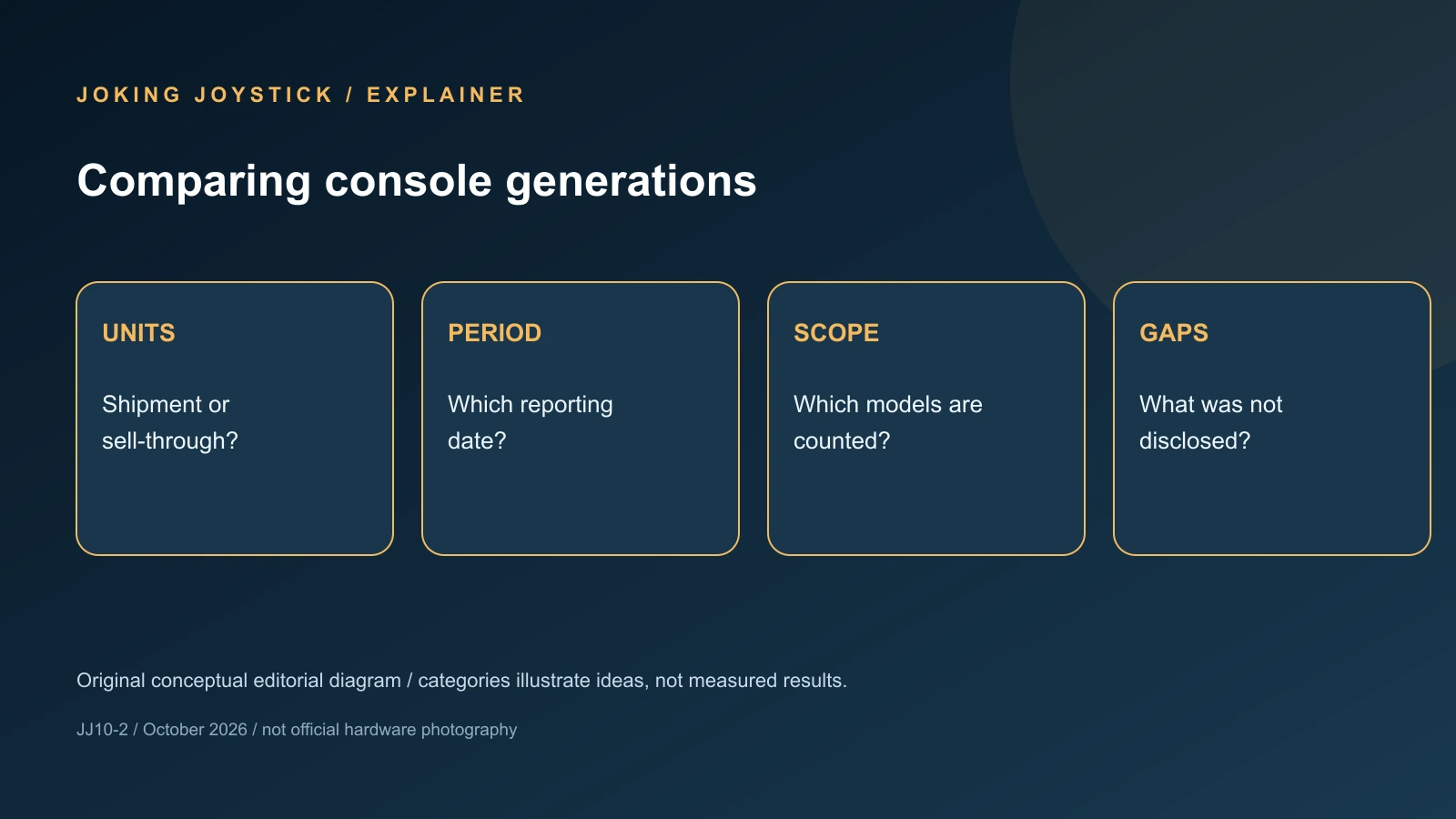
The most important distinction is between sell-in and sell-through. Sell-in generally describes units shipped by the manufacturer to distributors, retailers or other channel partners. Sony’s historical reporting defines production shipments as units leaving its manufacturing bases, and its current PlayStation hardware tables identify reported hardware units as sell-in. That is a record of supply entering the channel. It is not automatically a record of a customer taking a console home.
Sell-through means consumer purchases only when the source explicitly uses that definition. In ordinary writing, companies sometimes use “sold” in a broad promotional sense, while investor documents may use more specific shipment terminology. The wording cannot safely be standardized after the fact. A figure described as “sold worldwide” on a corporate history page should remain attached to that wording rather than being silently converted into audited consumer sell-through.
That distinction does not make sell-in figures worthless. They can show the scale of production and distribution, reveal the timing of a company’s reporting, and provide a consistent series when the same company uses the same method over time. They become misleading when placed beside a consumer-purchase estimate and presented as a direct head-to-head result. The right comparison is not always the one with the most complete-looking table. Sometimes the honest table has an entry marked “not disclosed.”
An installed base is another related but separate idea. It usually means the number of consoles accumulated in homes or the market, but its precise definition can vary. An installed base may include machines that have been replaced, broken, resold, stored or used only occasionally. It may also count a household with several consoles differently from a measurement based on individual owners. Shipments, consumer purchases and installed base are connected, but none is a synonym for the others.
Monthly active users, or MAUs, measure account activity during a period. Sony describes PlayStation MAUs as estimated unique accounts that played games or used services online during the last month of the quarter and notes that the number may be revised. MAUs are therefore useful for discussing engagement and reach, not for counting hardware ownership. The metric should not be treated as interchangeable with console shipments, consumer purchases or installed base.
Revenue answers a different question again. Hardware revenue is not hardware volume unless the company provides enough information about average selling prices, discounts, bundles and accounting treatment to support that calculation. A broader platform category is further removed from a unit count. Microsoft’s FY2026 annual report defines XBOX as including hardware and content and services: first- and third-party content, XBOX Game Pass and other subscriptions, XBOX Cloud Gaming, advertising and other cloud services. The report lists XBOX revenue of $21.790 billion for the fiscal year ended June 30, 2026. That figure demonstrates the scale of the reported XBOX category, but it cannot establish how many XBOX consoles were sold.
Manufacturer claims and audited figures should also be distinguished without assuming that one category is automatically truthful and the other unreliable. A company may publish a precise operating figure in an investor filing, a rounded milestone in a press release and a historical total on a product page. Those statements can be accurate within their own definitions while remaining unsuitable for direct comparison. The relevant questions are: who measured it, what was counted, where, when and under which accounting definition?
This feature uses October 26, 2026 as its cutoff. Later announcements, revised totals and subsequent reporting are excluded. Where an official comparable number is unavailable, the record will say so. That restraint is especially important for Microsoft’s current console totals, because its recent public financial reporting describes the Xbox business broadly rather than supplying a comparable Series X|S unit series. A missing number is not evidence of zero sales, failure or victory for the other platform. It is evidence that the requested measurement has not been disclosed in the same form.
Original Xbox vs PS2: Two Definitions of Console
The original Xbox and PlayStation 2 did not enter an empty market at the same time. PS2 launched in Japan on March 4, 2000, followed by North America on October 26, 2000 and Europe on November 24, 2000. Microsoft’s Xbox arrived in North America on November 15, 2001. That gap gave Sony an established first-mover position before Microsoft had placed its first console in consumers’ homes, and it meant that early comparisons were shaped by different stages of the hardware cycle.
PS2’s proposition extended beyond being a faster successor to the original PlayStation. It played DVDs, supported backward compatibility with original PlayStation software and later accepted a Network Adaptor for online functions. DVD playback gave the console a second household role as a media player. It is reasonable to infer that this broadened the reasons some buyers could consider the machine, but the hardware facts alone do not prove how much DVD playback contributed to sales. The defensible point is narrower: PS2 combined games, films and access to an existing software library in one product.
The original Xbox made a different argument. Microsoft built the machine around a hard drive and an Ethernet orientation, choices that treated storage and connectivity as central parts of the platform rather than optional afterthoughts. The hard drive could support functions that were not dependent on memory cards, while Ethernet prepared the machine for a more deliberate online strategy. This did not make every Xbox experience online, but it gave Microsoft a hardware foundation for treating network identity and connected play as platform features.
The contrast was therefore partly about technology and partly about the meaning of the box. PS2 broadened the console’s role through DVD playback and compatibility. Xbox emphasized the console as a connected entertainment computer with a hard drive and a network port. Neither description captures every use of either machine, and neither proves that one proposition was universally more attractive. They explain why the platforms could appeal to different priorities even when they competed for many of the same game purchases.
Microsoft’s launch communication identified 19 Xbox launch-week games. That was an effort to present the new platform as a functioning ecosystem rather than simply a piece of hardware waiting for future software. Titles such as Halo and Project Gotham Racing helped establish an identity around first-party-backed action and racing experiences. The launch catalogue could not match the time PS2 had already spent accumulating software, but Microsoft was attempting to make the first day feel like the beginning of a platform rather than an experiment.
PS2’s advantage was not just an earlier date. Its backward compatibility gave owners a reason to see the new machine as an extension of an existing library. Its DVD function also created an additional use beyond playing new software. Those features could reduce the perceived risk of buying new hardware, although the cited historical material does not isolate their individual effects on demand. A person considering PS2 could evaluate games, films and original PlayStation compatibility together rather than judging the new generation in isolation.
The sales record requires more care than a simple lifetime ranking. Microsoft reported that 1.5 million Xbox units were sold in North America between November 15 and December 31, 2001. This is a dated, regional company figure covering a defined launch period. It is not a worldwide lifetime total, and it should not be expanded into one by implication.
Sony’s figures for PS2 also appear in more than one form. Sony reported 155 million PS2 units in March 2012, while a later official PlayStation history page described the system as having sold more than 160 million. Those statements are not automatically identical measures. They come from different contexts and use different wording. The later figure may reflect a revised historical presentation, but without a shared methodology it should not be placed beside the Xbox launch-period figure as though the two describe the same interval.
What can be said securely is that PS2 had a much longer commercial runway and a substantially documented global legacy, while Xbox established a first platform with a more deliberate emphasis on hard-drive storage and connectivity. The numbers support scale and timing observations, not a single explanation for why consumers chose one machine. Price, retailer availability, regional launch timing, software, brand familiarity and the appeal of DVD playback all operated alongside the hardware design.
The original comparison also set a pattern that would recur. Sony used an existing audience and a broad household proposition to make the PlayStation easy to extend. Microsoft entered with a technically assertive platform and tried to define a new relationship between console, storage and network. One strategy benefited from continuity; the other sought distinction. Console history becomes clearer when those are treated as different definitions of value rather than as competing specifications in a vacuum.
Original-Generation Libraries: Breadth and Identity
A console library is not one thing. It can mean every title released in a territory, games owned by the platform holder, titles available at launch, games that were exclusive for a period, or software that remained playable years later. A comparison that simply counts names risks treating a short regional release, a major global franchise and a minor port as equivalent evidence. It also risks confusing availability with identity: a game can appear on a platform without defining why people bought it.
Xbox’s launch line-up shows how Microsoft tried to establish that identity quickly. Its launch announcement highlighted 19 launch-week games, including software such as Halo and Project Gotham Racing. Those titles represented more than a numerical catalogue. They gave the new hardware recognizable reasons to exist and helped distinguish it from an established competitor. A launch library cannot by itself predict a generation’s outcome, but it can shape the first impression of a platform’s intended audience.
First-party ownership was particularly important for a new entrant. Microsoft was not inheriting a decade of consumer expectations around Xbox-branded characters or series. Platform-defining software could communicate the machine’s identity: the kind of controller it suited, the kinds of technical effects it could support and the communities it hoped to build. That identity was not limited to one genre, but the launch messaging made clear that recognizable exclusive or platform-associated games were part of the recruitment effort.
PS2’s library strategy rested on a different foundation. The official PlayStation history describes a long commercial life, backward compatibility, DVD adoption and a broad range of genres, including platformers, racing games, role-playing games, fighting games and online experiments. The breadth mattered because the system did not need to persuade every prospective buyer with the same type of experience. A household could approach it through a familiar franchise, a new role-playing game, a racing title, a child-oriented platformer or its media functions.
Backward compatibility amplified that breadth. It allowed the new system to carry part of the previous platform’s software history forward, reducing the sense that buying new hardware meant abandoning an existing collection. Compatibility is not the same as a new release, and it does not guarantee that every older title has equal commercial value. It does, however, change the perceived risk of moving to the next machine. A platform with access to an earlier library can appear more useful on its first day than a platform whose catalogue begins at zero.
The distinction between first-party and third-party software is essential. First-party titles are controlled by the platform holder or its studios, giving the company greater influence over release timing, marketing and platform positioning. Third-party titles are developed by outside publishers and may be exclusive, timed exclusive, multiplatform or released differently by territory. A game’s presence on one console does not establish global exclusivity. Nor does a contractual or regional arrangement necessarily have the same commercial meaning as a permanent first-party franchise.
Regional availability complicates the idea of a single “Xbox library” or “PS2 library.” Release schedules could differ by country, and online functions could depend on local infrastructure or publisher support. A title available in Japan was not automatically available in North America or Europe at the same time. A comparison therefore needs a date and territory. Without them, a library list can combine games that consumers could not access simultaneously and imply a uniform choice that did not exist.
Library size also says little about quality without a defined question. A larger catalogue may offer more genres and more opportunities for niche audiences, but a smaller group of distinctive games may be more important to a platform’s identity. A title can be culturally influential without being exclusive. A multiplatform release can sell more software because it reaches more hardware, while an exclusive can attract buyers precisely because it is unavailable elsewhere. These outcomes concern different parts of the platform economy.
There is also a two-way relationship between hardware and software. A larger installed audience can make a platform more attractive to publishers because it offers more potential customers. A strong exclusive or a well-supported release can then make the hardware more attractive to consumers. The cited historical facts show the ingredients of that cycle, but they do not prove a single direction of causation. It would be too strong to say that PS2’s breadth alone created its hardware reach, or that Xbox’s signature games alone created its platform identity.
The same caution applies to third-party confidence. Publishers consider audience size, development tools, hardware capability, commercial terms, online requirements and the likely cost of supporting a platform. The existence of a release does not reveal which of those factors mattered. Nor does the absence of a game establish that a platform was technically incapable of running it. Contracts, schedules, regional priorities and business decisions can all affect a catalogue.
Seen this way, the original-generation library comparison is not a contest over which machine had the objectively superior games. PS2 offered continuity, a long commercial life and a broad multi-genre ecosystem reinforced by DVD playback and compatibility. Xbox used a concentrated launch identity, recognizable platform-associated software and a technically distinctive connected foundation. The meaningful difference is how each platform reduced uncertainty for a buyer: PS2 through accumulated breadth and familiarity, Xbox through a clearer new-platform proposition.
Xbox Live, PS2 Online and the First Network Divide
Online console gaming is often described as though it were a single feature switched on or off. In practice, it consists of several layers: a network connection, hardware support, an account or identity system, matchmaking, voice communication, downloadable content, publisher servers and rules for maintaining the service. Two consoles can both advertise online play while offering very different levels of standardization. The original Xbox and PS2 made that difference visible.
Xbox Live officially launched in November 2002. Microsoft’s account of the service emphasizes the original Xbox’s Ethernet strategy and the evolution of Live as a unified platform. The documented evidence supports describing it as a premium, connected service built around online games and voice communication. It is safer not to infer from this source alone every later detail of account identity or cross-game standardization. The historical significance is that Microsoft presented networking as an organized platform service rather than merely as a feature supplied independently by each game.
The original Xbox’s built-in hard drive and Ethernet orientation supported that approach. Ethernet did not guarantee that every household had broadband access, and it did not remove the need for publisher servers or game-specific design. It did give the platform a consistent physical direction. The hard drive also meant that Microsoft could design connected features around storage already present in the machine instead of assuming that every user would purchase an optional storage device.
Xbox Live’s service model helped frame online activity as part of the Xbox platform rather than as a collection of unrelated game modes. Microsoft’s historical account supports the importance of voice communication, online games and a continuing service relationship. It does not by itself establish that every title used one identical account, matchmaking or downloadable-content implementation. The narrower conclusion is that Microsoft supplied a common platform context in which those functions could be developed and presented to players.
PS2’s Network Adaptor became available in July 2001, before Xbox Live’s official launch. The date matters because PS2 was not absent from online gaming. Its challenge was that online support depended more heavily on individual hardware and software arrangements. Players needed the relevant network hardware, a supported game and the connection or service arrangements required by that title. The result was a more title-specific ecosystem rather than a single standardized online identity spanning the platform.
That structure could produce both flexibility and inconsistency. A publisher could design its own online model, but the player’s experience depended more on which game they selected. Account creation, matchmaking, voice support, downloadable content and server maintenance were not necessarily presented through one common platform layer. For consumers, “PS2 supports online play” therefore described a range of experiences rather than one uniform service.
Xbox Live’s advantage in this comparison is best described as an earlier and more deliberately integrated service proposition, not as a universal verdict on practical quality. Broadband availability differed by territory and household. Publishers still had to support their games, and a central service could not solve poor server performance, limited regional coverage or a game whose online community disappeared. Similarly, PS2’s less unified structure did not make every online title unsuccessful. It meant that more of the player’s experience depended on the individual game, accessory and publisher arrangement.
Downloadable content illustrates the distinction. A unified service can make purchasing, identifying and retrieving digital additions more coherent across games. But the value of downloadable content depends on what publishers create, how much it costs, whether it is available in a region and whether the game retains an active audience. Infrastructure makes a business model possible; it does not determine the quality or importance of every item delivered through it.
Communication also had a platform dimension. Voice chat can transform multiplayer from a series of isolated matches into a social network, but it requires hardware, software support and a service architecture that allows players to find one another. Xbox’s connected identity helped frame communication as a normal part of the platform. On PS2, communication and matchmaking were more dependent on the arrangements of individual games. That difference influenced the feeling of using the machines even when both could connect to online play.
Final Fantasy XI demonstrates why longevity must be handled carefully. Its PS2 support continued through 2016, showing that one substantial online title could maintain a long relationship with the hardware. It does not demonstrate that PS2 online support as a whole remained active until that date, nor that every PS2 game shared the same infrastructure or lifespan. A platform can contain an enduring online exception without having a universally durable online service.
Broadband adoption and game design were equally important. A network feature has limited practical value where connections are slow, expensive or unavailable. Some games were built around persistent worlds, while others treated online play as an optional mode. Publishers also had to decide whether the expected audience justified server costs and technical support. The first network divide was consequently not simply Xbox versus PS2 hardware. It was a difference between a centrally organized platform service and a collection of title-led online implementations.
The original generation established a pattern that would shape later comparisons. Microsoft treated network identity as a core part of Xbox’s meaning from the start, building toward a service that could span games and years. Sony’s PS2 allowed meaningful online experiments but relied more on the individual arrangements of games and accessories. Xbox therefore offered the clearer standardized network proposition, while PS2’s history shows that a less unified system could still support important and unusually long-lived online experiences.
Xbox 360 vs PS3: The Expensive Reset
The second-generation comparison began with a timing advantage for Microsoft. Xbox 360 launched in November 2005, while PlayStation 3 arrived almost a year later in Japan on November 11, 2006, North America on November 17 and Europe on March 23, 2007. That staggered sequence affected more than the calendar. By the time PS3 reached each market, Xbox 360 had already had time to establish a software catalogue, an online identity and a population of users. Sony was asking customers to wait longer and pay attention to a machine whose most ambitious features were not immediately easy to explain.
PS3 was designed as a broad technology statement. Its Cell processor represented a distinctive approach to distributing computational work, while Blu-ray placed the console at the centre of Sony’s interest in high-definition physical media. The system was also presented as a multimedia device with ambitions beyond conventional game hardware. Those decisions gave PS3 a large potential role: game machine, film player, media hub and demonstration of a new generation of Sony technology.
Ambition, however, imposed costs. Sony’s later corporate account acknowledged that investment in PS3 exceeded expectations, market penetration was slow and the company’s semiconductor ambitions were curtailed. That description is important because it prevents a simplistic reading of the machine’s early problems. PS3 was not merely an underpowered or badly supported product. It was an expensive attempt to make the console carry several strategic objectives at once, including a new processor architecture and a new optical format.
Xbox 360 made a different bet. Its identity was built less around a single headline technology than around a connected platform. Xbox Live, achievements, downloadable content and digital distribution were treated as parts of a continuing relationship with the user. The console was not only a box that played discs; it was an account, a friends list, a record of progress and a route to additional software. That continuity gave Microsoft a way to keep the platform visible between major retail releases.
The contrast between the machines was therefore architectural and commercial at the same time. Cell and Blu-ray helped define what Sony wanted PS3 to be, while Xbox Live helped define how Microsoft wanted Xbox 360 to be used. Neither strategy was automatically sufficient. A sophisticated processor does not guarantee a broad audience, and an integrated online service does not guarantee a compelling catalogue. Their effects depended on launch timing, pricing, developer support, manufacturing cost and the ability to communicate value to consumers.
PS3’s delayed launch also changed the meaning of its hardware proposition. Buyers were not comparing an abstract specification sheet with Xbox 360. They were comparing an available, increasingly established platform with a later and more expensive-feeling technological proposition. Retail availability, software selection and familiarity accumulated on the Xbox side while Sony was still completing its rollout. The regional sequence mattered particularly in Europe, where PS3 arrived in March 2007 rather than during the previous holiday season.
Yet the generation did not remain frozen at launch. Hardware revisions, price changes, software improvements and the growing importance of Blu-ray altered the calculation over time. A launch assessment can explain early momentum without explaining the whole lifecycle. PS3’s format position also gained significance as Blu-ray competed with another high-definition disc standard. The console’s optical drive was therefore not simply an additional specification; it connected the machine to a wider format contest and to Sony’s interests in film distribution.
Xbox 360’s own history was not a frictionless march. A long-lived hardware platform has to manage manufacturing, revisions, storage capacity, accessories and the expectations created by its online service. Its advantage in launch timing created opportunity, not immunity from technical or commercial problems. Likewise, PS3’s later improvements did not erase the burden created by its original price, complexity and delayed arrival. Both platforms changed substantially after release, which is why launch reception should not be treated as a final generational verdict.
The generation also blurred the boundary between hardware and service. Xbox Live made achievements and downloadable content visible as continuing platform features. PS3 developed PlayStation Network functions, trophies, Remote Play and other capabilities over time rather than presenting every part of the eventual ecosystem at launch. That difference illustrates how a platform can be evaluated at several moments: initial proposition, revised hardware, mature online service and late-generation software environment. A comparison that selects only one moment can produce a technically accurate but historically incomplete story.
For these reasons, the 360-versus-PS3 era cannot be reduced to a slogan about one company winning and the other losing. Xbox 360 had the earlier launch and a more mature connected identity. PS3 carried a costly architecture, a multimedia strategy and the significance of Blu-ray, then had to recover from a slow start. The generation was a contest over timing, manufacturing economics, format control, developer experience, online infrastructure and consumer perception. Its outcome depended on the interaction of those factors, not on a single processor, service or sales figure.
Second-Generation Sales: What Is Actually Knowable
The sales record for Xbox 360 and PS3 demonstrates why console history needs definitions attached to every number. Microsoft reported that Xbox 360 had sold 76 million worldwide by June 10, 2013. That is a dated company claim with a stated global scope. It does not describe the final lifecycle total, because the console continued to be sold after that date, and it should not be silently converted into a number for the generation as a whole.
The word “sold” also needs to remain in context. A company announcement may use that word as a commercial milestone, while an investor table may count production shipments. The two records can be useful without being interchangeable. The 76 million figure is not a substitute for a later audited total, and its presence does not justify filling an evidence gap with an unattributed estimate. It tells us what Microsoft chose to report at a particular moment.
Sony’s historical supplemental materials use production-shipment definitions for hardware tables. In that system, units are counted when they leave manufacturing bases. Such figures describe supply entering the channel rather than confirmed purchases by consumers. They can show how many machines Sony distributed and permit comparisons across periods when the same method is maintained, but they are not automatically sell-through. A shipment can remain with a distributor or retailer rather than being immediately installed in a home.
The distinction matters especially when a table places a Microsoft “sold” milestone beside a Sony production-shipment total. The result may look precise while measuring different events. One side may represent a company’s broad sales claim at a specific date; the other may represent units shipped from factories over a reporting period. Even if the numbers are close, their difference in definition prevents a clean head-to-head calculation.
| Platform | Documented figure | Date or period | Definition and limitation |
|---|---|---|---|
| Xbox 360 | 76 million worldwide | June 10, 2013 | Microsoft company claim described as sold; not a final lifecycle total |
| PS3 | 80 million worldwide | November 2, 2013 | Sony milestone announced November 6, 2013; the release identifies the hardware number as sell-in, so it is not automatically consumer sell-through |
The table is intentionally dated rather than presented as a final generational ranking. Both entries are official company milestones, but they are not identical in wording or necessarily identical in measurement. Microsoft described the Xbox 360 figure as worldwide units sold by June 10, 2013. Sony announced the PS3 milestone as 80 million worldwide as of November 2, 2013, while the release’s footnote identifies the number as sell-in. The two figures are close in date and geography, yet the definition difference remains material.
Regional scope creates another problem. “Worldwide” appears clear, but a global number can still be reported at a different point in the lifecycle from a regional number or a fiscal-year shipment table. Launch timing also affects the denominator. Xbox 360 had been available since November 2005, while PS3 entered Japan, North America and Europe on different dates. A figure covering a fixed calendar year may therefore include different lengths of market exposure for the two platforms.
Model revisions can further complicate interpretation. Slimmer designs, altered storage configurations and later bundles may extend a platform’s retail life or change its cost structure without creating a separate generation. A cumulative figure normally covers the model family unless the reporting company says otherwise. It should not be assumed that every revision sold at the same rate or carried the same margin.
Sales figures also do not explain the economic quality of those sales. A shipment may generate revenue at one transfer point, but profitability depends on manufacturing cost, retail terms, promotional spending, accessories, software royalties and online services. A platform can distribute many units while absorbing substantial investment, especially when its architecture is expensive or its price is reduced to broaden the audience. Unit reach and business performance are related, not identical.
Nor can a single hardware total answer which platform was more influential. Xbox 360’s reported milestone supports the conclusion that Microsoft had reached a large worldwide audience by mid-2013. Sony’s 80-million PS3 milestone supplies a useful dated reference point, but its sell-in qualification must remain visible. Software engagement, online activity, format adoption, development economics and late-generation momentum require different evidence. The sales table can establish reported scale at particular dates; it cannot by itself explain the generation’s commercial or cultural result.
The responsible conclusion is narrower than a conventional winner-loser headline. Xbox 360 had a clearly dated Microsoft-reported worldwide figure of 76 million by June 10, 2013. Sony announced 80 million PS3 units worldwide as of November 2, 2013, but the accompanying release identifies that number as sell-in. Those milestones are informative because their dates and geographies are close, while still requiring a definition warning. A source-pure comparison is better than a more exact-looking ranking assembled from incompatible measures.
Libraries and Developer Economics in the 360/PS3 Era
The 360 and PS3 generation made the relationship between hardware design and software economics unusually visible. A console architecture is not experienced only through frame rates or visual effects. It determines the tools developers use, the kinds of technical work required to divide a game across available processors, the difficulty of sharing code between platforms and the cost of supporting patches and downloadable content. Those factors influence publisher confidence even when consumers encounter only the finished game.
Sony’s own historical account described PS3 as technologically challenging and less profitable for developers. That statement should not be expanded into the claim that every PS3 game was expensive, poorly optimized or commercially unsuccessful. It does indicate that the platform’s design created development pressures. Cell was a distinctive architecture, and taking advantage of it could require specialist knowledge and different approaches from those used on more conventional hardware.
The practical consequence was a potential gap between theoretical capability and accessible capability. A feature is valuable to a publisher only when the development team can use it within schedule and budget. If exploiting a processor requires additional engineering, testing or platform-specific optimization, the machine may impose costs that are invisible in a retail specification. Those costs can affect decisions about parity, release timing, downloadable content and whether a smaller project is viable on the platform.
Xbox 360 offered a contrasting environment built around a more unified commercial identity. Xbox Live connected player accounts, achievements, multiplayer and downloadable content. That service layer gave publishers established routes to sell additions, support online communities and keep a game visible after its disc launch. Again, infrastructure did not determine the success of a particular release. It created a framework in which publishers could plan recurring interaction rather than treating the retail launch as the only significant event.
Achievements also had an economic dimension beyond their status as player rewards. They gave users a persistent record tied to an account and made progress visible across games. This encouraged continued engagement with the platform, although the existence of such a system cannot prove that it increased the sales of a particular title. The broader point is that Xbox 360 made platform identity part of software consumption. A game could be evaluated not only as an isolated product but as an item in a connected account ecosystem.
PS3 developed comparable platform features over time, including PlayStation Network functions, trophies and downloadable services. Its later environment should not be confused with its initial one. The generation’s online platforms evolved during the same period that publishers were learning how to manage downloadable content, patches and persistent communities. Any comparison of developer economics must therefore identify whether it is discussing launch conditions, mature tools or the full lifecycle.
Third-party confidence also depended on audience scale and market geography. Publishers wanted to know where a game could be sold, whether the hardware base justified a version and whether the online audience would support additional content. A platform with a strong regional position might receive different priorities from one with a different distribution pattern. A release schedule can reflect those commercial calculations without proving that a specific technical feature caused the decision.
First-party software gave each company a way to absorb some of that risk. A platform holder can fund or manage projects that serve a strategic purpose even when immediate software profit is not the only objective. It can also use a franchise to demonstrate hardware features, populate an online service or maintain interest between hardware revisions. Third-party publishers make related calculations, but they generally must evaluate the direct commercial return of supporting an additional architecture and service environment.
The generation’s multiplatform development also exposed the cost of difference. When a game appeared on both machines, teams had to account for distinct hardware arrangements, graphics capabilities, online requirements and certification processes. The existence of a shared release does not prove that the versions were developed at equal cost or achieved identical results. Nor does a platform-specific title prove that the other machine was technically incapable of supporting it. Publishing agreements, studio ownership, scheduling and audience strategy can all be decisive.
PS3’s architecture could therefore be a source of both ambition and friction. It offered Sony a distinctive technical story and supported the company’s wider multimedia goals, but the development burden was serious enough that Sony later presented PS4 as moving closer to creator needs. That change is evidence of a strategic lesson, not proof that PS3 had no technical strengths. A platform can be technologically ambitious and commercially difficult at the same time.
Xbox 360’s advantage was not simply that it was easier to understand as hardware. Its online identity gave software a continuing commercial context. Achievements, downloadable content and multiplayer infrastructure encouraged publishers to think in terms of post-launch activity, while the platform’s earlier arrival helped establish an audience for that activity. Those conditions could improve confidence, but they do not establish that Xbox 360’s tools caused any individual game to sell more.
The most useful comparison therefore separates four questions: what each machine’s architecture made possible, how accessible that capability was to developers, what service infrastructure surrounded the software and how large or attractive the addressable audience appeared. PS3’s ambitious design carried heavier development concerns; Xbox 360 built a more unified online and digital platform. Neither statement is a complete library ranking. They describe different economic environments in which first-party strategy, third-party support and consumer demand interacted.
Xbox One vs PS4: Messaging and Pricing Correction
Xbox One and PlayStation 4 launched into a market that had learned to expect more from a console than disc playback and local saves. Both companies were presenting hardware as a service gateway, a social space and an entertainment device, but their opening messages emphasized different priorities. Microsoft announced Xbox One for November 2013 across 21 markets at a United States price of $499.99. The launch bundle included Kinect, and the company described the system as an all-in-one games and entertainment device.
That proposition was expansive, but it also made the product harder to summarize as a dedicated game machine. Kinect was part of the launch package rather than an optional accessory in the initial framing, so the advertised price represented both the console and a motion, camera and voice-oriented component. Buyers who wanted only conventional game hardware could regard the bundle as added value, added cost or both. The same design choice could broaden the entertainment pitch while narrowing the group willing to pay for the complete package.
Microsoft’s language reflected an attempt to place Xbox One in the living room’s wider media system. Television and entertainment functions were part of the addressable audience, not merely background capabilities. The strategy sought to make the console useful between game sessions and to position it as a central household device. That was a coherent proposition, but it competed with a simpler question consumers often ask at launch: what does this machine do for games, and how much must I spend to get it?
PS4 launched in North America on November 15, 2013. Sony’s presentation placed greater emphasis on games and on the social actions surrounding them. The company highlighted 8GB of GDDR5 memory, sharing, streaming, Communities, Share Play and Remote Play. These features framed the console as a place not only to play but also to capture, broadcast, join groups and involve other people in the experience.
Sharing and streaming addressed a change in how game activity was becoming visible. A player no longer had to treat a session as private or wait for a formal review to show others what a game looked like. The platform could carry clips and live activity into a social environment. Communities and Share Play extended that idea by making participation less dependent on every person owning the same software or sitting in the same room, although the practical value of each feature depended on network conditions, game support and user adoption.
Remote Play likewise broadened the definition of the console without replacing it. It connected the main system to another supported screen or device, making access a question of continuity rather than a single television. That did not mean every game or every use case behaved identically across devices. It did mean Sony was presenting the PS4 as part of a connected play environment, not simply as a box that delivered images to one display.
The hardware messages also differed in tone. Microsoft emphasized integration: games, entertainment, Kinect and a unified living-room role. Sony emphasized a games-focused machine with memory and social tools that lowered the distance between playing, sharing and watching. Neither description should be treated as proof that one feature alone determined the generation’s eventual performance. Product positioning works through accumulation. Price, launch timing, retailer presentation, software, brand expectations and the clarity of the offer all influence whether a customer understands the value.
Price was especially important because the Xbox One launch bundle attached a specific cost to a broader package. A consumer comparing it with PS4 was not evaluating identical propositions. One machine arrived with Kinect included and an entertainment message; the other foregrounded games, memory and sharing. The relevant question was not simply which console had more features, but which features a buyer considered worth paying for. A feature can be strategically valuable to a company and still be interpreted as unnecessary by part of the market.
The generation also illustrates why technical language needs discipline. Saying that one console was “more powerful” can refer to memory type, graphics throughput, processor arrangements, development tools or title-specific results. The documented PS4 emphasis on 8GB of GDDR5 establishes a hardware design choice, not a universal performance result in every game. Likewise, Xbox One’s entertainment integration says nothing by itself about the speed or quality of a particular title. Specifications require context, and real outcomes require measured evidence tied to software.
Both companies could refine their messages after launch. A platform holder can give more attention to games, simplify the explanation of an accessory, adjust the role of entertainment features or emphasize social capabilities as user habits change. Such corrections do not erase the original proposition. They show that a console generation is also a communication process in which companies discover which parts of their strategy consumers understand and value.
The Xbox One and PS4 opening comparison is therefore best read as a correction in emphasis rather than a single decisive mistake. Xbox One offered a larger all-in-one entertainment vision at a stated $499.99 with Kinect included. PS4 arrived two days later in North America with a more games-centred message built around 8GB of GDDR5 and social sharing tools. The eventual difference between the platforms cannot responsibly be assigned to one accessory, one specification or one slogan. It emerged from how price, purpose, software, timing and audience fit combined over the life of the generation.
PS4’s Sales Lead Without a False Xbox Total
PS4 has a documented official sales figure. The complication is not whether Sony’s console reached a large audience, but what the reported number means and what it can legitimately be compared with. Sony’s PlayStation history reports more than 117 million PS4 systems sold worldwide. That is the figure supported by the cited history page. The reviewed material here does not establish the separate exact formulation of 117.2 million sold-in units as of June 30, 2022, so that more precise number should not be presented without its direct investor source.
Sony’s investor hardware tables use sell-in for current reporting. Sell-in counts units supplied by the manufacturer into the distribution channel. It does not automatically mean that each unit had been purchased by a consumer or activated in a home. Sony has also used different wording in corporate history pages, including “sold,” and a historical statement can therefore carry a different presentation from an investor table. The safe formulation is that Sony’s history page reports more than 117 million PS4 systems sold worldwide, while any separate sell-in figure must be quoted only with its own dated investor citation and definition.
The distinction affects how a mature platform should be interpreted. A shipment can be counted when it leaves a manufacturing base or enters a distributor’s inventory, whereas sell-through records consumer purchases only when the source defines the number that way. At a late stage, channel inventory may be relatively small, but the editorial task is not to assume that it is zero. Retail promotions, regional stock, discontinued models and production timing can still separate the two measures. That is why a rounded historical “sold” claim and an investor sell-in table should remain separately labeled even when they describe the same product family.
Microsoft’s reviewed filings do not provide a comparable lifetime Xbox One unit total. That leaves the historical comparison asymmetrical: Sony disclosed an official PS4 figure, while Microsoft did not disclose an equivalent Xbox One total in the reviewed material. The responsible conclusion is not that Xbox One had no substantial audience. It is that an official Microsoft number using the same scope, date and definition is not available here.
Third-party estimates can sometimes fill gaps in console history, but they must remain estimates. They may be based on retail panels, shipment assumptions, regional tracking or analyst models, each with its own coverage and limitations. An estimate should never be rewritten as “Microsoft sold” a particular number. Nor should an analyst’s figure be placed beside Sony’s official sell-in number as though both were audited measurements of the same event.
The absence of an Xbox One total also explains why engagement statistics cannot substitute for unit sales. Microsoft reports Xbox activity across consoles, Windows-enabled devices and other endpoints, so blended engagement cannot be converted into an Xbox One console count. These measures answer different questions: an activity measure describes use during its reporting period, while a shipment or sales figure describes hardware moving through a defined part of the market.
Revenue is equally unsuitable as a unit proxy. A platform’s revenue can include hardware, first-party games, third-party content, subscriptions, advertising and other services. A large revenue figure could reflect software spending by an established audience, subscription payments across devices or cloud access without a corresponding increase in console sales. Conversely, hardware revenue can move because of price cuts, model mix or manufacturing costs even when unit demand changes in another direction.
PS4’s lead in documented hardware reach can still be discussed historically. Its launch in North America on November 15, 2013, a games-centred proposition and a large software ecosystem formed part of the platform’s commercial story. Xbox One launched in November 2013 with a $499.99 United States price and Kinect included in the initial bundle, presenting a broader games-and-entertainment package. Those differences help explain the competitive context, but they do not turn an incomplete sales record into a precise causal account.
Hardware reach and business strength are also different questions. A console with a larger documented installed channel can provide publishers with a wider potential audience. A platform with fewer disclosed units can nevertheless generate meaningful software, subscription or advertising revenue. The effect depends on engagement, spending per user, software mix, regional economics and the share of activity occurring outside the physical console.
The cleanest historical statement is limited but useful: Sony’s PlayStation history reports more than 117 million PS4 systems sold worldwide. The reviewed packet does not contain the direct primary citation needed to retain a separate exact 117.2-million sell-in figure dated June 30, 2022, so that precision is omitted here rather than inferred. Microsoft’s reviewed filings do not disclose a comparable Xbox One lifetime unit total. The evidence supports identifying PS4’s documented official reach without pretending to know an official Xbox figure that Microsoft did not provide.
Libraries, Subscriptions and the Platform Shift
The console business changed meaningfully as the PS4 and Xbox One generation progressed. Earlier platforms were still built around selling a machine, a disc and, in many cases, a separate online service. By this period, the initial transaction had become the entry point to a continuing relationship. Digital purchases, downloadable content, account systems, subscriptions, cloud access and advertising all helped determine the value of a platform after the console had been placed in a home.
PlayStation Plus illustrates the beginning of that transition. It launched on June 29, 2010 as an optional layer over the free PlayStation Network. Its original benefits included selected games, trials, discounts and automatic downloads. The service did not simply turn access to PlayStation into a single rental arrangement. It added recurring benefits to an existing network, while users could still use core PlayStation Network functions without joining Plus.
That structure created several kinds of value at once. A discount could encourage a purchase that might otherwise not occur. A trial could reduce the risk of trying an unfamiliar game. Automatic downloads could make the console feel more convenient, while included games could increase the perceived return of paying for the service. None of those mechanisms means that every subscriber owned every included title. Access conditions, claim dates, account status and platform support shaped what a user could actually play.
Xbox’s later business vocabulary became broader still. Microsoft’s reporting category for Xbox content and services includes first- and third-party content, Game Pass, other subscriptions, cloud gaming, advertising and related services. That category is designed to describe a platform business rather than a narrow console-software ledger. It captures how Microsoft monetizes users across more than one type of device and more than one form of access.
Game subscriptions change the publisher’s relationship with the audience. A traditional sale records a transaction for a particular game. A subscription can generate recurring revenue while making a catalogue available under terms that may change. The platform holder may use the catalogue to attract sign-ups, reduce churn or encourage users to spend time inside the wider ecosystem. Publishers may receive different commercial arrangements from direct retail sales, depending on the agreement and the service’s role in discovery.
Catalogues are therefore moving lists rather than permanent libraries. A game can be available in one country and absent in another, included in one tier and excluded from another, playable on console but not cloud, or present for a limited licensing period. Backward compatibility can extend access to older purchases, but it does not make every historical game available on every current system. The phrase “games available” needs a date, region, tier, platform and definition before it can support a useful comparison.
Library size alone is also a weak measure of quality or reach. Two catalogues may contain the same number of games while differing greatly in first-party ownership, recent releases, genre coverage, language support, performance options and licensing stability. A service catalogue can be valuable because it provides discovery and variety, while a purchased library can be valuable because access is less dependent on a subscription remaining active. These are different forms of access rather than points on one simple scale.
Account activity introduces another measurement trap. Monthly active users are estimated unique accounts that played games or used services online during the last month of a defined period. They are not a count of consoles, households or paying subscribers. Sony's disclosed MAU definition establishes account activity on PlayStation services, but it does not by itself specify how many consoles are represented by those accounts. A high MAU number demonstrates reach or engagement within the account system, but it cannot be divided into console sales without unsupported assumptions.
Subscription totals are not equivalent to MAUs either. A subscriber is a customer enrolled in a paid service under a particular set of terms. An active account may use free functions, play a purchased game or access a service without paying for the same subscription. Conversely, one household subscription can serve multiple users, depending on account and device arrangements. Treating these populations as interchangeable makes a platform appear more precisely measured than it is.
The shift also changed the economics of exclusivity. A game may be owned by a platform holder but offered across console, PC and cloud. Another may be available on competing hardware after a period of exclusivity. A third-party title can appear in a subscription catalogue without becoming a first-party property. “Available on the platform,” “included in the service,” “owned by the platform holder” and “exclusive to the platform” describe four different conditions.
The most useful comparison is therefore not which company has the longest list. It is how each ecosystem converts access into value. PlayStation Plus added recurring benefits to PlayStation Network, while Xbox’s content-and-services model grew to include subscriptions, cloud gaming and advertising alongside software. Those strategies broadened monetization beyond the initial hardware transaction, but they also made simple library counts and account totals less capable of answering the questions readers actually ask.
Xbox Series X|S vs PS5: Continuity Over Clean Generations
The current hardware cycle began on November 10, 2020, when Xbox Series X and Series S launched as a family. PS5 followed on November 12, 2020 in selected territories and on November 19 in wider markets. The closeness of those dates encouraged a conventional head-to-head comparison, but the systems were designed around continuity as much as generational separation.
Series X and Series S are members of one Xbox generation, not identical performance targets. Series X occupies the higher-performance position in the family, while Series S provides a lower-entry route into the same broad software environment. The distinction affects how developers plan resolution, graphical settings, memory use and performance modes. Family compatibility does not mean that every game runs with identical visual output or identical technical headroom on both machines.
Microsoft’s developer requirements make one part of the continuity principle concrete. XR-130 requires titles targeting the Xbox Series X|S generation to support the entire Series family: saved games must work across Series console types, online players must not be segmented by console type within that generation, and identical game modes must be offered across those devices. This is evidence about compatibility within the Series X|S family. It should not be cited as proof of Xbox One-to-Series cross-generation support, which requires a separate source.
The broader backward-compatibility question must therefore be kept separate from XR-130. The supplied policy establishes how a game must behave across Series X and Series S, not which older Xbox titles are available on those machines. For this feature, the supported conclusion is that Microsoft designed the Series family around shared saves, multiplayer participation and game-mode requirements, while the inherited catalogue should be discussed only where a separate compatibility source identifies the relevant titles or programme. This distinction prevents a family-level developer rule from being overstated as a complete historical library claim.
PS5 launched with two principal configurations documented by Sony: a model with a disc drive and a digital edition without one. The difference is more than a cosmetic choice. A disc model can use physical game purchases and compatible disc-based media, while a digital model depends on downloads and account-based access. Price, storage management, retail availability and a user’s existing collection can therefore make the model distinction economically meaningful.
PS5 also supports backward compatibility with PS4 software, creating a similar bridge between generations. Its hardware proposition included an SSD architecture and DualSense controller features. The SSD changes the storage and data-delivery foundation compared with the previous generation, while the controller adds haptic feedback and adaptive triggers as mechanisms developers can use. Those mechanisms are capabilities, not guarantees that every game uses them in the same way or that every title experiences the same benefit.
Storage is an important part of the ownership calculation for both families. Digital libraries require download space, and large modern games can make capacity management a recurring issue. A disc drive can provide a physical installation source but does not eliminate installation or update requirements. A digital model can simplify purchasing and reduce dependence on retail stock, but it also ties access more closely to downloads, account systems and store availability.
Service continuity further softens the idea of a clean break. Xbox Game Pass and related Xbox services can span console, PC and cloud according to the relevant plan and title. PlayStation’s subscription tiers and backward-compatible access likewise place current hardware within a wider service environment. The console remains important, but the user’s relationship with the platform may include other devices, previous purchases and recurring access.
Performance claims need to remain title-specific. Series X and PS5 have different hardware designs, while Series S is a distinct target within Microsoft’s family. A game’s output depends on its engine, settings, patching, developer priorities and chosen performance modes. It is not methodologically sound to conclude that one console is always faster from a general specification or from one measured title. Nor does a newer storage architecture make every loading sequence behave identically.
The model families also create different entry strategies. Series S lowers the initial hardware barrier within the Xbox ecosystem, but its lower performance target can affect the way games are designed and tested. PS5’s disc and digital editions let buyers choose between physical-media capability and a download-focused configuration, while retaining the same broad generation identity. Neither approach is simply better for every buyer; each shifts cost, convenience and technical expectations in a different direction.
The current generation is therefore best understood as a period of managed continuity. Both companies carried forward software, accounts and services rather than asking every customer to begin again. Xbox made the family distinction especially visible through Series X and Series S, while PlayStation divided PS5 primarily by disc configuration. Comparing them requires attention to entry price, model purpose, backward compatibility, developer requirements and service reach—not a universal claim that one machine is always the faster or more complete system.
What the Numbers Mean in 2026
By October 26, 2026, console statistics describe several overlapping businesses rather than one simple race. A hardware total can indicate documented reach. An active-account figure can indicate activity. Revenue can show the scale of a combined platform operation. A subscription figure can indicate recurring participation. None of these measures answers all the others, and a responsible comparison begins by asking what question a number was designed to answer.
By March 31, 2026, Sony's supplemental information listed 93.7 million cumulative PS5 hardware units on a sell-in basis. Sony's May 8, 2026 earnings speech used the rounded formulation that cumulative PS5 sales had exceeded 93 million as of the end of March. Separately, Sony's supplemental information for the first quarter ended June 30, 2026, published July 31, 2026, reported 1.6 million PS5 hardware units for that quarter on a sell-in basis. These figures should not be added together or treated as though they describe separate consumer-sales events: the 93.7 million figure is cumulative as of March 31, 2026, while the 1.6 million figure is the quarter ended June 30, 2026, under Sony's sell-in reporting definition.
Sony's May 8, 2026 earnings speech reported 125 million PlayStation monthly active users for March 2026. The MAU figure is an estimated count of unique accounts that played games or used services online during the last month of the quarter, and Sony notes that such figures may be revised. It is not a count of PS5 owners. The cited definition establishes account activity on PlayStation services; it does not, by itself, specify the device mix or show how many consoles are represented by those accounts.
Microsoft’s fiscal-year 2026 report recorded $21.790 billion in XBOX revenue. Microsoft defines the XBOX category as including hardware and content and services such as first- and third-party content, XBOX Game Pass and other subscriptions, XBOX Cloud Gaming, advertising and other cloud services. The figure is significant as a measure of the reported XBOX business category, but it cannot establish how many Series X or Series S consoles were sold. It also cannot be placed directly beside Sony’s PS5 hardware figure as if both were unit totals.
The accounting difference reflects a business strategy as well as a disclosure choice. Microsoft’s annual report describes XBOX as operating across console, Windows-enabled devices and other endpoints, with revenue mainly affected by subscriptions, first- and third-party content and advertising. A person can therefore contribute to the reported XBOX category without buying a current XBOX console. This does not make console hardware irrelevant; it means that hardware is one route into a broader commercial system and that the revenue line cannot be reverse-engineered into a console count.
PlayStation is also more than a box. Digital software, network services, subscriptions, accessories and account activity contribute to its business. Yet the reviewed Sony materials provide a documented current PS5 hardware figure, while the reviewed Microsoft filings do not provide a comparable Series X|S total. The evidence therefore supports two separate statements: PlayStation has a disclosed hardware measure, and Xbox reports a broad platform-and-services business without disclosing a matching console-unit series.
Those statements should not be converted into a universal current winner. If the question is documented hardware reach, the available evidence gives PlayStation the clearer reported position through Sony’s 93.7 million cumulative PS5 sell-in units as of March 31, 2026, alongside Sony’s rounded statement that sales exceeded 93 million. If the question is the scale of a combined platform business, Microsoft’s $21.790 billion XBOX revenue category is relevant. If the question is account activity, Sony’s 125 million MAUs provide one measure. None of these answers can stand in for the others, and Microsoft’s reviewed report does not disclose a comparable Series X|S unit total.
Historical comparisons require the same caution. The original Xbox’s 1.5 million units were a North American figure covering November 15 through December 31, 2001, not a worldwide lifetime total. Sony’s PS2 reporting has included a 155 million figure dated March 2012, while a later history page says more than 160 million sold. Xbox 360’s 76 million worldwide figure was a Microsoft claim dated June 10, 2013, not a final lifecycle total. PS3 production-shipment tables do not automatically match that definition.
The same rule applies to software. A game’s sales can measure transactions, while a subscription catalogue can measure access. A digital-ratio figure can describe the share of software revenue or sales under a particular company definition, but it does not necessarily reveal how many people played. A library list can show availability on a date, but not ownership, quality, engagement or regional reach. Each statistic needs its unit, period and population attached.
Readers should also distinguish a platform’s reach from its resilience. A large hardware base can help publishers justify support and can make a console culturally prominent. A service-led model can continue earning from users across devices and can reduce dependence on selling a new box to every customer. These advantages operate through different mechanisms. Hardware creates installed access; services monetize continuing use; software and subscriptions connect the two.
The numbers therefore support interpretation rather than a single scoreboard. Ask whether the figure measures units entering a channel, consumer purchases, active accounts, paid subscriptions, software transactions or blended revenue. Ask whether it covers one model, a model family, one region or the world. Ask whether the date is a launch milestone, a quarter, a fiscal year or a final lifecycle statement. Once those questions are answered, the comparison becomes narrower but more meaningful.
As of the stated cutoff, the strongest defensible conclusion is that PlayStation has a documented current PS5 hardware measure, while Xbox’s disclosed business is organized around a wider platform and service ecosystem without a comparable public Series X|S unit total in the reviewed Microsoft report. That does not settle every comparison involving performance, software, value, library access or user preference. It does establish the limits of the sales evidence. The useful question is not which brand wins every category, but which measure answers the reader’s particular question: hardware distribution, consumer purchases, active accounts, software access, recurring revenue or business resilience.
Related reading and hardware searches
Check the exact item, edition, seller, compatibility, regional fit, price and availability before buying.
Affiliate disclosure: As an Amazon Associate, Joking Joystick earns from qualifying purchases. Search results do not guarantee stock or price.