The White House has removed “Build the Wall”, a block-stacking browser game that appeared on its arcade.gov site, after the Tetris Company publicly distanced itself from the title and said it takes copyright infringement seriously. The game was one of five politically themed titles introduced on the government-hosted arcade site on September 3.
Its removal is a straightforward but unusually conspicuous collision between a globally recognizable game design and a highly charged political message. “Build the Wall,” subtitled “Zombie Border Siege,” used gameplay patterned after Tetris: players arranged falling blocks to construct a barrier. Within the game’s framing, figures approaching from Mexico bounced away from the completed wall and disappeared. Let the stack reach the upper limit, and the game ended with a “BORDER BREACHED” message.
By Tuesday, the title was no longer available through arcade.gov. Neither the White House nor the Tetris Company provided a response to requests for comment on the game’s removal.
Tetris owner distances itself from the game
Tetris Holding LLC owns Tetris rights globally, while the Tetris Company serves as its exclusive licensee. In a social-media statement posted Friday, the Tetris Company made clear it had no role in making “Build the Wall.” Its message emphasized connection and community, describing those ideals as contrary to division, while also stating that it treats copyright infringement as a serious matter.
A representative had said the company was reviewing the situation when asked whether legal action was under consideration. There is no indication here that a lawsuit was filed, or that a formal legal demand was made public. The key confirmed development is narrower: a game bearing a conspicuous resemblance to the classic falling-block format went offline from the White House arcade after the rights holder made its position known.
That distinction matters. Copyright disputes can unfold through private discussions, takedown requests, legal letters, litigation, or a creator’s independent decision to pull material before any of those steps become public. The removal alone does not establish precisely what discussions occurred behind the scenes. It does, however, leave the site with one fewer game and put renewed attention on how much identity can be wrapped up in a familiar gameplay template.
Why the comparison mattered
Tetris is not merely a generic label for “blocks falling from above.” It is one of the most famous and enduring game properties in the medium, with decades of licensed releases, distinctive presentation conventions, and a rights structure that has been carefully managed internationally. When a game is immediately understood as “Tetris-like,” that can be useful shorthand for readers—but it can also signal the commercial and legal sensitivities that arise when a project seems close to a protected work.
The exact legal line in any given case depends on details well beyond the basic notion of stacking shapes. Copyright generally does not grant ownership over broad game ideas or abstract rules alone, but it can protect creative expression: particular artwork, sounds, layouts, audiovisual presentation, code, text, and a sufficiently specific combination of elements. Trademark considerations can add another layer where names, branding, or consumer confusion are involved.
None of that settles the legal status of “Build the Wall” on its own. It does explain why the Tetris Company’s statement was significant, especially because the game appeared on a high-profile official website rather than an obscure fan page. The larger lesson for publishers and developers is less exciting than a perfect four-line clear: recognizable inspiration demands careful review before launch. A parody, homage, clone, or political game may each raise different questions, and familiar mechanics are not a free pass to duplicate protected presentation.
Games increasingly sit at the center of public messaging, brand campaigns, and cultural arguments. That visibility can make the traditional development checklist feel incomplete. Beyond performance, accessibility, age suitability, and web security, a project can require close examination of its visual language, audio, interface, game loop, marketing copy, and implied relationship to a well-known property. A concept that seems like a quick browser diversion can become a major news item when it borrows from a title with Tetris-level recognition.
Arcade.gov still lists other games
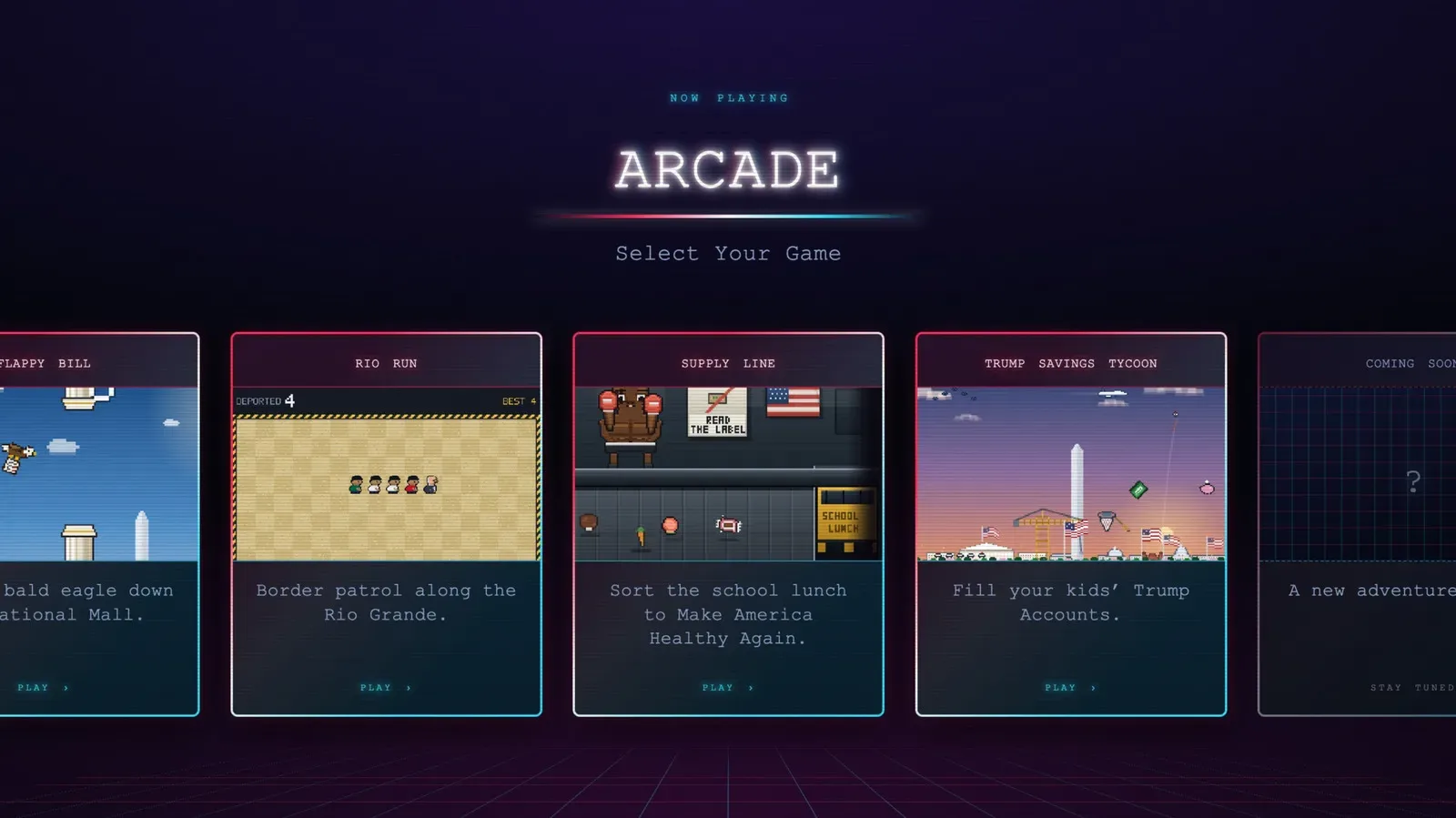
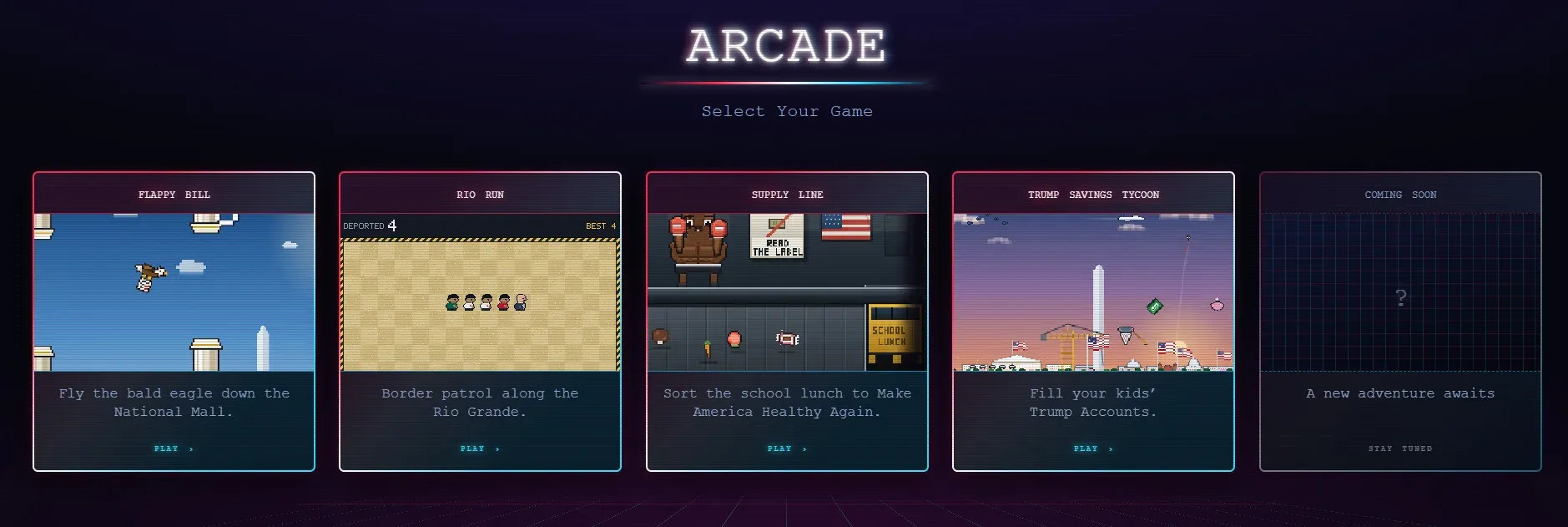
“Build the Wall” was part of a five-game lineup. As of Wednesday afternoon, another immigration-focused game, “Rio Run,” remained available. That title is patterned after the classic snake-game format. It casts the player as an officer moving along the Rio Grande, with immigrants gathered in a chain behind the character as part of the game’s deportation-themed premise.
The rest of the original group also remained part of the site’s offerings:
- “Flappy Bill”, a game modeled on the one-button airborne format associated with Flappy Bird, has players guide a bald eagle through the National Mall.
- “Trump Savings Tycoon” asks players to use a net to collect money bags and other rewards tied to the prompt to fill children’s Trump accounts.
- “Supply Line” centers on sorting food items along a school-lunch conveyor belt under a “Make America Healthy Again” theme.
The continued presence of those games means the takedown was not a shutdown of arcade.gov itself. It was a change to a single entry in a small collection built around political messaging and simple, recognizable arcade-style formats.
The comparison among the titles is notable because simple browser games often rely on immediate player familiarity. A user who understands the broad logic of avoiding obstacles, collecting items, steering a growing chain, or stacking pieces can start playing almost instantly. For designers, that familiarity is a powerful communication tool. For rights holders, it can be a reason to watch closely when the similarities move from a genre-level nod toward something that may look or feel too closely tied to a particular protected game.
A small game with a very public footprint
In another setting, the removal of a lightweight web game might be a minor maintenance note. Here, the circumstances give it outsized cultural weight. The title combined a border-policy message with imagery involving people crossing from Mexico and a structure strongly associated with Donald Trump’s political agenda. Its gameplay reference point was Tetris, a property whose appeal has historically crossed countries, ages, platforms, and political identities.
The Tetris Company’s public language underscored that contrast. Its statement did not merely deny involvement; it framed Tetris as a shared experience intended to bring people together. That is a values statement as much as a rights-management statement, and it placed the game’s imagery and theme at the center of the reaction rather than treating the matter as a dry technical dispute.
For people tracking how games show up outside the traditional console and PC business, the episode is another reminder that a game’s mechanics can never be entirely separated from its context. The same design shorthand that helps a project communicate in seconds can carry a long history of cultural associations and legal ownership. The question is not only whether someone recognizes the inspiration. It is also who is using it, where it is being hosted, what message it is attached to, and whether the property owner wants any connection to it.
That broader industry tension arrives at a moment when game-adjacent technology and publishing questions are receiving plenty of attention, from platform tools to creator rights and the instability facing development careers. For a wider look at that latter issue, see Tim Cain’s comments on why stability has never been guaranteed in game development.
For now, the concrete result is simple: “Build the Wall” is gone from the White House game site, the Tetris Company has said it was not involved, and the remaining arcade.gov titles continue to show how quickly even basic web games can become part of much larger debates over authorship, politics, and public identity.