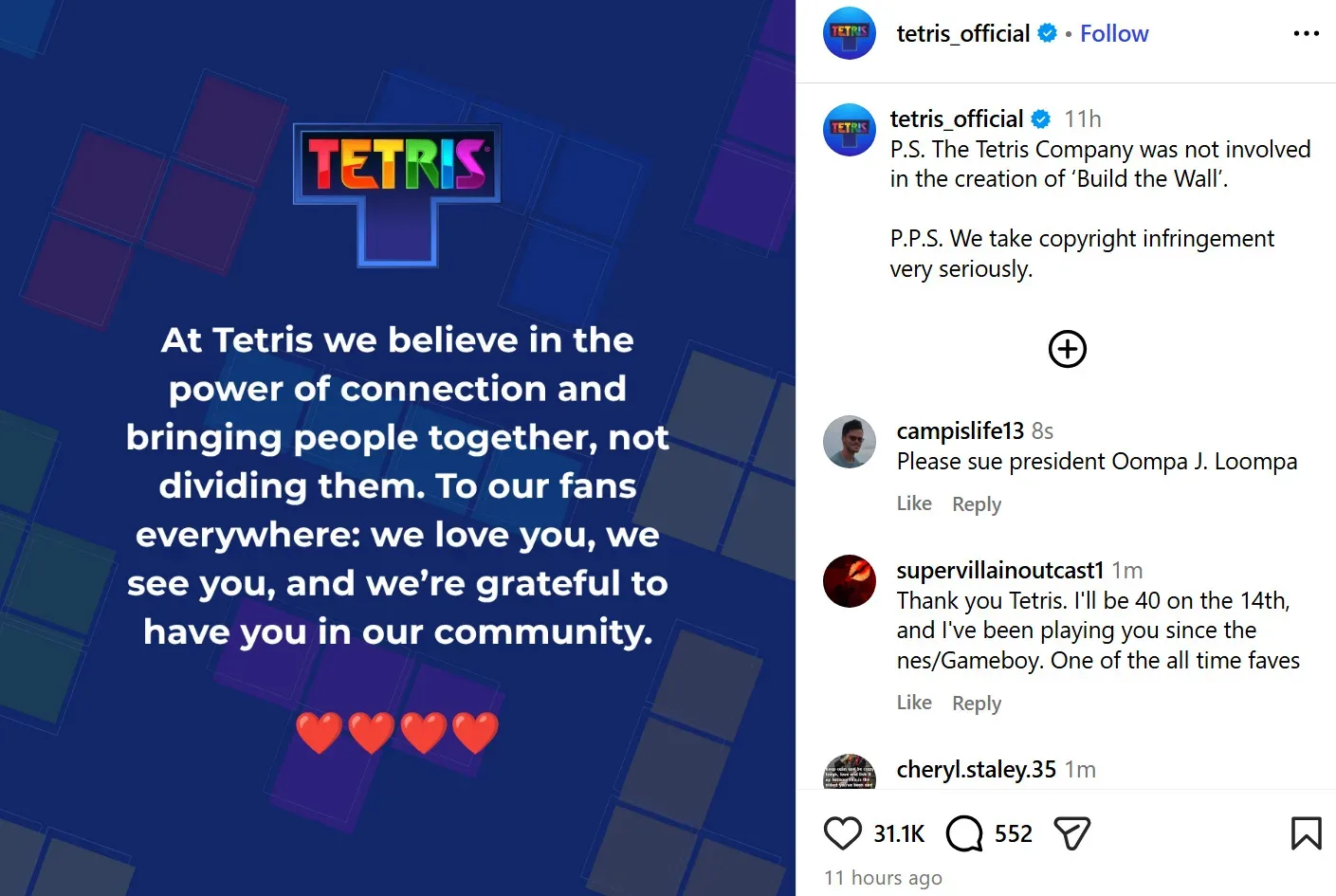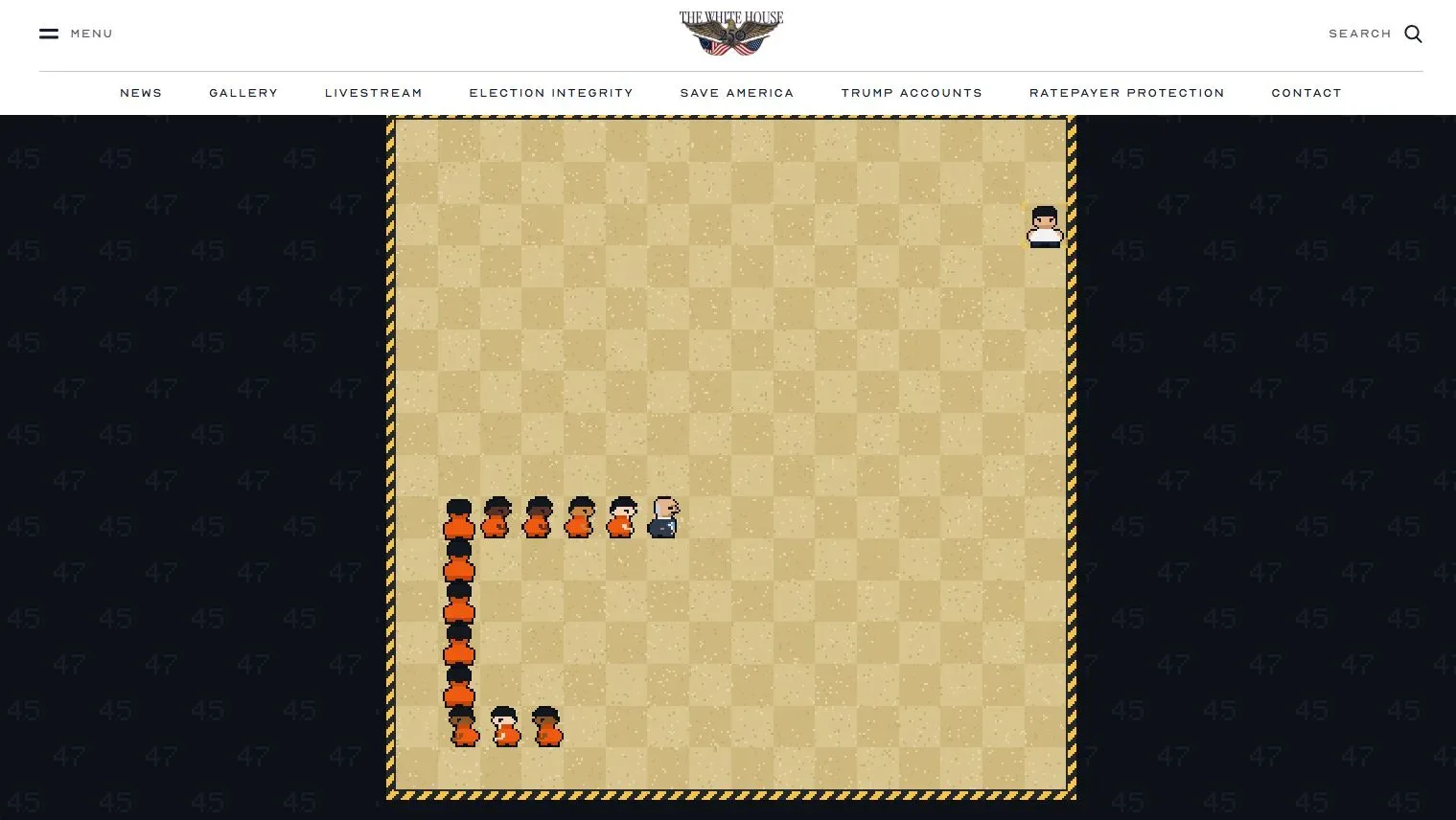
The Tetris Company has publicly separated itself from Build the Wall, an immigration-themed browser game recently added to the White House website as part of a six-game arcade collection. The company said it was not involved in making the title and did not authorize or license the Tetris brand or its intellectual property for the project.
That matters because Build the Wall uses a familiar falling-block premise. Players place descending brick shapes into a structure, an immediately recognizable setup for anyone who has spent time rotating tetrominoes under pressure. But its rules and theme point in a sharply different direction: completed rows do not disappear. Instead, the construction keeps expanding as the game frames the objective around stopping an approaching “zombie horde” near a broadly labeled Southern Border.
It is an unusual collision of public-sector web communication, arcade-game shorthand, intellectual-property questions, and a politically charged message. It also puts one of gaming’s most globally recognizable puzzle brands in the position of clarifying that association should not be presumed simply because a new title resembles its foundational mechanics.
A clear statement of non-involvement
In an Instagram post, The Tetris Company emphasized the inclusive identity it associates with the long-running puzzle game: a game built around connection and a community spanning cultures and generations. The caption accompanying that post said the company had no role in Build the Wall and takes potential copyright infringement seriously.
In a further statement, the company repeated that it had not authorized the use of Tetris intellectual property. It also contrasted the new game’s wall-building goal with the essential Tetris loop: arranging pieces efficiently so that lines are cleared. The company said it is reviewing the situation.
For a game company, this is about more than whether falling shapes appear on a screen. The specific presentation, mechanics, branding, and commercial or institutional context can all matter when questions of authorization and protected expression arise.
It is important not to jump ahead of that review. A public assertion of non-authorization is not itself a ruling on infringement, and no outcome has been established here. Still, the company’s response leaves little ambiguity about the central point: Build the Wall is not an official Tetris product, collaboration, or licensed use of the Tetris name and property.
How Build the Wall differs from Tetris
The resemblance is rooted in a basic vocabulary that video games have been speaking for decades: geometric blocks fall from above, the player slots them into place, and a structure rises as space becomes scarce. Tetris made that vocabulary iconic, but Build the Wall directs it toward a fundamentally different outcome.
Related coverage includes Tetris Company Disavows White House's 'Build the Wall' Browser Game.
Traditional Tetris rewards clearing completed horizontal lines. The board is constantly threatened by accumulation, while line clears create breathing room and allow skilled players to continue. That tension between order and collapse is the engine of the game. Its elegance comes from making subtraction feel like success.
In Build the Wall, the wall is meant to remain and grow. Filling a line does not erase it; it contributes to an ever-larger barrier. That reversal is not a tiny design tweak. It changes the game’s underlying metaphor from managing and eliminating clutter to permanent construction and exclusion.
- Tetris: falling shapes are arranged to make lines vanish.
- Build the Wall: falling shapes are assembled into a continuing wall.
- Tetris: the challenge is survival through efficient clearing.
- Build the Wall: the stated objective is to build a defensive obstacle against an incoming threat.
Its title and border setting make the intended political symbolism hard to miss. A wall along the U.S.-Mexico border has remained a policy goal across President Donald Trump’s two terms, and the browser game translates that real-world political position into a simplified arcade objective. Reducing immigration rhetoric to a block-stacking scenario is precisely why the game reads as more than a generic puzzle clone with an unusual theme.
Six browser games, one conspicuous controversy
Build the Wall is one of six arcade-style titles released on the White House website on Thursday. Browser games are, in practical terms, accessible communication tools: they load quickly, can be shared easily, and ask for very little commitment from a visitor. For an institution trying to speak in internet-native formats, a simple game can function as a piece of messaging as much as a piece of entertainment.
That approach has precedents in the administration’s broader online style. Government accounts and agencies have pursued gaming-adjacent engagement, including the use of Halo-related imagery in material promoting Immigration and Customs Enforcement recruitment. Such attempts to borrow the language of games, memes, and fandom can travel far beyond conventional policy posts. They can also create immediate questions over ownership, permission, and whether the borrowed cultural reference is being used appropriately.
The distinction between a meme-like visual gesture and an entire web game is substantial. A game has systems, art direction, interface decisions, a premise, and a player-facing identity. When those elements call a well-known game to mind, the rights holder may see a much larger issue than a passing reference.
For readers interested in the wider business context, Joking Joystick’s coverage of immersive media’s push toward shared spaces and new storytelling formats is a useful reminder that games are increasingly used as cultural and communications platforms, not merely standalone products. That versatility can be powerful, but it also raises the stakes when a familiar play format is attached to a contentious message.
Why the Tetris identity is especially sensitive
Tetris is not merely an old puzzle game whose basic premise is easy to summarize. For more than 40 years, it has been a carefully managed entertainment brand with a distinctive identity. Its accessibility has helped it endure across hardware generations, regions, age groups, competitive scenes, handheld systems, phones, and browser windows. The game’s appeal is unusually broad because its core is abstract: shapes, space, rhythm, and the satisfaction of a clean line clear.
That abstraction gives Tetris a cultural flexibility that Build the Wall does not share. One has historically invited players into a universal puzzle; the other deploys a visually similar kind of play in service of a specific political border message. The Tetris Company’s emphasis on bringing people together was therefore not just standard brand language. It was a direct contrast with the use to which the new game puts its own variation on falling-block mechanics.
The company’s statement also identifies the heart of Tetris in functional terms: stack purposefully and clear as many lines as possible. That description does not settle any legal question, but it plainly establishes where the company believes its game’s identity lies. Build the Wall preserves the act of stacking while rejecting line clearing in favor of an accumulating structure. The difference may be mechanically meaningful, yet it does not erase why observers would associate the game’s presentation with Tetris in the first place.
What could happen next
The immediate known facts are limited. The White House has hosted the arcade collection; The Tetris Company says it was not involved and gave no license or authorization; and the company is reviewing the matter. There is no confirmed takedown, lawsuit, settlement, or formal finding described at this stage.
That uncertainty is worth keeping front and center. Online disputes involving recognizable game concepts can end in many ways: an owner may seek clarification, request changes, issue a formal notice, negotiate privately, or take no publicly visible action while it evaluates options. A takedown under the Digital Millennium Copyright Act is one possible route in digital-content disputes, but it should not be treated as inevitable simply because prior pop-culture borrowing has drawn complaints or removals.
There is also a broader reputational dimension. The White House’s choice to put an overtly political message into a small arcade package ensures that the game will be judged not only on whether it echoes Tetris, but on what it asks players to enact. For Tetris, a brand that has spent decades cultivating an all-ages, cross-cultural puzzle legacy, a public disavowal may be necessary even before any legal process reaches a conclusion.
For now, Build the Wall stands as a peculiar artifact of official online messaging: a government-hosted browser game using falling blocks to turn a divisive border policy into an arcade task. The response from The Tetris Company makes the other half of the story equally clear. Whatever happens after its review, the company does not want its famous puzzle, its name, or its values folded into that message.