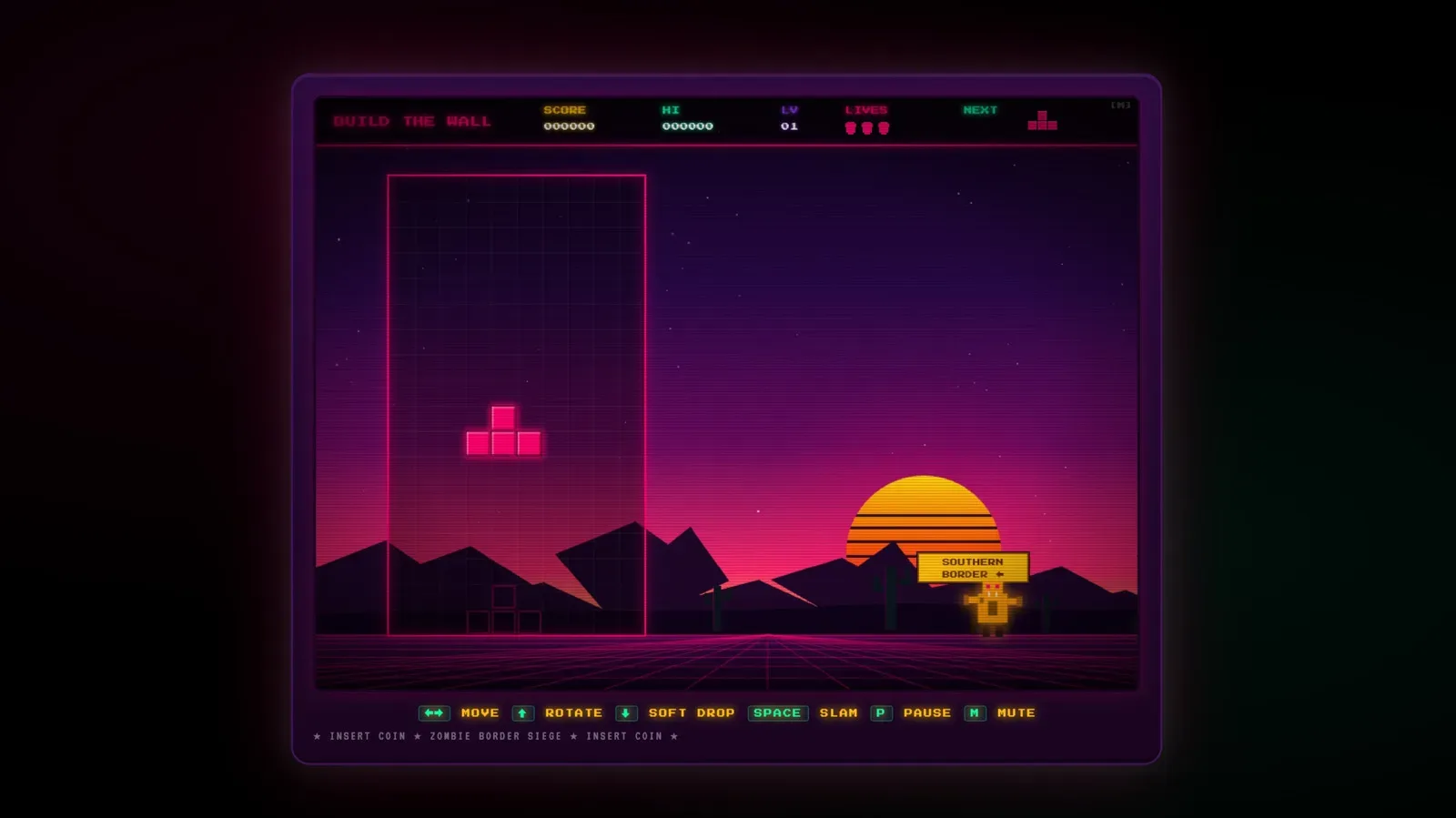
The White House has removed Build the Wall, the browser-based block-stacking game that asked players to assemble bricks along the U.S.-Mexico border. Its disappearance from the administration’s online arcade follows public criticism from The Tetris Company, which objected both to the game’s divisive political framing and its apparent resemblance to the long-running puzzle classic.
That sequence does not establish exactly why the game was pulled, and it remains unclear whether any formal legal step occurred. But the timing is notable: Build the Wall arrived in the arcade on September 3, The Tetris Company publicly responded on September 4, and the game was subsequently removed. The episode is an unusually visible reminder that borrowing the instantly recognizable language of a game can bring scrutiny even when the work is presented as a short, topical web diversion.
A political minigame built on familiar falling-block language
Build the Wall was not subtle about its reference point. Its central interaction used the essential visual and mechanical shorthand associated with block-stacking puzzle games: placing descending pieces efficiently to construct a larger arrangement. Rather than making rows disappear, however, the premise turned brick placement into a depiction of a border wall.
The game’s subject matter placed it directly within the Trump administration’s immigration messaging. That made its use of a format strongly associated with Tetris more than an ordinary retro-game homage. In this instance, a familiar play pattern became the delivery system for a contentious political idea, raising two separate but overlapping questions: whether the game too closely mimicked protected creative elements, and whether a company connected to one of gaming’s best-known brands wanted any association with that message.
The Tetris Company made clear that it did not. In posts shared on Instagram and X, the company said it disagreed with the rhetoric surrounding Build the Wall and emphasized a belief in connection and bringing people together. It also said it takes copyright infringement seriously. When asked about a potential response beyond those posts, the company said it was reviewing the matter, rather than committing publicly to litigation.
The essential point from The Tetris Company was twofold: it rejected the game’s rhetoric and signaled that its intellectual-property concerns were not merely theoretical.
The arcade included more than one obvious imitation
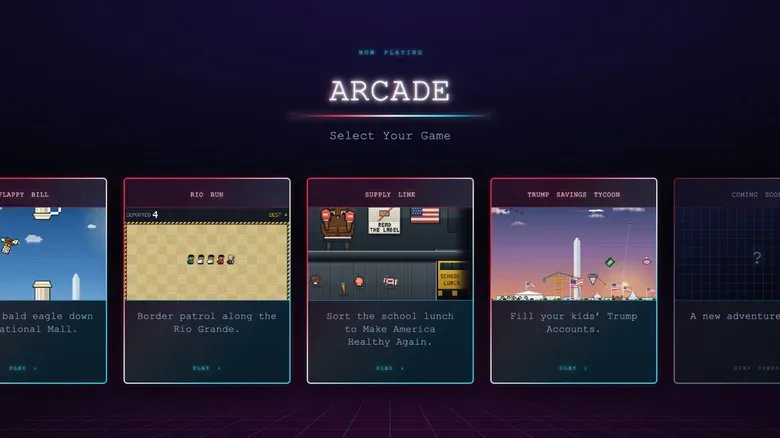
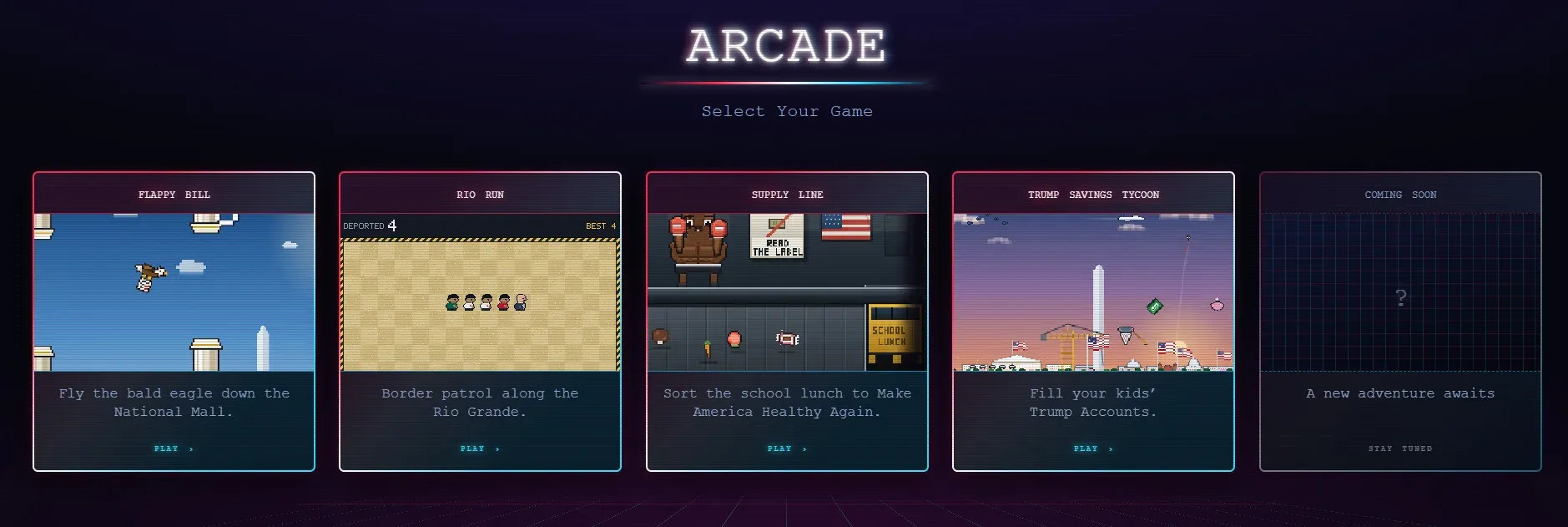
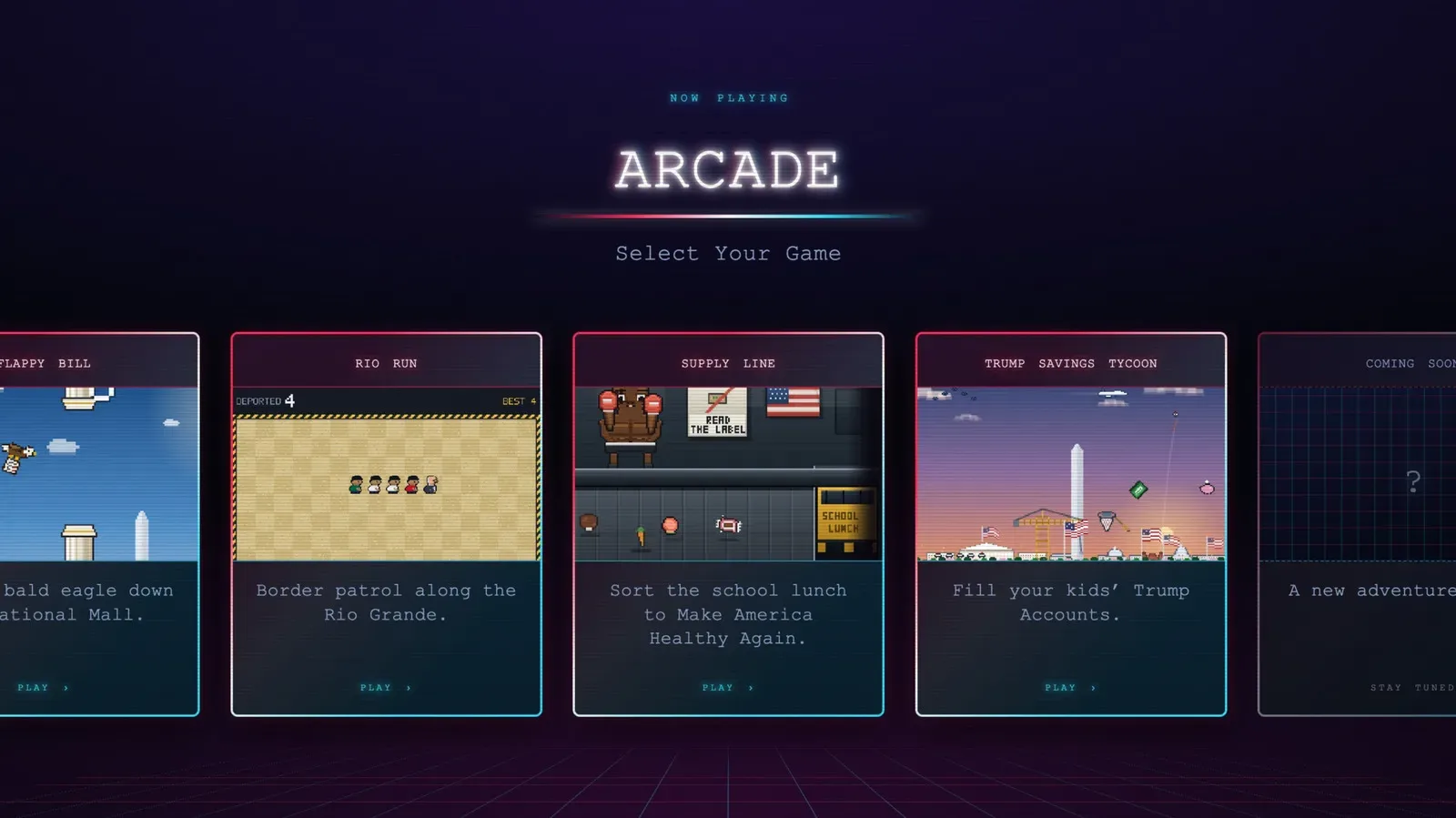
Build the Wall was part of a set of White House games introduced on September 3. The group appeared designed around quick, easily understood online minigames, with political branding and familiar arcade concepts doing much of the work. It was also not the only title whose name and format appeared to echo an existing hit.
- Build the Wall used block-stacking mechanics closely associated with Tetris.
- Flappy Bill echoed the name and basic concept of Flappy Bird.
- Rio Run resembled the classic growth-and-navigation structure of Snake.
That matters because the controversy is larger than one removed game. A name, a visual setup, or a familiar control scheme can immediately tell a visitor what they are expected to do. That recognition is useful when a publisher wants a fast joke or a shareable political message. It is also where the line between genre inspiration and conspicuous copying can become uncomfortable.
Game mechanics by themselves are complicated territory. Broad ideas such as moving a character through obstacles, matching colors, or guiding a growing line around a playfield have appeared across countless games. But a project can still attract attention when it combines a recognizable name, an unmistakable presentation, and a gameplay loop that points viewers toward one particular commercial work. The closer a game feels to a famous original in total, the less useful it is to insist that each individual component is common on its own.
Why Tetris is a particularly recognizable target
Tetris is not merely a puzzle genre reference. It is one of the medium’s most enduring and widely recognized properties, identified with falling geometric shapes, rotation, placement, line-clearing, and a distinct visual language developed over decades. Its reach spans dedicated game hardware, consoles, computers, mobile platforms, merchandise, competitive events, and pop culture at large.
That prominence makes an apparent imitation especially conspicuous. Viewers do not need a detailed mechanical comparison to understand the association when a game presents block shapes dropping into a narrow area and treats their arrangement as the entire point. The association becomes still stronger when the project is called out publicly by the company connected to the original property.
It is worth being careful about what has and has not been established. The public record described here does not show that The Tetris Company filed a lawsuit, sent a takedown demand, or reached a settlement with the White House. The company said it was reviewing the issue to determine what further action, if any, was appropriate. The precise internal decision behind the game’s removal has not been disclosed.
Still, public disavowal can be consequential on its own. A rights holder does not always need to litigate for a disputed project to become an unnecessary problem for its publisher. Where the work is hosted by a prominent institution and has already created an unfavorable news cycle, removing it can be a faster path than defending a deliberately provocative clone.
The limits of nostalgia as a shortcut
There is a long history of games drawing on recognizable genres and classics. That is not inherently a problem. Platformers, shooters, card battlers, racing games, puzzle games, and survival games all operate through conventions players understand before a tutorial begins. Developers routinely use those conventions to make new work accessible.
The distinction is that genre literacy is not the same thing as recreating a famous game’s identity. A falling-block game can be original if it gives the formula a genuinely distinct structure, objective, aesthetic, or system. A satire can make a reference without functioning as a near-direct substitute for the thing it invokes. But simply adding a topical label to a familiar hit is a much shakier creative proposition, particularly if the original’s signature appeal is doing all the heavy lifting.
That principle applies well beyond browser arcade experiments. Fan projects, mods, promotional games, and social-media tie-ins often use existing game language because it is fast, cheap, and instantly legible. Yet the closer the reference is, the more a creator should expect questions about rights, attribution, and reputational association. The gaming space has plenty of examples of unofficial work built around established properties; even projects that are clearly transformative can face constraints. For a different example of how a game modification can become part of a public conversation, see our coverage of Benjamin Burnley promoting his Fallout 4 mod.
A small game, a large symbolic fight
The removal of Build the Wall is significant less because it was a major gaming release than because of where it appeared and what it represented. A browser minigame can normally vanish with little notice. Here, the game was hosted in an official government-facing setting, used a politically charged theme, and appeared to borrow heavily from an institutionally protected entertainment brand. Those factors transformed a simple arcade-style diversion into a cultural and legal flashpoint.
The result also illustrates an awkward truth about political novelty games: their speed is often their weakness. A quick reference can generate attention, but the same obviousness can make it easy for audiences to identify where it came from and for rights holders to respond. What reads as an efficient joke or meme may also read as a conspicuous attempt to benefit from someone else’s design legacy.
For now, the central factual outcome is straightforward. Build the Wall is no longer available in the White House arcade. The Tetris Company publicly rejected its framing and flagged copyright concerns, while leaving the possibility of additional action open at the time of its statement. Whether the other politically branded games face comparable scrutiny remains unknown, but the removal shows that even a modest wave of pushback can matter when a clone is this easy to recognize.