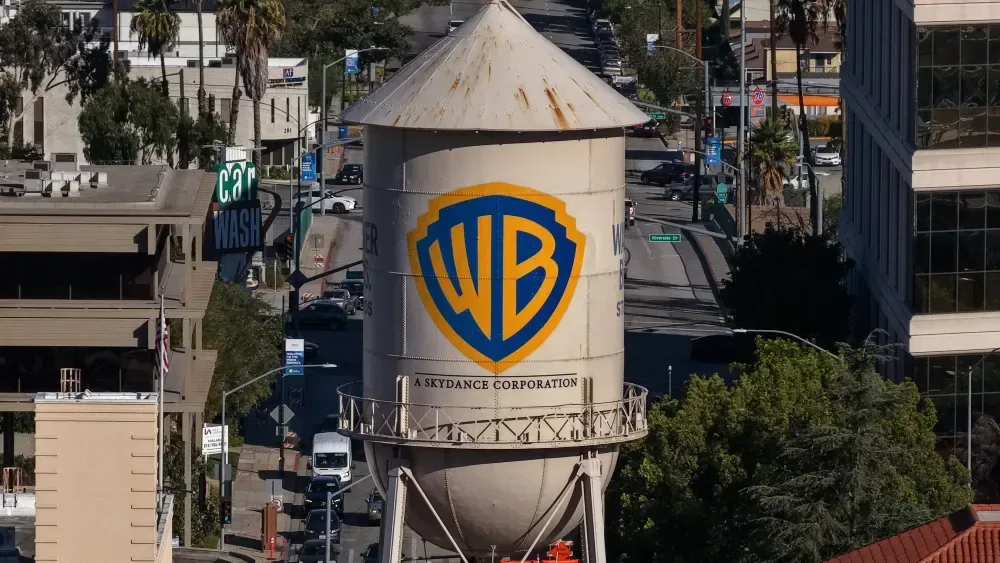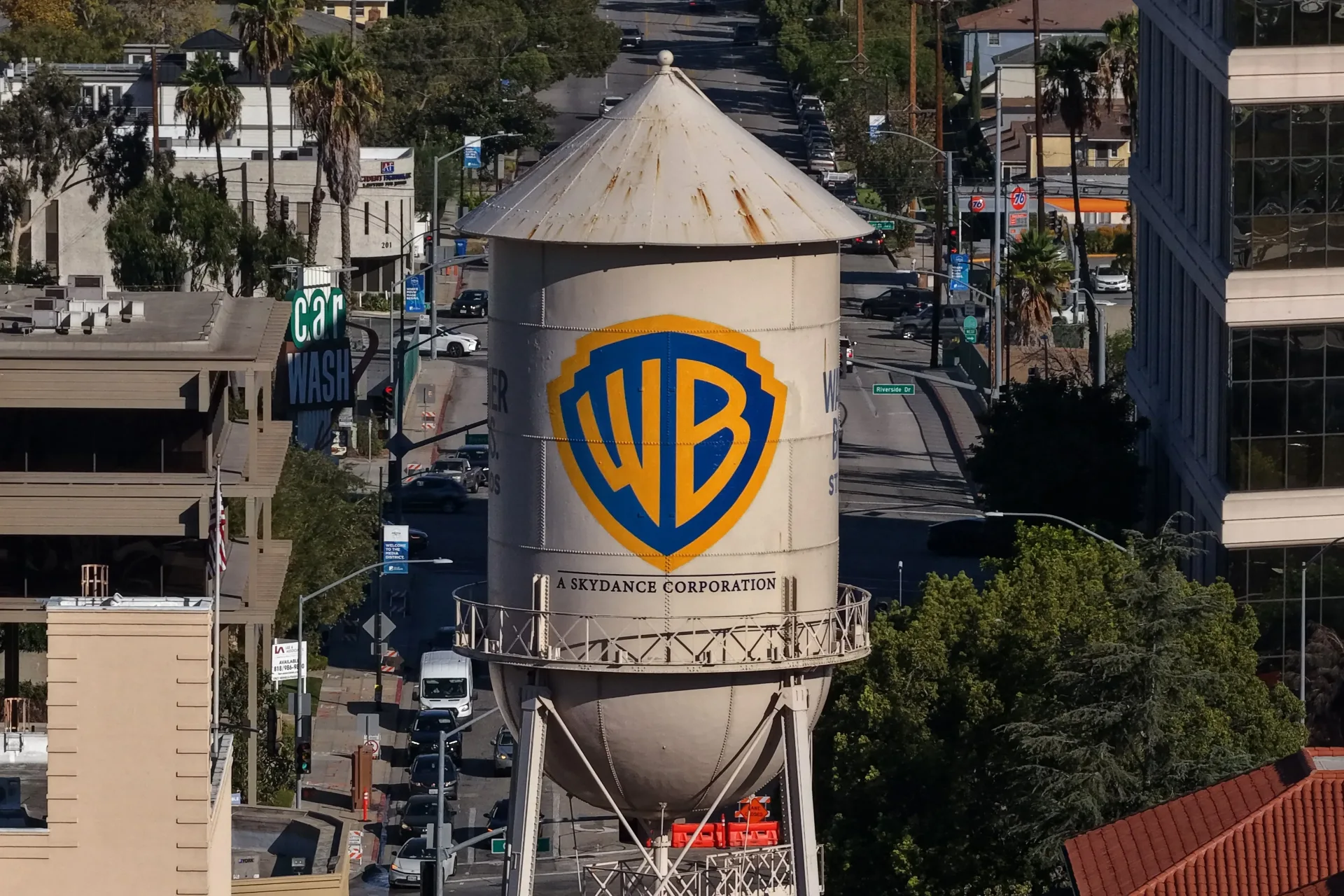
The Warner Bros. water tower in Burbank has received a notable new line of lettering: “A Skydance Corporation.” The change arrived Tuesday morning shortly after the $111 billion merger of Paramount and Warner Bros. Discovery officially closed, creating the company now known as Skydance.
It is a small physical alteration with outsized symbolic value. Studio landmarks are more than wayfinding signs for employees and visitors; they are enduring pieces of entertainment-industry iconography. Adding the Skydance name to the Warner Bros. tower makes the corporate shift visible at one of the best-known studio properties in Hollywood.
The wording also matters. Warner Bros. remains the name displayed most prominently, while the new line establishes its relationship to the newly formed parent company. Rather than erasing a major legacy studio name from a landmark overnight, the update presents Warner Bros. as part of Skydance’s larger corporate structure.
A familiar branding move at another studio lot
This is not the first time a tower associated with a major studio has acquired the same corporate identifier. Following Skydance Media’s takeover of Paramount Global in August 2025, the water tower at Paramount Pictures Studios in Hollywood was likewise updated with “A Skydance Corporation.”
With both the Paramount and Warner Bros. lots now using that language, the paired signs serve as a concise representation of the new company’s scale. Skydance was founded by David Ellison in 2006 as a film production firm. It now sits atop a combined operation that incorporates two major studios, an array of television networks and two major streaming services.
The timing of the Warner Bros. update suggests that the name was intended to be a central part of the post-merger identity, not merely a temporary label for a deal. The company has adopted Skydance as the name for the combined business, and the water-tower treatment visibly connects the familiar Warner Bros. brand to that new parent.
What is inside the combined company
The merger places a wide range of entertainment assets under the Skydance umbrella. The business includes the Paramount and Warner Bros. studios, television networks including CBS, CNN, Comedy Central, MTV and TNT, plus the Paramount+ and HBO Max streaming services.
That breadth explains why a water-tower repaint can draw attention well beyond a studio lot. The deal affects organizations whose programming, films and streaming libraries reach audiences across multiple parts of the entertainment business. It also unifies brands that have historically operated as separate companies and, in many cases, have distinct public identities.
Related coverage includes Warner Bros. Water Tower Adds Skydance Name After $111B Merger.
For viewers, the immediate practical effect of a corporate sign change is limited. A new line of lettering does not itself establish a new streaming plan, alter a television schedule or announce a specific film release. But it is an unmistakable indicator that a period of integration is underway. Integration is the process of combining the operations of businesses after a merger: leadership structures, internal teams, systems and strategies may all be reassessed as the new parent company determines how its parts will work together.
Skydance has said the new company will have nearly $70 billion in annual revenue. At the same time, it must address approximately $80 billion in net debt. Net debt is commonly used to describe debt obligations after accounting for cash on hand. In straightforward terms, revenue indicates the enormous amount of business flowing through the company each year, while net debt points to a substantial financial responsibility management must contend with as it combines the two organizations.
That dual reality is important context for the new branding. The combined company has considerable reach, but it also faces the demanding work of building a unified organization while managing its balance-sheet obligations.
Leadership and control
David Ellison is chairman and CEO of the new Skydance. Ynon Kreiz, formerly Mattel’s chief executive, is co-CEO. The two executives sent employees a memo Tuesday outlining their ambitions for the combined business while recognizing that joining Paramount and Warner Bros. will bring workforce changes.
“Integrating two companies will bring change, including difficult decisions that affect our workforce,” Ellison and Kreiz wrote. “We are committed to handling this process thoughtfully and respectfully.”
The message makes clear that the merger’s next phase will not be defined only by visible identity updates. Job cuts are expected as the operations of Paramount and Warner Bros. are integrated. Such cuts are among the most consequential aspects of a merger because they affect the people who make, market, distribute and support the company’s entertainment output. The executives’ acknowledgement does not specify the extent, timing or departments involved, but it does establish that workforce decisions are expected.
Ownership structure is another major feature of the new company. The Ellison family, supported by Larry Ellison, holds the largest equity stake in Skydance. The Ellisons and investment firm RedBird Capital Partners are the only holders of Paramount Class A common stock, giving them complete control of the combined company’s voting shares.
Voting shares are shares that carry the right to vote on key corporate matters, including the election of directors. The ownership arrangement means control over those votes is concentrated with the Ellisons and RedBird rather than dispersed among a broad group of Class A shareholders. For a newly combined media company, that concentrated control gives its leadership and principal backers a particularly direct role in determining corporate governance and long-term direction.
For additional deal context, Joking Joystick previously covered RedBird’s investment in the Paramount-Warner transaction.
A difficult path, and a public-facing signal
The merger was opposed by many actors, filmmakers and other industry professionals. That opposition forms part of the backdrop to Tuesday’s milestone: although the deal is now closed and the water tower has been repainted, the broader response to consolidation in the entertainment sector has not been uniformly positive.
At a town hall for workers from the former Paramount Skydance and Warner Bros. Discovery, livestreamed globally, Ellison and Kreiz addressed staff from Los Angeles. CNN anchor Anderson Cooper moderated a question-and-answer segment with the executives.
Ellison told employees that getting to the closing had not been easy, describing setbacks and difficult moments before saying the result was worth pursuing because of what the combined workforce can build. It was a message focused on the future of the unified company, delivered on a day when the new corporate identity was made literal on the Warner Bros. lot.
There is a contrast between the permanence implied by a landmark’s signage and the uncertainty that usually follows a merger. A tower can be repainted in hours; coordinating leadership, workers, channels, studios and streaming platforms is much more complicated. The “A Skydance Corporation” line therefore works as a declaration of ownership and intent, but it is not a roadmap for how every part of the combined company will operate.
Why the water tower matters
In entertainment, corporate branding often exists in abstract places: press releases, credits, investor documents, app interfaces and corporate websites. A studio water tower is different. It is a physical object, tied to a specific place and recognizable to people who may never read an investor filing or an employee memo.
For Warner Bros., retaining the studio name atop the new parent-company wording acknowledges the lasting public weight of that brand. For Skydance, the added wording ties its relatively newer corporate identity to one of the industry’s most recognizable landmarks. The Paramount tower had already made a similar statement; the Burbank update now reinforces that Skydance’s name is meant to span both sides of the newly combined enterprise.
What follows will matter more than the paint itself: how leadership handles debt, integration and anticipated job cuts; how individual brands are positioned; and how the company’s sprawling film, television and streaming operations are organized. Those decisions have not been spelled out by the tower’s new lettering. Still, the change provides a clear marker that the merger has moved from a proposed transaction to a new corporate reality.