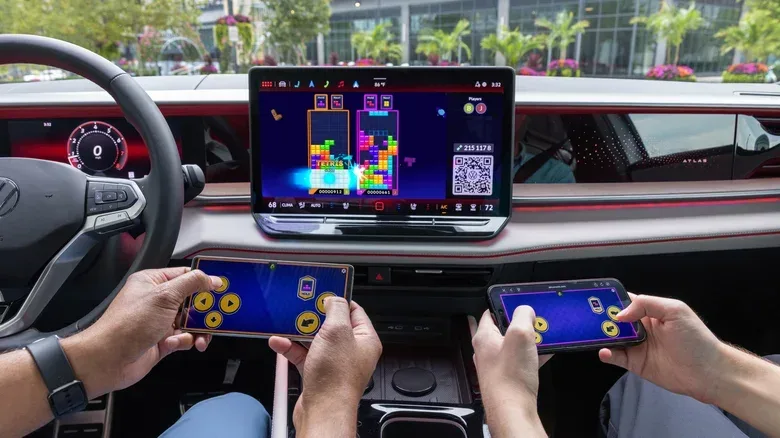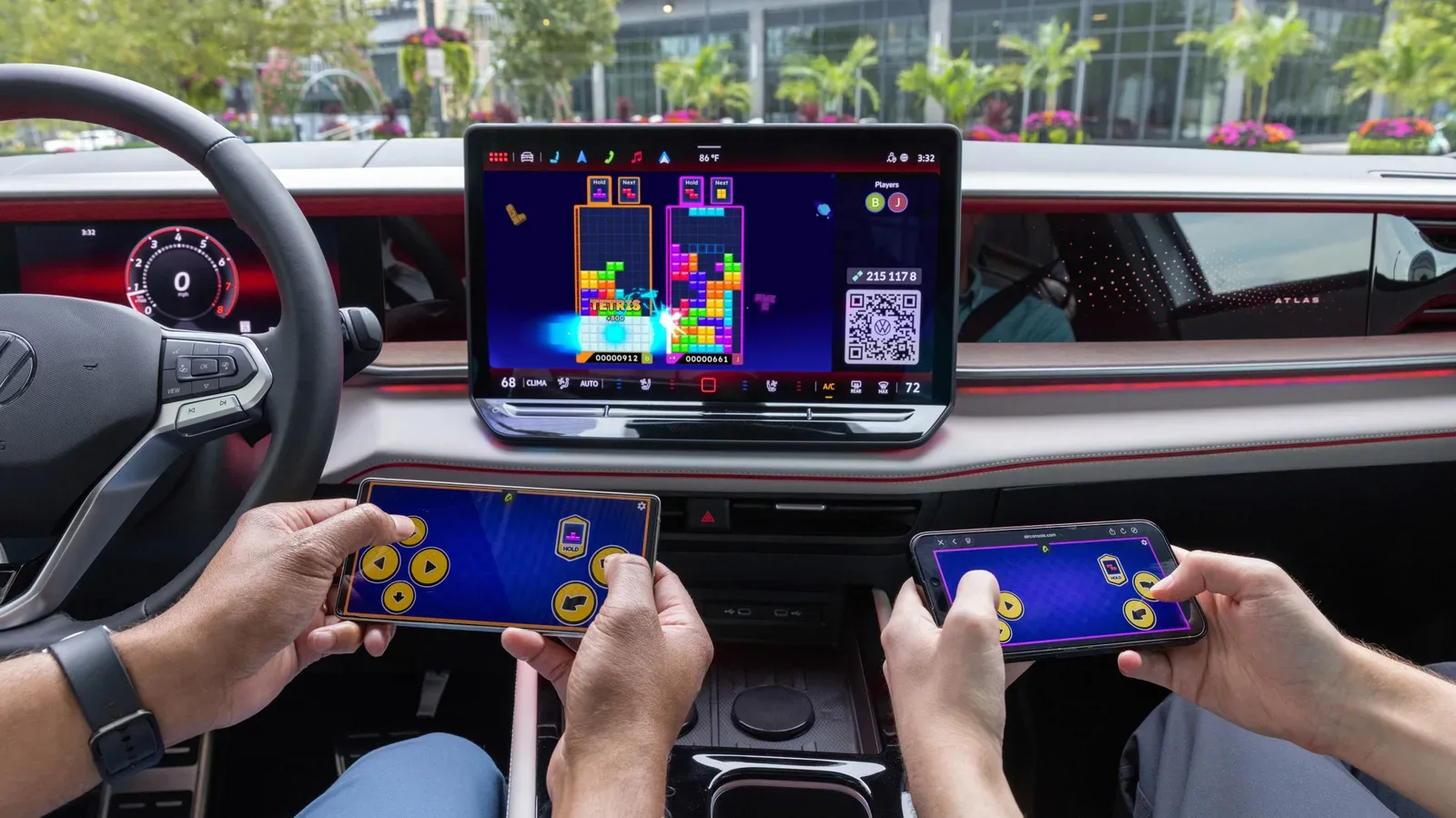
Volkswagen is making its infotainment screen a little more like a game console for the 2027 model year. Its in-car AirConsole offering will launch with 20 games, including Tetris, Pac-Man Championship Edition, and Uno Car Party, on a group of supported Volkswagen vehicles.
The basic pitch is delightfully straightforward: when the vehicle is parked, the central display runs the game and a phone serves as the controller. It is a neat fit for the reality of waiting in a car—whether that means killing time before a pickup, occupying passengers during a stop, or simply proving that a parking space can be a venue for one more attempt at clearing four lines at once.
There is a catch, naturally. The game library is tied to Volkswagen’s In-Vehicle Premium service. Most 2027 vehicles include three complimentary months, after which continued access costs $149 per year. That subscription also includes Wi-Fi hotspot support, exclusive navigation functions, and other connected features. In other words, Tetris may be the attention-grabber, but it sits inside a broader connected-car package rather than arriving as a one-time game purchase.
Which Volkswagen vehicles get AirConsole?
AirConsole is being integrated into the infotainment systems of the 2027 Atlas, Atlas Cross Sport, Tiguan, Golf GTI, Golf R, and ID vehicles. The platform is developed by N-Dream and will begin with 20 games.
That supported list matters more than the novelty of a game logo on a dashboard. This is not a claim that every Volkswagen on the road can suddenly become an arcade cabinet. The availability described here is specific to listed 2027 vehicles, and it is built into their infotainment setups.
The selection also spans several kinds of Volkswagen buyers. The Atlas and Atlas Cross Sport are likely to frame the feature as passenger entertainment, while GTI and Golf R owners may appreciate the sheer absurdity of having a score-chasing game waiting behind the same display used for driving information. ID vehicles, meanwhile, underline how closely software services and vehicle features are becoming entwined in newer cars.
A phone is the controller, not an optional accessory
AirConsole’s control scheme is central to how it works. Players first choose a game on the vehicle display, then use a smartphone wirelessly as the controller. There is no indication of conventional console controllers or other compatible peripherals at launch.
For solo play, that means a smart device is required. For multiplayer, it likely means several smart devices: each person needs something to hold and use. The exact number of devices that will be supported at launch has not been specified, so anyone imagining a full family tournament should treat player-count assumptions cautiously until Volkswagen or the platform clarifies them.
This approach has an obvious benefit: nearly everyone arriving at a car already has the necessary controller in a pocket. It avoids stocking a vehicle with extra hardware that can be misplaced, need charging, or roll into an impossibly inaccessible gap beneath a seat. It also means the infotainment display can remain the shared screen while players use their own devices for inputs.
There are practical limits, too. Multiplayer depends on passengers having phones available and ready to connect. A dead battery, a forgotten handset, or one person stubbornly using a device that does not cooperate could turn a quick round of Uno into an unexpected support session. None of that invalidates the concept; it simply makes this a phone-led party-game setup rather than a built-in console with dedicated controllers.
Parked means parked
The most important rule is also the least surprising one: the AirConsole game library is accessible only when the vehicle is parked. This is not a driving distraction feature dressed up as a technological triumph. The games are intended for stationary moments, and that limitation is essential.
In-car entertainment can sound frivolous until it is considered in its actual setting. Cars regularly become waiting rooms: outside a school, at a charging stop, before an appointment, or while one passenger is inside somewhere and another remains in the vehicle. A game library can make those stretches feel shorter without requiring another screen to be packed along.
It also creates a clear distinction between the game experience and the driving experience. The infotainment display already carries a lot of responsibility in a modern vehicle, from navigation to media and connected services. Restricting games to parked use preserves the idea that play is for downtime, not something competing with the road for attention.
Tetris is the obvious headliner
Tetris is a particularly natural choice for this kind of rollout. Its rules are easy to explain, its sessions can be short, and its core challenge works with simple controls. The enduring appeal is not mysterious: players rotate and place falling shapes to complete horizontal lines, and the pace steadily becomes less forgiving. It is instantly legible on a shared display, while still leaving plenty of room for a veteran to get intensely competitive about piece placement.
That simplicity is useful in a car context. A player does not need a long tutorial, an elaborate account setup, or hours of uninterrupted time to understand what is happening. You can open a game, chase a score, stop when it is time to leave, and resume ordinary life without having to remember a quest objective or a complicated control map.
Pac-Man Championship Edition adds a different flavor: it takes the recognizable maze-chase identity of Pac-Man and places it in the launch selection. Uno Car Party, meanwhile, signals an interest in shared, social play rather than only individual score attacks. With 20 games planned for the initial library, those named titles should be seen as examples of the offering rather than its full extent.
For readers interested in how game access has increasingly become a service layer around hardware, the shift has a distant parallel in the distribution ecosystem that helped define PC gaming; this look at the path toward Steam offers useful context for why a platform and its ongoing account or service relationship can matter as much as the device running it.
Pac-Man gets the Volkswagen treatment
Volkswagen is not limiting itself to placing established games on the screen unchanged. A custom Volkswagen version of Pac-Man swaps the familiar power pellets for Volkswagen logos and changes fruit pickups into cars.
That is branding at its most literal: the maze now has automotive corporate identity scattered across it. Some players will find the crossover amusing, especially because Pac-Man is so immediately recognizable that even a cosmetic rewrite is easy to spot. Others may prefer the original visual language, where the pellets and fruit are part of the game’s iconic silhouette rather than opportunities for automotive product placement.
Either reaction is fair. The relevant point is that Volkswagen is positioning this as a bespoke in-car entertainment feature, not merely a generic app portal. The company is using one of gaming’s most recognizable formats to make the interface feel specifically Volkswagen-shaped.
Ambient lighting could make the cabin part of the game
On certain vehicles, some games will also integrate with ambient lighting. Volkswagen says the cabin lighting can correspond to events occurring in the game. The precise games and vehicle configurations involved have not been detailed, so expectations should remain modest until those specifics are available.
Ambient lighting, in this context, means the interior’s decorative illumination responding alongside the on-screen action. It does not change gameplay mechanics or turn the car into a full-motion arcade attraction. It is a presentation feature: a way to extend the game’s color and energy beyond the display and into the cabin.
That may be especially effective for fast, readable games where visual changes are frequent and instantly understood. It could also be a small but meaningful way to distinguish an in-car game session from playing the same title on a phone alone. Still, it should be viewed as an enhancement rather than the reason to subscribe. The game catalog, the parked-only safety guardrail, and the phone-controller setup are the more consequential parts of the proposition.
The subscription question is part of the package
The economics are straightforward on paper. Eligible 2027 vehicles generally include three months of In-Vehicle Premium at no extra charge. Beyond that period, the service costs $149 annually. AirConsole access is one element of that service alongside hotspot capability, navigation features, and other connected experiences.
Potential buyers should therefore evaluate it as a bundle. Someone who values the Wi-Fi hotspot and navigation additions may see the games as a pleasant extra. Someone interested only in playing Tetris may calculate the value differently. The supplied information does not break out a separate games-only plan, so there is no basis to assume one will be available.
Volkswagen’s move is a compact example of where dashboard software is heading: cars are not merely gaining screens, but gaining software libraries, service tiers, device connectivity, and themed experiences around those screens. For 2027 Volkswagen owners of supported models, that trend includes a particularly familiar proposition. Park the car, connect a phone, and try not to make a terrible decision with the long bar.