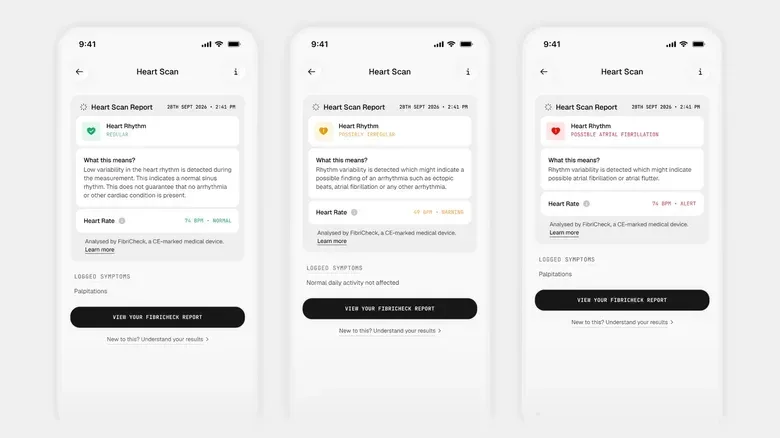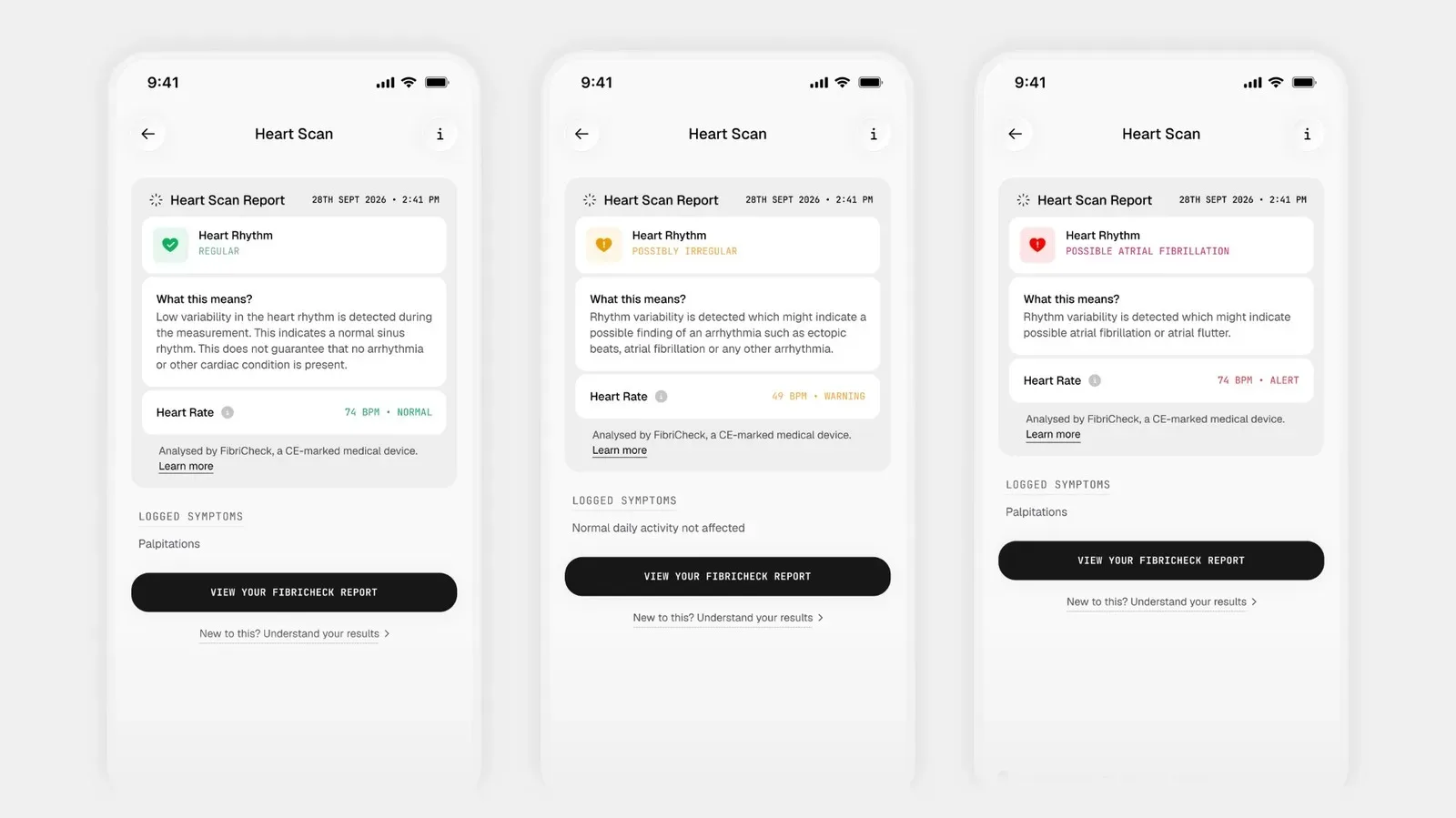
Ultrahuman is expanding the heart-focused tools available to Ring Air and Ring Pro owners with Heart Scan, an on-demand rhythm check developed through a partnership with FibriCheck. The new option is intended for moments when a user feels that something may be off and wants to make a dedicated recording rather than wait for the ring’s overnight monitoring.
The feature builds on Ultrahuman’s existing Atrial Fibrillation, or Afib, add-on. That add-on observes a person’s heart rhythm while they sleep; Heart Scan adds a user-initiated check that can be run from the Ultrahuman app during the day. The distinction matters: passive monitoring is designed to watch for patterns over time, while an on-demand scan is a focused snapshot begun by the user.
How Ultrahuman Heart Scan works
To begin a scan, an eligible Ring Air or Ring Pro owner opens the Ultrahuman app and starts the dedicated Heart Scan process. The user then needs to remain still for 60 seconds. FibriCheck’s technology uses a smartphone camera for an optical test, and its algorithm analyzes the data after the recording is made.
In this context, an optical test means the phone camera is being used to capture physiological information rather than a traditional clinical instrument being attached to the body. Ultrahuman has not detailed the full technical method in the information provided, so it is important not to assume capabilities beyond the stated camera-based assessment and algorithmic analysis.
Once processed, the result is compiled into a PDF. That document can be shared with a healthcare professional and is described as containing the recording of what occurred, rather than merely a condensed summary. For a person seeking professional input, that could make the export more useful than an isolated app notification: it gives the clinician material from the actual scan to consider.
What Afib means—and why an on-demand option is notable
Atrial fibrillation is commonly shortened to Afib. Ultrahuman’s existing paid add-on is specifically named for it and monitors heart rhythm during sleep. Heart Scan does not replace that overnight component; it extends the same general area of health tracking into a deliberate, daytime workflow.
That creates two separate situations in which the platform may be useful:
- Overnight observation: the existing Afib add-on watches heart rhythm while the user sleeps.
- A moment-of-concern check: Heart Scan can be started in the app if the user wants to check their rhythm at that time.
The new workflow is especially notable because symptoms and concerns do not necessarily arrive on a schedule. A wearable can collect information in the background, but a 60-second test requested at a particular moment offers a different kind of record. The practical value is not simply that there is another metric to look at; it is that the scan can be converted into a shareable file for a healthcare professional.
Availability and subscription details
Heart Scan is limited to unspecified supported markets across the UK, Europe, the Middle East and Asia-Pacific. Ultrahuman has not provided a complete country-by-country list here, so Ring Air and Ring Pro owners should not assume that regional availability automatically means the feature is enabled where they live.
For people already subscribing to Ultrahuman’s Afib Power Plug, Heart Scan is being included at no added cost. That is an important detail for current subscribers: the new on-demand capability is being folded into the existing add-on rather than launched as a separate payment tier.
The company’s setup also makes clear that the ring is part of a broader system rather than the sole component of the scan. The supported ring provides eligibility within Ultrahuman’s platform, the phone handles the camera-based test, FibriCheck supplies the analysis, and the Ultrahuman app is where the process begins. Owners considering the feature will need both their compatible ring and a suitable smartphone available when they want to run the test.
A record to discuss, not just another wellness score
Wearable-health features are often presented as dashboards, trends and headline scores. The notable element in this case is the PDF record designed for sharing. A trend can be useful for personal awareness, but a recording tied to a particular 60-second window gives a healthcare professional a more concrete item to review than a user’s recollection of an alert.
That does not mean every concern can be reduced to a one-minute capture. The supplied details describe one optical test and an algorithmic analysis; they do not establish that Heart Scan can account for every heart-health issue or substitute for professional care. Users should therefore treat the PDF as information to bring into a healthcare conversation, consistent with Ultrahuman’s stated sharing use case, rather than as a comprehensive answer on its own.
The emphasis on accessible smartphone testing also reflects a wider practical reality of connected health tools: hardware works best when it creates a usable path from a personal device to a meaningful follow-up. In this case, the path is straightforward—open the app, stay still for a minute, receive the analyzed result, and share the PDF if professional input is needed. That is less flashy than a constantly updating feed, but it may be the more consequential part of the feature.
People who use several connected devices may also be accustomed to the smartphone as the hub for accessories and health services. Juggling a wearable, app and camera-based assessment makes device compatibility and reliable app access important considerations, just as they are with other Android hardware such as the Samsung Galaxy S26 FE.
Why the added option could matter
The news arrives alongside a sobering real-world reminder of the unpredictability that can surround heart-rhythm events. A person in their 40s who had not previously experienced heart issues reportedly had atrial fibrillation while driving, lost consciousness and crashed while travelling to work with two colleagues. Everyone involved was safe, and the person later received a pacemaker.
One incident cannot establish what any particular device would or would not have detected, and no claim should be made that an on-demand phone test could have prevented it. But the account illustrates why some users may value an option to record a rhythm concern when it occurs, even if they have never thought of themselves as being at risk.
Ultrahuman’s Heart Scan is consequently best understood as an expansion in timing and documentation. Ring Air and Ring Pro users in supported markets can now make a 60-second, camera-based rhythm recording on demand through the app, have it analyzed through FibriCheck, and receive a PDF intended to be shareable with a healthcare professional. Existing Afib Power Plug subscribers get that additional option without an extra charge.