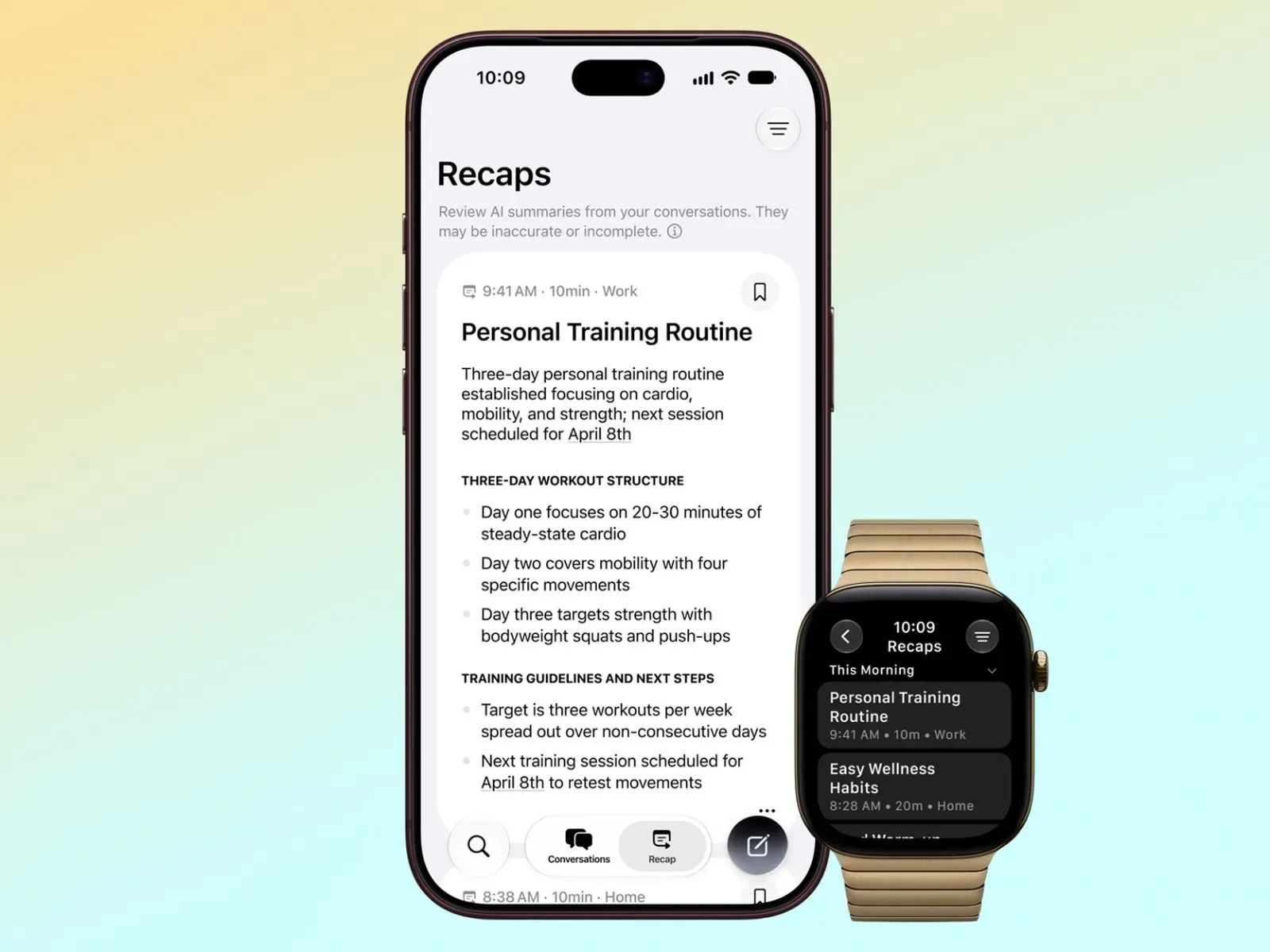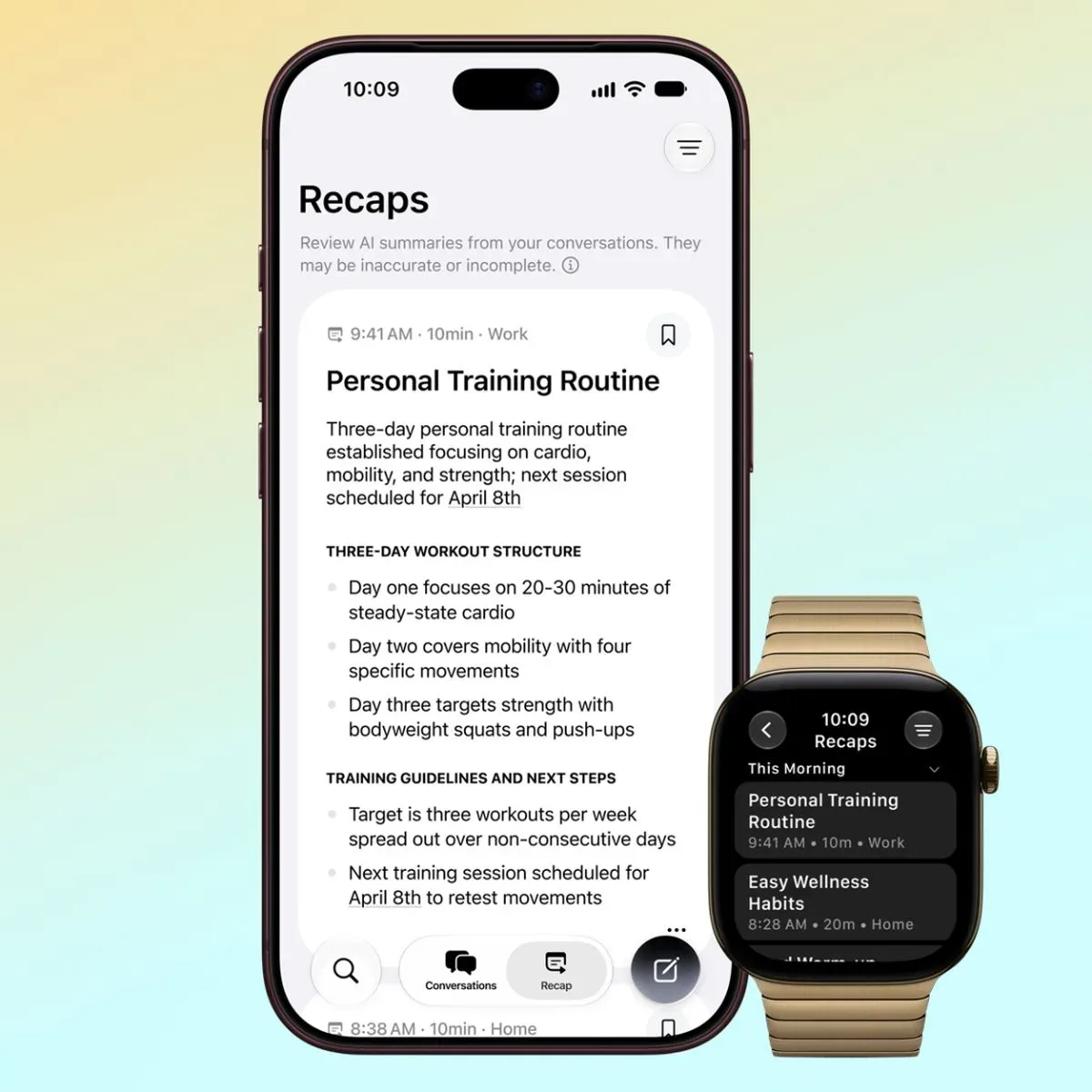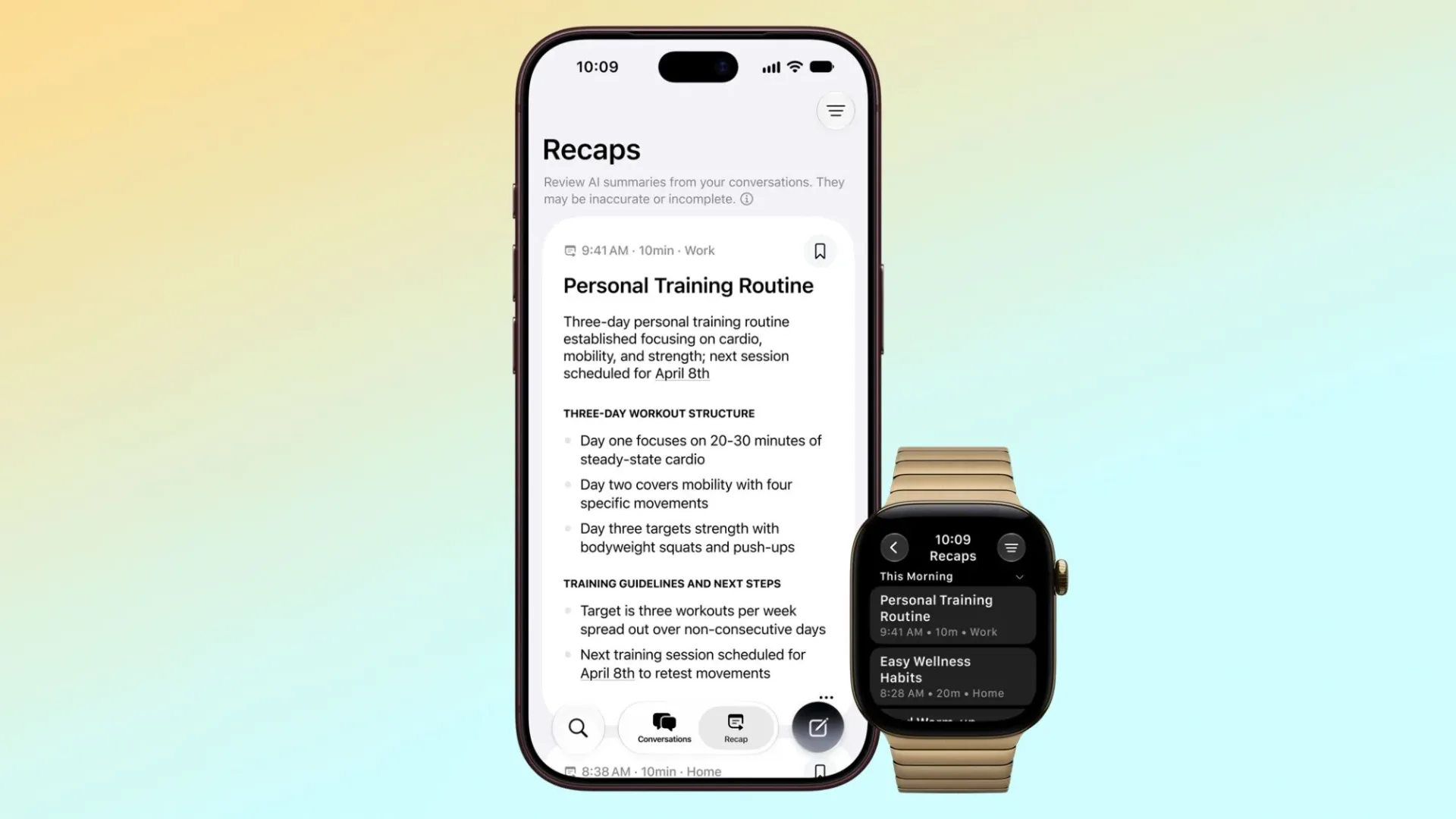
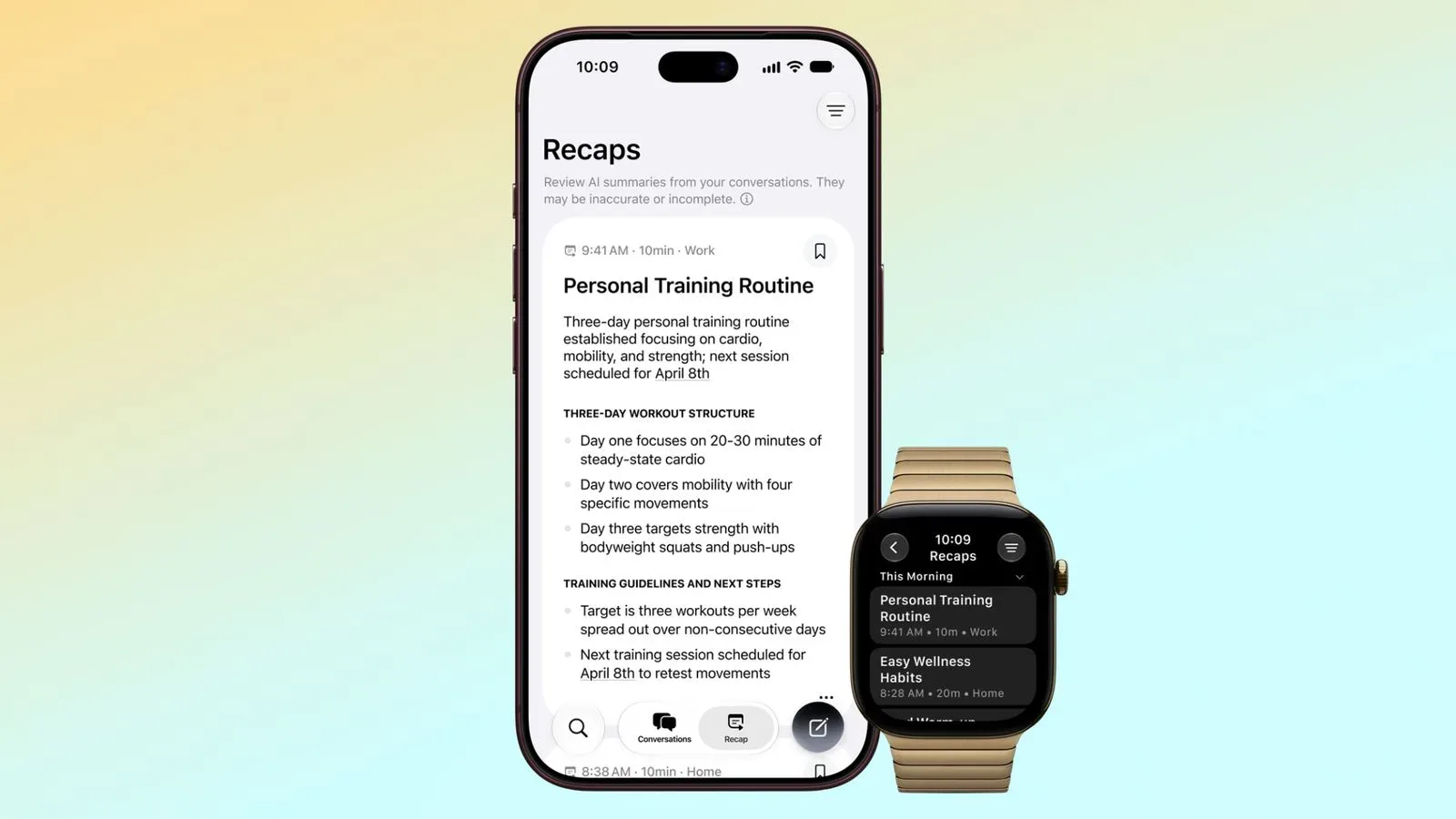
Apple is testing a new Apple Watch feature called Siri Recap in the watchOS 27.3 beta, and its pitch is immediately understandable: let the watch turn nearby conversation into a short written recap, then discard the underlying audio. On supported Apple Watch Series 12 and Apple Watch Ultra 4 models, the feature is meant to create a lightweight record without leaving a searchable trove of recordings behind.
That privacy-centered architecture is meaningful, but early testing suggests it produces a difficult trade-off. A summary can be useful only if it faithfully preserves who said what, which details belong together, and what context makes a statement meaningful. The beta's reported failures—summarizing media dialogue, blending separate subjects from one conversation, and omitting speaker labels—show why those requirements matter. A neat-looking note can become more harmful than no note if a wearer treats it as an accurate account.
What Siri Recap is designed to do
Siri Recap listens to conversations and produces brief summaries of what was discussed. The captured audio is isolated from apps, Apple and the rest of the operating system, then discarded once a summary has been generated. That design makes Siri Recap notably different from a conventional voice recorder: the intended lasting artifact is the AI-written text, not the source audio.
In practical terms, this is a privacy-forward approach to ambient note-taking. Keeping raw audio unavailable to apps and removing it afterward can reduce the amount of sensitive material retained on a device. It also limits an obvious risk of conversational archives: a recording can be replayed, copied, searched or heard out of context long after the original moment.
But there is an important consequence. When a recap is questionable, the wearer apparently has no original recording to check. The summary is not merely a shortcut to the primary material; it becomes the only surviving version of the conversation. That makes accurate attribution and contextual separation especially important.
A beta, not the finished feature
Siri Recap remains beta software within the watchOS 27.3 beta. It has not been released publicly, and watchOS 27.3 is expected in December. Some early shortcomings may change before launch, especially errors in how the system groups ideas. Still, the available behavior provides a useful look at the basic choices Apple is testing—and at the kinds of limitations that may follow from those choices.
It is also worth separating a summary error from an ordinary transcription error. A transcription system tries to preserve spoken words. A summarization system decides which words and ideas matter, condenses them, and may join details from across a longer exchange. That judgment step is convenient when it works, but it creates more ways to distort the record.
The beta can capture talk that is not for the wearer
One early issue is the apparent inability to distinguish every kind of nearby spoken material from a real-world conversation. Siri Recap reportedly recognized television shows and movies, but it summarized dialogue from YouTube videos and Instagram Reels. The system did not limit itself to exchanges involving the wearer, despite Siri being able to recognize the wearer's voice.
This is a major usability problem because a recap is supposed to reduce noise, not turn nearby speech into a diary entry. Video dialogue has none of the status of a personal discussion, yet it can be phrased in a way that resembles a direct conversation. If a watch turns a Reel into a recap, the resulting note is not simply irrelevant; it can make a user's timeline of what mattered that day less trustworthy.
There is also a social dimension. When Siri Recap is enabled, people around the wearer reportedly receive no indication that the watch is listening. Even with the claimed protections around audio access and deletion, a feature that listens to ambient conversation can feel intrusive to people who did not choose to use it. Privacy is not only about where data goes after collection. It is also about whether people understand that collection is occurring in the first place.
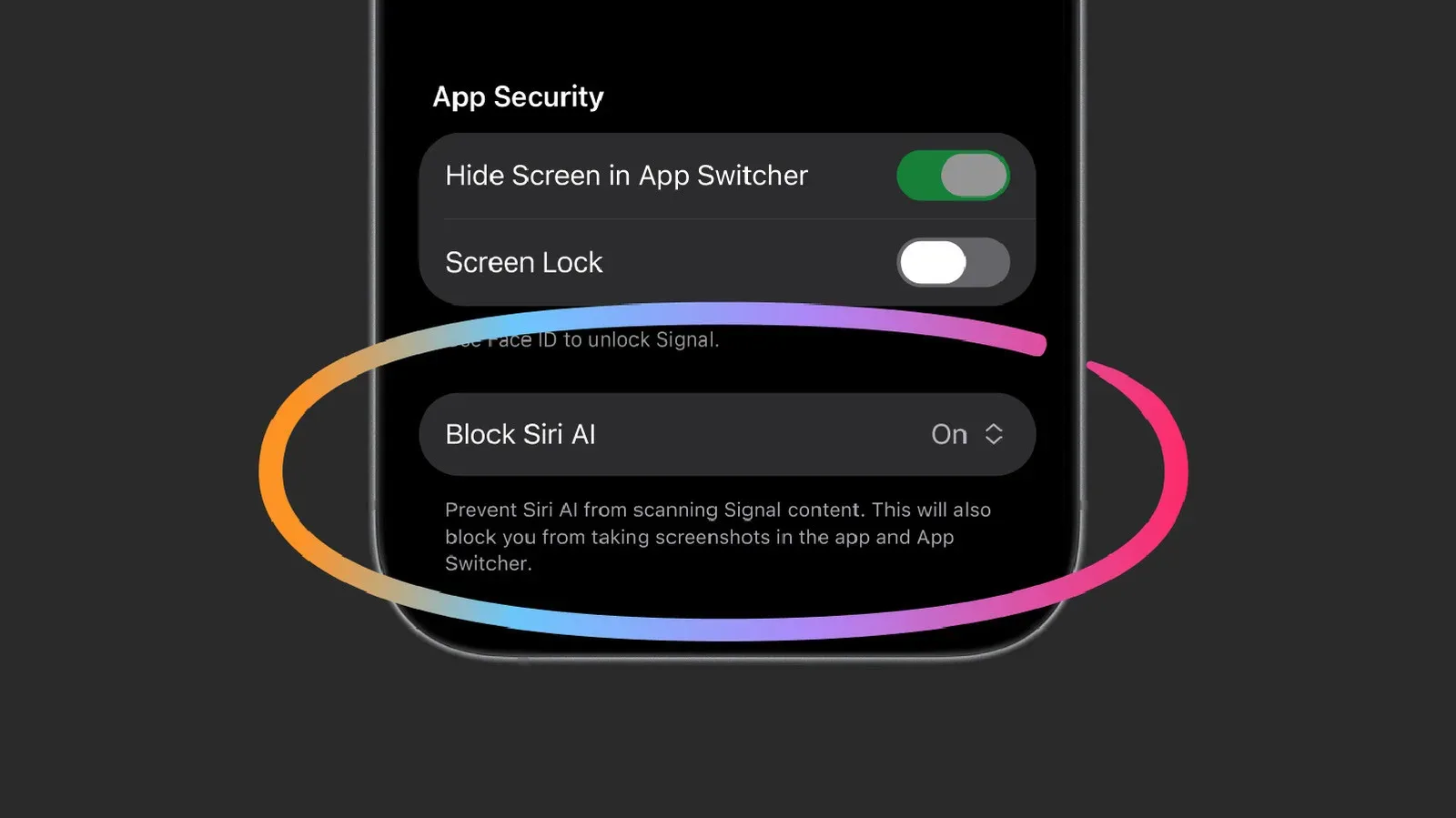
The distinction is especially relevant as personal AI features become more common. A system can minimize retention and still create discomfort if it invisibly converts a room's conversation into persistent text. The question is not just “Is the audio stored?” It is also “Whose words are being transformed into notes, and do they know?” Similar concerns sit behind efforts to keep AI tools away from sensitive conversations, including Signal’s screenshot-blocking move aimed at private chats.
Why speaker labels matter more than they sound
The more serious reported limitation is that Siri Recap does not identify speakers. Speaker labeling, sometimes called speaker attribution, means attaching statements to the person who made them: “the vet said,” “I asked,” or “a friend mentioned.” Without it, a summary can flatten a multi-person discussion into a single bundle of facts.
An early test involving a veterinary appointment illustrates the problem. Comments about a cat being selective about dry food, drinking plenty of water and gaining weight were combined into a recap that did not make sense. In another portion of the appointment, a request for heartworm medication advice led to a discussion about a veterinarian's own cat and a rabbit in that veterinarian's home. Because no speakers were labeled, the resulting recap implied that the wearer had a rabbit.
This is not a cosmetic problem. In a discussion involving medical, financial, work or family information, attribution often carries the central meaning. “I take this medication” and “my clinician warned me about this medication” contain similar words but entirely different information. A recap that cannot preserve that distinction is a poor fit for decisions that depend on accurate personal records.
The absence of labels is described as intentional, so it may not be a straightforward beta bug. That does not mean it can never be improved. The software might become better at phrasing a summary around the wearer’s own actions and questions, or at separating examples from instructions. But a deliberately unlabeled output has a built-in ceiling: it gives the system less ability to show its work.
Brief summaries can collapse separate context
Another reported pattern was the merging of concepts from different points in longer conversations. The vet appointment recap joined separate remarks about food, hydration, weight and prescription diet in a way that changed their relationship. This is a classic context problem for generative summaries: all the individual concepts may be present, yet the link between them may be invented or overstated by the compression process.
Context is the information that tells a reader why a statement was made and how it relates to the rest of the exchange. In a long conversation, two details can be minutes apart, refer to different people, or be offered as unrelated examples. A summary engine must decide whether they belong together. If it guesses wrong, the output can sound concise and coherent while no longer representing what happened.
That is why brevity itself is not automatically a virtue. A short recap that says “discussed pet health” may be too vague to be useful. A more detailed recap may become confidently wrong if it stitches separate details into a causal story. Siri Recap's early results suggest that Apple has not yet found a consistently dependable balance between those extremes.
The risk of treating an AI recap as memory
The testing also raises a subtler issue: what happens after someone rereads a flawed summary. In the veterinary example, revisiting Siri Recap's version later in the week reportedly made its details more prominent than other parts of the appointment and subtly altered the wearer's memory of it.
That concern does not require the recap to be wildly inaccurate. A misplaced rabbit detail or a merged statement can be enough to reshape how a conversation is recalled, particularly when the original audio is gone. The recap has an advantage over ordinary memory because it appears as a saved note on a personal device. Its written form may lend it more authority than it deserves.
For this reason, users should avoid treating a beta-generated recap as a definitive record for consequential conversations. It may be reasonable as a prompt to remember that a topic came up. It is much less suited to replacing notes made by the user, instructions supplied in writing, or a direct follow-up with the relevant person. That is a practical distinction, not a claim that every recap will fail: the issue is that the user may have no easy way to identify a failure afterward.
What would make the feature more dependable
The beta feedback points to several concrete areas where Siri Recap would need improvement to become more useful. First, it needs stronger boundaries around what counts as a conversation worth summarizing. Avoiding YouTube and Instagram dialogue would reduce obvious false captures.
Second, the feature needs to handle conversational structure better. It should keep separate topics separate and make clearer when a detail belongs to someone other than the wearer. Even if explicit speaker names are not part of Apple's intended design, a recap needs enough attribution to prevent a third party’s anecdote from becoming the user's personal fact.
Finally, users need to understand the feature's limits. The privacy model may be appealing precisely because it deletes audio, but deletion makes review impossible. That trade-off should lead to careful use, especially in appointments or discussions where a wrong summary could affect later choices.
Siri Recap has a clear ambition: offer a convenient memory aid without building an enduring library of private recordings. The early beta demonstrates why that is harder than merely listening and shortening. A recap must know what to ignore, preserve the boundaries between people and topics, and earn enough trust that its brevity helps rather than rewrites the past. Until it can do that reliably, the privacy benefits do not by themselves make its notes useful.