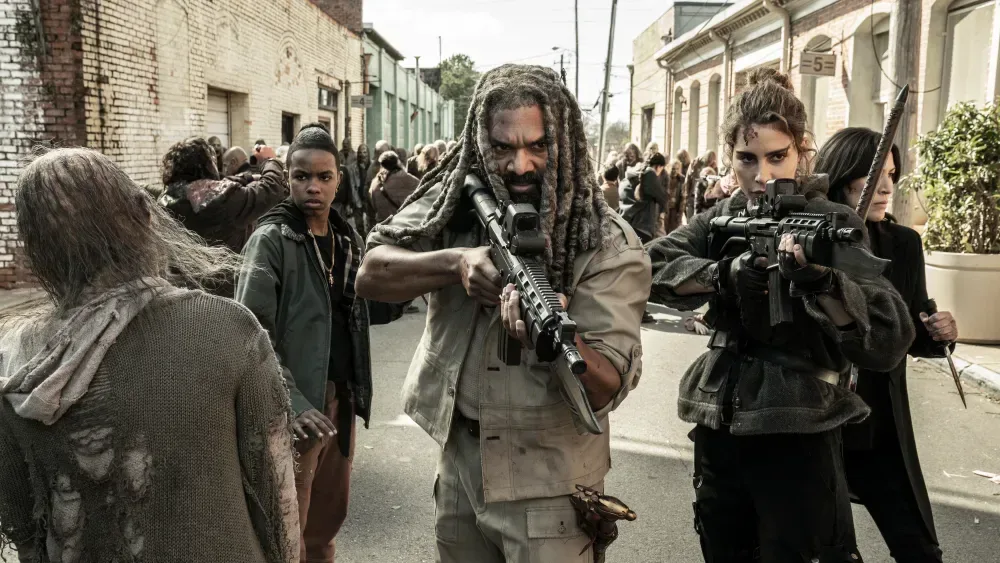
In a development with the timing of a season finale written by a lawyer who has watched far too much prestige television, AMC Networks and five producers of The Walking Dead have settled their remaining litigation for $120 million. The agreement ends a profits battle that began in 2017 and had been heading toward a federal trial in Los Angeles scheduled to start on October 27.
The producers covered by the settlement are Robert Kirkman, Gale Anne Hurd, David Alpert, Charles Eglee, and Glen Mazzara. Their dispute with AMC centered on the money generated by one of modern television’s biggest genre franchises: a universe that expanded from an apocalyptic survival drama into multiple spinoffs, a constant conversation starter, and a sizable piece of pop-culture machinery.
It is a television-business story rather than a game release story, but it matters to the broader gaming and fandom ecosystem. The Walking Dead has long crossed media boundaries, including its prominent role in narrative games. Its legacy remains part of a wider argument about how successful genre properties are built, licensed, extended, and paid for. The same question often follows a beloved franchise whether it is on cable, streaming, consoles, PC, or a collectibles shelf: when the property keeps growing, how is that success shared among the people who helped create it?
A $120 million resolution, with payments set through January 2027
AMC disclosed the settlement in a securities filing. The company expects to pay $85 million this month, followed by $35 million by January 31, 2027. It also said the agreement lowers its expected cash flow for the year from $220 million to $150 million.
Both sides released a joint statement describing the deal as an amicable resolution of all remaining claims and litigation connected to The Walking Dead television franchise. They also said they expect to participate in the franchise’s continued success in the years ahead.
That language is important because it signals that the settlement is not framed as an exit from the world of walkers. Instead, it draws a line under a major contractual conflict while leaving the commercial future of the franchise intact. For an entertainment brand that has endured through changing casts, locations, formats, and audience habits, settling a dispute this old removes one especially persistent undead hand from the doorframe.
How the dispute began in 2017
Kirkman, Hurd, Alpert, Eglee, and Mazzara first filed suit against AMC in 2017. Their central allegation was that AMC’s use of a definition for “modified adjusted gross receipts” deprived them of profits they believed they were contractually owed.
At the core was a familiar Hollywood accounting fight: a highly successful show can produce enormous value across broadcasts, licensing, spinoffs, distribution arrangements, and related businesses, while participants argue over the specific calculation used to determine the money that reaches them. The disputed term may sound less exciting than a katana rescue or a walker siege, but contractual definitions can become the most consequential plot device in the entire production.
The producers argued that the show and its offshoots had brought in billions for AMC, and that the company’s accounting approach was designed in a way that shortchanged them. Their claims echoed issues raised in earlier litigation involving The Walking Dead creator Frank Darabont and Creative Artists Agency, better known as CAA.
Profit-participation cases are rarely simple scoreboard exercises. They turn on individual agreements, language negotiated years before a series becomes a phenomenon, the relationship between related companies, and the way revenues and expenses are allocated. A franchise can be visibly huge to viewers and still create complex legal arguments over what counts as profit under a particular contract.
The 2022 ruling did not end the fight
The producers’ case appeared to hit a major obstacle in 2022. A judge ruled that they had not been improperly denied profits and that AMC had used a standard definition. On its face, that ruling seemed likely to close off the original path of the lawsuit.
But the wider Walking Dead litigation picture changed when AMC reached a $200 million settlement with Darabont and CAA. That deal created the basis for a new claim by the five producers.
The producers’ attorneys argued that the Darabont settlement should result in a payment to their clients through a “most favored nation” clause in their own agreements. In broad terms, such provisions can require comparable treatment when another participant receives more favorable terms under relevant circumstances. Whether a clause applies is intensely dependent on the language of the contracts and the facts around the other settlement, which is why this became the new legal battlefield rather than an automatic payout button.
AMC contested that position. The company characterized the producers’ suit as an attempt to obtain additional money and noted that they had already received $70 million under their agreement. The settlement now resolves the remaining conflict without a trial determining whose interpretation would prevail.
A 2024 court win set up the scheduled trial
The case regained momentum in 2024, when a federal judge declined to dismiss the producers’ complaint. That ruling did not decide the ultimate merits of the claim, but it allowed the dispute to continue toward trial.
Since then, AMC and the producers had been preparing to argue the matter before U.S. District Judge Fernando L. Aenlle-Rocha in Los Angeles. The trial date moved more than once, but it was most recently set for October 27. Friday’s settlement means the courtroom showdown will not happen.
A settlement before trial avoids the uncertainty, expense, and public airing of a lengthy proceeding. It also means there will be no trial verdict that serves as a clean, definitive public answer to every accounting and contract question raised during the dispute. Instead, the disclosed $120 million payment structure is the clearest public measure of the resolution.
For fans, the practical effect is less about a new episode or a surprise crossover and more about stability behind the scenes. Major rights and compensation litigation can hang over a franchise for years. Closing it can make the business surrounding future projects less burdened, even if it does not itself confirm any particular creative plans.
Why franchise accounting resonates beyond television
Genre entertainment is increasingly built around properties that live in several places at once. A story might start in comics, turn into a hit series, inspire licensed merchandise, reach games, and return through new screen spinoffs. That cross-platform cycle makes ownership, participation, and contract language unusually consequential.
The Walking Dead is a clear example of this wider franchise pattern. Its television incarnation became a cultural fixture, while games helped demonstrate how its harsh moral choices and survival setting could work in an interactive format. Those versions do not turn a television compensation dispute into a video-game case, of course. But they show why the financial life of an established property can be much larger and more complicated than one show’s initial run.
That expansion is also why fans often follow industry stories even when no controller is involved. The people behind favorite worlds, the agreements that govern long-running brands, and the money that supports future iterations are all part of the infrastructure beneath entertainment fandom. For another example of how established properties stretch beyond their original audiences and formats, see Sega’s discussion of Sonic, Persona, and Yakuza reaching beyond controllers.
A separate Fear the Walking Dead case remains pending
Not every legal issue tied to the broader franchise has been wrapped up by this agreement. Dave Erickson, a showrunner on the spinoff Fear the Walking Dead, filed a similar lawsuit last year.
AMC has sought to move Erickson’s claim into arbitration, and that matter remains pending. Arbitration is a private dispute-resolution process that can be required by contract, rather than a public court trial. Its status means the newly announced settlement should not be read as automatically deciding Erickson’s separate case.
Still, the $120 million deal marks the end of an exceptionally long chapter involving five central figures from the television franchise. Nine years after the original suit began, a trial has been avoided, AMC has outlined when it expects to make the payments, and the parties have said they intend to share in the franchise’s continued success. In a universe famous for refusing to stay buried, the business dispute has finally reached a settlement-shaped stopping point.