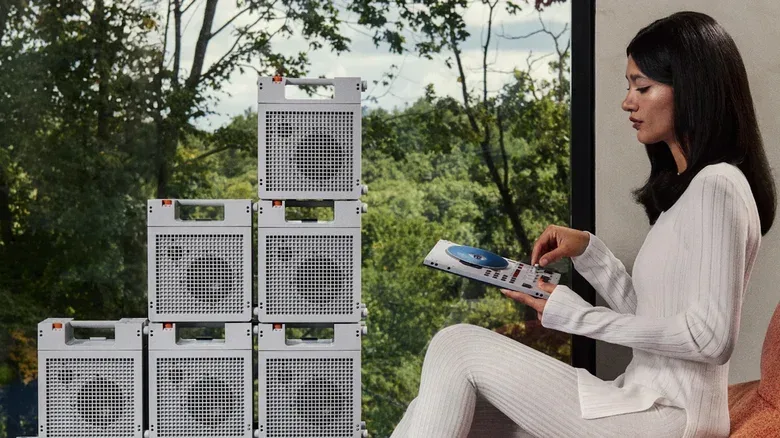
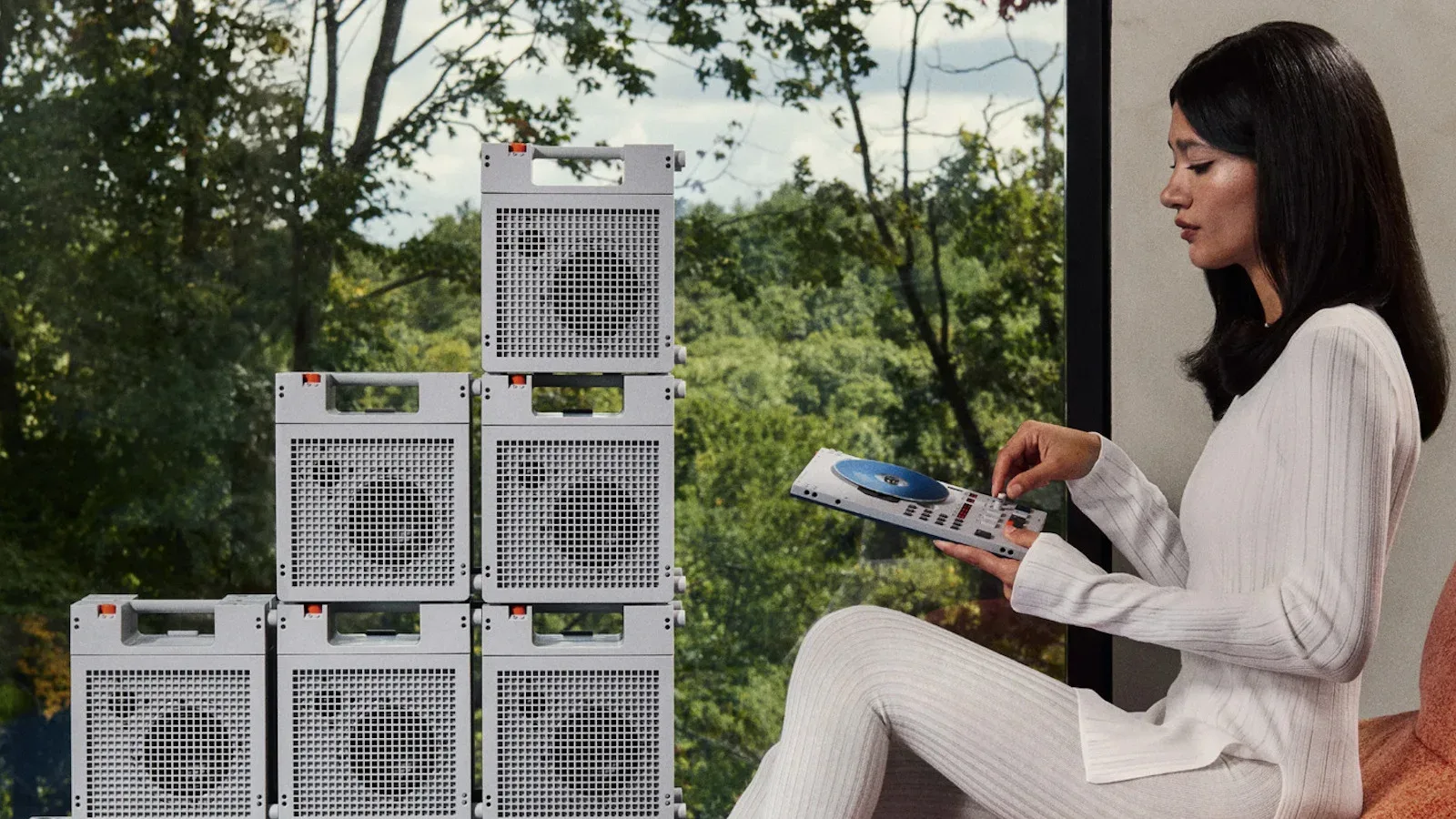
Teenage Engineering has introduced its first CD player, the EP/BC-1, and it is plainly not interested in blending into the stack of anonymous black audio boxes. Priced at $329, the portable player presents the compact disc out in the open, spinning on top of a form that reads more like a miniature turntable than a conventional CD deck.
That visual decision is not merely decorative. The EP/BC-1’s exposed disc makes playback visibly mechanical in a way that is increasingly rare: music is not just selected from a screen, but physically rotating in front of the listener. Teenage Engineering has paired that display-minded design with a row of red LEDs for left- and right-channel volume, plus a separate readout for timecode and track-related information.
Its feature set goes well beyond simple portable listening. The EP/BC-1 includes a varispeed dial for changing playback speed, beat detection that can provide tempo in sync, the ability to rip audio CDs to digital files, Bluetooth and Auracast streaming, USB-C charging and a headphone jack. Clips also let it connect with recent Teenage Engineering gear including the EP-35 portable speaker and K.O. II groove machines.
A CD player built to be watched
Most CD players were designed around a straightforward premise: put the disc safely inside, hit play, and let the music happen with as little visual drama as possible. The EP/BC-1 takes the opposite approach. Its disc is a visible moving part, giving an older digital music format some of the performative appeal normally associated with a record player.
The turntable resemblance does not mean the device is presenting CDs as vinyl. A compact disc is read optically rather than by a stylus tracing grooves. But the styling gives the format a more deliberate physical identity, while the LED meters and time information make the player look equipped for monitoring rather than just background listening.
For people who still buy, borrow or maintain a library of audio CDs, that distinction may matter. The EP/BC-1 is positioned as a device that lets a disc remain the centerpiece of the experience while also translating it into formats and connections that fit a modern setup.
What varispeed and beat detection mean here
The EP/BC-1’s most notable functional addition is its varispeed dial. Varispeed refers to varying playback speed: turning it one way can make a track play faster, while turning it the other can slow it down. That is unlike ordinary CD playback, which is generally expected to run at the track’s fixed, standard speed.
The practical use is most obvious for DJs. If two songs are playing at different tempos, adjusting one track’s playback speed can help bring their beats into alignment before a transition. This process is commonly called beatmatching. The player’s beat-detection feature is intended to assist by identifying tempo and outputting tempo information in sync.
Those functions do not automatically turn every CD into an effortless DJ set. A tempo display is information, while a clean transition still depends on the person operating the equipment and on the music involved. Still, the inclusion of speed control and beat detection establishes that the EP/BC-1 is meant to be more than a nostalgic disc spinner. It gives CD-based music a place in a workflow where timing, monitoring and transitions matter.
It is also a distinctive fit alongside Teenage Engineering’s K.O. II groove machines. The supplied details confirm that the EP/BC-1 can physically connect to them using clips, though they do not spell out every possible routing or performance workflow. What is clear is the company is treating the new player as part of a broader hardware ecosystem rather than a standalone novelty.
From disc to file, and from player to listeners
The device can rip audio CDs to digital files. In plain terms, ripping creates a digital copy of music from a disc, enabling playback without keeping that specific CD in the player. That makes the EP/BC-1 a bridge between a physical collection and file-based listening, although the available information does not specify the file formats, storage destination or transfer process.
Wireless output is handled through Bluetooth and Auracast. Bluetooth is the familiar short-range wireless connection used by many headphones and speakers. Auracast is a broadcast-oriented audio capability that can send sound to compatible receivers, making it relevant to a product introduced under the name Broadcast Series. Compatibility details, including which listening devices can receive that signal, have not been provided.
USB-C charging reinforces the player’s portable intent, while the headphone jack keeps a direct, private listening option on the device. This mixture of physical media, digital copying, wireless broadcasting and wired headphones is the core of the EP/BC-1’s appeal: it does not ask the CD to stay in a time capsule.
The first product in the Broadcast Series
Teenage Engineering calls the EP/BC-1 the first product in a new range named the Broadcast Series. No further products in that lineup have been detailed, so the label currently says more about direction than it does about a complete product family.
Even so, the name makes sense for a player with an exposed disc, level meters, track data, variable speed and Auracast support. These are features that emphasize presentation and shared output as much as individual listening. The EP/BC-1 seems designed for a desk, a small music setup or a performance-adjacent environment where the act of playing a CD is part of what people see.
That approach arrives at a moment when game music is often discussed in terms of massive playlists and station counts, such as the reported nearly 750 songs across 20 radio stations in GTA 6. The EP/BC-1 is a different proposition: it makes one chosen album or disc tangible, adjustable and visible. Neither model replaces the other, but they reflect two very different ways of engaging with music.
A premium proposition with carefully defined facts
At $329, the EP/BC-1 is not being framed as a bargain-bin way to revive an old CD wallet. Its price and design place the focus on the complete object: a portable player with a conspicuous visual identity, performance-minded playback controls and contemporary connectivity.
Potential buyers should also separate confirmed specifications from unanswered questions. The announced details establish the price, exposed-disc design, LED channel display, timecode and track information, clips for specified Teenage Engineering products, varispeed, beat detection, CD ripping, Bluetooth, Auracast, USB-C charging and headphone output. They do not establish audio codec support, battery duration, detailed recording settings, storage capacity, durability considerations around the exposed disc, or the full extent of its connections with other devices.
Those omissions do not diminish the confirmed concept; they simply define what cannot yet be assumed. The EP/BC-1’s clearest identity is already easy to read. It is a CD player that treats compact discs as active, visible music media, while adding tools that make sense for digital libraries, wireless listening and tempo-conscious playback.
For Teenage Engineering, the result is an unusual opening statement for the Broadcast Series: a familiar format reworked into something closer to a compact audio instrument. The CD is still the source, but the player is designed to make the source feel like an event.