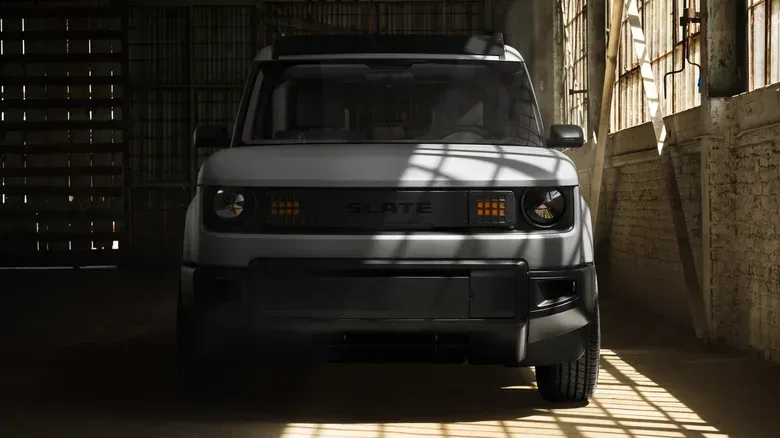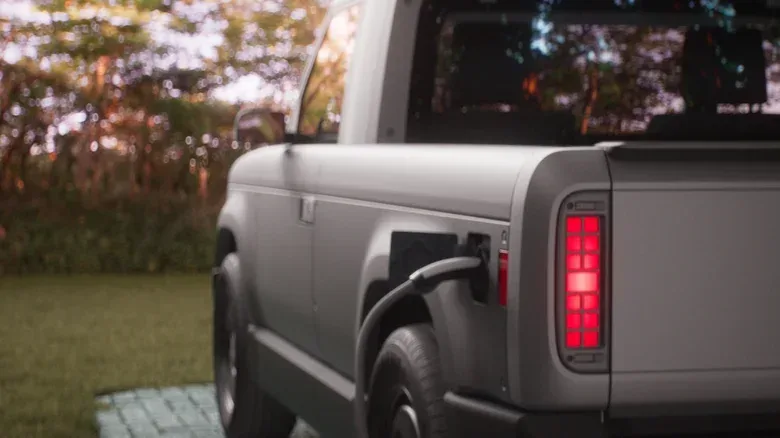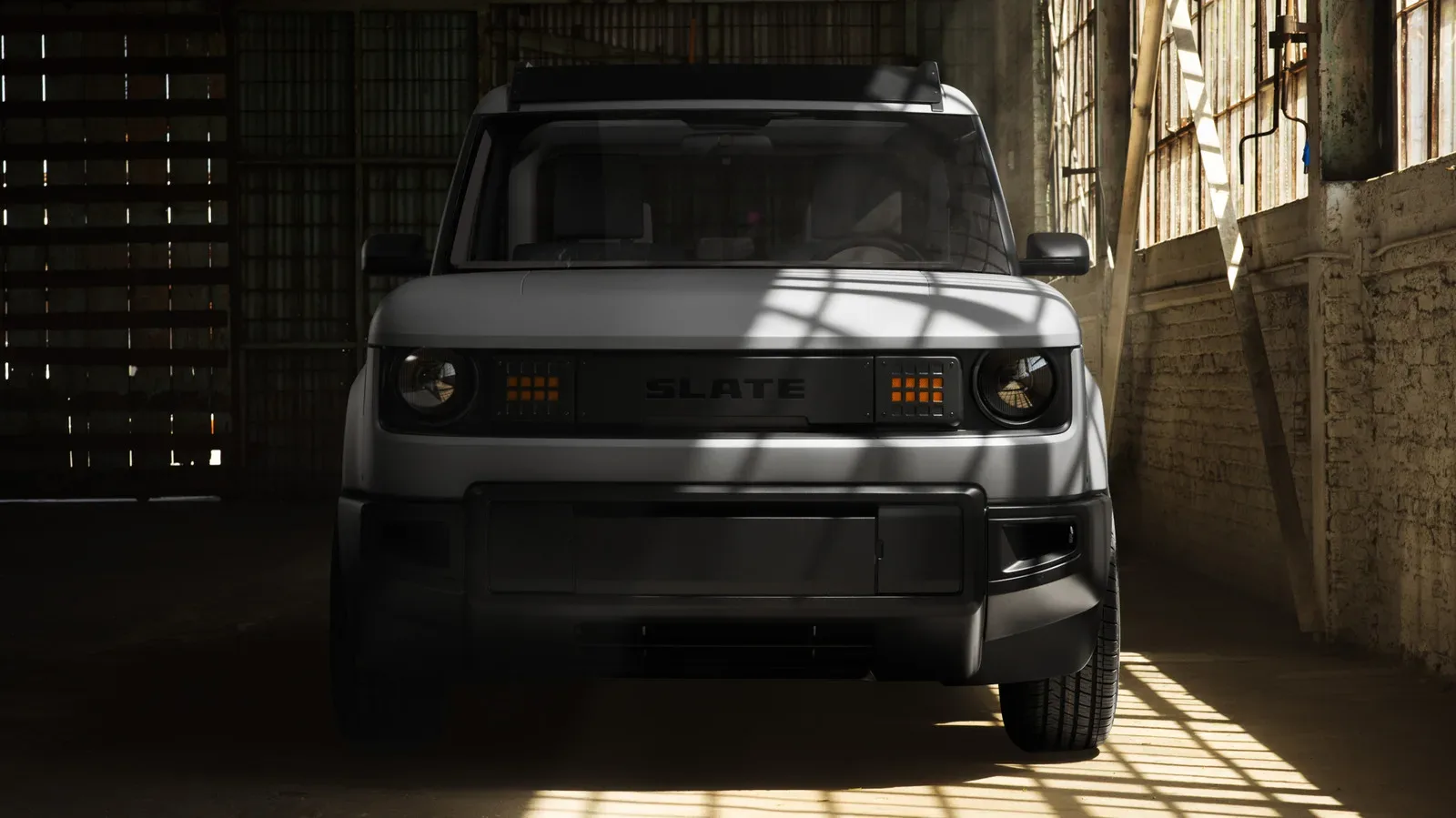
Slate’s electric pickup is now built around one battery choice rather than two: a 65kWh lithium-iron-phosphate, or LFP, pack supplied by Gotion and manufactured in Manteno, Illinois. The truck is projected to travel 205 miles on a charge under an EPA test-cycle estimate, though that figure is not yet a final EPA range rating.
The decision replaces the battery plan presented when the stripped-back truck debuted in April 2025. At that point, the proposed entry model used a 52.7kWh nickel-manganese-cobalt battery, commonly shortened to NMC, from SK On for an estimated 150 miles. A larger 84.3kWh option was intended to supply roughly 240 miles. That larger-range version is no longer part of the plan.
For prospective buyers, the simplest answer to “what battery does the Slate Truck use?” is now: a 65kWh LFP battery pack with prismatic cells, made in Illinois. But the change matters beyond a chemistry label. It affects the truck’s projected range, output, packaging, charging habits and the strategy behind its advertised $24,950 starting price, before a $1,450 destination fee.
One battery, one range target, fewer purchase decisions
Slate’s original arrangement asked buyers to choose between a lower-capacity, 150-mile-estimate truck and a larger battery aimed at 240 miles. The revised approach consolidates those choices into one pack and one projected driving range: 205 miles.
That does not mean battery chemistry alone created the 55-mile increase over the old base model. The new pack is larger at 65kWh, compared with the prior 52.7kWh proposal. Slate has also made aerodynamic and thermal changes. kWh, or kilowatt-hours, measures battery energy capacity: broadly, it describes how much energy the battery can hold, not a guarantee of how far the vehicle will drive in every situation.
Range estimates are influenced by much more than capacity. Aerodynamics affect the energy needed to move through air, while thermal systems manage battery and vehicle temperatures. Slate’s 205-mile number should therefore be understood as a company projection based on an EPA test cycle, rather than a finalized regulatory rating. Real-world mileage can differ with conditions and usage, and the supplied information does not establish a final EPA figure.
There is a practical upside to standardization. A buyer no longer has to decide whether a longer-range configuration is worth a higher upfront cost, because the former extended-range configuration has been eliminated. Slate gets a more straightforward product lineup, and every truck uses the same fundamental battery format.
What LFP means—and why it suits a cost-focused truck
LFP stands for lithium iron phosphate. In simple terms, it identifies the material family used in the battery’s cathode. The competing NMC chemistry uses nickel, manganese and cobalt in that part of the cell.
The immediate business case is cost. Iron and phosphate allow LFP packs to avoid the nickel, manganese and cobalt used by NMC. Slate is aiming to retain its stated entry price, and a less expensive battery chemistry is particularly meaningful in a vehicle designed around minimizing costs and complexity.
LFP also has a charging-related advantage for a vehicle with a projected 205-mile range. This type of battery can generally better tolerate frequent charging to 100%. That does not rewrite the truck’s range, but it can be convenient for owners who want to begin a regular drive with the full projected distance available rather than routinely leaving a larger buffer at the top of the pack.
The trade-off is energy density. Energy density means how much energy can be stored for a given physical size or weight. NMC can store more energy in that same space than LFP. This is central to why Slate’s former 240-mile battery option has disappeared: the 65kWh LFP pack already occupies the available battery space beneath the truck. Adding substantially more LFP capacity would require more room than the vehicle has, while another chemistry could potentially carry more energy in the same footprint.
So the LFP switch is not a blanket claim that one battery type is superior. It is a design choice with a clear set of priorities: lower material cost, available supply, local pack manufacturing and a single middle-ground range target. The price for those priorities is that the previously proposed 240-mile version is gone.
Prismatic cells help Slate use the space it has
The newly described pack uses prismatic cells. These are box-shaped battery cells that can be stacked directly into the battery pack. Slate’s previous SK On concept used separate modules, which are groups of cells packaged together before they are integrated into the larger pack.
Directly arranging prismatic cells in the pack makes more efficient use of the constrained space under the truck. That packaging change is important because LFP’s lower energy density creates pressure to use every available inch efficiently. It is part of the broader explanation for how Slate arrived at a 65kWh LFP pack and a 205-mile projected range rather than simply retaining the old 52.7kWh configuration.
The new supply arrangement could reduce logistics costs as well. Gotion’s Manteno, Illinois production is roughly 90 miles from Slate’s factory in Warsaw, Indiana. The originally planned SK On module supply in Commerce, Georgia, was about 710 miles away. A shorter route does not answer every manufacturing challenge, but fewer miles between battery production and vehicle assembly can support the company’s emphasis on keeping costs controlled.
The tax-credit calculation changed
Battery sourcing was initially tied to federal clean-vehicle tax-credit requirements. Eligible buyers could have received up to $7,500, but qualification depended in part on where battery components and critical minerals came from. A U.S.-made NMC setup was a more natural fit for those requirements than an LFP supply chain heavily concentrated in China.
That specific incentive question changed when the federal credit ended for vehicles acquired after September 30, 2025. Once the credit was no longer available for those acquisitions, Slate had one less reason to structure the truck around the relevant sourcing rules.
Supply capacity had been another obstacle. A supplier considered earlier could not provide the capacity Slate required and could not meet tax-credit restrictions involving battery materials associated with certain China-linked entities. Gotion’s ability to produce the pack in Illinois changes the practical equation: Slate can use LFP while sourcing its pack much nearer to its Indiana assembly location.
There is a larger manufacturing lesson here, even outside electric vehicles. A product specification is not fixed solely by what looks best on a launch slide. It has to align with supplier capacity, component geography, policy conditions, production costs and the physical room inside the finished product. Game-industry readers have seen similarly messy realities in broader production decisions, from studio ownership questions to scheduling pressures; the reported uncertainty around studio sales is a reminder that the business structure behind a product can be as consequential as the public-facing plan.
Range improves, but power declines modestly
Slate’s change also affects output. The current truck is rated at 181 horsepower, down from the originally announced 201 horsepower. The stated reason is the lower voltage of the LFP system. Voltage is a key part of how an electric powertrain delivers energy; here, the chemistry and system design trade some peak output for the pack’s other advantages.
Even with that reduction, Slate says the truck can reach 60 mph from a standstill in eight seconds. That claim should be treated as Slate’s stated performance target rather than independent test data. The supplied details do not provide additional acceleration testing, towing information, charging-speed figures or a vehicle weight, so those points remain outside what can be firmly concluded.
For buyers, the critical comparison is not merely 181 versus 201 horsepower. It is the combined proposition: 205 projected miles, one battery configuration, an advertised $24,950 starting price before destination, and a battery-and-powertrain warranty lasting 10 years or 110,000 miles. Whether that balance works depends on an owner’s driving needs, especially since there is no longer a 240-mile alternative within Slate’s announced battery plan.
What remains unclear
Slate has not publicly explained what happened to the previously announced battery deal with SK On. The available information also does not provide a final EPA range rating, charging times, battery weight or a detailed comparison of performance in different climates. Those omissions matter because battery capacity and chemistry give only part of the ownership picture.
What is clear is the direction of travel. Slate has moved away from a two-tier NMC proposal to a single, locally manufactured LFP pack. It gains a projected 205-mile range over the former 150-mile base estimate while retaining its advertised starting price, but it gives up the planned 240-mile version and some announced horsepower in the process.
That makes the Slate Truck’s battery story less about chasing the largest number and more about choosing a workable compromise. The company is putting its weight behind a 65kWh LFP pack that fits under the truck, can be built nearby, and is intended to support a low-cost electric pickup. The final EPA label will determine how that 205-mile projection stands up as an official number, but the underlying hardware decision is already defined.