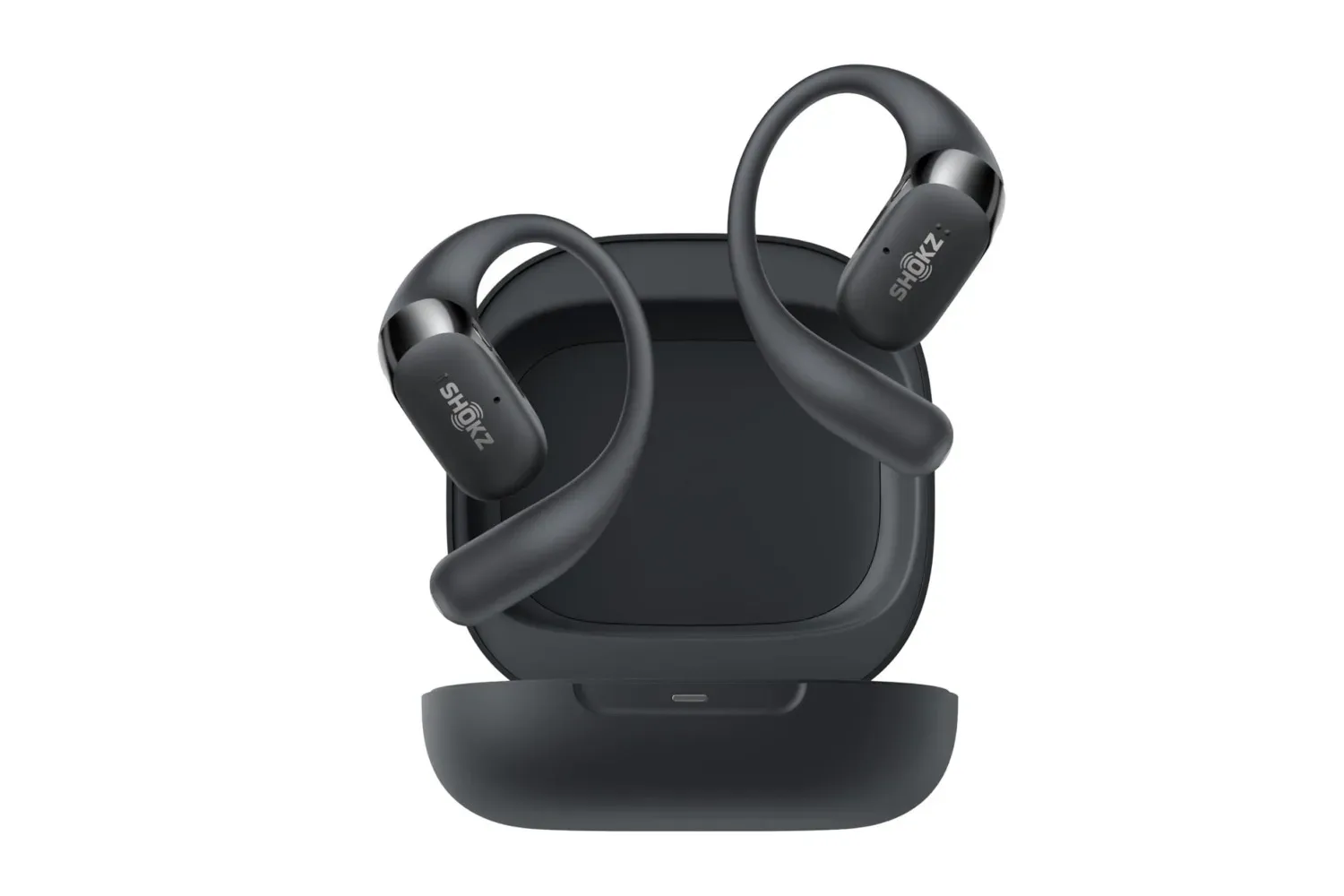
The Shokz OpenFit 2 open-ear earbuds are listed at $140, a $40 reduction from their stated $180 regular price. That works out to roughly 22% off. The listing also includes shipping and offers a free protective cover for the charging case, described as a $30 item, while stock lasts.
The main appeal is not simply the lower price. OpenFit 2 is built around an open-ear fit: rather than sealing earbuds inside the ear canal, the buds rest around the ear and leave the canal unobstructed. That is a meaningful difference for players who want background audio from a game, music or voice chat without shutting out the room entirely.
For people who use earbuds beyond a desk, the design could also be useful on walks, commutes and workouts, where hearing traffic, announcements or nearby conversation can matter. The trade-off is inherent to this category: an open-ear product prioritizes situational awareness over the isolated, sealed-in listening experience associated with traditional in-ear buds.
What the $140 listing includes
The discounted price is for the Shokz OpenFit 2 earbuds and charging case. The protective-cover promotion is separate from the price cut and requires an extra step on the retailer’s product page. Buyers need to use the available Claim free item option, add the earbuds to the cart through the resulting window, then add the case cover at no additional cost.
That distinction is worth making because the cover will not necessarily appear automatically. It is also a stock-dependent offer, as is the discounted listing. A sale page can change before checkout, so the cart is the practical place to verify both the $140 price and whether the free accessory has been applied.
- Listed earbud price: $140
- Stated regular price: $180
- Price difference: $40
- Stated discount: 22%
- Bonus offer: a free protective cover for the charging case, described as a $30 value, when claimed through the product page
- Shipping: included with the listing
Open-ear listening explained
Open-ear earbuds are not just standard earbuds with a different hook. Their central purpose is to deliver audio while preserving awareness of the environment. In practical terms, that may suit someone waiting for a doorbell, sharing a home office, keeping an ear open for family, or playing a more relaxed game while remaining engaged with the space around them.
For gaming, that can be a deliberate setup choice. A player may prefer a closed headset when they need to focus on a competitive match, block distractions or hear every small positional detail. But that same isolation can be inconvenient during a casual mobile session, a lengthy grind, or gaming between other tasks. Open-ear buds offer another option: game audio remains available without creating the sensation that the rest of the world has been muted.
They may make particular sense for phone players whose gaming time happens in short sessions rather than a dedicated headset-only setup. Device shape and portability also affect those habits, as explored in this look at how clamshell and book-style foldables fit a gaming day. Earbuds that can stay comfortable while the player moves between calls, music and games are aiming at that same flexible-use scenario.
Related coverage includes Shokz OpenFit 2 Open-Ear Earbuds Drop to $140 With a Free Case Cover Offer.
There is an important expectation to set, however. Awareness does not mean outside noise disappears; it means more of it remains audible. Similarly, it does not make an open-ear product automatically safer in every circumstance. Users still need to pay attention to their surroundings and keep volume at a sensible level.
Comfort hardware and fit
Shokz says the OpenFit 2 uses a nickel-titanium, or Ni-Ti, alloy in its ear-conforming structure. Nickel-titanium is a flexible alloy, and its stated role here is to help the buds contour to the wearer’s ears. Combined with the lightweight design, the intended benefit is a fit suitable for extended listening without the pressure that some people associate with buds placed inside the ear canal.
Fit remains personal, especially with an ear-hook-oriented open design. Ear size, glasses, hats, hair and movement during exercise can all influence how any pair feels. The supplied information supports the product’s comfort-focused design goal, but it does not establish that the fit will be equally comfortable for every listener. Buyers should treat the material and lightness claims as features intended to help long-session wear, rather than a guarantee of universal comfort.
For gamers, comfort can be more consequential than it first appears. A pair of earbuds may sound good but still be a poor match for long RPG sessions, remote-play stretches, podcast-heavy games or all-day desk use if it causes ear fatigue. Conversely, listeners who want a sealed fit or a more cocooned experience may find the defining benefit of the OpenFit 2 less compelling.
Audio design: detail, bass and leakage control
The OpenFit 2 uses separate high- and low-frequency audio units. In plain language, the high-frequency component is intended to preserve detail in higher-pitched sounds, while the low-frequency component is intended to provide deeper bass. That matters for material with a wide range of sound, from music to game effects and dialogue, though the information available does not provide measured audio results or comparisons with competing earbuds.
The product also uses Shokz’s DirectPitch 2.0 technology, which is intended to direct sound toward the listener’s ears and reduce sound leakage. Sound leakage is audio that escapes from the earbuds and can be heard by people nearby. It is a particular consideration for open-ear designs because they do not rely on a physical seal in the ear canal.
Reduced leakage is not identical to zero leakage. If someone needs maximum privacy in a quiet shared room, at a library or beside a sleeping person, a more isolating audio product may still be the better fit. The useful claim here is narrower: the OpenFit 2 is designed to limit leakage while retaining the open-ear form factor, rather than abandoning awareness in pursuit of isolation.
Battery figures and quick charging
Shokz rates the OpenFit 2 for up to 11 hours from the earbuds on one charge. With the charging case included, the stated total rises to up to 48 hours. The case therefore functions as a portable reserve of power, letting users recharge the earbuds between sessions without immediately searching for a wall outlet.
A 10-minute charge is stated to provide up to two additional hours of listening. That is the kind of specification that may be useful when a player realizes shortly before a commute, workout or session that the earbuds are nearly empty. It does not replace a full recharge, but it can reduce the disruption from a missed overnight charge.
As with most battery figures, the word up to matters. The supplied ratings identify the maximum stated listening time, not a promise that every use pattern will reach those numbers. Volume, audio content, connection behavior and other conditions can affect real-world endurance. Still, the stated 11-hour single-charge figure gives the product a long-session focus, while the 48-hour case total suggests fewer full-case charging cycles during routine use.
What IP55 water resistance means
The OpenFit 2 carries an IP55 water-resistance rating. An IP rating is a standardized shorthand for protection against ingress, meaning dust and water reaching the product’s internals. The first 5 indicates dust protection, while the second 5 indicates resistance to water jets. In the context supplied for these earbuds, the practical takeaway is that sweat from exercise should not be a problem.
Water resistance should not be confused with waterproofing. The rating supports use around sweat and exposure consistent with the stated protection level; it does not make the earbuds an all-purpose underwater or submersion-ready product. Keeping that distinction clear is especially important for gear meant to move from gaming to workouts and outdoor use.
Who should consider the deal
The OpenFit 2 listing is most relevant to listeners who specifically want open-ear comfort and awareness, rather than shoppers seeking the greatest possible isolation. Its stated combination of a flexible Ni-Ti fit structure, up-to-11-hour earbud battery life, up-to-48-hour total battery life, quick-charge support and IP55 resistance gives it a broad everyday-use pitch.
For gaming use, it is better viewed as a companion for casual sessions, mobile play, background listening and multitasking than as a substitute for every dedicated gaming headset. The very feature that helps a player hear what is happening around them also means it is aimed at a different listening experience from a sealed headset.
At $140 instead of $180, the price cut is straightforward. The potential extra value comes from remembering to claim the free case cover before purchase. Since both the discounted listing and the accessory promotion are described as limited by availability, buyers should confirm the price and bonus item at checkout rather than assume either will remain in place.
Shop the products
Check current price, model and availability at the retailer.