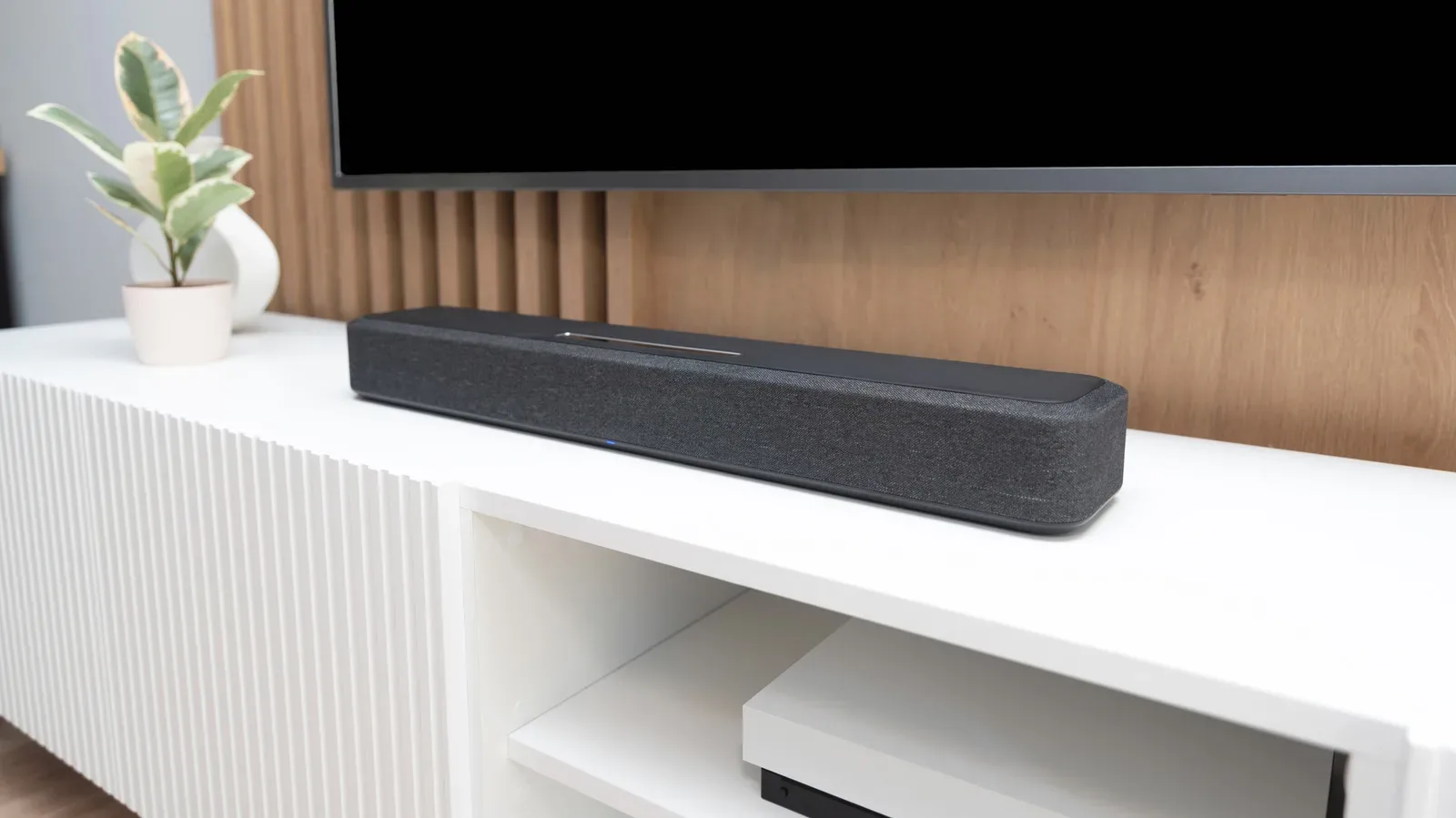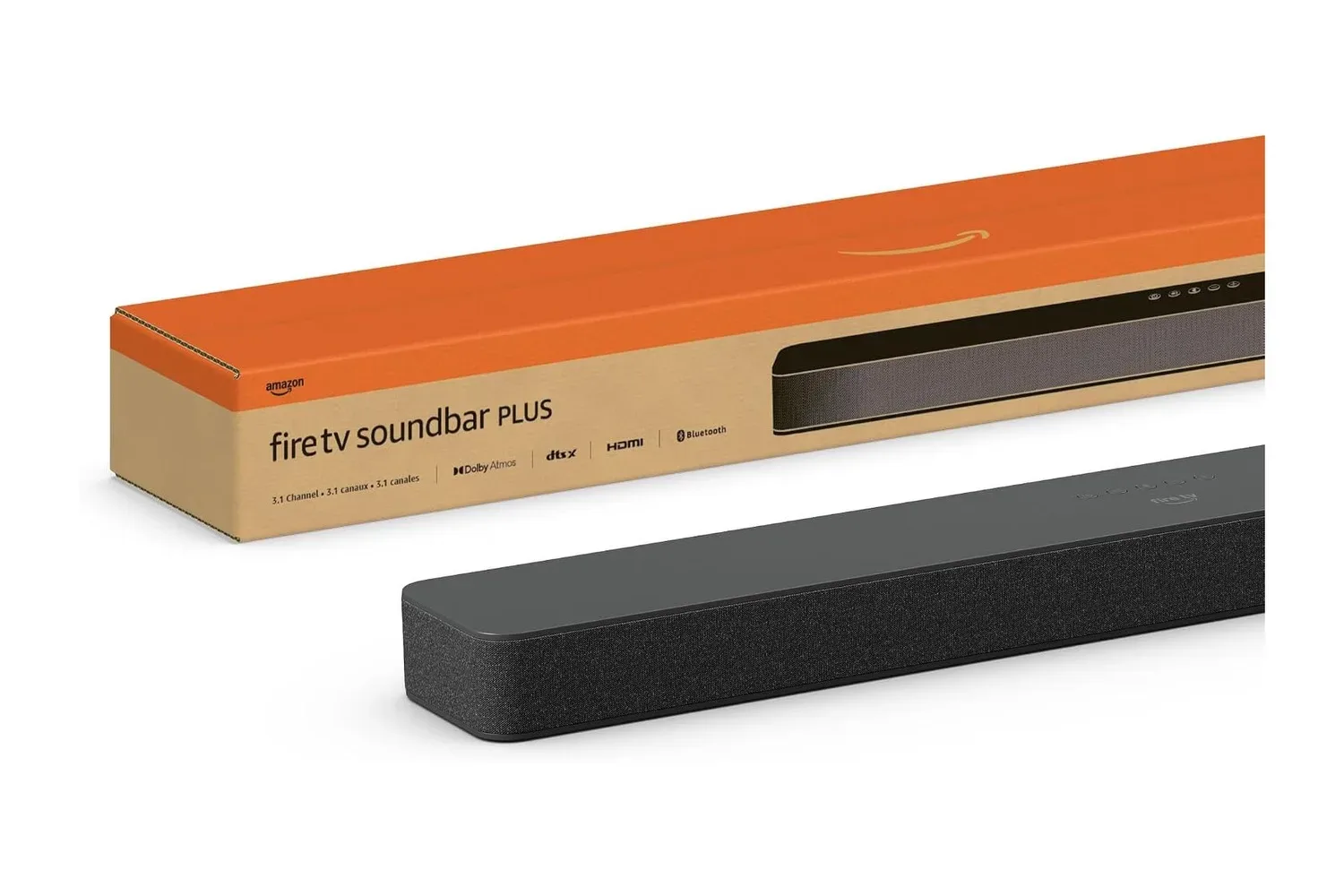
Amazon’s Fire TV Soundbar Plus is listed at $190, a $60 reduction from its stated $250 regular price. The 24% discount puts the focus on a compact audio upgrade for people who want clearer television and game sound without beginning with a separate receiver, multiple speakers and a more involved home-theater installation.
The 37-inch bar uses a 3.1-channel design with eight drivers: three full-range speakers, three tweeters and two woofers. Its stated feature set includes Dolby Atmos and DTS:X support, HDMI eARC and optical connectivity, Bluetooth streaming, USB-A playback, four sound modes, adjustable bass and treble, and processing intended to make dialogue easier to understand.
For a living-room console setup, that mixture is potentially more important than simply making everything louder. Game mixes can shift quickly between quiet spoken objectives, music, menus and effects. Television speakers can leave voices competing with those sounds, particularly at modest volume. A dedicated center channel and dialogue settings address that particular problem directly.
What 3.1 channels mean in this soundbar
The numbers in a 3.1-channel configuration describe the sound layout. The first number refers to three main channels—left, center and right—while the “.1” identifies bass handling. Here, Amazon places the bass drivers inside the soundbar rather than requiring a separate external subwoofer.
The practical distinction is the center channel. In a properly mixed film, show or game, a center channel is commonly where much of the on-screen speech is directed. The Fire TV Soundbar Plus includes a dedicated center speaker intended to hold voices in place even when music and action become busier. That makes the product’s Dialogue Enhancer feature a logical companion rather than an unrelated software extra.
The two integrated woofers are designed to extend low-frequency response for more impact than a television’s built-in speakers can generally offer. It is important, though, to distinguish an internal bass solution from a claim that the bar replaces every larger system. The supplied details say the soundbar can be expanded with a wireless subwoofer and rear surround speakers, so buyers who later want a broader system have a stated upgrade path.
That flexibility may appeal to players who begin with a TV stand setup and do not want additional boxes immediately. It also avoids making an external subwoofer a prerequisite for the initial installation.
Dolby Atmos and DTS:X: immersion depends on the rest of the chain
Dolby Atmos and DTS:X are spatial-audio formats intended to create a more dimensional sound field in compatible movies, shows and games. The Fire TV Soundbar Plus supports both. In straightforward terms, they can carry audio information beyond conventional left-and-right playback, helping a compatible setup convey movement and placement more convincingly.
Support alone should not be read as a guarantee that every title will produce the same result. The content itself must use a compatible format, and the television, connected device and audio connection all matter. The product information specifically identifies HDMI eARC or ARC as the route for synchronized TV audio with the included HDMI cable. eARC stands for enhanced Audio Return Channel; ARC is the older version of the same basic TV-to-soundbar connection concept. Both reduce cabling by allowing audio to travel from the TV to the soundbar over HDMI.
That matters when a console, streaming device or other hardware connects to the television first. Rather than building a complicated arrangement around the soundbar, users can send the TV’s audio back through the compatible HDMI connection. Optical is also available as an alternative connection, although the listed information does not make any specific format-performance comparison between optical and HDMI.
For readers weighing broader console purchases alongside an audio upgrade, our look at four Xbox Series X drawbacks to consider before buying in 2026 covers a separate set of ownership considerations. The soundbar question is more narrowly about improving what players hear from the equipment they already use.
Dialogue tools may be the standout everyday feature
Flashier audio labels draw attention, but the Fire TV Soundbar Plus’s most useful features for many households may be its voice-focused controls. DTS TruVolume is designed to automatically moderate sudden volume changes, such as shifts into commercials or louder parts of a program. That is a convenience feature rather than a replacement for individual volume preferences, but it targets a familiar annoyance.
The Dialogue Enhancer offers five levels of voice amplification. That gives users a choice instead of treating dialogue clarity as an all-or-nothing switch. Someone having trouble with softly delivered lines, unfamiliar accents or speech masked by a score can raise the effect, while another viewer can leave it lower if it changes the balance more than they prefer.
It is also worth separating this function from subtitles and closed captions. A dialogue enhancer attempts to make the audible speech more prominent; captions present text. The former can make casual viewing more comfortable, while the latter remains useful for accessibility, noisy environments or moments where text is preferred. The soundbar may reduce the need to strain for certain scenes, but it does not turn clearer sound into a substitute for captions where viewers need them.
Modes and adjustments for different rooms and routines
Amazon includes four preset modes: Movie, Music, Sports and Night. Presets generally provide quick starting points for different material rather than proving that one setting is universally best. The helpful part here is that they sit alongside separate bass and treble controls with nine levels each.
That gives users two ways to tune playback. A preset can quickly change the overall character for a film, live event or music session. Bass and treble adjustments then offer more granular correction. If voices feel overly subdued, the dialogue control and treble setting are relevant places to start. If action scenes lack weight, bass adjustment is the more direct control. These settings are not a promise that any room’s acoustics can be fully corrected, but they offer useful control without adding components.
Night mode is especially relevant for shared homes. Its purpose is to keep conversation intelligible while listening at a lower volume. For late game sessions or evening television, that can be more valuable than pursuing maximum bass output. A soundbar’s best setting is often the one that lets people hear the information they need without forcing the entire room—or neighboring rooms—to hear every explosion at the same level.
Connection options and Fire TV integration
The simplest listed setup is one HDMI connection between a compatible TV and the bar. The included cable works with televisions that support eARC or ARC, and settings can be adjusted with a Fire TV remote. That remote integration could be meaningful for Fire TV households because it reduces the need to swap controllers just to change sound settings.
Not every television offers the required HDMI audio-return feature, which is why the optical input is useful as a fallback. Buyers should check their TV’s ports before assuming the one-cable HDMI arrangement will apply. The supplied information establishes that both HDMI eARC and optical inputs are present, but it does not establish compatibility details for any individual TV model.
Outside TV viewing and gaming, Bluetooth enables music streaming from a phone, while USB-A allows music playback from a USB drive. Those additions broaden the bar’s role beyond a fixed screen accessory. They do not need to be the deciding reason to buy it, but they make the unit more adaptable in a smaller setup where a separate speaker may be unnecessary.
Who this $190 soundbar suits—and what to check first
At the listed $190 price, the Fire TV Soundbar Plus makes the clearest case for people currently relying on TV speakers who value dialogue clarity, simple connection and integrated bass. Its 3.1-channel configuration is particularly suited to viewers who want a dedicated speech channel rather than a barebones left-right speaker bar.
- Best fit: TV and console users looking for a single-unit upgrade with Dolby Atmos and DTS:X support, dialogue controls and bass built in.
- Useful for late viewing: Night mode, Dialogue Enhancer and DTS TruVolume address low-volume listening and abrupt loudness changes.
- Check before ordering: Confirm whether the television has HDMI eARC or ARC if the preferred setup is HDMI audio return; optical is the stated alternative.
- Consider the upgrade route: The bar can be expanded with a wireless subwoofer or rear surround speakers for users who decide they want more later.
The important limitation is not a defect so much as a buying decision: this is a soundbar-first solution, not a preassembled full surround system. Its value rests on consolidating clearer dialogue, stronger low-end response and spatial-format support in a 37-inch bar. For many TV and gaming spaces, that simplicity is exactly the point. As with any retailer price, the $190 listing is worth verifying at checkout.
Shop the products
Check current price, model and availability at the retailer.