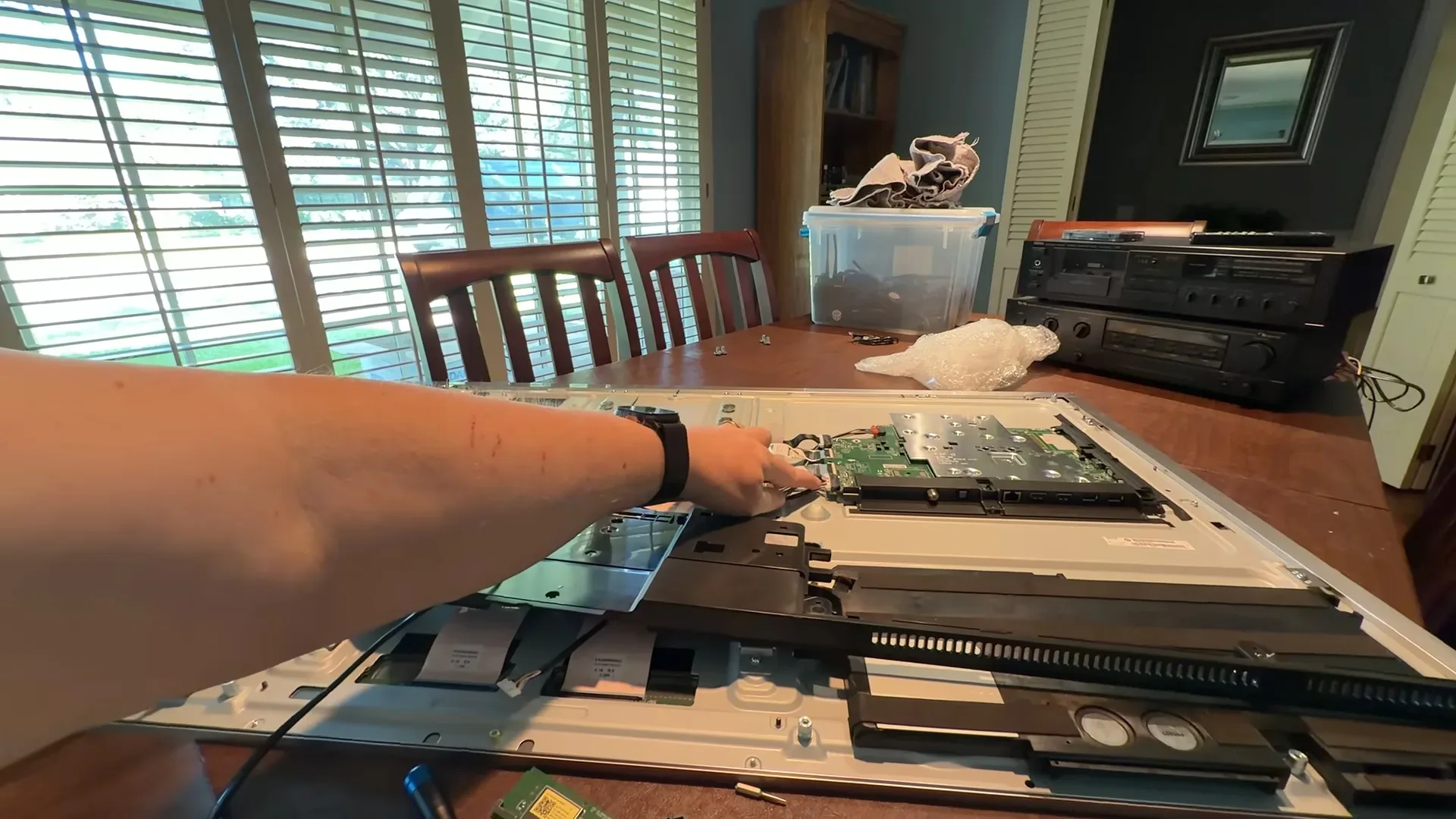
An LG G6 OLED owner has turned a smart-TV privacy argument into a very literal hardware modification. In a newly posted video, YouTube creator tfm55x opens the television and removes components identified as the set’s Wi-Fi, microphone, and Bluetooth antenna hardware. The creator later posted a follow-up showing the television operating after the work.
The video arrived after a separate, widely circulated September 6 report from the YouTube channel Gamer’s Nexus raised allegations about LG smart TVs’ data practices. Its claims included that many LG TVs record and store conversations, scan for nearby devices and Wi-Fi signals, and continue certain behavior even after internet disconnection. LG responded to the report and denied those claims. That denial is important context: the allegations remain disputed, rather than established fact.
Still, the episode has clearly hit a nerve with people who see a television not merely as a display, but as a networked computer sitting in the middle of their living room. tfm55x’s response was not to adjust a menu setting or rely on a separate private virtual network. It was to remove the physical pieces that, in the creator’s view, enabled the TV’s unwanted communications.
A hardware-level protest, not a setup guide
The creator’s short video is framed as a refusal of the terms attached to an expensive connected television. tfm55x said they had initially considered putting the TV on a private virtual network in an attempt to govern its internet behavior. After watching the allegations in the Gamer’s Nexus report, however, the creator concluded that approach would not offer enough reassurance and decided to open the device.
That distinction matters. A virtual network, in this context, is a separated or controlled network environment intended to limit what a device can reach or how it interacts with other connected equipment. It is a software and network-management measure. Removing a Wi-Fi antenna, microphone, or Bluetooth hardware is different: it is a physical alteration to the device itself.
The video is therefore best understood as a personal protest and a demonstration of ownership, not as evidence that every smart-TV concern can—or should—be solved by taking a set apart. It does show one owner’s chosen response to a dispute over data collection and consent. It does not establish that the same components, method, or result will apply across LG’s product range, or across smart TVs from any manufacturer.
For gamers, that boundary is especially relevant. A modern TV is often treated as the final, passive link in a console or PC setup: the big glass panel that receives the picture. But smart TVs can also include their own operating systems, network connections, microphones, wireless radios, app platforms, and account systems. In other words, the screen may be the most visible part of the purchase, while the connected-device layer is where many privacy concerns live.
“The glass” becomes the central argument
Part of the Gamer’s Nexus report focused on clips in which LG executives and partners purportedly said that the company “own[s] the glass,” rather than the customer. tfm55x seized on that language in the modification video, arguing that the television and its screen belonged to the buyer. The creator called the project a rejection of the agreements presented with the TV and objected to paying a premium price for a device that might collect information in the home.
“You don’t own the glass on this one,” tfm55x said while explaining the removal.
It is an unusually blunt version of a familiar question in consumer technology: what does ownership mean when a physical product is governed by long digital agreements and linked to online services? The source material does not settle the legal question, and the video does not attempt to. Its point is more immediate. If a buyer believes a feature conflicts with their expectations of privacy, they may see physical control over the purchased device as the clearest expression of refusal.
That broader ownership tension has also appeared elsewhere in technology disputes involving data, access, and control. The ongoing debate over how companies use material in digital systems is part of the backdrop to stories such as the arguments around AI music models and unlicensed training. The subject matter is different, but the underlying question is recognizable: when a product or service depends on data, who gets meaningful say over its collection and use?
What the removal involved—and what it does not prove
tfm55x describes removing Wi-Fi and microphone hardware, along with a Bluetooth antenna. Each term refers to a different capability:
- Wi-Fi is a wireless networking method. In a smart TV, it can provide a connection to online services and other networked functions.
- A microphone is the component that captures sound. In connected consumer hardware, it is central to any feature that needs audio input.
- Bluetooth is a separate short-range wireless technology, commonly used for direct connections between devices rather than a home’s Wi-Fi network.
Separating those concepts is useful because “offline” is not a single universal state. Disconnecting a television from one network is not the same thing as removing every communication-related component. Conversely, removing certain hardware from one particular television does not, on its own, answer every question about remaining features, data practices, or the behavior of other models.
The source material says the owner carefully opened the recently purchased set and removed the relevant parts. It also says a Thursday follow-up video showed the TV still functioning. That is the concrete outcome shown by this particular creator: the display continued to work after the modification. It should not be stretched into a blanket assurance about the consequences of modifying any television, nor into verification of the contested privacy allegations that motivated it.
Why the story matters to people who play on TVs
For a console player, a television can be the center of a setup for years. That makes the purchase decision about more than panel quality, ports, or screen size. A buyer may also care about the device’s internet connection, account prompts, permissions, and whether optional connected features match their comfort level.
The tfm55x video gives the frustration a theatrical form: no lengthy acceptance flow, no buried preference screen, just the removal of the components the creator did not want. Its appeal in the comments—where viewers praised the move as a forceful “I do not accept”—is easy to understand. It turns a dense and often abstract concern about agreements and data into an action anyone can immediately recognize.
But the practical takeaway is not that viewers should copy the teardown. The better takeaway is that connected features deserve scrutiny before and after a purchase. The disputed claims about LG and the company’s denial are a reminder to distinguish allegation from confirmation, while the owner’s reaction illustrates how strongly people can feel when a product’s networked behavior seems out of step with their expectations.
A TV can be a game display, a streaming hub, a voice-enabled device, and a wireless endpoint at the same time. The more roles it performs, the more important it becomes for consumers to understand which of those roles they actually want in their homes. In this case, one OLED owner supplied an emphatic answer: keep the picture, remove the connections.
For further reporting on the modification video and the privacy debate around it, see this coverage of the OLED owner’s hardware removal.