Netflix is testing a new TV-app feature called AI Discover, an attempt to solve one of streaming’s most familiar rituals: opening an app, scrolling through rows of titles, rejecting several perfectly serviceable options, and eventually deciding that it is too late to start anything.
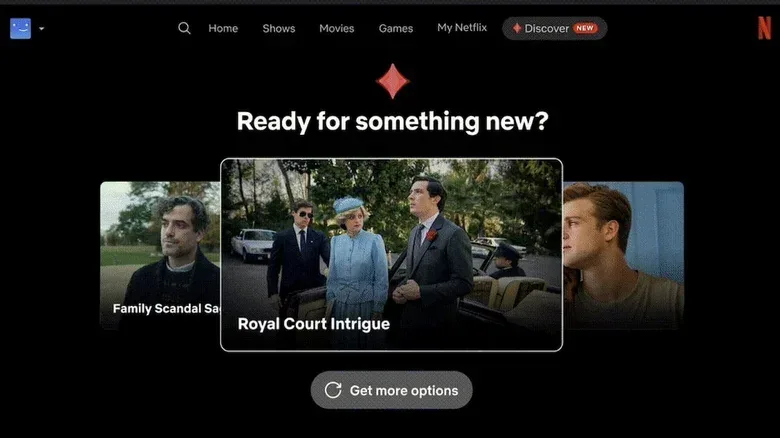
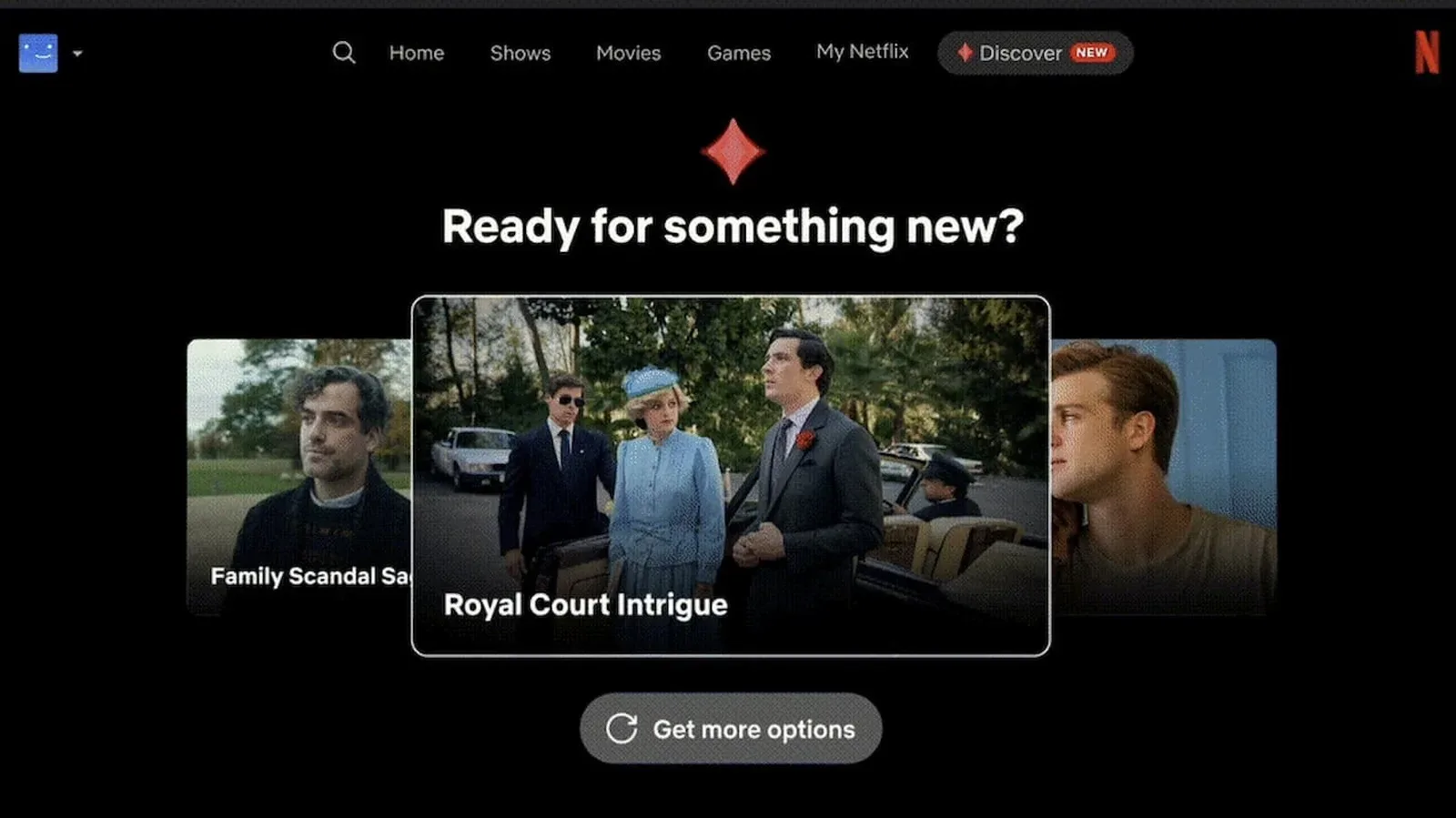
The experiment appears as a Discover tab marked by a red gem in the top navigation bar for accounts that have access. Rather than presenting viewers with only the usual broad library lanes, AI Discover initially offers a set of themes accompanied by a relevant clip from a film or series. The idea is to give the viewer a usable starting point before they enter the endless catalogue maze.
It is an early test rather than a confirmed permanent redesign. Netflix describes AI Discover as a space for trying features that could later become part of the service’s main experience. Its initial rollout is limited to supported TVs, English-language use, and accounts in the United States. Availability is set to expand gradually over the coming weeks, while kids profiles will not receive the feature.
What AI Discover is actually trying to recommend
The important detail is that the first version is built around themes, not an open-ended chatbot prompt box. Those themes can reflect the people watching, the desired tone, the available time, what is new or popular, and a member’s recent viewing habits.
That means the tool may surface directions such as a family movie night, a horror pick, a lighter comedy, or titles that will not consume an entire evening. After selecting one, viewers can narrow the results further with more specific themes. They can also refresh the available theme choices if none of the first batch fits.
This is a meaningful distinction. A conventional recommendation row often asks the viewer to infer its purpose from a label such as “Because you watched…” AI Discover is designed to begin with intent: who is here, what kind of mood is in the room, and how much time is available. The answer may still be a familiar title, but the route to it is meant to be more conversational in structure even when no typing is required.
Netflix says AI helps generate the themes shown and will explain the results as people move through the experience. The company has also described the system as a new intelligence layer that responds to feedback in real time and continues learning.
“Real time” does not mean a magic mind reader
In this context, an intelligence layer is best understood as the recommendation machinery sitting between the library and the screen: a system that can interpret signals from a viewer’s choices and decide which categories or titles to put forward next. Selecting a theme, refining it, refreshing choices, saving an item, or rejecting a suggestion can all become useful signals for future recommendations.
That does not guarantee that every pick will land. “Funny,” “short,” and “something for everyone” are famously slippery requests, especially for a household rather than one person. The more practical promise is narrower: AI Discover could make it faster to discard the wrong direction and move toward a better one.
The feature’s clearest quality-of-life tool may be the ability to tell Netflix that a particular title should not be recommended again. Anyone who has repeatedly passed the same suggested programme knows that positive signals alone are incomplete. A watchlist says, “perhaps later”; a permanent dismissal says, “not this, please.” Giving viewers that negative control could make subsequent suggestions feel less like a stubborn billboard.
Users can also add titles to their list directly from AI Discover. That preserves a useful middle path between committing to a selection now and losing it to the scroll. If a recommendation fits the mood but not tonight’s schedule, saving it should be more valuable than making the viewer search for it again later.
Why the TV rollout matters
Launching first on supported televisions makes sense for the problem Netflix is targeting. TV browsing tends to be a shared, lean-back activity. A person with a remote may be choosing for several people, and the interface has less room for dense filters or lengthy search behavior than a phone or computer. Theme cards and video clips are a relatively simple way to turn a vague group decision into a sequence of smaller choices.
It is also a reminder that the television interface itself matters. A streaming service can add smarter discovery tools, but viewers still need a supported setup to see them. For people using an older display, a separate streaming device can add app access and modern smart-TV functions without replacing the screen; a streaming stick can be one route to bringing smart features to an older TV.
That does not establish which devices will support AI Discover, and Netflix has not provided that device-by-device detail here. It does underline a practical limitation of TV-app experiments: a feature can be available in a region but absent from a particular account because the television or connected streaming hardware is not supported.
Netflix has been trying to tame choice overload for years
AI Discover is not Netflix’s first effort to reduce decision fatigue. The service previously tried a shuffle-style playback option, designed to make the choice on the viewer’s behalf. It also tested an OpenAI-powered chatbot during a redesign last year. Longer-term users may remember Max, an earlier and notably chatty recommendation assistant.
The progression is revealing. Shuffle approaches the problem by removing choice. A chatbot makes the act of choosing more explicit and text-driven. Theme-based discovery occupies a middle ground: it asks for a little guidance, then does the catalogue work in response.
That middle ground may be better suited to the living room. A viewer often knows the broad shape of what they want but not the title: something tense but not too grim, something appropriate for a group, or something that fits before bed. Browsing based on themes makes those partial preferences actionable without requiring a person to formulate a detailed request.
Clips are also doing important work. Text labels can communicate a premise, but a short excerpt can indicate pace, style, cast chemistry, tone, and whether the mood of a programme is actually compatible with the room. A viewer who says they want a comedy may still be looking for a very particular kind of comedy. The clip gives them a rapid way to accept or reject the vibe.
The useful measure is less scrolling, not more AI branding
The test will succeed only if it improves the ordinary act of settling on something to watch. Calling a feature AI-powered is not, by itself, a solution to a crowded catalogue. The meaningful questions are simpler: Do the themes make sense? Do refinements move results in a noticeable direction? Does “don’t recommend this again” stop unwanted titles from resurfacing? And does the process get people watching more quickly than standard rows do?
There is a possible trade-off. Discovery tools can help surface titles viewers might otherwise miss, but highly personalized recommendations can also keep people inside a narrow comfort zone. The refresh option matters here. If it provides genuinely different routes into the library rather than near-identical labels, it could preserve some room for surprise while still respecting the viewer’s initial preference.
Netflix’s promise to explain results is equally worth watching. Recommendation systems can feel arbitrary when the logic is invisible. Even a concise explanation—whether a suggestion follows from a chosen theme, a recent watch, or popularity—can give viewers a way to judge whether the tool has understood them. It also gives them a basis to change direction when it has not.
For now, AI Discover is a limited TV test with a fairly grounded purpose. It does not claim to replace human taste, settle family arguments, or make every recommendation perfect. It is trying to convert a sprawling streaming library into a sequence of manageable decisions. For anyone who has spent more time evaluating thumbnails than watching the programme they opened the app for, that is a sensible problem to tackle.