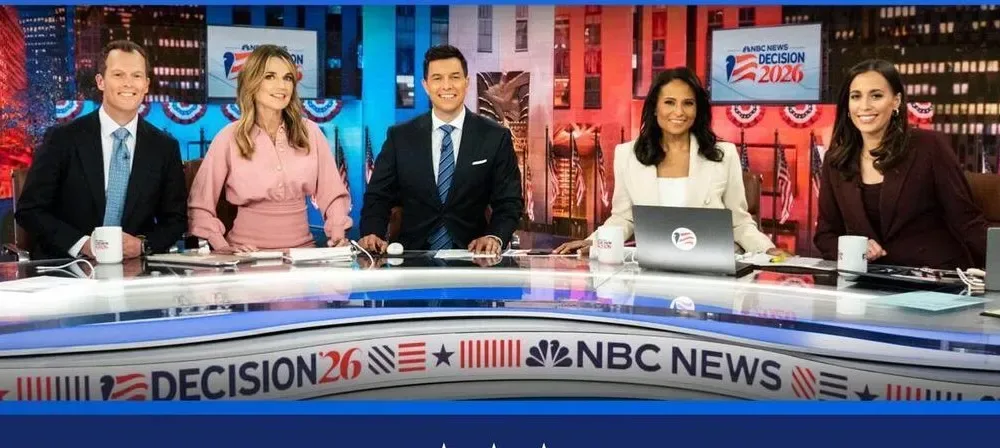

Election Night television has always been part scoreboard, part endurance contest and part giant live-service dashboard. The 2026 U.S. midterms delivered a particularly useful reminder that the old TV-news hierarchy is not fixed: NBC News led primetime coverage in total viewers, CNN led cable in the audience most prized by advertisers, and the overall linear-TV audience rose meaningfully from the previous midterm cycle.
NBC News averaged 6.74 million viewers in primetime as voters handed Democrats control of both the U.S. House and Senate. ABC News followed with 5.19 million, while Fox News Channel drew 4.315 million. The result stands apart from recent major election nights, when ABC and Fox had more regularly occupied the largest-viewer positions.
That does not turn a single evening into a permanent realignment. It does, however, provide media executives with a substantial data point about scheduling, personalities, partisan audience behavior and the continuing value of broadcast reach. It also makes clear that a party’s strong electoral night does not automatically transfer into ratings momentum for every outlet perceived to serve viewers sympathetic to that party.
NBC got the biggest primetime crowd
The clearest headline is NBC’s overall lead. Its 6.74 million-viewer primetime average put it comfortably ahead of ABC and Fox News Channel. NBC also registered the largest audience among adults 25 to 54, attracting 2.794 million people in that demographic. ABC was second in that measurement with 1.672 million.
The 25-to-54 figure deserves a quick explanation. It is commonly called the key demo: a selected age group advertisers use to judge the commercial appeal of a news program. Total viewers measure the broadest audience. The demo indicates which outlet reached the largest group within the age range advertisers emphasize. Neither number tells the whole story alone, which is why an outlet can lose in total viewers but still claim an important business win in the demo.
NBC’s format likely gave viewers more places to spend time with its coverage. The network expanded the hours dedicated to the results and offered a standalone Kornacki Cam on a streaming outlet, placing data analyst Steve Kornacki in a continuous, more specialized viewing environment alongside his appearances on the primary coverage. Savannah Guthrie, Tom Llamas, Kristen Welker, Hallie Jackson and Ryan Nobles were also part of NBC’s election-night presentation.
That is not proof that any one personality or stream caused the ratings result. Audience figures cannot, on their own, isolate why a viewer chose a network. Still, the approach reflects a practical programming strategy: pair the broad, familiar network broadcast with a more narrowly focused digital feed for viewers who want to follow a particular analyst and the evolving numbers in greater detail.
CNN takes cable’s advertiser-friendly race
CNN did not lead all networks in total audience, but it captured an important cable victory. Its 1.512 million viewers aged 25 to 54 far outpaced Fox News Channel’s 771,000 and MS NOW’s 665,000 in the same group. CNN’s election coverage, featuring Jake Tapper, John King, Dana Bash, Kaitlan Collins and other on-air figures, also drew the third-largest overall audience among the outlets measured.
For a cable-news operation, leading the key demo provides a strong piece of evidence for advertising sales and for the value of a coverage style aimed at viewers looking for results, analysis and breaking updates. But it should not be confused with a declaration that cable has displaced broadcast. The night’s largest demo totals belonged to NBC and ABC, and the total audience split still leaned toward broadcast networks.
Of the estimated 31.2 million people who watched primetime midterm coverage across 13 linear-TV networks, 57% watched on broadcast and 43% watched on cable. In plain terms, cable remained a huge election-night destination, but the over-the-air broadcast networks collectively reached the bigger share of the linear audience.
The total was also larger than the 2022 comparison: 31.2 million viewers across 13 networks in 2026, versus 25.4 million across 12 networks four years earlier. That increase is notable because it occurred in a media environment crowded by digital video, podcasts, independent commentators and social platforms. Linear TV’s audience is fragmented in many day-to-day contexts, but a consequential event with results arriving in real time can still create a sizable appointment-viewing moment.
ABC’s result needs more than one reading
ABC’s 5.19 million primetime average placed it second, but its full evening cannot be reduced to that one number. A special edition of World News Tonight reached 7.4 million viewers from 6:30 p.m. to 7 p.m. Eastern. Many ABC affiliates then carried local programming at 7 p.m. before network primetime election coverage began.
That scheduling matters because election-night totals depend on the precise window being measured. A strong early-evening audience and a primetime average answer different questions. The former shows the scale of a specific newscast period; the latter compares competing coverage during the shared primetime hours. Both can be valid, and neither should be used to erase the other.
ABC’s second-place primetime result is therefore still significant, even if it was below NBC’s. The more complicated question is why it did not claim the top overall position it has often held in recent major election events. The numbers supplied here cannot establish a definitive answer. Programming length, affiliate choices, viewer habits and the competitive landscape may all matter, but the ratings alone do not identify a single cause.
A Democratic wave did not create a simple cable-news mirror image
One of the more revealing outcomes was MS NOW’s performance. Despite expectations that Democratic gains might produce a ratings lift for a network associated with a left-leaning audience, MS NOW had fewer total viewers than every mainstream outlet except CBS News. It also placed behind CNN and Fox News Channel in the 25-to-54 group.
This is a useful caution against treating election-night viewing as a direct referendum on ideology. Viewers may tune in for a preferred political viewpoint, but they can also choose based on anchoring teams, habit, a perceived strength in projection analysis, the pace of results, or simply which channel was already on when the coverage began. A favorable outcome for one party does not guarantee that audiences will consolidate behind a news brand identified with that party’s supporters.
Fox News Channel’s 4.315 million total viewers put it behind NBC and ABC, while its 771,000 key-demo audience trailed CNN. Fox Corp. CEO Lachlan Murdoch has discussed potential viewer fatigue among some audience members. The election took place as Democrats rose to congressional control, a result that may not have been especially attractive viewing for portions of Fox’s usual audience. That is a plausible context, but it remains analysis rather than a demonstrated, viewer-by-viewer explanation.
Fox’s Election Night programming also included opinion hosts Sean Hannity and Laura Ingraham, who acknowledged some harms caused by President Trump’s policies while supporting his broader vision. The choice illustrates an enduring tension in cable news: networks must decide how closely their live event coverage should resemble straight results programming, how much opinion should be incorporated, and what their core viewers expect during a difficult political night.
CBS and the newly shared corporate picture
CBS News had the smallest overall audience among the mainstream outlets discussed, even though its viewership increased from 2022. Yet CBS outperformed both Fox News Channel and MS NOW among viewers aged 25 to 54. That split reinforces why total-viewer rankings and demo rankings should be read together rather than as rival facts.
The result may receive added scrutiny because CNN and CBS News now sit under Skydance following the Paramount and Warner Bros. Discovery merger. Their election-night performances present different strengths: CNN’s cable demo lead and third-place overall showing, alongside CBS’s smaller overall turnout but comparatively stronger position in the advertiser-focused age range than Fox or MS NOW.
For corporate leadership, the practical question is not merely which brand “won.” It is whether the networks have distinct uses and audiences that can be maintained without blurring each other. Election nights are unusually high-profile tests of that identity. They show who arrives for breaking results, who stays for extended analysis and which audience segments are available to advertisers.
Media consolidation is increasingly part of the entertainment-business conversation more broadly, as seen in reports around potential platform deals such as the New York Times Company’s reported Letterboxd talks. The details differ greatly, but the underlying pressure is familiar: companies are weighing how audiences, brands and distribution work when attention is spread across many services.
Digital competition is real, but linear TV still has a role
The 2026 midterms unfolded amid a more distributed news ecosystem than the one that defined earlier election cycles. Traditional networks were competing not just with one another but with political streams, podcasts and personality-led digital programs. Kornacki, Ali Velshi and Fox News Channel’s Ruthless podcast team all appeared in digital channels, while figures including Piers Morgan, Chuck Todd, Katie Couric, Jim Acosta, Don Lemon, Scott MacFarlane and Katie Phang were also seeking audiences across online platforms.
This competition changes what an election-night win means. A linear rating captures a meaningful but bounded portion of the public’s attention. It does not account for every stream, clip, podcast, social-video segment or independent digital broadcast that may have shaped how people followed the results. Nor does the presence of those alternatives mean television has become irrelevant. The 31.2 million linear-TV viewers show that major network coverage remains a large-scale option when the story is national, live and unsettled.
The strongest immediate lesson may be that TV news has to operate as both a mass-reach product and a collection of specialized experiences. The main broadcast can serve viewers who want trusted anchors and a broad narrative. A dedicated analyst feed can serve viewers who want the map, the math and continuous detail. Cable can compete for distinct audience segments. Digital voices can build closer relationships with narrower communities.
NBC’s earlier attempt to bring Megyn Kelly over from Fox News Channel after Trump’s first election victory showed the risk in reading a political moment too literally. The pairing did not work out. The 2026 ratings should prompt experimentation, but not simplistic conclusions that one election result dictates what every viewer now wants.
For now, the scoreboard is straightforward: NBC took primetime’s total-viewer lead, CNN owned cable’s key demo, broadcast networks accounted for most of the linear audience, and the full field is trying to retain relevance while viewers have more ways than ever to watch, listen and scroll through election results.