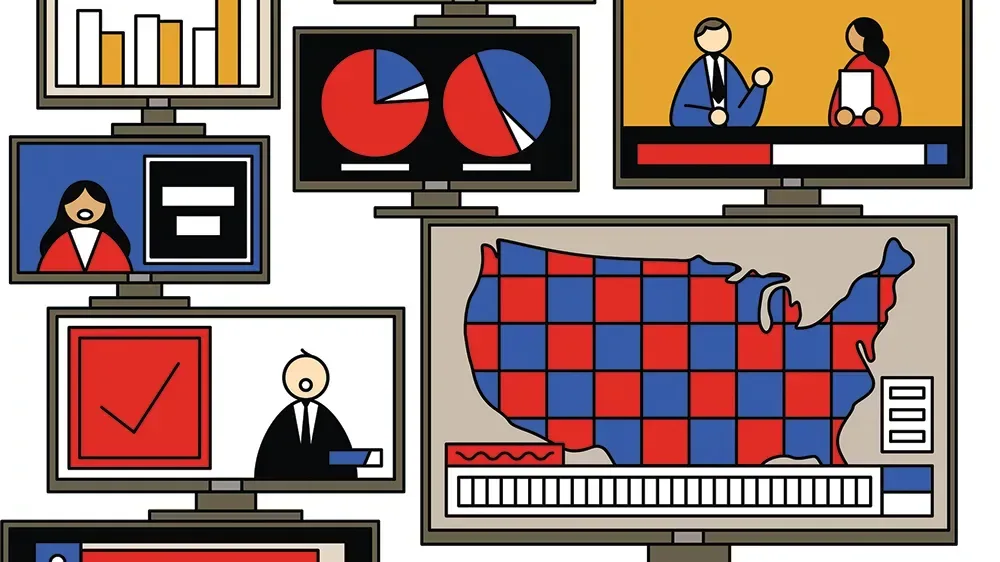
Election Night has traditionally belonged to the big television networks: towering touchscreens, carefully timed projections, orchestral intros and a tightly controlled parade of anchors and analysts. This midterm cycle, a growing field of independent journalists and digitally native hosts wants a place on the same crowded night—without reproducing every part of that television formula.
The change is not merely aesthetic. The new streams are designed around direct access, looser conversation and a host’s individual point of view. They are also businesses. For the people putting them on, a major election is a rare chance to build audiences, attract advertisers, sell subscriptions and demonstrate that an independent operation can hold viewers through a live, rapidly changing national event.
Scott MacFarlane, formerly seen at the CBS News Election Night desk, is among the journalists taking a new route. He is set to appear on a MeidasTouch livestream beginning at 7 p.m. Tuesday alongside former MSNBC host Katie Phang. MacFarlane has described the appeal in simple terms: instead of a contribution shaped by the layers of a conventional television production, he expects to speak directly and without a teleprompter.
That distinction gets to the central appeal of the creator-led election broadcast. Traditional news coverage depends on editorial coordination. Producers determine which live shots, guest interviews, vote counts and pieces of analysis reach the air, and when. A creator stream can still be planned and produced, but its hosts are selling viewers the possibility of a more immediate voice: fewer formal handoffs, less rigid pacing and more room to react in real time.
A crowded second screen becomes its own event
The independent slate is sizable. Chuck Todd and Chris Cillizza are planning The Projection, a livestream set to run across YouTube, X, Substack, Decision Desk HQ’s Votes portal and Noosphere. The breadth of that distribution matters. Rather than requiring an audience to enter through one channel, the program is meeting viewers on several services that serve different habits—from social video to newsletter-driven communities and subscription platforms.
Piers Morgan is traveling from London to Washington, D.C., for several nights of coverage through his Uncensored company. Jim Acosta and Katie Couric plan a live program from the University of Virginia, with guests including Rahm Emanuel, Pete Buttigieg and Tara Setmayer. Don Lemon is due to host a New York City bar-based show featuring guests such as Joy Reid and Hunter Biden.
C-SPAN is also joining the wider livestream push through planned simulcasts of coverage from The Young Turks and conservative commentator Patrick Bet-David. The format is therefore not confined to one political outlook, one platform or one kind of media personality. It includes former television anchors, partisan outlets, subscription-driven operations and commentators with different approaches to analysis.
For viewers, that creates an Election Night menu much broader than the familiar question of which network’s decision desk to watch. The trade-off is equally clear: more choices can mean more perspectives and more conversational programming, but it can also fragment attention. A person may watch a formal network broadcast for race calls, a creator feed for commentary, and social clips for fast reactions—all during the same hour.
What “creator-led” coverage actually means
“Creator” can be an imprecise label, especially when many of the people using it have extensive resumes at major news organizations. In this case, it is most useful as a description of the relationship between presenter, platform and audience.
- Direct distribution: Hosts can publish through their own social accounts, video channels, newsletters or subscription services rather than appearing only on a network schedule.
- Personal brand: The audience may arrive primarily for a specific host’s analysis and style, not a broader network identity.
- Flexible production: A stream can adopt a conversational setup, field reporting, remote guests or a venue-based atmosphere instead of a traditional studio presentation.
- Multiple revenue paths: Advertising, sponsorships and subscriptions can all be part of the same operation, rather than a single conventional television advertising model.
None of those points automatically makes a stream more accurate, more insightful or more independent in every practical sense. A looser format can make an audience feel closer to a host, but it also puts more responsibility on viewers to distinguish analysis, commentary and confirmed election information. The value proposition is not simply “unscripted.” It is that a host can explain events in a recognizable voice and respond at the pace of an online audience.
Acosta has framed his and Couric’s program as coverage free from the ownership structures associated with Fox News, CBS News and CNN. He says the pair can “let it rip,” while Couric has emphasized that they can be more direct than when they were working within network news. Both have also said their program will be less stiff and more casually presented than a conventional network broadcast.
That rhetoric is part editorial pitch and part brand strategy. The promise of freedom from corporate oversight may attract viewers who feel that television news has become too constrained. At the same time, it is a way to tell audiences why this stream is a separate product rather than a smaller version of what those hosts previously did on television.
The real contest is for a repeat audience
The midterms offer an unusually concentrated test. Election Night delivers urgency, recognizable guests and a reason for people to watch live rather than catch up later. If a host can convert that attention into channel follows, newsletter subscribers, paid members or returning viewers, the broadcast can have value long after the final race is called.
That is why the commercial side is openly part of the conversation. Rashida Jones, now CEO of Morgan’s company after leading MSNBC, has said advertisers were eager to sponsor the Washington programming. Her view is that a strong showing can build audiences and business, and that the event could preview a larger shift ahead of the next major election cycle.
There is evidence for the audience shift, though it does not settle the question of which individual programs will succeed. A recent Pew Research Center survey found that 58% of U.S. adults see social media as an important way to stay up to date with news, while 13% said it is their most important source. In 2022, the comparable figures were 43% and 5%.
Those figures describe changing news habits, not a guarantee that every Election Night stream will find a viable business. An audience can be broad while still being split among many feeds, apps and personalities. It is also possible for a heavily viewed live event to produce conversation without producing enough subscriptions or advertising to sustain a larger operation. The competition itself is a reminder that attention is valuable precisely because it is limited.
The wider political media economy is already shaped by that race for attention, with disputes over commentary, monetization and audience behavior extending beyond coverage itself. That context sits alongside concerns raised in a recent look at political betting culture and the questions it raises. Election content is not just civic information; it is increasingly packaged for live digital consumption, and the incentives around engagement deserve scrutiny.
Legacy media is adapting instead of standing aside
The story is not a clean replacement of television by independent streaming. Established news companies are adopting elements of the same playbook, often by creating companion programming that addresses a different audience or viewing format.
Fox Nation will carry a three-hour live special led by the team behind the Ruthless podcast. Co-host Josh Holmes has said the event, taking place before a crowd in a Washington, D.C., bar, will aim to keep a sense of humor while offering what the group sees as an under-the-hood view of serious issues. Holmes has positioned it as a supplement to Fox News’ main election coverage with Bret Baier, Martha MacCallum and Bill Hemmer rather than a replacement for it.
That is an important model. A network can retain its flagship broadcast for audiences who want a familiar anchor desk and formal pacing, while offering a more personality-forward companion for viewers who prefer podcasts, live chats and a venue atmosphere. The result is less an either-or battle than a proliferation of packages around the same event.
NBC News is making a comparable format adjustment with its first vertical-video Election Night program. Led by anchor and correspondent Gadi Schwartz from Texas, the program will include conversations with NBC journalists stationed around the country and will appear through both NBC News social accounts and Schwartz’s own feeds.
Vertical video refers to programming composed for a phone held upright rather than the landscape frame associated with television sets and desktop screens. It is a technical choice with editorial consequences. A vertical feed is built for scrolling, quick attention shifts and platform-native viewing. NBC’s stated conversational approach signals an effort to make live election coverage feel suited to that setting rather than simply shrinking a standard television broadcast onto a phone.
Experience remains a significant advantage
The strongest independent entrants may be the ones who bring established audiences and newsroom experience with them. Couric and Acosta have said their backgrounds in legacy media made their shift toward a digital platform easier, in part because each arrived with an existing following. They have also taken a direct role in booking guests and shaping the program’s look and feel.
That combination matters. Election coverage is difficult to improvise well: results change quickly, projections require care, races can remain unresolved for long stretches, and viewers need presenters who can explain uncertainty without manufacturing drama. A relaxed wardrobe or bar setting can change the mood, but it does not remove the need for judgment.
In that sense, the emerging format is best understood as a remix rather than a rejection of everything that came before. The hosts retain the reporting instincts, contacts and live-TV discipline developed in traditional organizations. They are shedding some of the visual ritual, production hierarchy and language associated with network broadcasts. Whether audiences see that as a meaningful improvement will depend on what each stream actually delivers when results begin to arrive.
For now, the midterms are turning Election Night into a high-stakes demonstration of where political news is headed. Networks still have their large broadcasts. Creators have their own channels, communities and revenue ambitions. And viewers have more ways than ever to choose not only whose numbers they trust, but whose company they want while waiting for them.