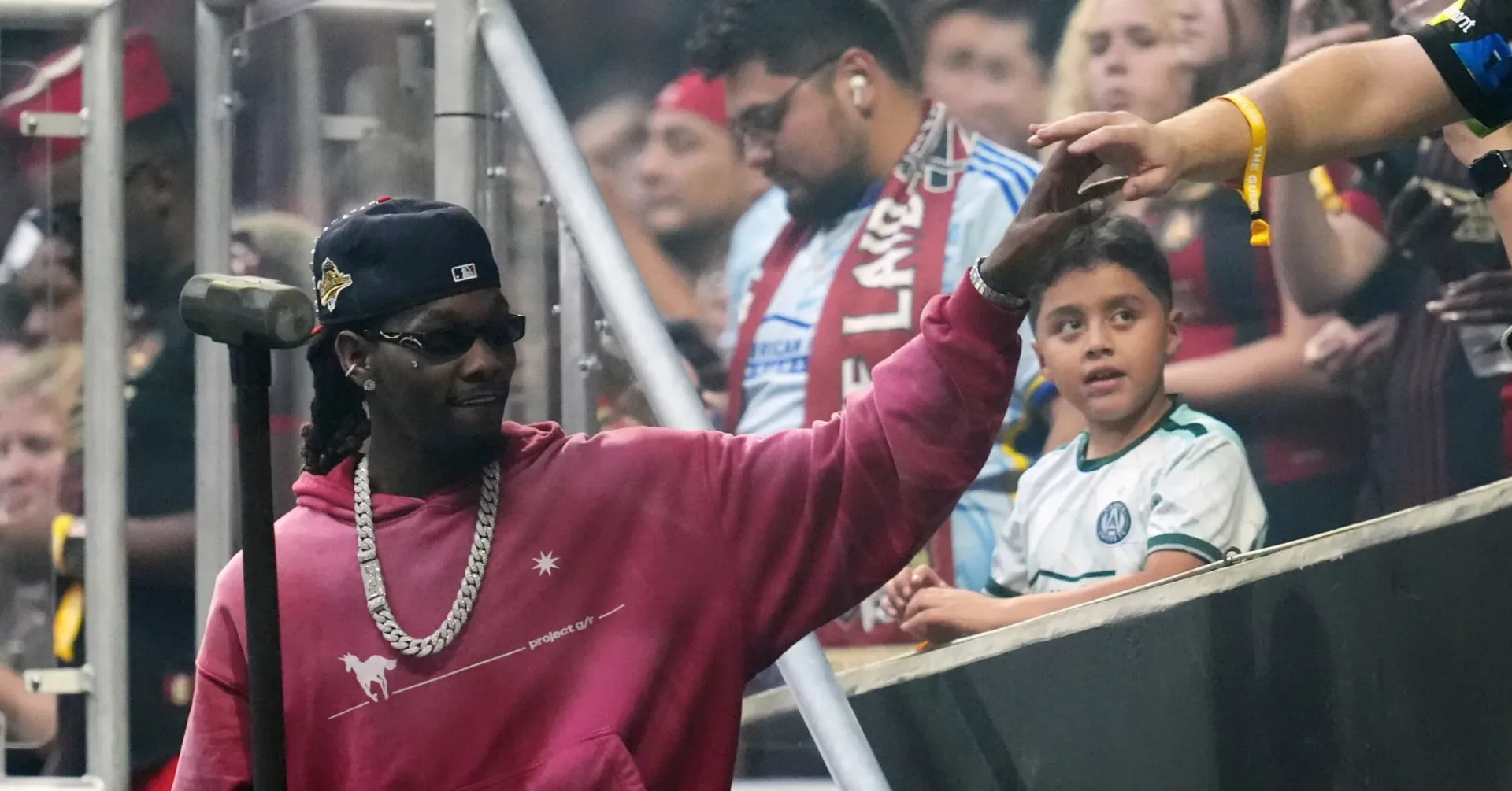
Offset is reportedly attracting renewed concern from fans after sharing a political wager said to be worth $5,000. The post reportedly backed Keisha Lance Bottoms, with Offset expressing confidence in his selection. The reaction, however, was not limited to the outcome of the wager. Commenters instead focused on what another public bet might suggest about the rapper’s relationship with gambling.
That distinction matters. A wager, even a high-profile one, does not on its own establish that a person has a gambling disorder. Fans’ comments are expressions of concern, not a diagnosis. Still, when a celebrity turns a bet into a public-facing post, the stakes are no longer solely financial. The wager becomes part of that person’s image, a conversation prompt for millions of people, and potentially an advertisement for the broader habit of putting money behind uncertain outcomes.
The reported bet became the story
The reported $5,000 stake was accompanied by a brief show of support for Lance Bottoms. In ordinary circumstances, a celebrity endorsement of a candidate would already invite debate. Adding money to the statement changes the framing from endorsement to prediction.
That is the central tension in the reaction. Politics involves public interests, civic choices and real policy consequences; betting treats a result as an outcome to be priced, picked and won. The two can exist in the same online space, but they create very different incentives. One asks what a voter believes should happen. The other asks what a bettor believes is likely to happen—or, in some cases, merely what will generate attention.
There is also a simple optics problem. Public gambling posts can be read in several ways at once: as confidence, entertainment, bravado, promotion or a warning sign. The available account does not establish Offset’s motivation. What it does show is that many viewers interpreted the post through the lens of earlier discussion about alleged gambling concerns.
A public bet can be a personal choice, but the instant it is shared with an audience, it also becomes a message about what is worth normalizing and celebrating.
Why election markets feel different from ordinary picks
A political wager is a bet tied to an election or political event. Like a sports wager, its basic mechanic is uncertainty: money is placed on a specified result. But the subject is different. A game ends, a season moves on, and the competition is designed as entertainment. Elections determine who holds public power. That is why political betting tends to provoke a sharper reaction than a routine prediction about a game or a fight.
It is also important not to confuse betting with participation. Casting a ballot is a civic act. It gives eligible people a formal role in choosing leadership. Betting is a financial activity that sits alongside the event, not a substitute for voting or engagement. A person can do both, of course, but the two should not be treated as interchangeable expressions of political commitment.
Related coverage includes Offset’s $5,000 Keisha Lance Bottoms Bet Sparks Gambling Concerns.
The reported post arrived amid a midterm-election context and claims of a close contest. Close races are especially tempting material for betting narratives because uncertainty creates drama. Yet the same uncertainty should make readers cautious about turning odds, celebrity picks or confident social posts into political guidance. A wager is not evidence that a candidate will win, and a celebrity’s confidence does not change a voter’s responsibility to assess candidates and cast an informed ballot where eligible.
Fan concern is understandable, but limits matter
Comments responding to the reported wager included calls for Offset to seek help and claims that he bets on everything. Those responses reflect genuine worry from people who see a pattern. They should also be kept in proportion: strangers online cannot responsibly determine another person’s health status from posts and rumors.
Problem gambling is not simply another name for gambling, nor can it be proven by a dollar amount alone. The relevant concern is whether betting becomes difficult to control or causes harm. Public-facing celebrity coverage often strips away that nuance because the spectacle is easier to discuss than the underlying behavior. A dramatic stake gets clicks; sustained questions about loss, control, financial strain, relationships and wellbeing require care and evidence.
There is a useful middle ground between dismissing fans outright and treating comment sections as clinical expertise. It is reasonable for an audience to say a repeated stream of gambling content makes them uneasy. It is not responsible to present speculation as a confirmed medical conclusion. That standard should apply to celebrity stories as much as it would to anyone else.
Celebrity bets are content, whether intended that way or not
The report notes that other rappers have also been associated with election bets. That does not prove coordination, sponsorship or a campaign by any wagering platform. Such a theory remains speculation without direct evidence. But it does point to a larger online dynamic: recognizable names can make almost any market seem more culturally relevant.
In digital entertainment, attention is its own currency. A famous person making a pick can make the wager more shareable than the underlying event. Screenshots travel quickly because they are easy to understand: name, amount, side chosen. Context travels less well. The rules of a market, the possibility of loss, and the difference between one-off participation and a broader pattern usually receive far less attention.
That imbalance is particularly relevant to younger or more impressionable audiences. The most visible part of betting content is often the certainty: the confident pick, the declared odds, the cash figure. What is not visible is just as important. A post does not communicate someone’s full betting history, their losses, their personal financial circumstances or the effect gambling may have outside the frame.
For people encountering such posts, a practical rule is to resist treating them as advice. Do not assume a celebrity has special insight simply because the wager is large. Do not mistake a bet for civic information. And do not let the entertainment value of watching someone else risk money erase the fact that gambling carries real financial consequences.
The gaming-adjacent conversation is broader than one post
Gaming communities are already familiar with discussions about chance, monetization and the way entertainment can blur into spending behavior. Those debates are not identical to a political wager, but the overlap in audience habits is worth recognizing. In both cases, slick presentation and social proof can make a financial decision feel like a casual part of fandom.
That is one reason public figures have an outsized effect. A prominent post does not force anybody to gamble, but it can make a behavior feel routine, exciting or status-driven. The more frequently gambling is framed as a flex, the easier it is to overlook the people for whom it is not casual at all.
The same online ecosystems that amplify betting posts also amplify creator-led entertainment and community projects. For a different example of how internet personalities can mobilize audiences around shared events, see the latest Jingle Jam creator-news update. The contrast is useful: influence can direct attention toward many things, and audiences should remain clear-eyed about the commercial and personal messages attached to it.
What remains clear—and what does not
The report presents a straightforward public controversy: Offset was said to have shared a $5,000 wager favoring Lance Bottoms, and some fans voiced concern in response. It also describes wider discussion of alleged gambling issues. What the available information does not establish is a diagnosis, the full context of Offset’s gambling activity, or whether any betting-platform promotion was involved.
Those unknowns are not a reason to ignore the conversation. They are a reason to have it accurately. Public figures are entitled to make personal choices, and audiences are entitled to react to what is promoted in public. The responsible approach is to separate confirmed conduct from inference, betting from voting, and concern from certainty.
For now, the reported wager has done more than create an election-day talking point. It has reopened a discussion about celebrity influence, gambling visibility and the way online audiences interpret a cash stake when it is presented as content.