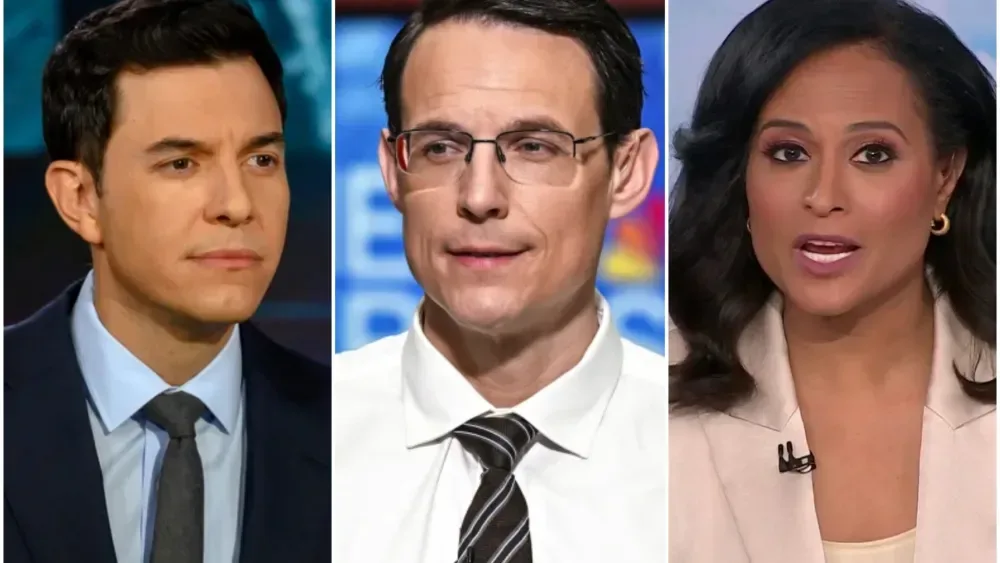
NBC News is preparing a broad Election Night operation built around a simple challenge: viewers no longer receive breaking news in one place, on one screen, or for one uninterrupted stretch of time. Its answer is a 13-hour television schedule supplemented by an always-on data stream and a vertical-video program designed for mobile viewing.
The plan is significant not merely for its length, but for how it divides the same high-stakes story into distinct formats. Hallie Jackson is set to begin television coverage at 5 p.m. Tom Llamas, Savannah Guthrie, Kristen Welker and Jackson are scheduled to appear together from 6:30 p.m. until at least 2 a.m. Craig Melvin and Kate Snow are slated to carry the overnight hours through 6 a.m.
The results could determine which party controls Congress, but NBC’s approach also reflects a broader competition for attention. Election coverage has to explain incomplete vote counts, shifting leads and uncertainty in a media environment where quick interpretations can spread before enough evidence exists to support a result.
A schedule built for a long and unsettled night
Thirteen hours of television coverage is a large commitment for a contest that is not a presidential election. It signals that NBC expects the outcome, and the process of reaching it, to command sustained attention. The on-air roster similarly emphasizes continuity: prominent anchors handle the busiest evening hours, while the programming remains live into the morning rather than treating the end of prime time as the end of the story.
That matters because an election night is rarely a straight line from polls closing to a final conclusion. Different precincts, counties and states report on different timetables. A lead in partial results is not necessarily a prediction of the final count. It can reflect which places have reported, which kinds of ballots are included in those reports, and how much remains outstanding.
That basic distinction is easy to lose amid a rapidly moving screen full of maps, percentages and projections. It becomes even more important when viewers encounter individual updates through short clips, social posts, newsletters or video-podcast discussions rather than following a full broadcast from the beginning.
Llamas has described preparing through multiple daily study sessions focused on the factors that may shape voting in different states. The stated goal is appropriately narrower than making election night feel like a spectacle: make sense of the results as they emerge and explain what they can, and cannot, establish.
Three formats for different viewing habits
NBC’s election coverage will extend well beyond the main TV broadcast. The organization plans an uninterrupted digital stream centered on Steve Kornacki and his touchscreen analysis of voting statistics and election data. It will also launch its first vertical-video program, led from Texas by correspondent Gadi Schwartz and featuring immediate reactions from reporters around the country.
Related coverage includes NBC News Plans 13-Hour Election Night Coverage Across TV, Streaming and Vertical Video.
These formats have separate practical purposes.
- The main television broadcast is structured around anchors, reporting, race analysis and a long live schedule.
- The dedicated data stream concentrates on Kornacki’s touchscreen work, giving viewers who want numerical context a feed built around it rather than treating it as an occasional segment.
- The vertical-video program is designed around the upright orientation associated with phones, placing on-the-ground reactions in a format suited to people checking in quickly.
Vertical video, in this context, means footage composed for portrait-shaped screens rather than the wide frame historically associated with television. The choice does not change the underlying election results; it changes how easily a viewer on a phone can follow a reporter or a developing update without rotating the device.
The important editorial question is whether these different paths preserve enough context. A viewer who sees a short vertical clip may need the essential caveat that a race has not been called. A viewer who prefers the data stream may want an explanation of why a county’s returns matter. The full television broadcast can provide more time for those elements, but it cannot assume that every audience member is watching it.
Catherine Kim, NBC News’ executive vice president of editorial, framed the strategy around this reality: audiences will move in and out of platforms during the night and the following morning. The aim is to be available across those points of entry.
Why early numbers can mislead
The most consequential part of the plan may be the effort to describe uncertainty with more precision. NBC says its Decision Desk will use new race classifications that go beyond familiar phrases such as “too early to call” and “too close to call.” The new labels are intended to indicate when the desk believes a race is trending in a particular direction while making clear that this is not the same thing as calling the winner.
A race call is the declaration that available evidence supports identifying a winner. An indication, as NBC describes the planned system, is a less final assessment of where the numbers appear to be heading. That difference is not just a wording preference. It is an attempt to offer viewers useful information without converting a developing pattern into a premature conclusion.
Marc Greenstein, an NBC News executive vice president overseeing elements of the election broadcast, said the approach is meant to provide more transparency around the numbers and how the organization reaches its assessments. The format is particularly relevant when social-media discussion can turn a limited batch of returns into a sweeping claim about the entire contest.
There is a tension in that approach. More granular status labels may help people understand that not every race is equally uncertain. But every new label also requires a clear explanation. If audiences interpret a directional signal as a call, the system could reproduce the confusion it is intended to reduce. The value of the presentation will therefore depend on persistent, plain-language distinctions between what has been decided, what is strongly suggested by available information and what remains unresolved.
NBC says it will not officially call a race until it reaches at least 99.5% confidence. That stated threshold places accuracy ahead of being first. It also gives producers and anchors a standard to communicate when viewers are impatient for answers: a close race does not become settled simply because the broadcast has been on the air for hours.
Data analysis is not a substitute for reporting
The Kornacki stream places election data at the center of one viewing experience, but the broader programming also depends on field reporting and political explanation. Welker has identified turnout as one major question, along with whether the coalition that helped Donald Trump win in 2024—including Latino voters and other groups—returns in 2026 with similar support.
Those are not questions a single statewide percentage can answer on its own. Turnout refers to how many eligible or registered voters actually cast ballots, and changes in turnout can shape results even if broad party preferences seem familiar. Coalition, meanwhile, refers to the groups of voters whose combined support makes an electoral result possible. Looking at whether a coalition holds requires careful comparison of returns across places and voting blocs, not an assumption based on a few early precincts.
The strength of a data-heavy presentation is its ability to make changing totals visible. Its limitation is that data still needs interpretation. Numbers can show that returns are incomplete; reporters and analysts must explain why the missing votes could matter. Numbers can reveal a candidate leading in a location; contextual reporting is needed to assess whether that location is reporting in a typical pattern.
That is why the planned mix of anchors, correspondents and dedicated analysts is more than a matter of production scale. It reflects the fact that election coverage contains several jobs at once: verify results, report what is happening on the ground, explain voting patterns and resist treating every incremental update as a final answer.
An industry test as well as a newsroom test
NBC is executing this plan while major television-news brands are adapting to changing ownership structures and a fragmented information market. CBS News and CNN are now part of Skydance, while MS NOW has separated from NBCU and is part of Versant. At the same time, independent journalists and creators using newsletters and video podcasts have become more prominent places for news discussion.
For a legacy broadcaster, scale is an advantage only if it translates into a clearer experience. NBC’s leadership is betting that its resources and distribution can do that: a long linear schedule for traditional television viewers, a data-focused stream for those who want continuous analysis, and a mobile-native program for people encountering the story in short sessions.
The approach resembles a platform strategy more than a single broadcast. The newsroom is not asking viewers to adopt one preferred format; it is trying to make the same reporting accessible wherever they arrive. That is an increasingly familiar challenge across entertainment and media, where formats are being reshaped around both audience habits and the devices in use. Recent coverage of the Hollywood Music in Media Awards’ game-related categories likewise shows how screen-based entertainment and its surrounding industries are being presented to audiences through specialized lenses.
Election Night carries a more demanding standard than ordinary programming, however. The audience is not simply deciding whether a format is engaging. It is relying on it to understand an outcome with immediate political consequences.
Prepared for news beyond the vote count
NBC’s plans also include contingencies for major breaking news unrelated to the election. That is a necessary acknowledgement that live coverage cannot isolate itself from the rest of the world just because votes are being tabulated. A significant event could require anchors and producers to shift attention, reassess the rundown and serve viewers following more than one urgent story.
Welker has compared the night’s drama to a Super Bowl, a comparison that captures the extended live stakes and the desire to hold viewers for hours. But the more useful comparison ends there. In election coverage, suspense is inseparable from restraint. The strongest presentation is not the fastest declaration or the most animated map. It is the one that makes clear what is known, what is probable, and what still needs time.
NBC’s 2026 operation is therefore a test of both reach and discipline. Its 13-hour TV schedule, data-only stream and first vertical-video news program are designed to meet audiences in several places. Its proposed race labels and 99.5% confidence standard are designed to keep a rush of partial information from becoming a rush to judgment. On a night where control of Congress may be decided, the second task is the one that will matter most.