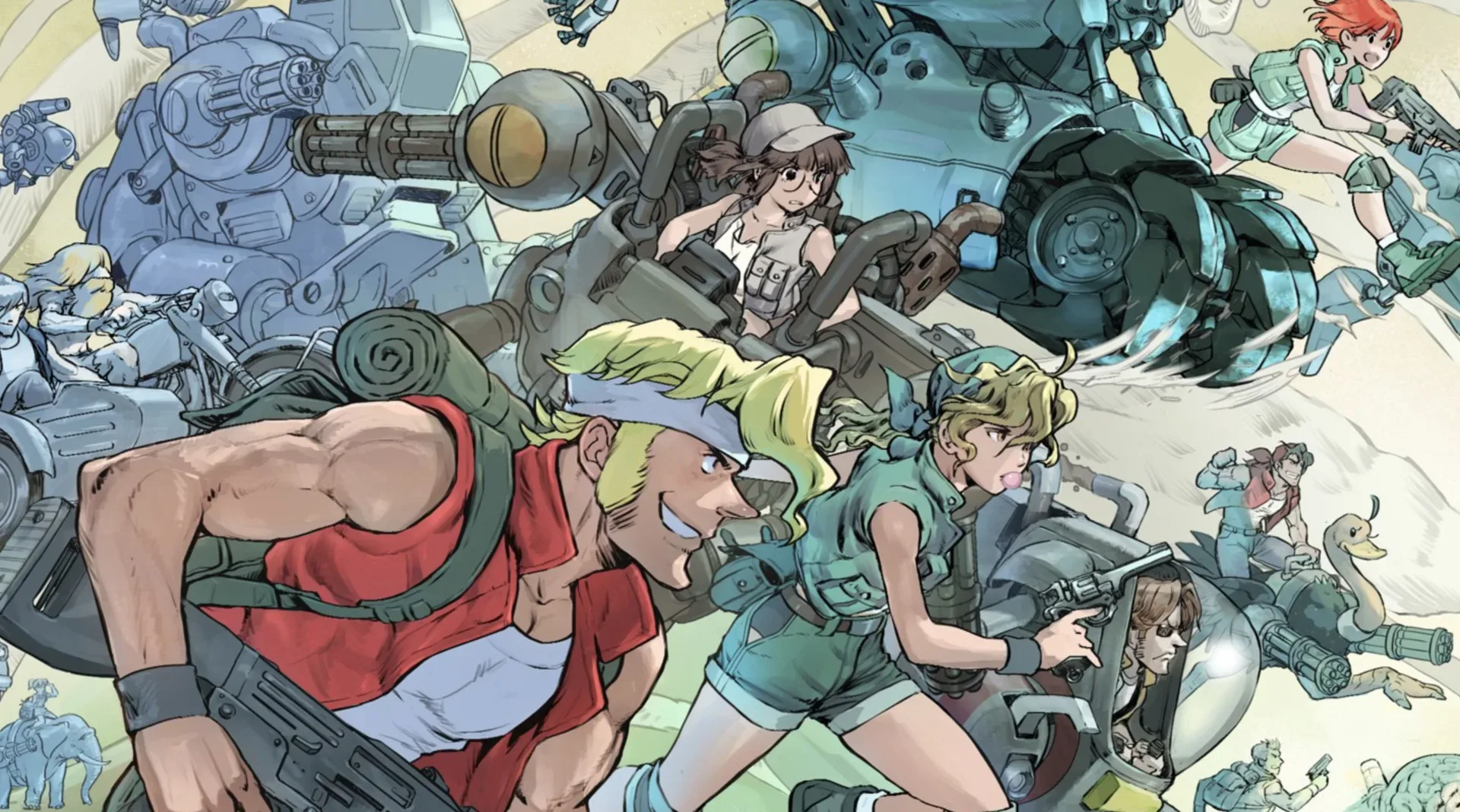
Metal Slug is heading toward the big screen. The Arena is developing a movie based on SNK’s long-running side-scrolling military action series, with I Love My Dad director James Morosini attached to the project. The early premise places the franchise’s familiar four-person crew—Marco Rossi, Tarma Roving, Eri Kasamoto and Fio Germi—at the center of a fight against General Morden and a threat to the world.
That setup is a recognizable starting point for an adaptation, but it also highlights the unusual challenge facing a Metal Slug movie. The games are known for immediate, arcade-style action rather than dense story construction: soldiers run, shoot, rescue captives, seize vehicles and battle ever-more-outlandish enemies. General Morden supplies a clear recurring antagonist, while the series’ world can rapidly veer from military conflict into aliens, zombies and yetis.
In other words, the announced film has a workable squad-and-villain framework, but it will need to turn a game built around momentum and spectacle into a standalone narrative. The key question is not whether Metal Slug has enough material for explosions and strange creatures. It plainly does. It is whether the adaptation can make its four recruits feel like a team audiences want to follow between the action scenes.
What has been announced
The project is described as a Metal Slug adaptation in development at The Arena. Morosini is attached as director. No release date, cast, distribution plan, format details, production timetable or further creative personnel were provided in the announcement material.
For more context, explore Google Pixel 11 Is Listed From $692 in an Early Black Friday Deal, With Unlocked Models on Sale.
The initial story outline focuses on Marco, Tarma, Eri and Fio as a mismatched group of army recruits taking on General Morden. Those names matter to fans because they provide the film with an established ensemble rather than asking it to build an entirely new set of heroes around the Metal Slug name.
General Morden is also an intuitive screen villain for this particular property. A film generally benefits from a clearly defined opposing force, and the premise makes him the immediate source of conflict. The broader Metal Slug universe, however, is significantly less restrained than a conventional military action story. Its enemies and scenarios can become deliberately bizarre, which gives the filmmakers a decision to make about tone: play the absurdity straight, lean into it, or find a balance between human characters and heightened arcade chaos.
Why Metal Slug is a distinct adaptation challenge
Metal Slug is a side-scrolling action platformer. In practical terms, that means its appeal is rooted in forward movement through dangerous stages, fast reactions, escalating enemy patterns and a visual barrage of vehicles, explosions and enemies. A player’s understanding of the world comes largely from what happens moment to moment, not from long exchanges of exposition.
Related coverage includes Metal Slug Movie Adaptation Announced With James Morosini Attached.
That differs from a game adaptation built around a sprawling campaign narrative or an extensively documented fictional history. Here, the advantage is flexibility. A film team is not constrained by a single elaborate plot that viewers may expect to see reproduced beat for beat. The trade-off is that the movie has to supply more connective tissue itself: character motivations, interpersonal dynamics, stakes and a satisfying arc for the squad.
The four named recruits offer the most obvious answer. Instead of treating Metal Slug simply as a collection of recognizable enemies and machinery, the film can use Marco, Tarma, Eri and Fio as the audience’s route into its volatile world. The announced “misfit quartet” approach suggests an ensemble-action direction, where the group’s contrasting personalities and growing coordination could be as important as the next large-scale confrontation.
That would also be a sensible way to preserve the cooperative spirit associated with arcade action. Even if the film is not recreating gameplay, a team working through overwhelming hazards is close to the basic rhythm that makes Metal Slug identifiable. The practical creative task will be ensuring that the action emerges from the characters’ decisions rather than becoming a string of disconnected references.
The Arena’s SNK-focused slate
The Metal Slug film is part of a much larger push to bring SNK properties into other media. The Arena was initially revealed as Arena SNK Studios and is led by producer Erik Feig. It was formed with backing from Saudi Arabia’s Crown Prince Mohammed bin Salman.
Its current slate is overwhelmingly tied to SNK’s catalog. A webtoon based on The Art of Fighting is in production, while Fatal Fury is being developed both as a television series and a movie. The studio is also working on a film connected to Samurai Spirits. Its cited non-SNK exception is an adaptation of the not-yet-released novel Kill Current.
A webtoon is a digital comic format designed for online reading, commonly presented in a vertical-scroll layout. Its inclusion on the slate indicates that The Arena’s strategy is not limited to feature films. The studio is pursuing multiple kinds of screen and digital-media projects around SNK brands, alongside fashion merchandise.
That breadth is notable because the properties are not interchangeable. Metal Slug begins with military action and comic-book strangeness; Fatal Fury and The King of Fighters are associated with fighting-game competition; Samurai Spirits is another distinct SNK setting. Turning each into a different entertainment product could help the studio test which concepts travel most effectively beyond games. But having many projects announced is not the same as having completed releases. So far, the studio’s tangible output has been fashion merchandise and social-media activity rather than released film or television work.
What the announcement does—and does not—signal
For Metal Slug fans, the clearest takeaway is that a screen adaptation now has a director attached and an initial premise built around the franchise’s best-known core characters. That is more specific than a vague statement that a property has been optioned or is being considered. It establishes a creative lead and a basic narrative direction.
It does not establish when cameras will roll, who will portray the team, whether the film will use live action or animation, how closely it will reproduce individual games, or when audiences might be able to watch it. Those are all material details that remain unannounced. Treating the project as a movie in development, rather than as a completed production with a release on the horizon, is the accurate reading at this stage.
There is also a business dimension behind the emphasis on familiar SNK names. SNK has faced heavy losses amid lower-than-expected sales, and The Arena’s emphasis on adaptations and merchandise gives its owners another route to seek value from an existing catalog. Intellectual property, often shortened to IP, refers here to the characters, worlds, titles and other rights connected to a creative brand. The value of adapting established IP is that it begins with some degree of recognition. The risk is that recognition can be concentrated among longtime players rather than a broad current audience.
Metal Slug may be one of the more accessible candidates for a mainstream action treatment because its core pitch is easy to express: a four-person military squad faces General Morden amid escalating, fantastical combat. Yet accessibility alone will not resolve the larger issue. The series’ identity depends on a peculiar blend of war-movie imagery, cartoon energy and surreal enemies. Removing that oddness could leave a generic action film; embracing it without a stable human center could make the story difficult to ground.
The tonal tightrope
The announcement’s four-recruit premise gives the adaptation a chance to make the strange parts of Metal Slug feel intentional rather than random. A disciplined ensemble story could begin with a recognizable conflict against Morden and expand outward as the squad discovers how strange its battlefield truly is. That structure would make room for the franchise’s aliens, zombies and yetis without requiring the movie to treat every idea as though it belongs to the same kind of realistic war story.
Morosini’s attachment is the major creative detail presently on the table, but the announcement does not explain his intended approach. There is no basis yet to claim the movie will be comedic, gritty, animated, faithful to a particular installment, or built around any specific visual design. Fans should be especially careful not to mistake the series’ eclectic game imagery for confirmed movie content. The disclosed premise confirms the central quartet and General Morden; the rest remains open.
For The Arena, Metal Slug is therefore both a recognizable title and a test of adaptation strategy. A successful version would need to respect the game’s unruly personality while providing the story logic that arcade design can afford to skip. It must give Marco, Tarma, Eri and Fio room to become more than familiar names, make Morden a compelling on-screen threat, and decide how far into the franchise’s stranger territory it wants to travel.
There is no release window yet, and many essential production details remain to be revealed. Still, the project’s announced direction is clear enough to define the opportunity: Metal Slug is not being positioned merely as a nostalgia label. The planned movie is built around the series’ central squad, its recurring enemy and its potential as unusually chaotic action entertainment.