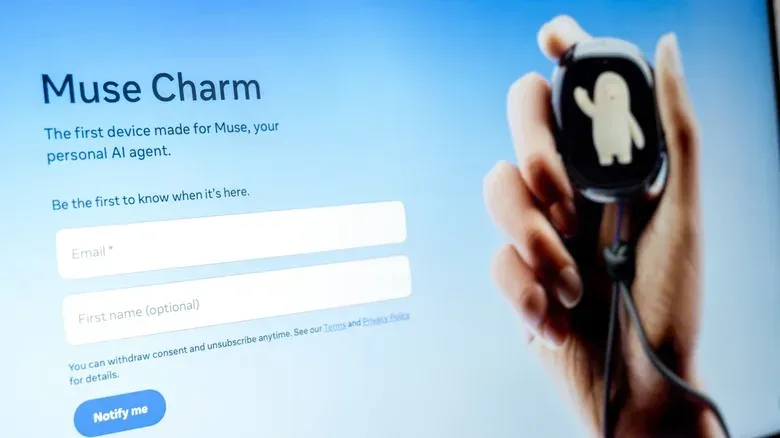
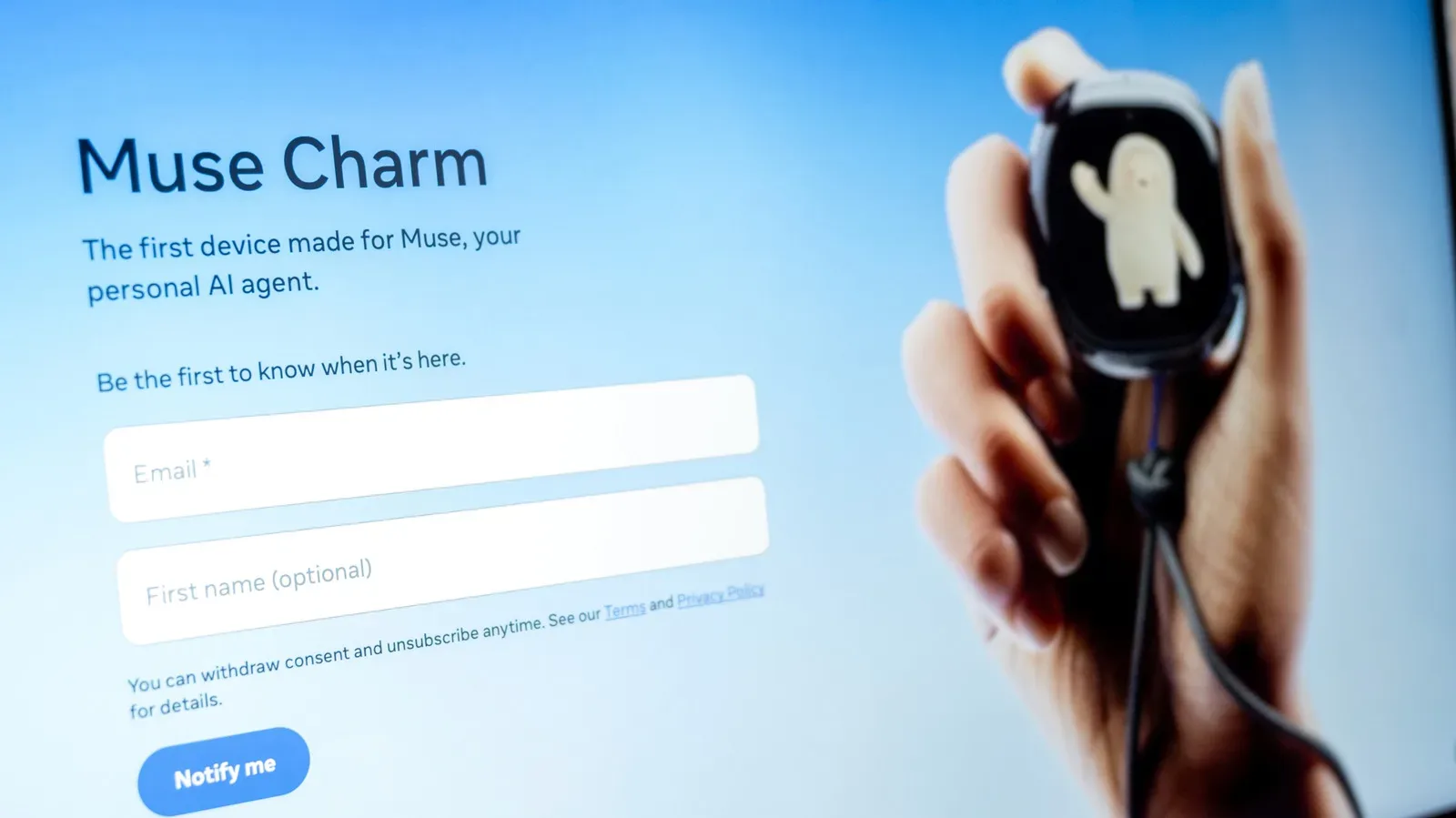
Meta’s push to make its Muse AI agent feel less like an app and more like a persistent companion may soon have a very small, very visible piece of hardware attached to it. The company is reportedly preparing to sell the Muse Charm for $300, positioning the keychain-sized device as a standalone way to speak with Muse without pulling out a smartphone.
The reported package includes up to 12 months of free Verizon 5G data and a fingerprint reader that verifies a user before commands can be issued. Meta has not confirmed the reported price or cellular-data details. What is established is that the company introduced the Muse Charm at its September Connect event and said the gadget was intended to arrive in time for the holidays.
At that event, CEO Mark Zuckerberg described the idea as putting the full Muse experience—including real-time voice interaction and an avatar system—into an object small enough to live on a keychain. It is an ambitious description for a device whose appeal depends on an unusually simple promise: the AI is there when a person wants it, rather than being buried behind a phone lock screen, an app icon and a few taps.
The hardware itself may be tiny, but the strategy behind it is not. Meta is building more routes into Muse through dedicated hardware, wearable apps and developer guidance for third-party devices. The apparent goal is to make the agent a regular entry point for information, services and eventually purchases—without making the smartphone the indispensable middleman.
What the Muse Charm is meant to do
The Muse Charm is a dedicated conversational-AI gadget. Rather than serving as a general-purpose screen device, it is designed around access to the Muse agent through voice. The “Charm” name and keychain form factor also matter: Meta appears to be treating the object as something that can be carried, personalized and seen, not merely a miniature speaker.
Its avatar element is central to that approach. An avatar, in this context, is the visual persona associated with the AI agent. Pairing an animated or customizable character with a voice agent can make the interaction feel more continuous than issuing one-off voice commands to a conventional assistant. That does not necessarily make the agent more capable, but it changes the product’s presentation. The agent is framed as a companion users can return to, not only a utility they summon for a task.
The fingerprint reader is another consequential part of the reported design. A fingerprint reader is a biometric authentication component: it uses a person’s fingerprint to confirm identity. For an always-carried voice device, the implication is straightforward. A user may need a quick way to establish that they, rather than whoever happens to be nearby, are authorized to send commands to their account.
That is particularly relevant when a device is built for immediate access. The more friction Meta removes between a spoken request and an agent response, the more important it becomes to define who is allowed to make that request. The available information does not establish precisely which Muse actions require fingerprint verification, what data is stored on the device, or how authentication will operate in practice. Those are important details still left unanswered.
The reported $300 price and Verizon data offer
A $300 reported price would place a meaningful cost on the convenience of phone-free access. Meta’s pitch is not simply that Muse can be used; it is that Muse can be reached without the familiar ritual of finding, unlocking and navigating a handset. Whether that distinction feels worth $300 will depend heavily on what people already do with the agent and how reliably the Charm provides access when they are away from Wi-Fi.
That is where the reported Verizon inclusion becomes significant. 5G refers to a generation of cellular-network technology that allows devices to connect to mobile data networks away from a home or office wireless connection. For a cloud-connected AI agent, cellular data could help keep the Charm useful while traveling, walking around town or otherwise outside Wi-Fi range.
“Up to 12 months” is an important qualifier. It indicates a maximum length for the included data benefit, not a permanent service arrangement. The information available does not specify the amount of data included, eligibility conditions, geographic limits, network performance, what happens when the included period ends, or any ongoing plan cost. Those terms would be essential for prospective buyers, especially because a standalone AI device’s basic usefulness may depend on continued connectivity.
There is also a practical distinction between including data and explaining the total cost of ownership. The reported bundle could make the Charm easier to start using, since a buyer would not necessarily need to arrange cellular service immediately. But it does not, on its own, answer what long-term use costs or whether every feature works under the same connectivity conditions. Until Meta provides formal specifications and service terms, the $300 figure should be treated as reported rather than final.
Muse is already spreading across form factors
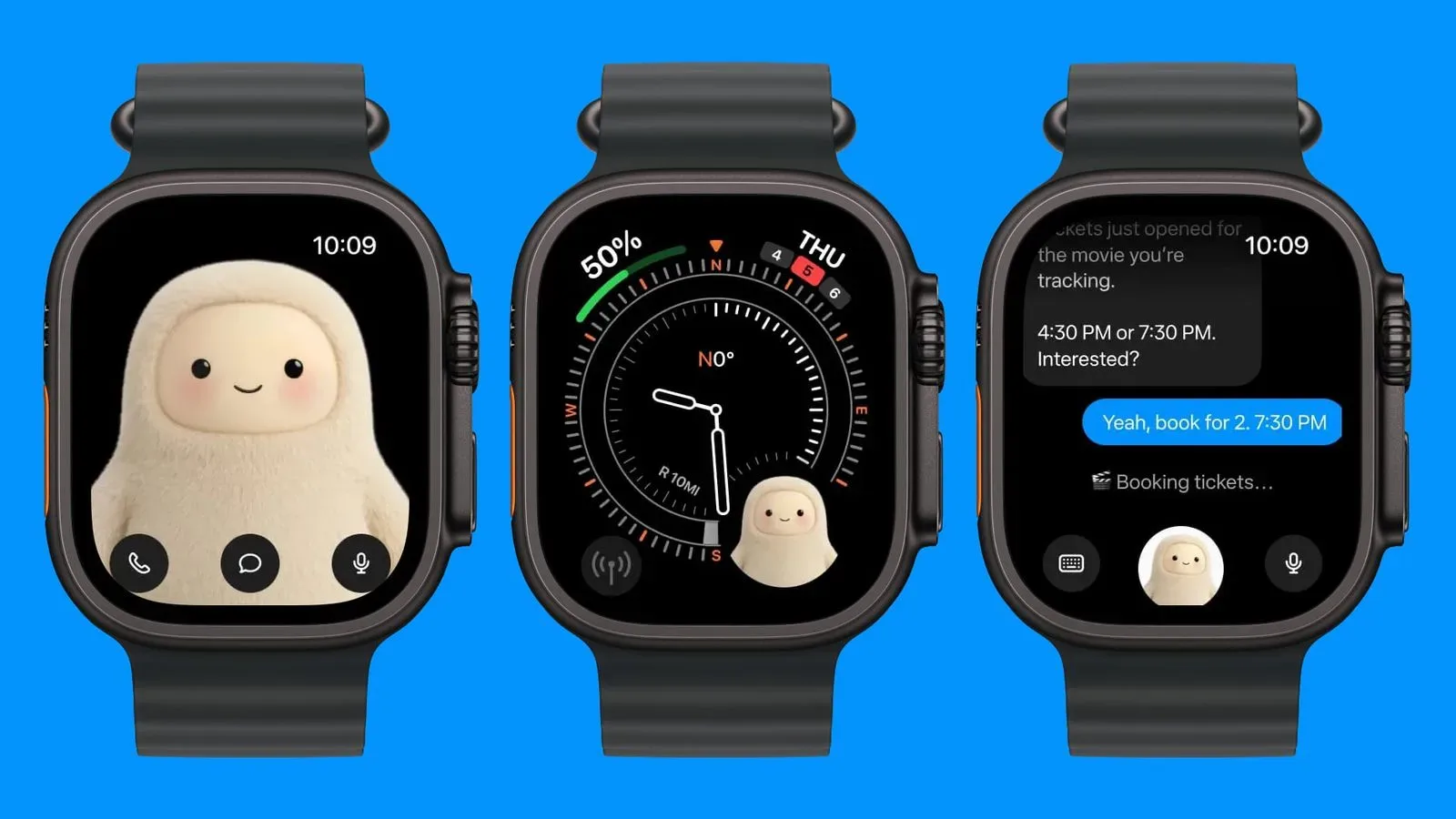
The Charm is not Meta’s only effort to give Muse a life outside its usual phone-based setting. The company released a Muse app for Wear OS and watchOS, extending access to compatible smartwatches. It also published open-source guides in October for developers who want to create their own “Muse Gadgets.”
Those moves suggest that Meta is not treating a single piece of hardware as the complete answer. Instead, the company appears to be building an ecosystem in which the same agent can be reached through a phone, a watch, a Charm or devices made by outside developers. An open-source guide generally means documentation or resources made available for others to inspect and use in their own projects. Here, the practical intention is to help interested developers create hardware experiences connected to Muse.
That developer angle could matter as much as the Charm’s own sales. If third parties are able to build different kinds of Muse-enabled products, the agent could appear in a broader assortment of objects and contexts than Meta could cover alone. The supplied information does not say what sorts of products developers will build, what requirements they must meet, or which integrations will be available. Still, publishing those guides signals that Meta wants Muse to be a platform as well as a feature.
Muse has already attracted more than 10 million users. Meta’s hardware and wearable initiatives can be read as an attempt to turn that existing audience into a more frequent audience: people who do not only open an AI app when they think of it, but who have an avenue to the agent on their wrist, on a key ring, or through another connected device.
Meta’s own smartwatch-like project, meanwhile, has reportedly been delayed until 2027. That makes the Charm especially notable. A keychain device could offer the company a path into dedicated personal hardware without waiting for its larger wearable effort to arrive. It is a different product category, but one pointed at the same broader question: how much of a person’s everyday digital interaction can move beyond the phone?
Why escaping the phone is the real point
Today, Meta largely reaches people through apps on smartphones. That arrangement puts its services inside ecosystems governed by Apple and Google. A dedicated Muse device would not make phones disappear, but it could allow Meta to own more of the direct interaction between a user and its AI system.
This is the central strategic logic behind the Charm. If an agent becomes the interface through which someone asks questions, gets help or initiates an action, the company operating that agent has an opportunity to become a more important layer between users and other services. The device’s compact physical design is therefore not just an aesthetic choice. It supports the idea that an agent should be constantly near at hand.
There are obvious tradeoffs. The convenience case is strongest when someone wants quick access without handling a phone. But a purpose-built device also needs to justify why it should be carried in addition to the phone and, for some users, a smartwatch. Its fingerprint security, cellular connection, voice experience and avatar personality all appear intended to strengthen that justification. Together, they make the Charm less like a simple accessory and more like a personal endpoint for Muse.
For players and technology watchers, this is also a useful example of a wider shift in AI product design. Much of the current conversation around generative AI focuses on software tools, assistants and model capabilities. Meta’s approach places equal emphasis on distribution: where an agent lives, how instantly it can be accessed and whether people develop a habit of using it. That same focus on putting AI closer to the moment of use is also surfacing in game development, as explored in Ubisoft’s move to bring generative AI from development workflows into gameplay.
Commerce could raise the stakes
Meta is also developing commerce tools that would let businesses pay a fee when a Muse user makes a purchase through the agent. That potential business model helps explain why the company may want a more direct relationship with Muse users. If the agent helps guide someone from a request to a transaction, it can become more than a conversational novelty.
The information available does not establish when those commerce tools will launch, which businesses would participate, how fees would work, or what buying flow users would see. But the direction is clear enough: Meta sees an AI agent as a possible route to revenue beyond its existing apps. Zuckerberg has said he believes Muse could eventually earn more revenue per user than those apps.
That claim should be understood as an ambition, not a demonstrated outcome. More than 10 million users is a meaningful audience, yet user count alone does not reveal frequency of use, spending behavior, retention or whether a dedicated gadget changes any of those measures. A Charm can make access easier, but it must still prove that people want the agent close enough to carry every day.
What remains unknown before a holiday launch
Meta said in September that the Muse Charm would launch in time for the holidays, but key buying details are still not confirmed publicly. The reported $300 price, the Verizon arrangement and the maximum 12-month data period all need formal confirmation. So do practical fundamentals: battery expectations, supported regions, the exact limits of the device’s voice features, personalization options, and the service terms after any included mobile-data offer expires.
Privacy questions will deserve particular attention because the Charm is designed around rapid voice interaction and uses biometric verification. The supplied details indicate a fingerprint reader, but do not state how fingerprint information is handled or explain the privacy controls for voice activity. Potential buyers should look for direct product documentation rather than assume those answers from the device’s small size or friendly avatar presentation.
For now, the Muse Charm is best understood as a reported $300 bet on access. Meta is trying to make its AI agent feel immediate, portable and personal, while reducing the role of the phone that currently stands between the company and its users. If the final product arrives with the described price and cellular bundle, its success will likely rest on a simple test: whether keeping an AI companion on a keychain feels genuinely more useful than keeping one in an app.