Meta is widening its subscription strategy with a new set of Meta One plans that range from $2.99 per month to $499 per month. The tiers cover Facebook, Instagram and WhatsApp benefits, but the larger shift is the way Meta is packaging expanded access to its AI tools alongside features aimed at creators and businesses.
The company says its principal apps and Meta AI will remain free. The paid plans are positioned as optional layers for people who want extra functionality, more capacity for AI work, or account-management and support benefits that are especially relevant when an account is tied to a business or audience.
For gaming creators, that distinction matters. A social account may be where clips, guides, community updates and short-form videos are published, even if the game itself is somewhere else. Meta’s new tiers are not game subscriptions, but their tools could affect the workflow around game-related publishing—particularly for accounts that use Instagram as a promotional channel.
The Meta One pricing ladder, explained
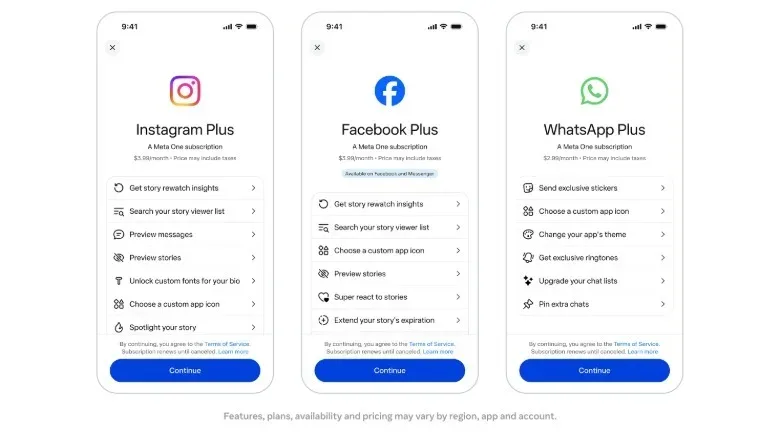
The entry-level offerings remain individual product subscriptions: Facebook Plus costs $3.99 per month, Instagram Plus costs $3.99 per month, and WhatsApp Plus costs $2.99 per month. Meta is also adding bundles that combine those benefits with greater Meta AI usage.
- Facebook Plus: $3.99 per month.
- Instagram Plus: $3.99 per month.
- WhatsApp Plus: $2.99 per month.
- Meta One Core: $7.99 per month, combining product benefits with more Meta AI usage.
- Meta One Premium: $19.99 per month, another bundled option with expanded AI access.
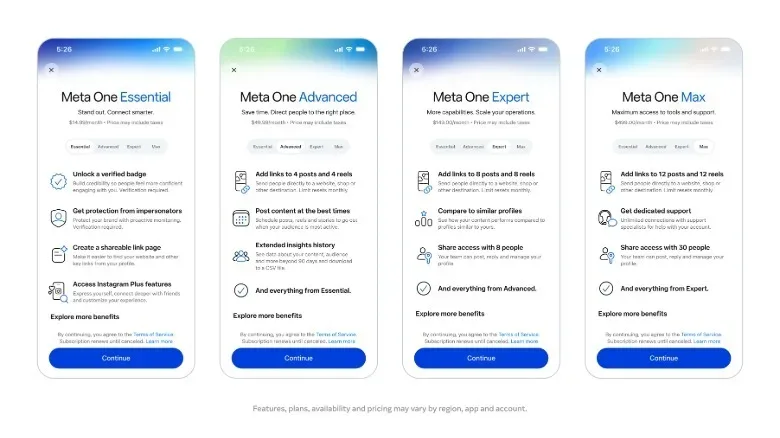
- Meta One Essential: $14.99 per month, geared toward creators and businesses.
- Meta One Advanced: $49.99 per month for Instagram business use.
- Meta One Expert: $149 per month.
- Meta One Max: $499 per month.
The pricing should not be read as a single linear feature list where every user simply moves upward. The lower plans are built around particular apps or broader bundles, while the upper plans are more clearly designed for professional accounts that may need AI capacity, publishing options, team access, account discovery tools and support.
“Expanded access” is an important phrase here. Meta specifically identifies AI image and video generation as tasks included in the bundled options, but it has not established in the supplied details a universal quota or a precise allowance for every tier. In practical terms, prospective subscribers should distinguish between a plan that includes an AI capability and one that provides enough usage capacity to make it central to a working process.
What the creator and business plans add
Meta One Essential, at $14.99 per month, combines aspects of Meta Verified subscriptions with newer AI offerings, including Meta’s business agent. A business agent is an AI-oriented tool intended for business use; the provided details do not specify all of its tasks or limits. Its inclusion nonetheless signals that Meta is treating AI assistance as part of a larger professional account package rather than as an entirely separate product.
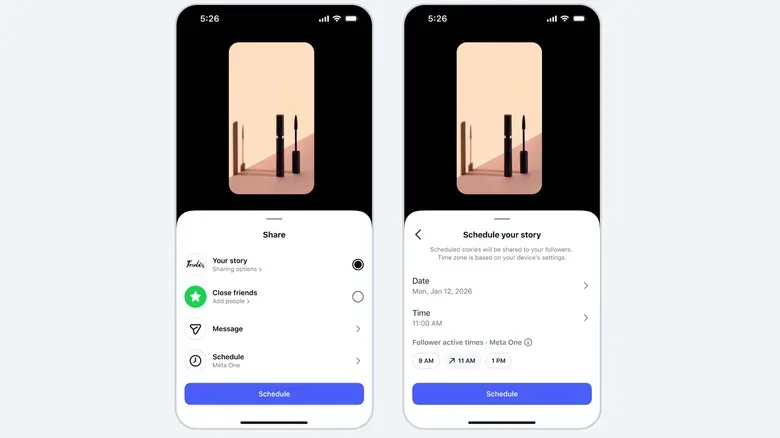
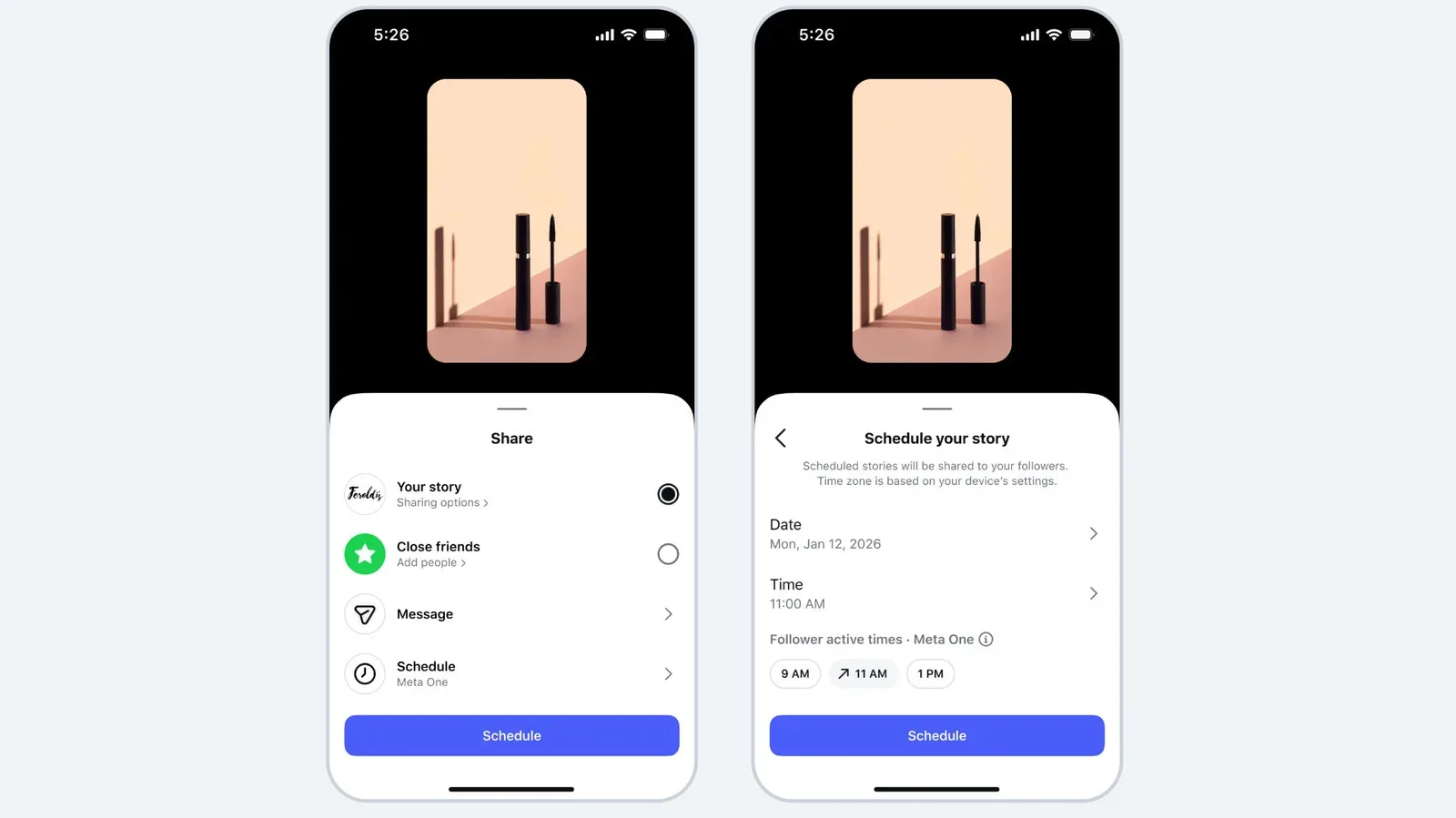
The more concrete creator-facing changes appear in the Advanced Instagram business plan, priced at $49.99 per month. It includes the ability to schedule Stories and the option to put four clickable URLs into post captions and Reels each month. The clickable-link feature had been tested earlier in the year through Meta Verified.
Scheduling Stories sounds mundane, but it addresses a real publishing constraint for any account working to a calendar. Stories are often used for reminders, time-sensitive promotions and follow-ups to a post or Reel. The ability to prepare and schedule them can reduce the need for someone to be present at the exact desired posting time. It does not make a better video or a stronger community strategy by itself, but it can make the administrative part of regular publishing less frantic.
Clickable URLs are also a practical addition, though they come with a clear limit: four per month on Advanced. A clickable URL means viewers can follow a link directly rather than copying text, searching manually or navigating through a profile link. For a creator, that could be useful when directing viewers to a video, a community page, a storefront or a specific written guide. Four links are enough to support selected campaigns, not a high-volume linking strategy.
That is particularly relevant to the broad gaming-creator ecosystem. A post about a mod, for example, may benefit from an uncomplicated path to the full coverage rather than a vague “link in bio” instruction. The same applies to a tutorial or news item, such as this look at a Metal Gear Solid 5 subsistence mod. Whether four direct links in a month justify a $49.99 subscription will depend on an account’s existing audience and how much value it places on measurable, low-friction referrals.
Team access without sharing the password
Both Advanced and Expert plans include the ability to delegate account access to additional people without giving them the account password. This is one of the most significant operational features in the announced set, even though it has none of the marketing flash of AI generation.
Delegated access means a person can work on an account under permissions granted by its owner rather than by receiving the owner’s login credentials. The supplied information does not outline individual permission levels, so it would be premature to assume exactly what a delegated user can publish, edit or view. But the core advantage is straightforward: account owners can involve collaborators without defaulting to shared passwords.
For an individual creator, this could be relevant when editing, community management, publishing and business inquiries are handled by different people. For a small team, it can also make offboarding cleaner: access can be removed without changing a password that may be used across other workflows. The feature is less about growing an audience than about reducing an avoidable point of account-security and administration friction.
Meta is also placing discovery-related perks in Advanced and Expert. Subscribers receive notifications when another account reposts original content and greater visibility in Instagram’s in-app search. Notifications may help an account keep track of how original material travels, while improved search visibility is intended to make an account easier to find inside Instagram. Neither guarantee is the same thing as a promised audience size or engagement result. They are platform advantages, not a substitute for content that people actually choose to watch and share.
The $499 plan makes support part of the product
At the top of the lineup, Meta One Max costs $499 per month. It combines the benefits described across the other plans and offers the highest-capacity access to Meta’s business agents. Its most unusual feature, however, is human support: users can make “unlimited” requests for help from an actual person and can request a phone call with a company employee.
Human support has value precisely because many platform problems are difficult to resolve through automated help channels, especially when an account is responsible for ongoing publishing or business communication. Still, the announced language should be read carefully. Meta describes an unlimited ability to request human support and the option to request a phone call. That wording does not define response times, outcomes, eligibility for every issue or a guarantee that every requested call will occur.
The $499 price means this tier is not a plausible routine expense for most casual users or small hobby accounts. It is more sensibly evaluated as a business overhead decision: can faster or more direct assistance, high-capacity business-agent access and the combined higher-tier perks produce enough operational value to offset the monthly cost? The information available does not answer that question for any particular business, but it makes clear that Meta is assigning a premium price to proximity to human assistance.
AI is central to the pitch, but not necessarily the deciding factor
Meta has been testing Meta One plans alongside resource-intensive AI features, including image and video generation. Generative AI refers to tools that create new outputs from prompts or other inputs; in this case, the relevant outputs are images and videos. Such tools can be useful for draft concepts, quick visual assets or iterative creative work, but a subscription’s usefulness depends on the quality of its output, the permitted usage level and whether the results fit the subscriber’s actual needs.
The announcement does not establish that AI features alone are the main reason users subscribe. Meta acknowledges that this remains uncertain, while saying its early plans have generated more than 15 million subscription and trial-subscription sign-ups. That figure combines paid subscribers and trials, so it should not be treated as a count of long-term paying customers. It does, however, show that the company has already attracted substantial participation while it broadens the program.
The structure of the new lineup suggests Meta is not relying on AI as a standalone sell. It is coupling AI access to practical advantages: scheduling, links, delegated access, repost awareness, search visibility and support. That approach may be more compelling to professionals, because it presents the subscription as a workflow bundle instead of asking creators to pay merely for the chance to generate another image or video.
What to consider before subscribing
Choosing among these plans is less about finding the most expensive tier than identifying the bottleneck that is actually costing time or attention.
- Start with the app you use. A Facebook-only, Instagram-focused or WhatsApp-centered need may fit a single-product plan better than a wider bundle.
- Separate AI curiosity from AI demand. Someone who occasionally wants an AI-generated visual has a different requirement from a team that expects to generate images or video regularly.
- Put a value on specific workflow features. Story scheduling, four clickable links per month and delegated access are concrete benefits. Consider how often each would be used.
- Do not confuse visibility tools with guaranteed growth. Better in-app search visibility may assist discovery, but it is not an assurance of reach, engagement or sales.
- Read support language precisely. The Max plan’s support promises concern the ability to make requests, not specified resolution standards in the information currently available.
Meta also says subscription-based features will eventually extend beyond its core apps to Edits, its video-editing app, and to its AI glasses. No timing, prices or feature breakdowns for those future expansions are included here. For now, the Meta One rollout is a substantial attempt to turn a collection of social, AI and professional-account advantages into a subscription ladder broad enough for casual users, creators, businesses and heavy users with very different expectations.