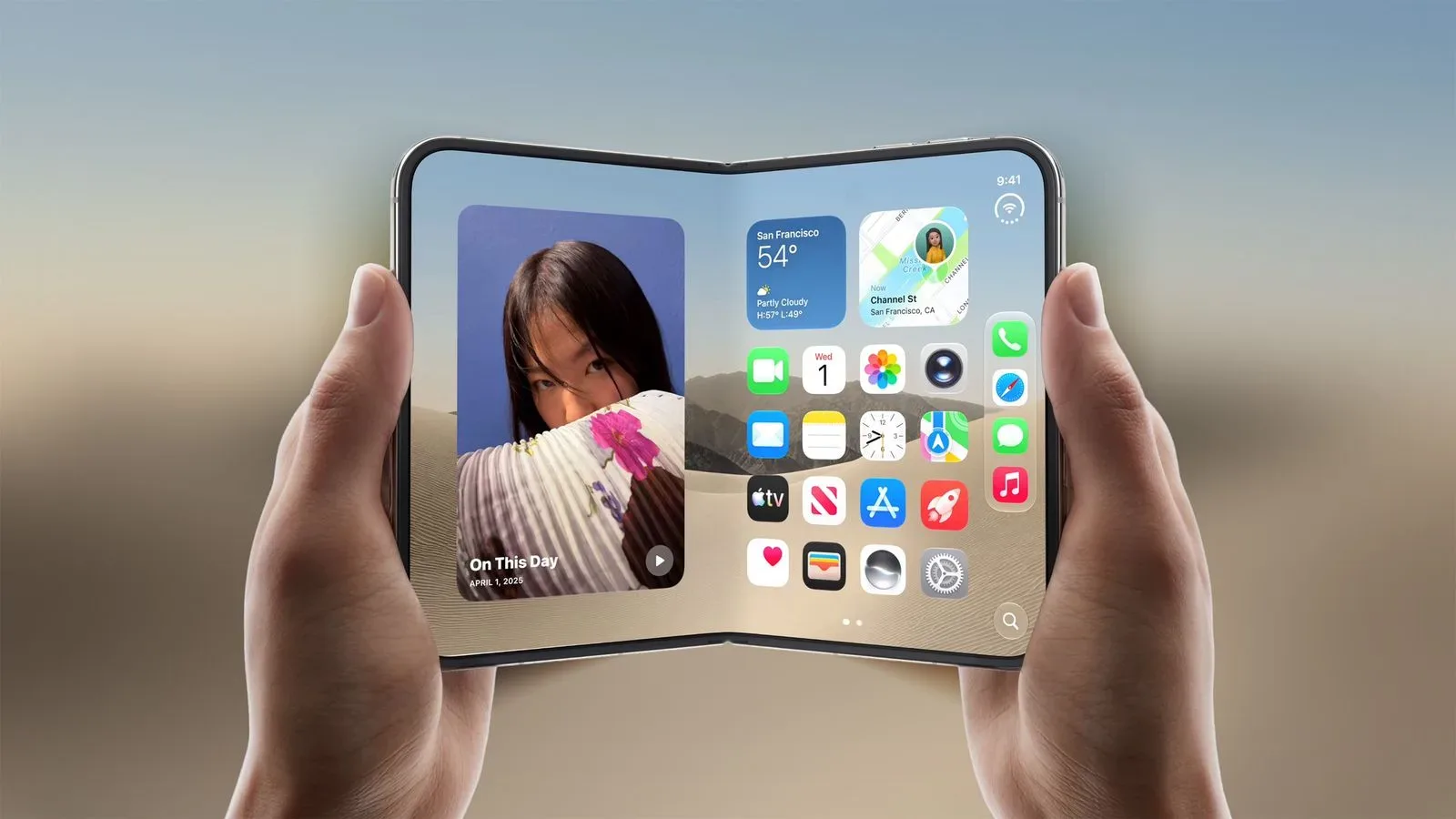
Apple’s iPhone Duo has reportedly drawn more preorders than the company expected in several major markets, a result that could matter well beyond one handset’s launch window. The immediate headline is demand for a rumored foldable iPhone. The more consequential industry question is whether that demand gives component makers and competing phone brands a reason to accelerate spending on the display technologies foldables require.
The report should be read with appropriate caution. It describes expectations and supply-chain views rather than confirmed Apple sales figures, and neither preorder totals nor the specific markets involved have been disclosed. Still, the distinction between a standard successful phone and a successful foldable is important: foldable designs demand a more specialized display stack, which can create new demand for suppliers even if the broader smartphone market remains hesitant.
The report on the preorder outlook points to display-driver companies viewing the iPhone Duo as a potential confidence boost for the category. Their focus is OLED TDDI, a component approach that brings touch sensing and display-driving functions together. It is a deeply technical acronym, but it has a practical implication: screen hardware can become a meaningful bottleneck and opportunity when manufacturers attempt to make devices thinner, more integrated and more mechanically complex.
Why foldable demand has a supplier-side impact
Foldables are not simply conventional phones with a larger panel. Their displays must work within a chassis that bends, while still handling touch input and screen control reliably. That makes display integration especially significant. The report characterizes OLED TDDI as a technical requirement for foldable products, positioning it as a likely beneficiary if more manufacturers decide the form factor has enough customer demand to justify development and production investment.
For more context, explore DaniLeigh Says Forgiveness, Faith and Motherhood Shaped ‘With Love, From Dani’.
OLED, or organic light-emitting diode technology, is the display technology named in the report. TDDI means touch and display driver integration: instead of treating touch sensing and display control as wholly separate pieces of electronics, the functions are combined. A display driver controls the display itself, while touch sensing is the layer that translates finger input into commands. Integration can be attractive because it offers a more consolidated component design.
For chip suppliers, that means the iPhone Duo’s reported reception may have value even before it is possible to judge the device’s long-term commercial performance. A strong preorder response can be interpreted as evidence that a high-profile foldable has a real audience. In turn, rival manufacturers may feel greater pressure to investigate or adopt comparable display architectures. Those rivals would not necessarily buy from Apple’s own supply chain, so the opportunity could extend to a wider set of display-component businesses.
That is the central chain reaction contemplated by the report: a successful-looking foldable launch creates confidence; confidence supports product planning at rival brands; those plans increase potential orders for integrated display parts. None of those steps is guaranteed. They are commercial decisions that depend on costs, production capacity, device design and whether early interest becomes sustained demand. But the possibility is why a preorder report can reverberate through a sector that most consumers never see.
Cost remains the limiting factor
The same outlook includes a substantial qualification. OLED TDDI is reportedly still too expensive to spread broadly through traditional flagship smartphones this year. That matters because a supplier technology only becomes a large-volume business when it reaches products made and sold at enormous scale. If the cost premium remains difficult to justify in non-folding flagship phones, adoption may be concentrated in the smaller, more specialized foldable category.
This does not make the technology unimportant. It instead clarifies the near-term market split described by the report. Foldables may provide a route to shipment growth for display-chip suppliers because the technology is regarded as necessary there, while conventional premium phones may continue using other solutions because they do not face the same design demands.
For buyers, it is also a reminder that a component’s technical relevance and its ubiquity are not the same thing. A part can be essential to a category without immediately becoming standard across all high-end devices. The iPhone Duo may therefore matter less as proof that every flagship will soon use OLED TDDI and more as a test of whether the foldable segment itself can command enough attention to support further investment.
A reported offset for weaker iPhone 18 Pro demand
The report also suggests that the iPhone Duo’s demand could help soften the effect of weaker iPhone 18 Pro sales. That framing is notable because it does not require the Duo to replace the Pro line outright. Rather, a new product category can contribute additional demand or shift attention during a period when a familiar premium model is performing more softly.
There are important unknowns here. The report does not provide sales numbers for the iPhone Duo or iPhone 18 Pro, does not establish the scale of any slowdown, and does not show how many buyers may be choosing one model instead of another. As a result, it would be premature to treat the Duo as a confirmed solution to any broader iPhone demand issue. What can reasonably be said is that strong interest in a new form factor may give Apple another high-end product through which to maintain momentum.
That prospect is especially relevant in a second half of 2026 described as a period of subdued consumer demand for the industry. In a softer market, an eye-catching device category can be more important because it gives manufacturers a way to compete for purchases that may otherwise be delayed. For suppliers, the appeal is even clearer: devices with more sophisticated display arrangements can raise demand for higher-value components.
The touchscreen MacBook angle
The report does not limit its display-industry expectations to phones. It also identifies Apple’s rumored touchscreen MacBook as another possible investment catalyst, this time for notebook display hardware. As with the iPhone Duo, this is an unconfirmed product direction, not a confirmed release plan. But the component logic is straightforward: adding touch capability to a notebook display expands the need for touch-related electronics alongside display-control systems.
A timing controller, often shortened to TCON, is another component mentioned in the report. Its job is to coordinate display operation. In the context presented here, a touch-enabled notebook can create opportunities for more advanced integrated touch-and-display drivers and timing controllers. That does not mean every notebook would immediately need the same components, nor does it establish what features a touchscreen MacBook would have. It explains why display suppliers may regard the possibility as commercially meaningful.
The larger theme is product complexity. A device that adds a touch layer or a folding screen can require a different mix of components from a more conventional design. Suppliers are watching for products that can make those designs more common, because wider adoption would expand the addressable market for specialized parts.
What to watch next
The reported preorder performance is an early signal, not a final verdict on foldables. Several developments would determine whether the optimism described by display-industry sources turns into a broader market shift:
- Whether reported preorder interest holds through wider sales: Early reservations can indicate enthusiasm, but sustained consumer demand is the more useful measure for long-term manufacturing plans.
- Whether competing manufacturers commit to similar hardware: Supplier optimism depends on rival adoption, not solely on Apple’s product performance.
- Whether OLED TDDI costs fall enough for conventional flagships: The report identifies price as the main hurdle outside foldables.
- Whether the overall demand environment improves: A subdued second half of 2026 could restrict the willingness of brands to take risks, even if a new category attracts attention.
- Whether a touchscreen MacBook materializes: If it does, notebook-display investment may become another area of interest alongside foldable phones.
For the moment, the most defensible reading is measured rather than triumphant. The iPhone Duo is reportedly off to a better-than-anticipated preorder start in several major markets. That has given display-component companies a reason to look again at foldables and integrated OLED touch technology. Yet the report’s own cost warning shows why a promising specialized use case should not be confused with immediate, industry-wide adoption.
Apple’s potential influence in this scenario is less about a single product’s headline and more about what a visible launch can signal to the rest of the hardware chain. If competitors interpret the iPhone Duo as evidence that consumers will pay attention to foldables, investment in the parts behind those devices could grow. If they do not—or if costs remain stubbornly high—the technology may remain a foldable-focused niche for longer.