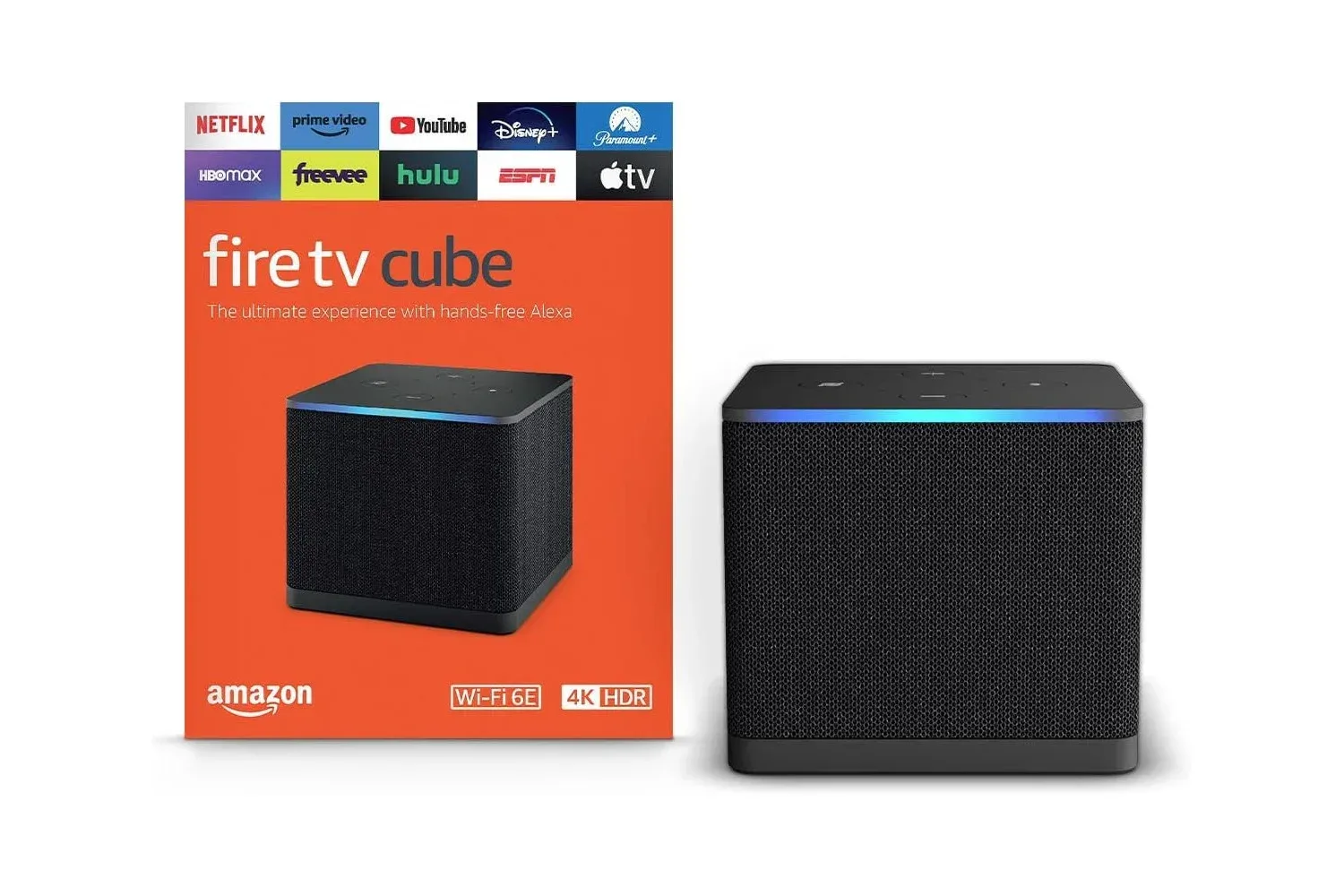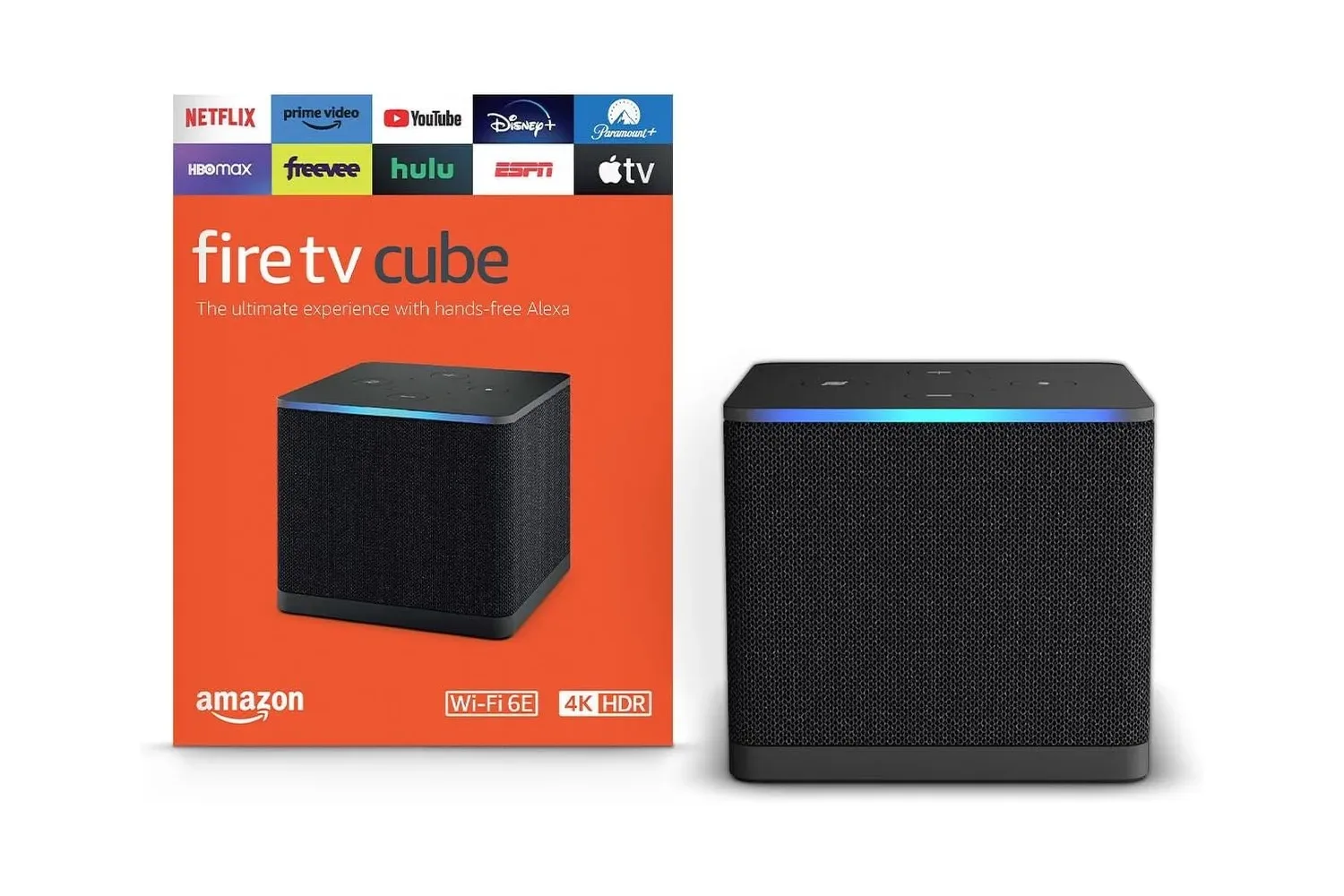
Amazon’s Fire TV Cube is listed at $110, reduced from $200. That is a $90 difference, or 45% off the stated regular price, for a device that is more ambitious than a basic streaming stick: it combines a 4K streaming player, a built-in Alexa speaker and hands-free voice controls in one compact box designed to sit beside a television.
For a gaming and entertainment setup, the important distinction is simple. The Fire TV Cube is not merely a way to add streaming apps to a screen. It is intended to act as a control point for a television, compatible soundbar or receiver, and compatible Alexa smart-home devices. Whether that broader role is useful is the real question behind the deal.
What is included in the Fire TV Cube
The Cube supports 4K UHD streaming and lists Dolby Vision, HDR10, HDR10+ and HLG among its high-dynamic-range video formats. It also supports Dolby Atmos audio, includes an Alexa Voice Remote, has far-field microphones for hands-free Alexa, and provides 16GB of internal storage for apps and games.
Its connectivity is notably broader than the usual minimalist streaming-device approach. The box includes Wi-Fi 6E compatibility, Ethernet, HDMI input and USB. It is powered by an octa-core processor, which is meant to make app loading and menu navigation feel quicker.
- Current listed price: $110
- Stated regular price: $200
- Claimed discount: $90, or 45%
- Video: 4K UHD, Dolby Vision, HDR10, HDR10+ and HLG
- Audio: Dolby Atmos support with compatible equipment
- Networking: Wi-Fi 6E compatibility and built-in Ethernet
- Storage: 16GB for apps and games
- Control options: hands-free Alexa and an included voice remote
Hands-free controls are the Cube’s main differentiator
The practical appeal of the Fire TV Cube is its built-in speaker and microphones. Instead of needing to pick up the remote, users can ask Alexa to begin playing a title, alter television volume, turn a television on or off, check the weather, set a timer, play music, or control compatible Alexa-enabled smart-home devices. Those voice functions remain available when the TV is off, giving the product a second role as a smart speaker.
Far-field microphones are microphones designed to recognize voice commands from farther away than a close-talk remote microphone. In this case, that means the device is intended to hear requests from elsewhere in the room. The benefit is convenience: a remote can stay on the table rather than becoming the mandatory gateway to every adjustment. The trade-off is more conceptual than technical: households that do not want an always-ready voice assistant in the living room may get less value from the Cube’s signature feature.
The supplied Alexa Voice Remote still has dedicated mute, volume and power buttons. That matters because voice control is best seen as an extra route to the same functions, not a requirement for every small change. Someone who wants a conventional remote-first experience still has one.
Picture and sound terms, explained
The Fire TV Cube’s format list will only deliver its full benefit when the television and audio equipment support those formats too. Compatibility is not a vague footnote here; it determines what picture and sound options the system can use.
4K UHD refers to a high-resolution video format. The Cube can stream in 4K UHD, but a 4K television is necessary to view that resolution as 4K. On a lower-resolution display, buying a 4K-capable player does not turn the screen itself into a 4K panel.
HDR, short for high dynamic range, is about image contrast and color rather than resolution alone. Dolby Vision, HDR10, HDR10+ and HLG are HDR formats supported by the Cube. On a compatible 4K UHD television, these formats are intended to improve color reproduction and contrast. Since different TVs support different HDR standards, the long list is useful because it gives the device several possible paths to match an existing display. It is not, however, a guarantee that every format will be active on every TV.
Dolby Atmos is an immersive audio format. The Cube supports it, but the intended listening benefit depends on pairing it with compatible audio hardware, such as a soundbar or receiver. A buyer using only a television’s own speakers should not assume the presence of an Atmos logo alone changes the whole audio experience.
The device also offers Super Resolution upscaling for HD content on a 4K UHD TV. Upscaling means processing a lower-resolution image for display on a higher-resolution screen. It can help HD material look more suited to a 4K display, but it does not create a native 4K source. That distinction is especially useful for anyone weighing a purchase around older video libraries or non-4K streams: upscaling is enhancement, not replacement footage.
Network and port considerations before buying
Wi-Fi 6E compatibility is one of the Cube’s forward-looking connectivity features. It can support smooth streaming when paired with a compatible router. That final condition is essential. A household without a compatible router should not expect to access Wi-Fi 6E simply by connecting this one device.
For setups where wireless reliability is a concern, the built-in Ethernet port provides a wired alternative. Wired networking can also make sense when the streaming box is positioned near a router or an existing Ethernet connection. The source material does not make a performance guarantee for either connection method, but the availability of both gives buyers a choice based on their room layout and network hardware.
The HDMI input and USB port add to the Cube’s hub-oriented design. Alongside the ability to control compatible TVs, soundbars and receivers, these ports reinforce the idea that the device is meant to sit in the middle of a living-room arrangement rather than function only as an app launcher. The exact usefulness of that arrangement will depend on the specific equipment already in the home and whether it is compatible.
For more context on a lower-cost Amazon television option—and why display specifications can matter as much as a headline discount—see our look at the Amazon Ember 32-inch 2-Series Fire TV and its 720p trade-off.
Where it fits in an entertainment and gaming room
Fire TV offers thousands of apps and channels, including streaming services, free television and live-TV options. The Cube’s 16GB of storage can hold apps and games, so it has room for more than a bare-bones selection of services. Its processor is positioned as the component that keeps browsing those options and moving through menus responsive.
For players, that description should set the right expectations. The provided specifications establish that the device can store games, but they do not establish it as a dedicated console or describe game-specific performance. Its clearest role is as a streaming and entertainment device that can organize video apps while reducing the number of separate controls in a TV area.
That may be particularly appealing in a room where a console, TV and sound system already compete for remotes. The Cube can control a television and compatible soundbars or receivers, while its Alexa functions can handle routine requests at a distance. On the other hand, a person who only needs a simple way to watch a couple of streaming services may not need the built-in speaker, far-field microphones, HDMI input, Ethernet and smart-home layer that help define this product.
Who should consider the $110 price
At the listed discount, the Fire TV Cube is best understood as a bundled living-room device. It makes the strongest case for someone who wants 4K streaming, uses or wants to use Alexa, has compatible home-theater gear or smart-home products, and would benefit from controlling several pieces of equipment through one device.
It is also a more logical match for buyers with a compatible 4K HDR TV and, if immersive audio is a priority, compatible sound equipment. Those are the conditions under which the format support has the most room to matter. Similarly, Wi-Fi 6E is a bonus for households with an appropriate router, while Ethernet remains useful to buyers who prefer a physical network connection.
The discounted price is substantial relative to the stated $200 regular price, but the purchase is still less about obtaining a generic streaming endpoint than deciding whether the Cube’s added control features belong in the room. If hands-free Alexa, central device control and the expanded port selection solve genuine setup annoyances, $110 is a materially different proposition. If a remote-operated streamer is all that is needed, much of the Cube’s purpose may go unused.
Shop the products
Check current price, model and availability at the retailer.