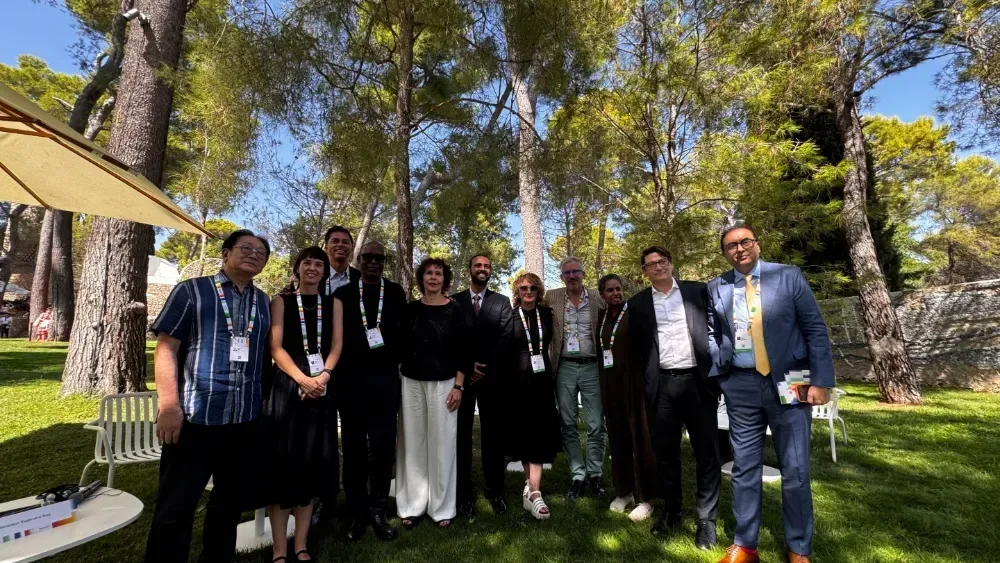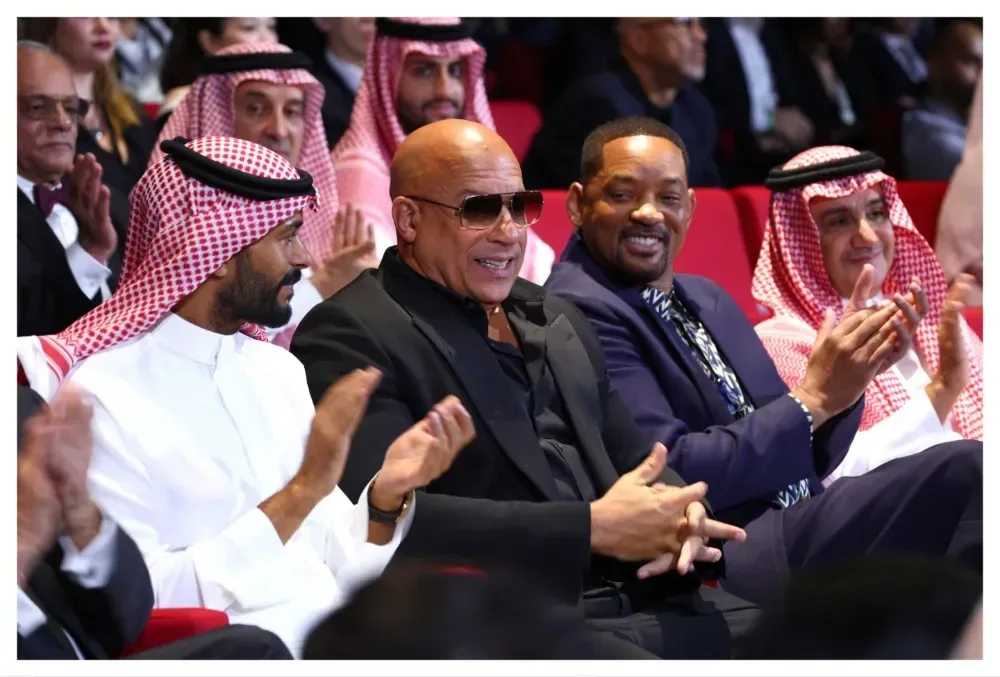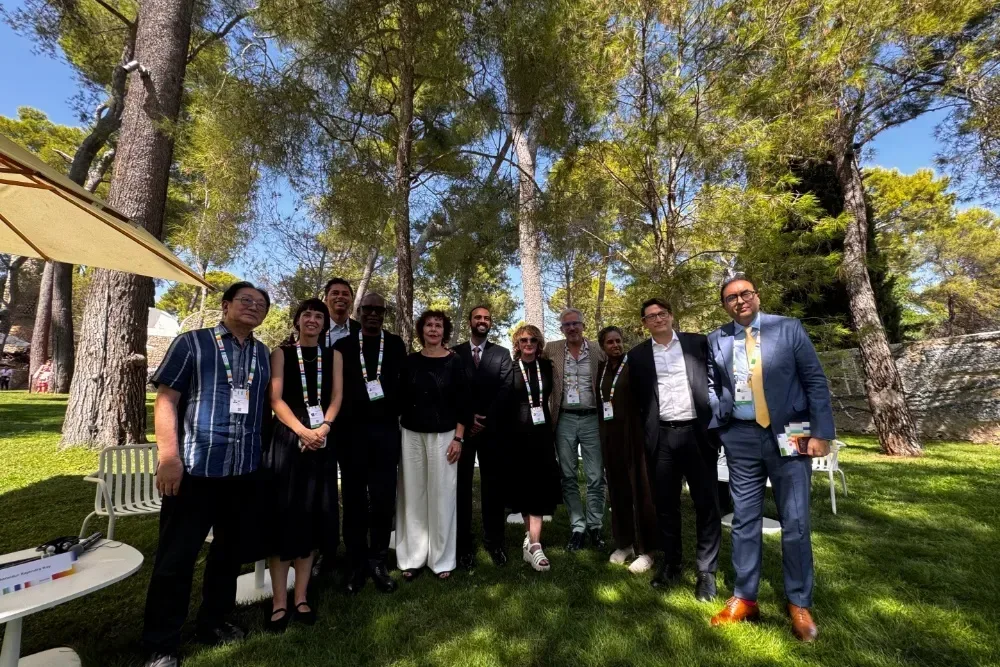
Film and television festivals are often sold to the public as glamorous temporary cities: red carpets, surprise premieres, packed theaters and the occasional celebrity photo that conquers social media before the credits have rolled. But the people responsible for running those cities spent a Lumière Summit panel in Saint-Paul-de-Vence, France, discussing the much less sparkly work of keeping them open, independent and useful.
The central concern was political pressure on programmers and institutions. During a session called Easy to Criticize, Impossible to Replace: Rethinking the Festival, leaders from major international festivals and industry organizations examined the push and pull between artistic selection, public access, media coverage, financing and national politics. Rajendra Roy, MoMA’s chief curator of film, moderated the discussion.
Laurence Herszberg, general director of Séries Mania, gave the panel’s clearest statement of principle: artists should be assessed through their work rather than their nationality. Her comments addressed a tension increasingly faced by programmers, who may be challenged by politicians, organized groups or members of the public over the inclusion of work from particular countries.
For Herszberg, the issue is not abstract. Séries Mania is free to attend and has 1,500 seats, a structure that welcomes an unusually broad public while making it impossible to tightly control every person entering the venue. In that setting, programming freedom depends on institutions receiving meaningful protection while continuing to advocate for the artists whose work they show.
Festivals are cultural meeting places, not passport checkpoints
Cameron Bailey, chief executive of the Toronto International Film Festival, expressed a closely aligned position: filmmakers should not be treated as stand-ins for their governments. That distinction is essential to the basic promise of an international festival. A festival asks audiences to encounter works made across borders, languages and political systems; reducing a filmmaker to a passport can erase the very individual perspective that the program is meant to foreground.
Bailey also looked back to joining Toronto as a programmer in 1990, when festivals felt more open and unconstrained. The nostalgia was not merely for a simpler era. It highlighted the current challenge: preserving an environment in which difficult, unfamiliar or politically charged art can be screened and debated without festival teams being pushed into performing someone else’s geopolitical sorting process.
That does not mean festivals can operate outside public debate. They are public-facing cultural institutions, frequently supported by public money, sponsors, ticket buyers and a local community. Their choices will be scrutinized. The point made in Saint-Paul-de-Vence was that scrutiny must not become a veto over the programming process itself.
Tricia Tuttle, director of the Berlinale, shifted attention to the people in the seats. The Berlinale recorded 450,000 admissions last year and has itself been caught in political controversy. Tuttle’s answer to the stack of pressures facing festivals was to keep audiences at the center, including people who do not yet think of themselves as devoted cinema-goers.
That framing matters because an audience is not just a ticket total. It is a constituency for cultural activity. Festivals with loyal, varied and engaged local audiences have a stronger argument for their value than events understood only as industry gatherings or invitation-only showcases. The challenge is to serve committed film fans without assuming the next generation will automatically appear, already fluent in auteurs, awards calendars and 11 a.m. subtitled screenings.
Access is audience development, not an optional extra
The panel produced several examples of festivals building their public beyond the familiar professional circuit. Toronto’s Next Wave youth program is now 15 years old. Bailey described it as a long-term audience investment, and pointed to the program’s support for Obsession, which went on to become one of the largest film-festival sales in a long time.
There is a useful lesson in that example. Younger viewers are not merely tomorrow’s consumers waiting to be trained; they can be active advocates today, helping identify movies with genuine energy around them. Festivals often build prestige through juries, critics and premiere status, but an enthusiastic audience group can be another powerful signal that a film has connected.
Toronto is also launching its first formal market this year. Bailey characterized that commercial layer as a source of nourishment for the festival ecosystem, supporting the continued flow of ambitious films. Markets may sound like the least romantic portion of festival life—contracts rarely photograph as well as premieres—but financing, sales and distribution determine whether discoveries can travel beyond a single screening.
Shivendra Singh Dungarpur, founding director of the Film Heritage Foundation and director of Mumbai’s MAMI Festival, likewise made a forceful case for access. MAMI’s events are free, and restored-film screenings regularly draw between 1,000 and 1,400 attendees. The festival’s MAMI Independent outreach effort has also worked with a major cinema chain to bring independent films to cities around India before the festival itself begins.
Those restored-film crowds are a reminder that preservation need not be a closed conversation among specialists. Physical-media collectors and repertory audiences already understand the thrill of encountering older work in a format that respects it, whether on a carefully curated disc shelf or at a theatrical screening. Recent interest in rediscovered cinema is also evident in projects such as Sergei Loznitsa’s Imperium, built from archival film. Dungarpur’s figures suggest that restored work can attract a substantial public when it is presented as a living cultural event rather than homework from history class.
At Annecy, Mickaël Marin has sought to widen the animation festival’s reach since taking the role in 2018. Annecy traditionally functions as a major professional meeting point for animation, spanning students, schools, studios and platforms. Its permanent exhibition space, which opened last June, is part of an effort to make the festival more legible and welcoming to general audiences as well.
Magdalene Reddy of the Durban FilmMart Institute offered a different but equally important reality check. In Africa, she said, the obstacle is not a lack of potential audiences. The problem is reaching those audiences when cinema infrastructure is insufficient. Community engagement, in that context, means physically going out into communities instead of waiting for viewers to reach a conventional theater.
The visibility problem: press, scale and discovery
Festivals also need media attention, but the relationship has become more complicated as newsroom resources shrink and online publishing speeds up. Maialen Beloki, deputy director of San Sebastián, noted that fewer critics are being sent to festivals each year. The loss is bigger than a reduced pile of reviews. It reduces the time available to discuss films with care, perspective and respect.
A fast online news cycle can efficiently identify winners, acquisitions and surprise appearances. It is less well designed for criticism that develops over a full program, spots emerging patterns or gives difficult films room to breathe. If coverage becomes limited to immediate headlines, the cultural value of a festival risks being measured by what can be posted fastest.
Peter Debruge, director of the South by Southwest Film & TV Festival, argued that studio-scale titles can still be crucial to discovery. High-profile films generate attention from press and audiences, creating a bigger tent under which smaller projects can be noticed. The idea is not that every festival must become a blockbuster parade; it is that recognizable attractions can supply the visibility that helps riskier work find viewers.
Iris Knobloch, president of Cannes, offered a snapshot of that global gathering function: 40,000 accredited participants from 140 countries and more than 4,000 journalists attend annually. Those numbers explain why large festivals remain uniquely consequential. They can bring talent, buyers, reporters and audiences into one compressed place where a single screening may start a much longer international journey.
Faisal Baltyuor, chief executive of the Red Sea Film Foundation, described a recent edition in which every screening sold out. He also said 11 films backed by the foundation appeared in Venice, while eight were heading to Toronto. For emerging filmmakers, this kind of institutional bridge can make the difference between completing a project and gaining the connections needed to reach an international stage.
An interdependent global system
The panel ended with a blunt yes-or-no question: could festivals survive without the American industry? Reddy alone answered no, while stressing that her own work remains focused on African content. Her response underlined a practical reality. Global festivals promote regional voices, but they operate within an interconnected system of financing, distribution, publicity, platforms, talent and trade relationships.
That interdependence should not be confused with creative uniformity. The strongest message from the discussion was that festivals have value precisely because they convene different cultures and artistic traditions without demanding that each one be filtered through a single national or commercial lens. The operational pressures are real: political campaigns, security concerns, scarce critical coverage, uneven access to theaters and the constant need to attract new audiences.
Yet the shared defense of programming autonomy pointed toward the reason festivals remain difficult to replace. They do more than schedule films. At their best, they create temporary public spaces where art can be encountered, challenged and discussed on its own terms—and where a viewer can take a chance on something they would never have found alone.