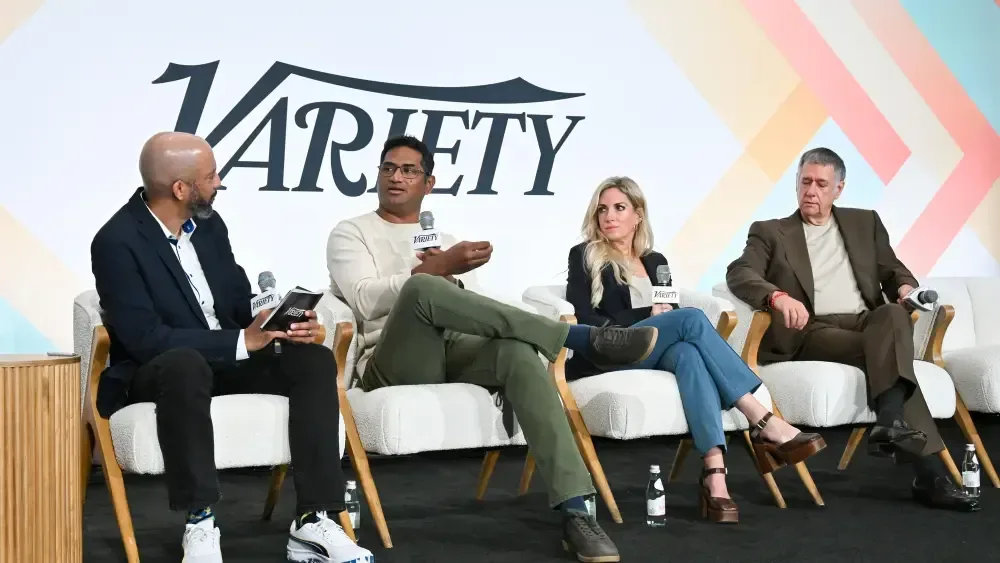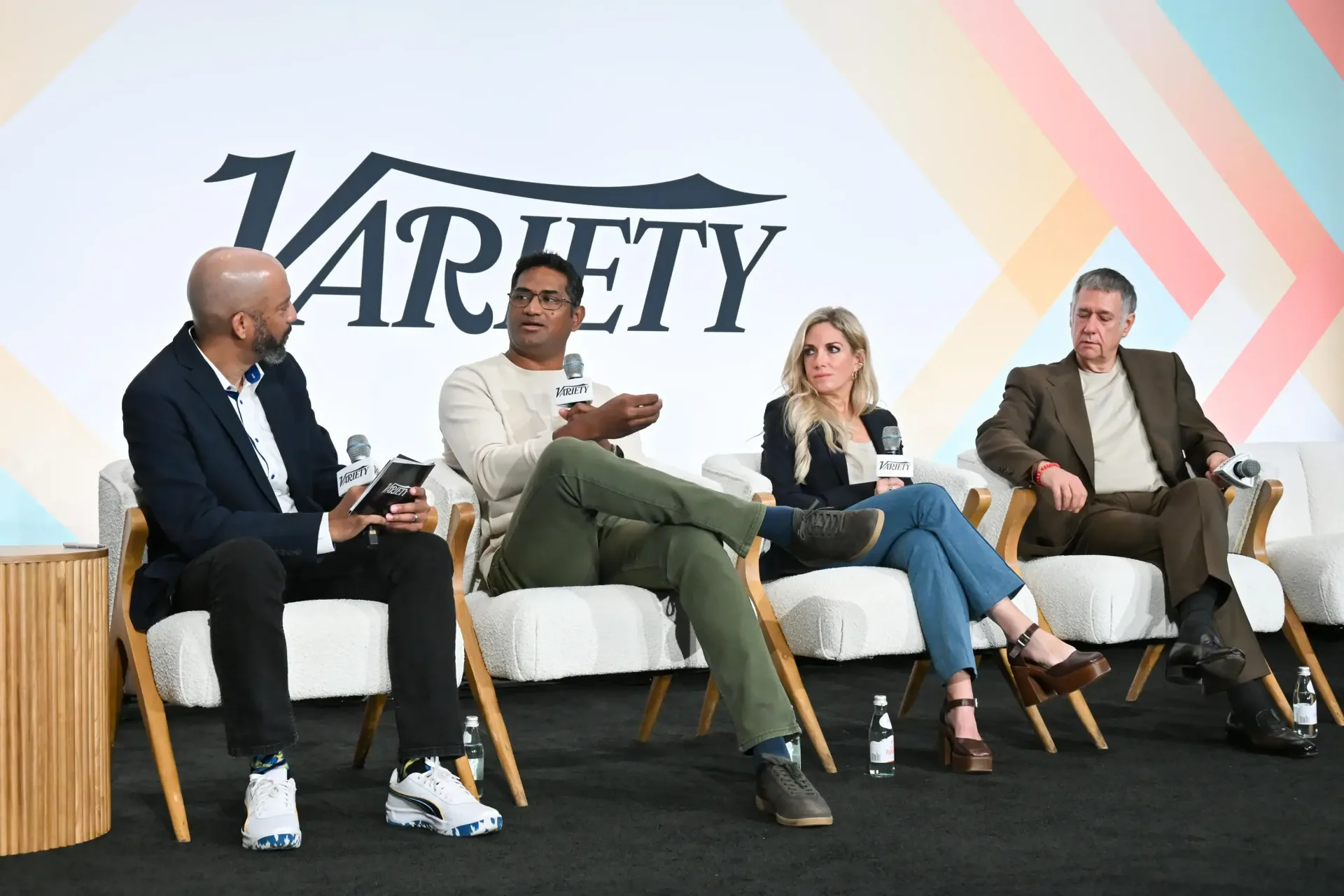
Artificial intelligence may be heading beyond recommendation feeds and generated images toward a less solitary role in entertainment: helping fans encounter familiar characters, music and archives in ways that can be tailored to an individual without losing the reason people gather in the first place.
That was the central idea at a recent entertainment-and-technology discussion featuring Vamsi Duvvuri of EY Americas, Warner Bros. Discovery Global Experiences and Studio Operations president Simon Robinson, and Nvidia Global Head of Audio and Music Developer Relations Shari Reich. Their examples ranged from long-neglected media catalogs to a studio-tour interaction with a Superman character, but the common point was more measured than the usual “AI changes everything” pitch. The technology is potentially useful when it helps a company understand what it owns, delivers a purposeful guest interaction, and preserves a social layer fans actually value.
For game players and broader pop-culture audiences, that distinction matters. A personalized experience is not automatically a better one, and an AI feature is not automatically a creative experience. The strongest case made in the discussion was for AI as an enabling layer: a way to make an archive searchable, a conversation less repetitive, or a piece of music more easily shared. It is a case for systems working behind the scenes and within carefully defined boundaries—not a claim that an algorithm should replace the artist, performer, or communal event.
The archive problem: valuable material that is difficult to find
Reich pointed to the vast catalogs held by entertainment businesses, including demos, video clips and large music libraries. The practical problem is not merely that material exists. It is that organizations may not have a complete, usable picture of what sits in storage, what rights or context surround it, and how a fan, producer or curator could discover it.
This is where metadata becomes central. Metadata is information that describes an asset rather than the asset itself: a track’s performer, a video’s subject, a clip’s date, a character’s name, or a descriptive tag attached to a scene. It is what makes a deep catalog navigable. If the labels are incomplete, inconsistent or missing, a library can hold plenty of cultural value while remaining functionally buried.
Duvvuri stressed that tagging catalog material and identifying its details remains heavily manual. AI could assist with that labor, but he also emphasized a crucial limitation: good AI depends on good data. In practical terms, an automated system can only be as dependable as the material, labels and rules used to build it. A tool that is asked to identify and organize assets without reliable underlying data may create new errors faster than people can spot them.
That is an especially useful corrective to a common misconception. Catalog digitization and content generation are not the same job. Digitization and tagging are about making existing materials legible and available inside a catalog. Generative AI is generally discussed as technology that creates new output from patterns in data. The panel’s most grounded opportunity concerned the former: bringing existing “crown jewels” into view so they can support discovery and new fan uses.
There is also an important creative implication. Better catalog visibility could help companies surface legitimate, existing material rather than treating AI solely as a machine for producing more content. That does not resolve every question around rights, attribution or artist control, but it directs attention to an immediate operational problem: knowing what material is already available and describing it accurately enough to use responsibly.
Related coverage includes Entertainment Leaders See AI as a Tool for More Personal, Shared Fan Experiences.
Why a studio-tour robot needs more than 15 minutes of dialogue
Robinson offered a concrete example from Warner Bros. Discovery’s Burbank studio tour. Guests can interact with Gary, Superman’s robot aide from James Gunn’s 2025 film, in the Fortress of Solitude setting. The current interaction is programmed for roughly 15 minutes, Robinson said, after which repeated material becomes a risk.
The potential AI use case is straightforward. Instead of a fixed, linear set of exchanges that every guest eventually exhausts, a system could shape the interaction differently from one visitor to another. Robinson said that could make encounters with Gary—or with the Sorting Hat from the Harry Potter franchise—more personal on a guest-by-guest basis.
Personalization, in this context, does not necessarily mean an AI creating unlimited new canon for an established franchise. At its most basic, it means adapting the order, selection or phrasing of an experience to the person participating. The difference is meaningful. A well-bounded character interaction can offer variety while maintaining a recognizable voice, clear safety limits and a coherent relationship to the property. An unbounded system raises a much harder question: who determines what the character can say, and how is that quality controlled?
The discussion did not lay out a finalized product or deployment timetable for such an experience. It did, however, highlight the design challenge any attraction faces once it adds conversational technology. Avoiding repetition is appealing, but novelty by itself is not an experience strategy. The interaction must still suit the location, the character and the audience. A guest may welcome a playful, personalized prompt from a robot guide, while the same approach could feel distracting or off-brand elsewhere.
This is why Duvvuri’s warning against deploying AI simply for AI’s sake is so relevant. An attraction should begin with an actual problem—such as an interaction becoming repetitive—and decide whether AI solves it better than conventional scripting, performance design or a larger bank of authored material. Technology is a means, not the thematic hook.
Personal doesn’t have to mean isolated
The more interesting tension from the session was between customization and collective participation. Robinson used Taylor Swift’s Eras Tour as an example of why fans seek shared settings: audiences do not attend a stadium event merely to receive an isolated experience. They are there with thousands of other people, reacting together in real time.
That observation applies across games, concerts, tours and fandom events. Individual tailoring can make a visitor feel recognized, but a live experience often derives much of its force from the knowledge that other people are seeing, hearing or responding alongside them. The design goal, then, is not to turn every fan into a separate audience of one. It is to find where personalization can enhance the common moment.
A studio tour could potentially tailor a character encounter while keeping the overall attraction shared. A music platform can help a listener explore a catalog while making it easier to pass that discovery to another person. Those are different forms of social participation, but both avoid presenting AI as a sealed-off, private assistant.
For entertainment companies, the practical question is whether the feature creates a worthwhile reason to talk, return or share—not merely whether it produces a different output for each user. A personalized feature that cannot be explained, remembered or shared may have limited fan value. Conversely, a carefully constrained tool can become part of how people compare experiences and introduce each other to material.
Music tools and the question of artist integrity
Reich pointed to Spotify’s AI-powered DJ tool and its upcoming AI remix tool as an example of personalization that can live within a platform where users share with each other. She framed the appeal as more than music generation: fans may engage with songs, make use of remix-oriented tools, and circulate those interactions person to person.
Her emphasis on maintaining artist integrity is a key qualifier. In this setting, artist integrity means that a feature should respect the creator and the work rather than reducing music to raw material for any result a user can produce. The discussion did not specify the mechanics or guardrails of Spotify’s upcoming tool. It did make clear that the perceived value of these systems is connected to how they balance fan participation with the identity and standing of the underlying work.
That balance has broader relevance to every franchise-based AI project. The value of a recognizable character or song comes partly from the creative decisions already embedded in it. A company seeking more engagement cannot assume that unrestricted alteration strengthens that value. Tools that invite participation need an intentional design: what can be changed, what remains fixed, what gets shared, and what standards determine whether an output represents the property appropriately.
The same principle is visible in adjacent consumer technology, where AI is increasingly framed as a practical feature set rather than one single product category. AI-focused software changes can also arrive as part of a wider quality-of-life package, a useful reminder that usefulness depends on the specific task being improved.
Data, intent and the limits of the pitch
The panelists’ examples point to a version of AI adoption that is less about spectacle than infrastructure and experience design. First, catalog holders need accurate data and workable metadata. Second, creators and operators need boundaries around characters, music and other intellectual property. Third, the experience needs a human reason to exist—better discovery, less repetition, easier sharing or a stronger communal occasion.
None of that makes the work automatic. In fact, it suggests that much of the crucial work remains human: deciding which catalog details matter, establishing what an interactive character should and should not do, and identifying where fan participation serves a property instead of diluting it. AI may accelerate sorting, selection and variation, but it does not eliminate the need for editorial judgment.
The most credible near-term promise is therefore modest but significant. Entertainment companies have deep libraries and live experiences that can become more responsive if they are organized carefully and designed with intent. The most durable fan experiences, though, are unlikely to be those that simply prove AI was involved. They will be the ones that make an archive easier to discover, a familiar encounter feel less canned, or a personal moment worth bringing back to the crowd.