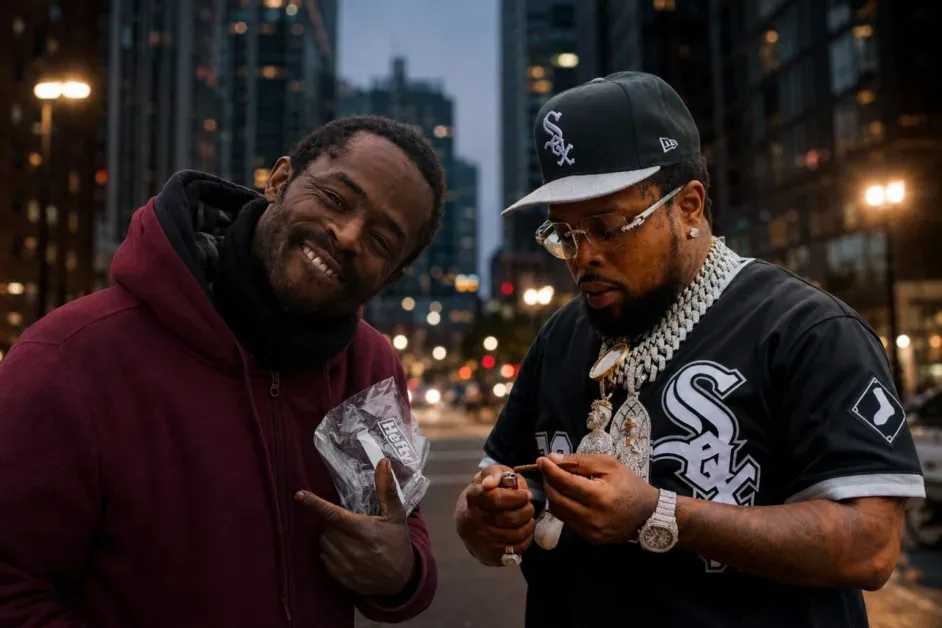
Eastside Flip, the Buffalo figure whose presence became inseparable from a defining stretch of Westside Gunn’s Griselda world, has died in a hit-and-run accident. Confirmation was shared through Flip’s personal Instagram account. He was a familiar face to listeners who encountered him through the cover art for 10, music-video appearances and later work connected to Gunn, but his significance was never limited to being recognizable artwork.
For Griselda’s audience, Flip represented something unusually tangible in an era when music branding can be flattened into fonts, merch drops and endlessly replicated social-media poses. He was part of the real Buffalo environment that informed the label’s presentation. His appearance, his personality and his connection with Gunn supplied a human dimension to a visual universe often discussed for its luxury, wrestling, art and street-rap references.
That distinction matters while remembering him. Eastside Flip should not be reduced to a memorable album cover or an element of an aesthetic. The available account of his life places him in Buffalo’s East Side, where he was known locally for freestyling and for a magnetic personal presence. He also faced addiction, a struggle Gunn addressed publicly at different points. Those facts together describe a person with a life beyond the fragments fans saw in promotional images and videos.
A presence that carried beyond the cover
Flip’s association with 10 gave him a lasting place in the visual history of Westside Gunn’s catalog. Album art can sometimes become as durable as the music it contains, particularly when it communicates a larger point of view rather than simply advertising a release. In this case, Flip’s image helped make the project feel grounded in a particular community and a particular set of relationships.
His role extended beyond that artwork. He appeared across multiple Griselda-connected moments, including the video for “Super Kick Party.” Those appearances gave audiences a sense of his energy rather than presenting him as a static emblem. For people coming to the music from outside Buffalo, Flip became one of the faces that made the label’s world feel personal, local and lived-in.
Griselda’s rise has always involved a tension between carefully curated presentation and a sense that the presentation comes from actual people and places. The label’s visuals are deliberate, but they are not built only from abstract references. Friends, neighborhoods, family histories and familiar personalities can be part of the frame. Flip’s visibility showed how much an independent music culture can be shaped by someone who is not following the standard industry route.
That is also why the language around his legacy deserves care. Calling someone an “aesthetic” can erase the person whose life gave the image its power in the first place. Flip was not a prop added to a polished campaign. The connection described between him and Gunn was a friendship, and the work he appeared in was only one public expression of it.
Gunn’s public support was rooted in friendship
Westside Gunn had spoken candidly about loving Flip and wanting to see him succeed. He also described stopping to spend time with him in Buffalo whenever he was back in the city. That public insistence on their bond became especially significant when outsiders questioned what support for Flip looked like or why his circumstances had not changed.
In December 2022, after Flip overdosed, Gunn defended him publicly and pushed back against simplistic criticism. The response focused on the difficult, ongoing reality of addiction and on the limits of spectators assuming they understand another person’s situation. It was a necessary correction to a familiar online habit: seeing a vulnerable person near a celebrity and treating a complicated life as a problem with an easy, performative solution.
Gunn’s support was also described through concrete opportunities and shared experiences. Flip traveled with him to Miami for Art Basel, appeared on tracks and remained part of the broader creative orbit. None of that turns a deeply difficult personal struggle into a neat story, nor should it. It does show that the relationship involved effort and continued inclusion rather than a one-time use of a striking image.
There is an important difference between visibility and care, but Flip’s story illustrates that they do not have to be opposites. Being seen can be meaningful when the person is treated as a friend and collaborator rather than a disposable source of attention. Gunn’s words and actions, as described publicly over the years, made clear that he viewed Flip as the former.
His last known appearance in the catalog
Flip’s final appearance connected to Westside Gunn’s releases came on the 2025 album 12. That detail gives his place in the catalog a continuity that stretches well beyond the era of 10. He remained present as Gunn’s artistic universe continued to evolve, rather than becoming a frozen reminder of a single celebrated project.
For listeners revisiting those releases, the images and videos may now carry a different weight. That is often how cultural memory works: a face once associated with a mood, a song or a release cycle comes to hold memories of the person and the relationships behind the work. The instinct to collect, archive and revisit such artifacts can be powerful, although it is worth remembering that objects and media are records of a life, not replacements for it. That tension is familiar in the emotional cycle of collecting, where attachment can shift from acquisition to the meaning people assign to what they keep.
In Flip’s case, the meaningful record is broad: an album cover, a video, music appearances, local stories of his freestyle ability, and the repeated evidence that he mattered deeply to people around him. The public is likely to remember the imagery first because imagery travels quickly. But the more complete picture is of a Buffalo resident whose visibility came from authenticity rather than conventional celebrity polish.
Remembering a person, not a symbol
Hit-and-run deaths leave families, friends and communities with a sudden and brutal kind of loss. The confirmation of Flip’s death has brought attention back to the place he occupied within Buffalo and Griselda culture, but mourning should leave room for the full person: a wheelchair user, a freestyler, a friend, someone who faced addiction, and someone whose character resonated with people far beyond his neighborhood.
His story also challenges the comfortable distance audiences sometimes keep from the people visible around music. Fans may know a collaborator from a cover, a cameo or a viral clip and believe that is the entirety of who they were. Flip’s relationship with Gunn offered a different view. Behind the material that reached a worldwide audience was a friendship marked by loyalty, concern and an effort to keep showing up.
Eastside Flip’s contribution to Griselda cannot be measured only in credits or conventional milestones. He helped give a major rap institution a face that audiences recognized and a connection to the Buffalo community from which it emerged. The work remains, but so does the more essential memory: Eastside Flip was a person loved by his people, whose presence made an artistic world feel more real.