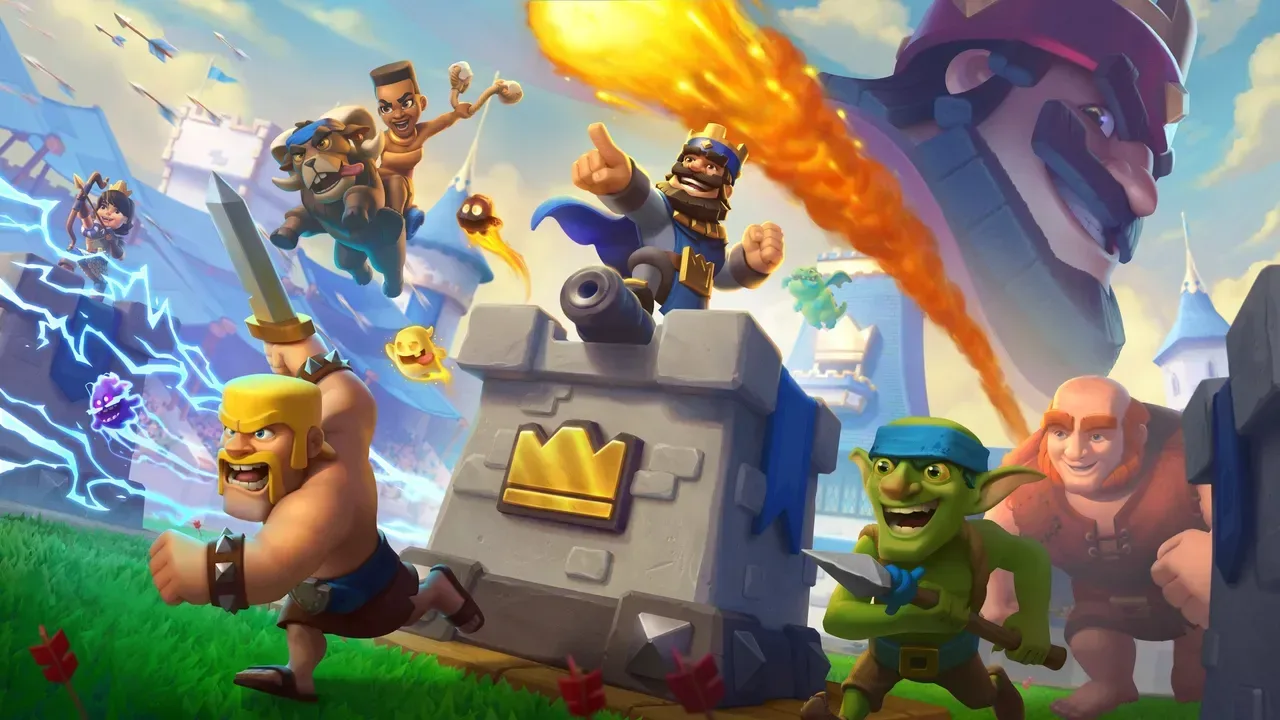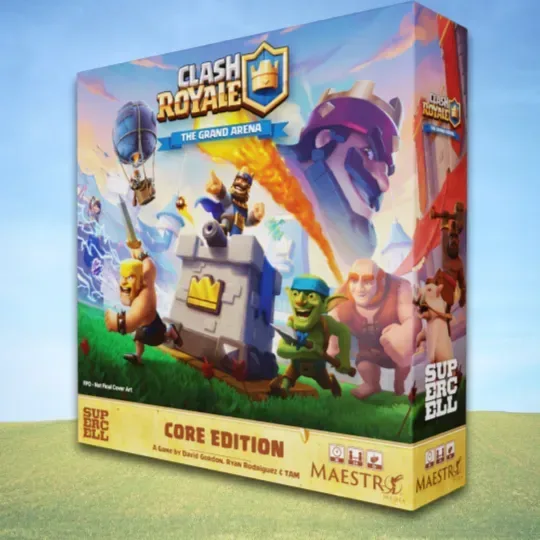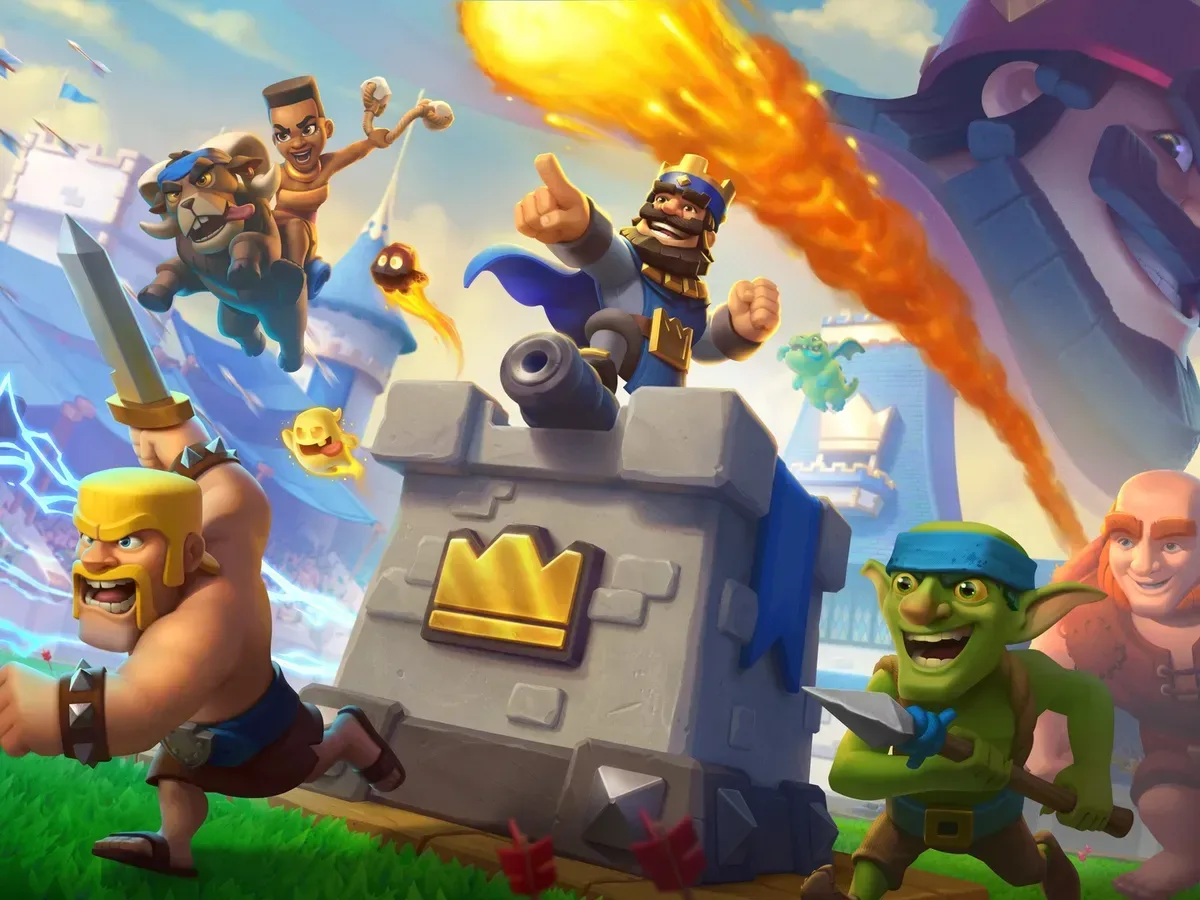
Clash Royale: The Grand Arena has crossed its initial $25,000 crowdfunding target in less than an hour after its Kickstarter launch. The tabletop adaptation brings the mobile game’s central contest—deploying forces, breaking towers and winning crowns—to a format built for two to four players around one table.
The fast start is an early sign of interest, but it is not the whole story of the campaign. Backing begins at $49, while higher pledge tiers include access to game expansions. The campaign is scheduled to run through November, meaning its final funding total, the full scope of expansion material and the eventual mix of backer selections remain unsettled.
What is already clearer is the team’s approach to translation. Rather than attempting to reproduce every aspect of a fast-moving mobile match literally, lead designer David Gordon says the design process tested several tabletop approaches before settling on a turn-based card system focused on spending elixir. That decision gets to the heart of the adaptation challenge: preserving the feeling of Clash Royale without asking a board game to behave exactly like a touchscreen game.
A familiar goal, rebuilt for the table
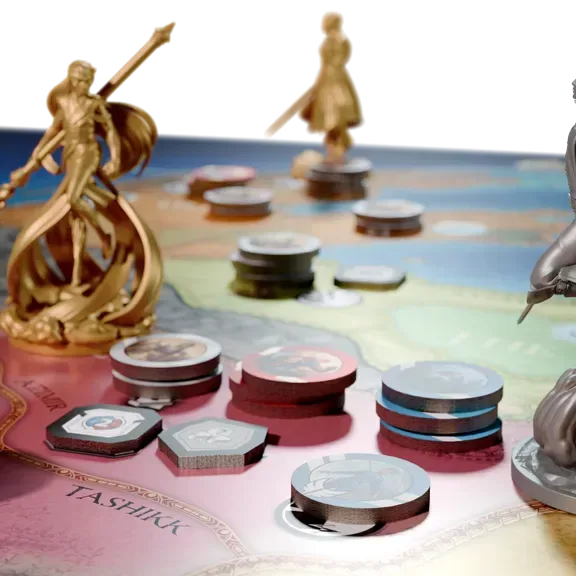
Each player controls a force built from an eight-card deck around a chosen Champion. On their turns, players use elixir to fuel their moves while attempting to destroy opposing towers. Every tower destroyed earns a crown; when the game ends, the player with the highest crown total wins.
That creates a clean tabletop version of the source game’s priorities. The match is not merely about removing opposing pieces or building an engine of cards. Tower pressure is the stated objective, and crowns turn that pressure into the scoring language that decides the winner. A player can therefore think in two connected layers: which action improves the current board position, and which action is most likely to translate into a crown.
For players new to either version, a few terms are worth separating:
- Champion: the chosen focal point around which a player’s eight-card deck is built.
- Elixir: the resource spent to power a player’s moves. In practical terms, it is the game’s limiter on what can be committed at once.
- Turn-based card play: players take actions in an ordered sequence rather than making every decision simultaneously in real time.
- Crowns: the score awarded for destroying towers, with the highest total determining the victor.
Those ingredients should make the win condition immediately legible even without franchise knowledge. Pick a Champion, work within the choices in an eight-card deck, allocate a finite resource, bring down towers and count crowns. The specific cards and tactical interactions will determine the game’s depth, but the basic structure is easy to state.
Why turn-based elixir spending matters
Gordon said the development team considered systems involving a clock, physical cubes and simultaneous reveals, alongside ways to reduce player administration. “Admin” is tabletop shorthand for the overhead required to run a game: tracking resources, resolving effects, moving markers and handling rules steps that do not themselves feel like the strategic decision players came to make.
Related coverage includes Clash Royale: The Grand Arena Smashes Kickstarter Goal Within an Hour.
A real-time clock could have echoed the urgency associated with a mobile strategy game. Simultaneous reveals might have introduced uncertainty and bluffing. Cubes could have provided a tactile way to represent units or resources. But the team ultimately found that a turn-based card-play structure centered on elixir spending was both fun and the closest match to the video game’s feel.
That is an important distinction. Fidelity is not necessarily a matter of duplicating a screen-based interface or forcing people to race a timer at the table. It can instead come from reproducing the decision pressure underneath: players have cards, a resource budget and enemy towers that must be attacked before the opponent does the same. The tabletop version can pursue that strategic rhythm through turns, rather than through constant simultaneous input.
Analysis: Choosing turn-based play also places more emphasis on visible choices. With players taking turns, the consequences of spending elixir should be easier to follow: one side commits resources, the other sees the new situation and must decide how to answer. That does not automatically make the game slower or simpler—there is not enough information yet to judge its pacing—but it does explain why the format can be approachable for a mixed group of mobile-game fans and board-game strategy players.
A stated goal beyond existing Clash Royale players
Gordon has emphasized that the tabletop game was meant to work for strategy fans who have never played the video game. That ambition matters because a licensed adaptation can serve two different audiences at once. Existing fans may be looking for recognizable concepts and the satisfaction of seeing a familiar game reimagined physically. Newcomers need rules and objectives that stand on their own without requiring character lore or prior competitive experience.
The announced structure points toward a relatively direct onboarding path. Players do not need to absorb an open-ended roster to begin; they are using eight-card decks tied to a Champion. They do not need to infer how victory works; destroyed towers produce crowns. And they do not need to deal with a separate economy whose function is unclear; elixir pays for moves.
There is still a meaningful difference between understanding a premise and mastering it. An accessible win condition does not reveal how distinct Champions shape deck-building, how players evaluate cards against one another, or how quickly elixir decisions can swing a match. Those are the areas that will define the game’s strategic identity once players can see the full rules and card pool. For now, the designers’ comments establish the intended entry point rather than a guarantee of how demanding advanced play will be.
The broader lesson is that familiarity can be useful without becoming a prerequisite. A successful adaptation has to make fans recognize the original while ensuring that a guest at the table is not relegated to learning vocabulary before they can make an interesting decision. The Grand Arena’s emphasis on towers, crowns, cards and elixir appears designed to give both groups a shared tactical language quickly.
The prior campaign provides context, not a prediction
The project follows an earlier collaboration between Maestro Media and Supercell: Clash of Clans: The Epic Raid. That Kickstarter campaign raised more than $500,000 before release. It establishes that the partnership has already brought a Supercell game to the tabletop through crowdfunding and found substantial support.
Still, that earlier number should be read as context rather than a forecast. The games are separate projects, and The Grand Arena’s campaign has its own pledge tiers, expansion offerings and remaining campaign time. Beating its goal rapidly demonstrates that the initial target has been met; it does not, by itself, establish where the campaign will finish or whether it will mirror the previous project’s result.
For prospective backers, the most concrete details currently supplied are straightforward: the base entry point starts at $49, the game supports two to four players, and more expensive options offer expansions. Anyone deciding among tiers will want to distinguish the core game’s stated format from any additional expansion access included above it. The campaign’s early momentum may be eye-catching, but the gameplay framework is the more useful reason to assess whether it suits a group.
What to watch as the campaign continues
The next useful details are likely to be the ones that show how the basic loop plays out in practice. The headline rules establish a contest of eight-card decks, Champions, elixir, towers and crowns. The unanswered questions are about texture: how cards vary, how Champions affect strategy, how much information players have at each decision point and how expansions extend the base game.
Those details will matter especially for groups deciding whether they want a head-to-head tactical game or a flexible four-player option. The stated player count confirms both formats are supported, but it does not yet explain how the game’s tower-and-crown contest changes as more players join. That is not a flaw in the announcement; it is simply an area where the currently available outline stops short of a full rules explanation.
There is also an interesting moment for tabletop adaptations of digital games. The Grand Arena’s development notes do not frame the board game as a stripped-down replica. They describe an iterative process of trying mechanisms and selecting the one that best captured the intended play experience while limiting administrative burden. That is a promising design principle: use physical components and turn structure for what they do well, rather than treating the board as a reluctant phone screen.
Players looking for other current gaming stories can also follow our coverage of Fortnite’s Nikki Freeman crossover debate, another example of how established games continue to extend beyond their original boundaries.
For Clash Royale: The Grand Arena, the immediate news is simple: the Kickstarter target is already surpassed. The more lasting question is whether the final game delivers on its clearest promise—a tower-smashing, elixir-spending strategy contest that feels recognizable to Clash Royale players and welcoming to people encountering the franchise for the first time.