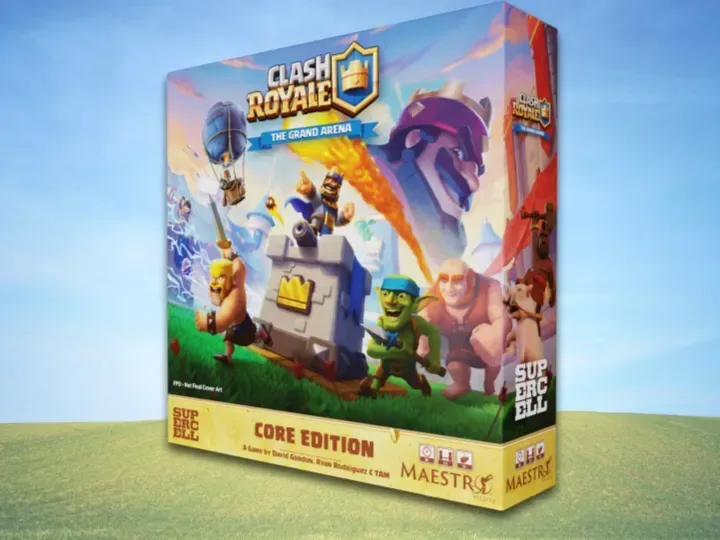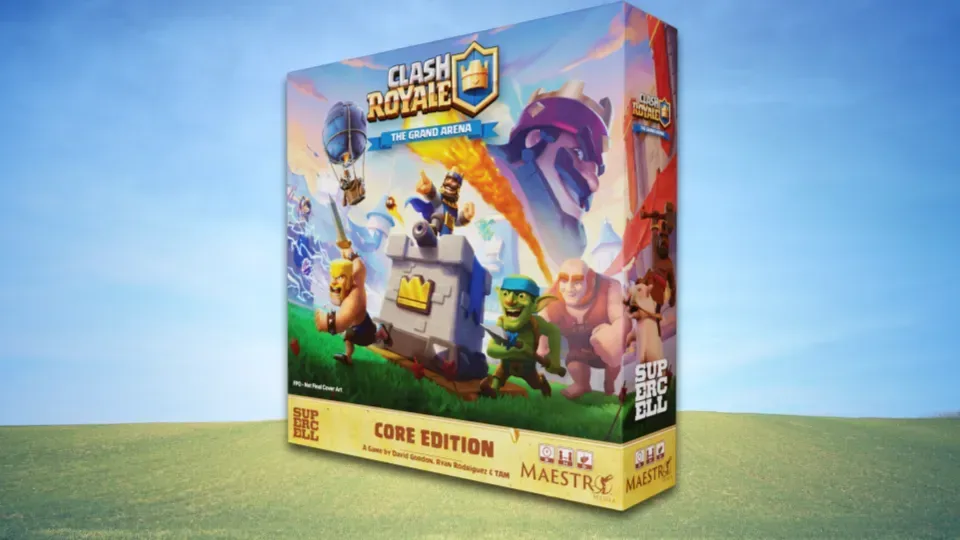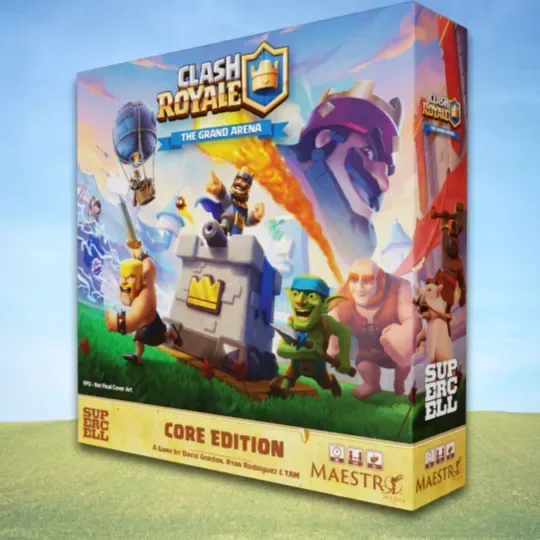
Clash Royale: The Grand Arena, a board-game adaptation of the mobile strategy game, is targeting an October 20 Kickstarter launch. Maestro Media’s project is designed for two to four players and brings familiar Clash Royale ideas—Champion-led decks, Elixir management, Tower attacks and Crown scoring—into a turn-based cardboard format.
The central pitch is straightforward: players build physical eight-card decks around a chosen Champion, deploy forces across a board with two lanes, and try to bring down opposing Towers while maintaining their own defenses. Each destroyed Tower earns a Crown, with the player holding the most Crowns at the end taking the win.
That framework preserves the mobile game’s recognizable battle priorities, but the tabletop version is not trying to literally reproduce a fast touchscreen match. Lead designer David Gordon said the team considered real-time play against a clock, cube-based approaches, simultaneous reveals and ways to reduce player administration before settling on a turn-based card-play system centered on spending Elixir.
“Ultimately, we found that focusing on elixir spending in a turn-based card play system yielded a fun experience that most resembled that of the video game,” Gordon said.
A Clash Royale match, rebuilt for the table
The announced structure suggests that The Grand Arena is concentrating on the decisions that give a Clash Royale battle its push-and-pull rather than attempting to carry every part of a mobile game into a board game.
Players control their own forces through eight-card decks. Those cards draw from Clash Royale’s card roster, including characters and items with roots in the wider Clash of Clans era. A selected Champion acts as the foundation for each player’s deck-building choices.
Deck-building, in this context, means choosing the cards that make up a player’s available toolkit before or during play as dictated by the finished rules. The supplied details establish eight-card decks built around Champions, but do not outline individual card effects, deck-construction restrictions, draw rules, or whether the game will include multiple deck-building modes. Those specifics will matter greatly to players assessing how much flexibility and replayability the final game offers, but they have not yet been detailed.
On the board, the battlefield has two lanes. That matters because positioning is not merely decorative: players must decide where to commit attackers, establish defensive units or use items. A two-lane board turns every deployment into a spatial choice. Sending resources into one lane may create pressure there, but it can also leave another approach less protected. Defending one Tower too heavily may allow an opponent an opening elsewhere.
Related coverage includes Clash Royale: The Grand Arena Kickstarter Planned for October 20.
The objective is similarly legible. Break an opponent’s Tower, gain a Crown. At the game’s end, the highest Crown total wins. It is a score-first goal that gives players an incentive to pursue attacks, rather than only building an impenetrable defense.
Elixir is the key translation problem—and the key solution
The most important named resource in the game is Elixir. In Clash Royale terms, Elixir is the limiting resource that determines what a player can afford to deploy. The tabletop adaptation retains that constraint: players cannot simply run through every card without restriction.
That limitation is vital to the game’s strategy. If every option could be played freely, the interesting question would mostly become which card is strongest in isolation. A spending limit instead creates trade-offs. Do you make a modest defensive response now, invest in a more significant push, hold resources for a possible counter, or spend to establish control in a lane before the opponent does?
Gordon’s comments indicate that Elixir spending became the mechanism through which the designers found their clearest link to the digital game. It also gives the tabletop version a practical way to represent tempo without requiring the entire table to react in real time.
Tempo is a strategy-game term for the advantage gained by making an opponent answer your actions on your terms. In a two-lane Tower battle, pressure can force spending. If one player commits a threat that must be dealt with, the defender may have fewer resources left for an attack or for protecting another lane. The announced rules do not reveal the exact Elixir economy, but the decision to foreground it suggests that resource timing is meant to be the game’s main source of tension.
A turn-based approach also has an obvious tabletop benefit: it gives players a defined sequence for evaluating the board and their hands. Real-time play can mimic the feel of a rapid mobile match, but it can be harder to administer with physical components. It may demand fast handling, fast rules interpretation and close attention to timing, all while players move cards and track resources. By contrast, turns can make consequences easier to read and resolve—without removing the need to make difficult choices.
Why the discarded ideas are revealing
The design team’s experimentation says a lot about the challenge of adapting a live mobile game to a shared physical space. The concepts tested included a clock, cubes, simultaneous reveals and methods intended to reduce administration.
Administration is board-game shorthand for the upkeep required to keep a game functioning: tracking resources, resolving effects, moving markers, checking timing and maintaining the board state. Some administration is unavoidable, especially in a card-driven strategy game. Too much can become friction, however, particularly if it interrupts the decisions players came to make.
Real-time play would have been the most direct attempt to capture a quick, reactive mobile-match feeling. Simultaneous reveals could have emphasized uncertainty and bluffing. Cubes could have represented resources, units or effects. None of these ideas is inherently wrong; they simply point toward different experiences. The final turn-based Elixir system appears to prioritize recognizable resource decisions and clearer play over a literal simulation of speed.
That is a sensible distinction for a licensed adaptation. A board game does not need to duplicate every sensation of its video-game counterpart to feel authentic. It needs to identify which decisions define the original. Here, the announced design treats lane assignment, deck identity, controlled spending, Tower defense and Crown scoring as the essentials.
Built for Clash players, but not only Clash players
The Grand Arena was play-tested with both experienced Clash players and people with no prior experience of the Supercell games. Gordon said that making the game work for strategy fans unfamiliar with the mobile title was an important target, with the hope that the board game could even encourage newcomers to try the video game.
“It was important that a strategy game fan who had never played the video game would find the tabletop version fun—and hopefully even inspire them to try the video game!” Gordon said.
That focus is more than a broad-audience marketing line. It is a design requirement. Fans can supply missing context automatically: they may already understand why Elixir matters, recognize characters and have instincts about lane pressure. Newcomers need the physical game to teach its own vocabulary and make every choice legible without relying on years of mobile-game familiarity.
The most promising part of the announced design for those newcomers is the directness of its win condition. Towers, Crowns, two lanes and a capped resource system give players clear points of reference. The individual cards will determine the real complexity, but the core loop is explainable: build a deck, deploy intelligently, manage Elixir, protect your Towers and score more Crowns than everyone else.
For established players, meanwhile, real cards and a shared board offer a different kind of social and tactical experience. Deck construction becomes a physical act, positioning is visible to every player around the table, and the contest is designed for up to four participants rather than a single screen. The details provided do not explain how four-player targeting, alliances or turn order will work, so it would be premature to assume the multiplayer structure mirrors any particular digital mode. What is confirmed is that each player commands a separate force and competes for Crowns.
What remains to be learned from the campaign
The Kickstarter will be the next major point of detail for The Grand Arena. The current information identifies the game’s core: two to four players, eight-card Champion decks, card play across two lanes, Elixir as a spending constraint, Towers as targets and Crowns as the route to victory.
It does not yet establish a release date, pledge levels, retail plan, final component list, play time, card list, rulebook details or the precise way larger player counts are handled. Those are meaningful questions for prospective backers, and none should be inferred from the campaign’s planned October 20 launch.
Maestro Media has prior history with this universe. Its earlier collaboration with Supercell, Clash of Clans: The Epic Raid, was crowdfunded in 2025 and is now available through retailers including Amazon and Target. That prior project provides context for the partnership, but it does not guarantee that The Grand Arena will follow the same funding path, contents or retail availability.
The project arrives as licensed games continue to look for ways to translate digital identities into tabletop systems rather than simply borrowing recognizable artwork. Elsewhere, the business side of major game releases remains a live issue, as seen in the discussion around how major launches can affect the wider games market. The Grand Arena’s narrower challenge is mechanical: can physical cards, turns and an Elixir economy preserve the satisfying decisions that make Clash Royale recognizable?
Based on what has been revealed, the designers’ answer is to avoid chasing a one-to-one real-time replica. Instead, the board game is being built around meaningful resource spending and lane-by-lane tactical pressure. Whether that balance lands will depend on the final rules and cards, but the October 20 Kickstarter target should provide the next look at how the digital arena is meant to work on a tabletop.