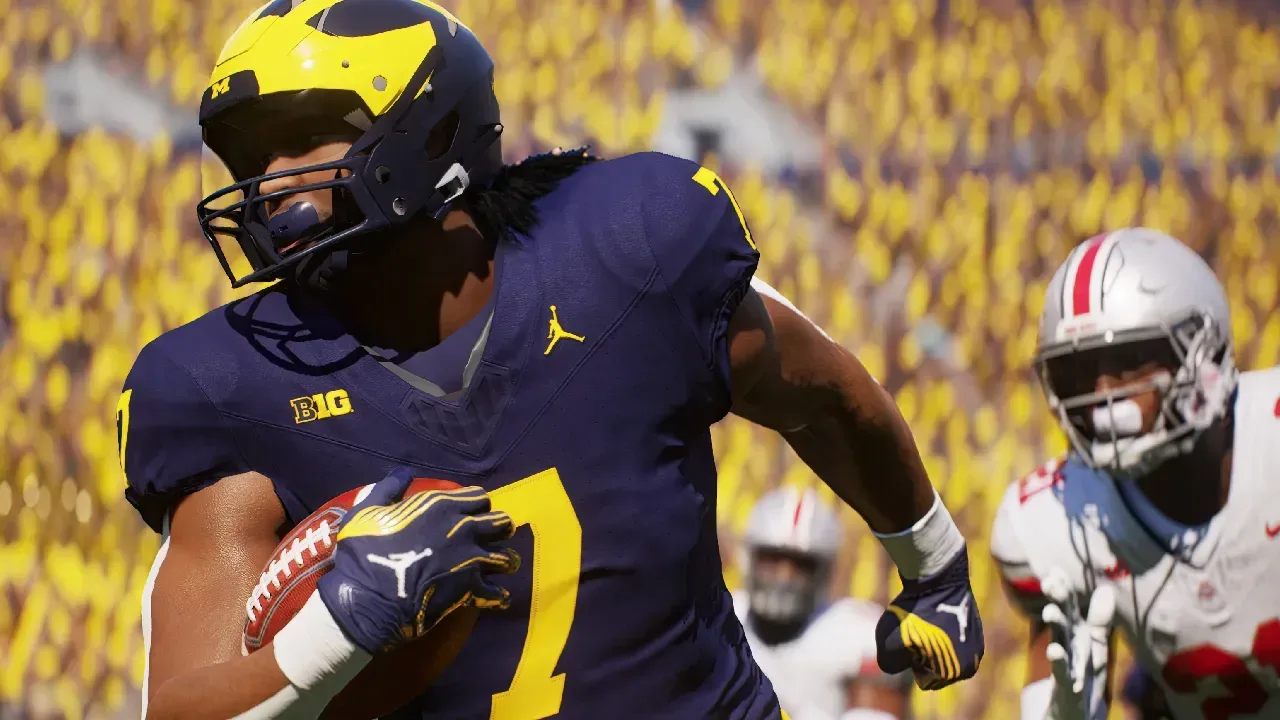
EA Sports College Football returned from a long absence with the kind of demand most annual sports series would love to bottle and sell next to Ultimate Team points. But a report based on accounts from senior-level people working on or around the franchise suggests that the excitement surrounding its 2024 comeback has not made its future effortless.
Some of those people reportedly worry the series could be gone before the end of the decade. That is not a statement that EA has made, and the available reporting also says other people close to the games remain optimistic about the brand’s prospects. Still, the concern outlines a familiar but particularly knotty sports-game problem: the cost of making an authentic annual release can increase even while a hit remains commercially successful.
The pressure points described are declining placement in annual sales rankings, growing name, image and likeness payments for athletes, and the challenge of adding revenue without making players feel that core modes have been converted into a toll road.
A hit series can still face a difficult business equation
College Football 25 was the second best-selling game in the United States in 2024. Its successor, College Football 26, ranked seventh in the United States in 2025, while College Football 27 is currently tenth this year. Those rankings do not establish that the newer games are failures. They do, however, illustrate why the extraordinary launch of the 2024 return should not automatically be treated as a permanent baseline.
The first game had a powerful, unusual advantage: fans had waited 14 years between the final NCAA Football release and the arrival of the new College Football line. The old NCAA series had been popular through the 2000s and early 2010s, then stopped amid legal issues tied to college athletes’ NIL rights. The modern series arrived after that long gap with substantial pent-up interest.
That context matters when reading the year-to-year rankings. A launch powered by a decade-plus absence can bring in lapsed players, curious players, and fans determined not to miss a long-requested revival. A follow-up release is judged in a different environment. The question becomes whether enough players return every year—and whether each returning player supports a game whose underlying costs are climbing.
There is another structural limit described in the reporting. College football has a substantially U.S.-centered audience compared with EA Sports FC. A domestic-focused fan base can still be huge, as the 2024 sales result shows. But it offers less of the worldwide reach enjoyed by football games built around a global sport. The franchise therefore cannot simply be assumed to have the same commercial ceiling as EA Sports FC, or the same scale as Madden.
NIL is a real cost, not a menu-screen detail
NIL means name, image and likeness: the rights connected to a real athlete’s identity. In a college sports game, securing participation from players helps the game represent real rosters rather than asking fans to mentally fill in the blanks for every quarterback, receiver and linebacker.
Related coverage includes EA Sports College Football Developers Reportedly Worry About the Series' Future Beyond 2030.
Reportedly, EA paid each participating player $600 in 2024, totaling approximately $7 million. The payment is now said to be $1,500 per player, bringing athlete compensation for the latest game to roughly $20 million. That is a major jump in one slice of the overall budget.
And it is only one slice. The report says EA also licenses universities, bowl games and other elements associated with college football. Those deals mean that tens of millions of dollars can go toward permission to use names, teams, events and identities before considering the ordinary work of building the game itself.
Licensing is often invisible when a virtual Saturday afternoon is working as intended. Players see uniforms, stadium identities, bowl branding and athletes they recognize. Yet those details are part of the product’s appeal precisely because college football is so tied to specific institutions, traditions and players. A generic substitute might cost less, but it could also undercut the authenticity that made the return compelling.
That leaves the publisher balancing competing priorities. It must pay for authenticity, develop a new annual game, and find a return that supports all of that spending. A strong release can be popular with players and still be examined internally through a stricter profitability lens. That distinction is central to the reported anxiety.
The microtransaction dispute explains the risk
The report also points to a recent backlash over attempts to monetize important parts of College Football’s single-player experience. Microtransactions are smaller in-game purchases, generally separate from buying the base game. In many sports games, publishers use them to sell optional digital items or other forms of progression-related value.
Here, the problem was not simply that microtransactions existed. Players felt they were being pushed to spend in order to progress efficiently through single-player content. For an audience that views modes such as Dynasty as a major reason to buy a college football game, that is an especially sensitive line.
EA reversed course after the backlash, but said it would rework the options and bring them back in future entries. One person cited in the report said microtransactions are expected to return to future College Football single-player games, and worried that such a move could alienate the players the series needs to retain.
The tension is straightforward. If rising rights costs create pressure to earn more after the initial sale, single-player modes become tempting places to look. But players commonly approach a single-player sports mode with an expectation that the purchase grants a self-contained route to build a program, manage a season or develop a career. Anything perceived as making normal progress slower to encourage payment can change the relationship from “play at your pace” to “pay to avoid friction.”
That does not mean every additional purchase is automatically unwelcome or that the exact form of any future system is known. It is not. The reporting only establishes that EA intends to revisit the concept after retooling it. The practical challenge will be designing optional purchases that do not appear to compromise the basic rhythm of the mode.
Why player retention matters beyond launch week
One concern relayed in the report is that the series needs to keep players engaged and, in turn, increase revenue. Retention is the industry term for keeping people playing over time rather than having them leave shortly after purchase. It matters most when a game has ongoing content or optional spending tied to continued participation.
For College Football, retention is a potentially awkward target because different groups can want different things. Some players want a long-running Dynasty save. Others may gravitate toward competitive or continually updated modes. The report does not detail a final monetization plan, so it would be premature to declare which audience EA will prioritize. But it does make clear that an attempt to extract more revenue from single-player users has already met resistance.
That resistance has practical implications. If a player believes a mode is designed around avoidable inconvenience, they may play less, skip the next annual release, or speak negatively about the game to the community. In a franchise that is still establishing its post-hiatus annual rhythm, confidence is valuable. It can be hard to rebuild once a segment of the audience feels that a beloved mode is being treated mainly as an upsell opportunity.
On the other hand, maintaining the game’s licensing breadth without finding some sustainable revenue balance is also portrayed as difficult. That is the no-fun part of the playbook: authenticity is expensive, but changing the economic model can risk the authenticity of the player relationship.
Concern is not a cancellation notice
The most important qualifier is that the reported fears are not unanimous, and no cancellation has been announced. Games are reportedly planned for the next several years. The worry is a view held by some people involved with or near the franchise, not confirmed proof that EA has decided to end it.
Even so, the concerns are credible as a description of the choices facing a licensed sports series. The College Football revival carries costs and expectations that are unusually visible. Real athlete participation comes with NIL payments. The school, bowl and related licenses contribute to the sense that this is college football rather than a generic stand-in. And the games arrive in the shadow of an enormously successful comeback whose initial demand may be difficult to reproduce every year.
The road ahead appears to depend less on whether people care about college football games—2024 answered that emphatically—and more on whether the series can preserve the features fans value while operating at a cost level that makes annual releases worthwhile. The sales-rank trajectory, rising NIL payments and single-player monetization dispute all make that a live issue rather than a hypothetical boardroom exercise.
For now, players should distinguish reported internal concern from a confirmed ending. But they should also expect the monetization conversation to return. EA has already indicated that it plans to retool and revisit the disputed options. How that happens may determine whether the franchise keeps its players onside while it tries to solve a budget problem that cannot be hidden behind a fresh coat of helmet paint.
For more on the broader business side of games and media, see our coverage of the Hello Sunshine and Mediawan studio deal.