EA has paused development on Project Lotus and says it will put its Sims efforts behind Project Evergreen, a move that gives the long-running life-simulation series a clearer immediate priority but leaves major questions unanswered about the next game.
The change came amid a wider company restructuring that included 400 layoffs and the closure of BioWare. For Sims players, the key message is narrowly defined: Project Lotus is paused, while Maxis is being given more time to pursue the stated “full potential and vision” of Project Evergreen. That is a change in development focus, not a public unveiling of a finished product, release window, platform list, business model, or confirmation that Evergreen is The Sims 5.
EA said it is prioritizing Project Evergreen for The Sims and pausing Project Lotus as part of its Lifestyle focus.
That wording matters. In game development, a pause does not necessarily mean a cancellation. It can describe a project being held while staff and budgets are redirected, with no public guarantee that work will resume. Conversely, prioritizing another project means resources are being placed there now; it does not establish precisely what that project will be when it eventually reaches players.
Still, the decision has understandably drawn an unusually strong response from the Sims community. The series has been navigating years of uncertainty around its next major step, and the names involved—Lotus, Rene, Evergreen, and Project X—have made it difficult to separate confirmed decisions from reporting and speculation.
What EA has actually confirmed
The company’s confirmed position is comparatively simple. Project Lotus has been paused. Project Evergreen is now the focus for its Sims development efforts, with Maxis receiving more time to develop it. EA also referenced skate. alongside The Sims as part of its long-term Lifestyle plans.
There is no confirmed public description here of Evergreen’s mechanics, player count, platforms, monetization, launch date, or formal place in the numbered Sims lineage. It has not been officially labeled The Sims 5. Those omissions may not be surprising for a project still in development, but they are central to why the announcement feels incomplete to fans seeking a firm direction after the long lifespan of The Sims 4.
The Sims 4 launched in 2014 and later became free-to-play. Its unusually extended era has shaped expectations for whatever succeeds or supplements it. Players are not merely asking whether a new Sims project exists; they want to know whether it will be a traditional single-player life sim, an ongoing platform, a multiplayer-focused experience, or several separate products sharing the Sims brand.
For now, Evergreen is the name attached to EA’s active priority. Everything beyond that needs to be labeled with care.
Why Project Lotus is being connected to Project Rene
Project Lotus has been widely rumored to be another codename for Project Rene, a Sims project previously presented as a possible successor to The Sims 4. That connection has not been confirmed in the pause statement, so it remains a reported and heavily discussed association rather than an established fact.
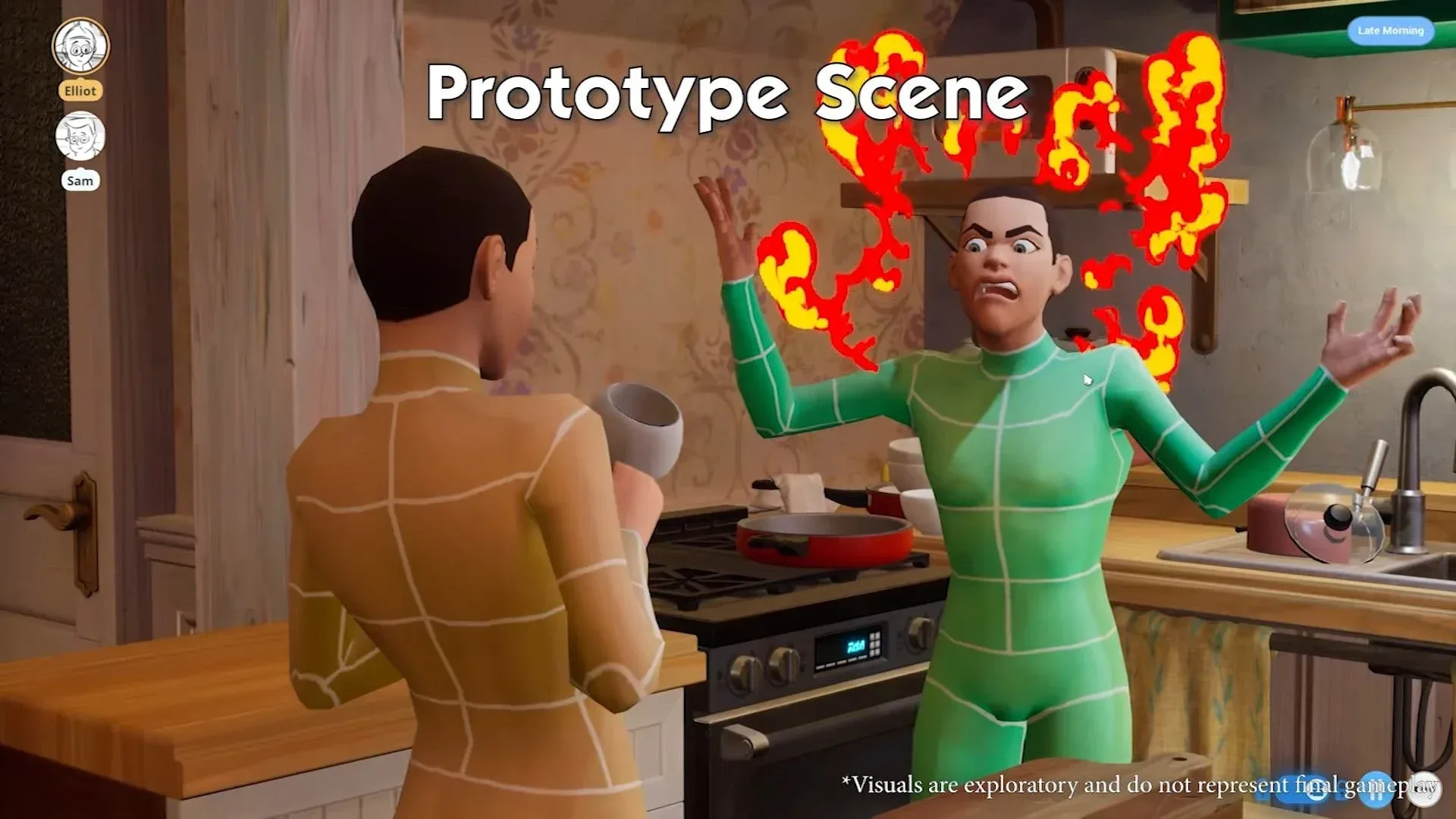
Rene had already become a focal point for skepticism and curiosity. Earlier material showed extensive customization and multiplayer-oriented gameplay. Those ideas are not inherently at odds with a Sims game: detailed home and character creation have long been core parts of the series, while social play can be appealing to players who want to create and share together.
But the possible direction became more contentious as screenshots circulated around 2024 that appeared closer in look to prior mobile Sims releases. Rene was also identified as free-to-play, while reporting and discussion suggested it could take the form of a platform comparable to Roblox. Subsequent playtests reportedly included experiences very similar to well-known Roblox formats, including the fashion-focused game Dress to Impress.
A free-to-play game is one that does not require an upfront purchase to begin playing. The term alone does not explain what players would receive for free or how an eventual game might be funded. A platform, meanwhile, usually implies an ongoing environment that can accommodate activities, updates, social features, or user-facing content over time, rather than one self-contained release. Neither label automatically determines quality. They do, however, suggest priorities that can differ from what players expect of a traditional mainline Sims sequel.
That perceived mismatch is behind much of the reaction to Lotus being paused. Some players see the apparent halt as a retreat from a direction they did not want. Others see it as troubling because a paused project can also mean uncertainty for work already done and for any players who were interested in its multiplayer or free-to-play approach.
Evergreen may be linked to another reported project—but that is not confirmed
Project Evergreen is even less defined publicly. Reporting has linked it to Project X, described as a separate single-player Sims game that could be closer to a conventional mainline entry than Rene. That possible connection has fueled fresh hope that Evergreen may eventually become the next numbered Sims game, or at least deliver a broader single-player life-simulation experience.
At present, that remains unconfirmed. “Single-player,” “Project X,” and “more traditional” should not be treated as official Evergreen feature promises. Nor should the Evergreen codename itself be read as proof that The Sims 4 is about to be replaced.
It is possible to draw a narrower, evidence-based conclusion: EA believes Evergreen is currently the Sims project most worth prioritizing. That is significant, particularly after the uncertainty surrounding Rene/Lotus. It does not tell players whether the game will retain familiar Sims structures, how it may coexist with The Sims 4, or whether it will be a successor in name as well as spirit.
For a detailed look at the earlier reporting around the shift, see our coverage of EA pausing Project Lotus and the reported Project Evergreen direction.
Why the naming problem has become part of the story
Codenames are normal in development. They allow teams to discuss projects before public titles, branding, and even final concepts are settled. Yet codenames can become a communication problem when several are publicly discussed at once without a clear map of how they relate.
- Project Lotus is the project EA says is paused.
- Project Evergreen is the Sims project EA says it is prioritizing.
- Project Rene is widely rumored to be connected to Lotus, but that link has not been confirmed in the new statement.
- Project X has been reported as a separate single-player Sims project and may be related to Evergreen, but that too is unconfirmed.
That distinction is more than semantics. Treating all four names as interchangeable could lead players to assume that a feature set from Rene is now part of Evergreen, or that a reported single-player Project X has definitely replaced Lotus. Neither conclusion is supported by the available information.
The most useful way to read the news is as a portfolio decision rather than a full product reveal. One development path has been put on hold. Another has been elevated. The exact shape of either path remains only partly visible.
What this means for Sims players right now
There is no announced action required from players of The Sims 4. Nothing in the stated decision establishes an end date for the current game, a release date for Evergreen, or an immediate replacement. The practical impact is instead one of expectations: the next major Sims initiative is now less likely to be defined by Lotus in the near term and more likely to be shaped by whatever Maxis is building under the Evergreen banner.
For players who were concerned that the series might increasingly pivot toward mobile-style systems, a social platform model, or free-to-play multiplayer, the pause may feel encouraging. For those who wanted Rene’s customization or communal features to mature into something distinctive, it may feel like a missed opportunity. Both reactions arise from the same lack of detail: players have seen enough to form preferences, but not enough to know what will survive a change in priorities.
The wider restructuring also adds weight to the uncertainty. A studio focus change cannot be considered in isolation when it arrives alongside layoffs and a major studio closure. It is reasonable for fans to be concerned about continuity and creative stability, even though the explicit Sims news points to ongoing investment in Evergreen rather than abandonment of the franchise.
What to watch next
The next meaningful update will need to answer questions the codename shuffle cannot. Is Project Evergreen a stand-alone game, a new long-term Sims platform, or something intended to coexist with The Sims 4? Is it designed primarily for solo play? Does it include multiplayer at all? Will it carry the Sims 5 name, or will EA continue to avoid a numbered designation? And, most importantly, what does its actual life-simulation gameplay look like?
Until those answers arrive, it is best to resist both extremes: declaring that a conventional Sims sequel has been confirmed, or declaring the franchise has no future. The available evidence supports neither. What it does show is a real shift in internal priority. Project Lotus is paused, Project Evergreen has been elevated, and Maxis has been granted more time to pursue that project’s vision. For a series whose future has recently been defined by competing possibilities, that is a consequential development—even if the destination is still out of view.