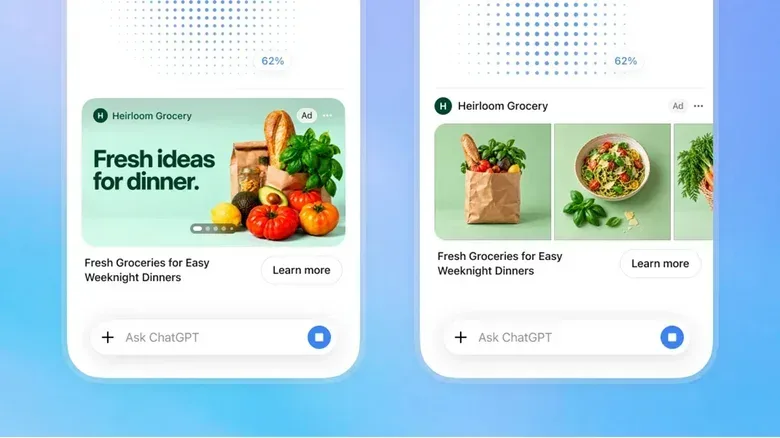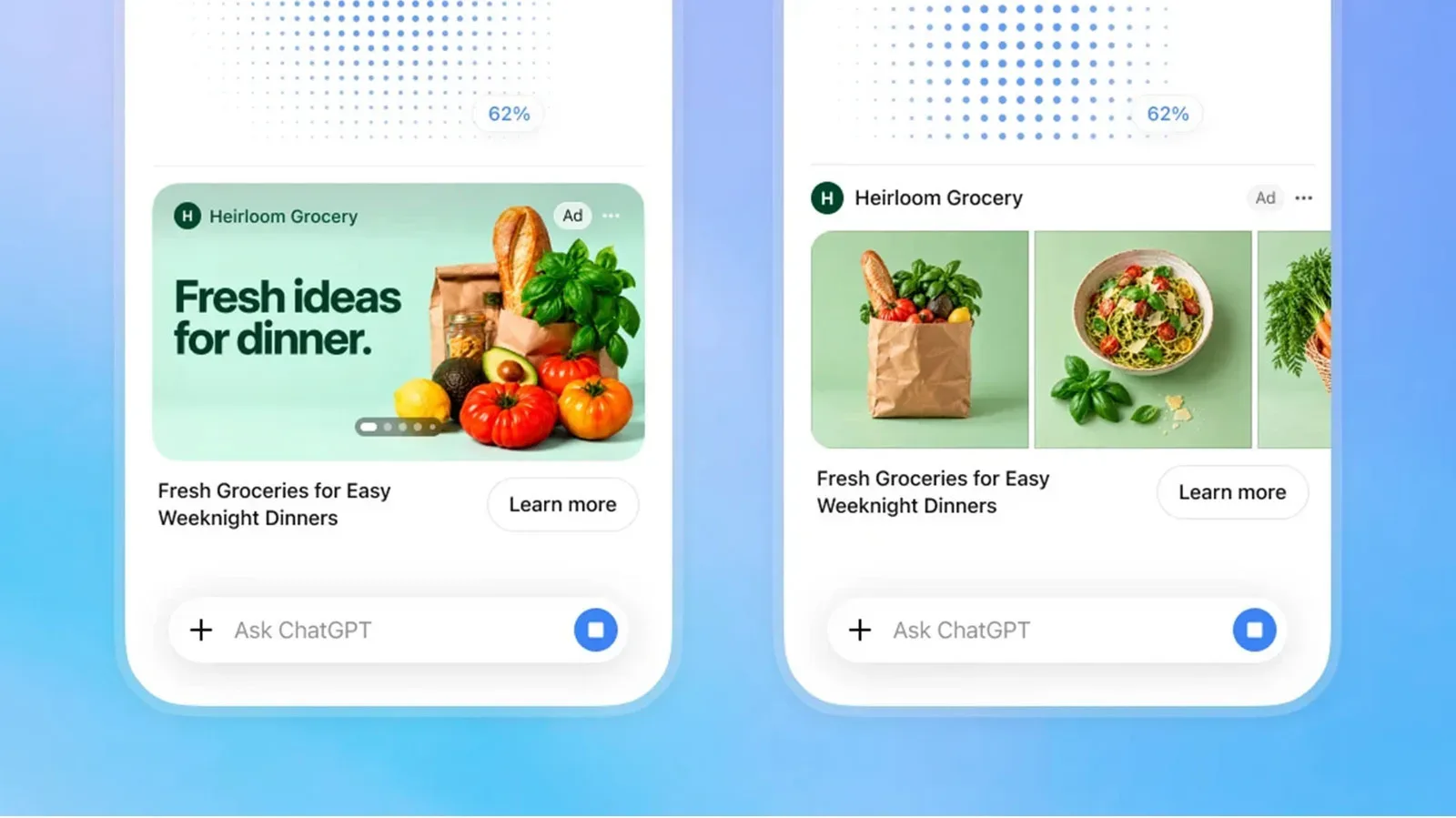
ChatGPT is preparing to make advertising more visual. OpenAI says it will begin testing a new ad format later this month for users in the United States, placing the first examples around requests made with ChatGPT Images.
The key detail is placement: the advertisements are not meant to become part of the picture a person asks the system to create. They will be clearly labeled and shown separately from the generated image. OpenAI also says advertising will not affect the answers ChatGPT gives.
For people who use the service for creative prompts, that distinction matters. An image-generation request has a visible final product, and a visual promotion positioned nearby could be more noticeable than a text-only sponsored module beneath a standard chatbot response. But the company’s description draws a boundary between an ad alongside the experience and commercial material inserted into the output itself.
What the new test changes
ChatGPT has already displayed ads this year in a more conventional sponsored area beneath chatbot outputs. Those placements identify the sponsor with its name and logo and include a link to the advertiser’s website.
The forthcoming experiment expands that approach by introducing visual creative. OpenAI’s stated rationale is that imagery can help people picture how a recommended product or service might fit into their lives. In practical terms, that suggests the company is testing whether a more image-led presentation is useful in a feature where users are already thinking visually.
It is important not to overread the scope of the announcement. This is described as a test, not a universal change to every ChatGPT conversation or every market. The initial rollout is for US users, and OpenAI says it is working with a select group of initial advertisers. The company also says it expects to explore other ad formats later.
That leaves several meaningful details unconfirmed: how broad the initial group will be, what kinds of brands will participate, exactly how the placements will look in the interface, and whether the format will expand beyond image generation. None of those outcomes should be treated as settled simply because the test exists.
Who will see ads — and who will not
The advertising test is not expected to apply to every type of account. ChatGPT Plus and Pro subscribers will not see ads in their chats. Enterprise customers will likewise not see advertisements in their conversations.
That creates a clear product split. The test is aimed at eligible users rather than paid subscribers or enterprise accounts, while the latter groups retain an ad-free chat environment. For regular users, the immediate takeaway is narrower: if the test reaches their account, the first new visual placements are tied to using ChatGPT Images, not necessarily every question they ask the chatbot.
What “separate from the image” means
In this context, “separate” is a product-design promise with a straightforward purpose. The user’s generated image should remain the result of their prompt, while the sponsored material occupies its own labeled area. It is not the same as asking an image model to depict a branded item, nor is it an indication that an advertiser selected the creative result.
Similarly, OpenAI’s statement that ads do not influence ChatGPT’s answers is a claim about the separation between sponsorship and the chatbot’s response process. An advertisement may appear in the interface, but it is not supposed to alter what the assistant says in response to a user’s request.
Those are useful distinctions for anyone evaluating AI interfaces. A generative tool can have several layers on screen at once: the prompt field, the assistant’s written response, a generated image, navigation controls and a sponsored placement. Keeping advertising visibly and functionally apart from the generated material is central to making those layers understandable.
Sensitive subjects are intended to be off limits
OpenAI says it has safeguards intended to limit ads to contexts where promotion is appropriate. Its example is especially notable: advertisements are not to be generated when the conversation concerns sensitive subjects such as a person’s health or mental wellbeing.
That is a contextual restriction, meaning the decision is based on the topic of the chat rather than merely whether an account is eligible for advertising. It recognizes that a sponsored placement which might be ordinary beside a creative image request could feel intrusive or unsuitable in a conversation involving personal vulnerability.
The company has not detailed every subject covered by those safeguards, so the announced examples should not be expanded into a full list of prohibited contexts. Still, the stated rule provides an important baseline for the test: ads are not presented as material that should follow a user into every kind of conversation.
Why image generation is a significant starting point
Starting with image generation makes the test more consequential than a minor change to a text sidebar. People often use image tools to explore a look, communicate an idea, produce a concept or visualize a scene. Visual advertising is built to operate in an environment where attention is already focused on imagery.
That does not mean an ad becomes part of a person’s creative request. OpenAI explicitly says the placement remains separate. It does mean the company is testing a format designed to complement a visual workflow rather than simply repeating the sponsor-name-and-link approach used under chatbot outputs.
For users, the practical questions will be simple:
- Is the placement clearly marked as sponsored?
- Can it be easily distinguished from the image and the chatbot’s own output?
- Does it appear only in suitable contexts?
- Does the service continue to maintain the stated separation between ads and answers?
Those questions are about interface clarity as much as advertising. Generative AI is often used for planning, brainstorming and creative experimentation, which can make the distinction between a system recommendation and a paid promotion especially important. Clear labels are the basic mechanism users have for understanding what they are looking at.
An ad model arriving as AI use broadens
The test also lands during a wider period of scrutiny around how AI tools are built and presented. In the games space, questions about AI-made material and review processes have already prompted visible reassessments, as seen when Jagex pulled a Dragon Slayer 2 trailer amid AI concerns and promised an overhaul of its review process. That is a separate situation from advertising in ChatGPT, but both point to a shared practical issue: people need to know what role automated systems, commercial interests and human oversight play in the material they encounter.
OpenAI’s current announcement does not suggest that visual ads will be incorporated into generated images or that they will direct the chatbot’s answers. Instead, it describes a controlled trial around ChatGPT Images, beginning in the US, with labels, account-based exclusions and contextual protections for sensitive conversations.
Whether the experiment grows will depend on future decisions that have not been announced. For now, the concrete change is limited but easy to understand: eligible US users may begin seeing a new kind of clearly identified visual advertising when they go to create images in ChatGPT, while Plus, Pro and Enterprise users remain outside the ad experience described here.