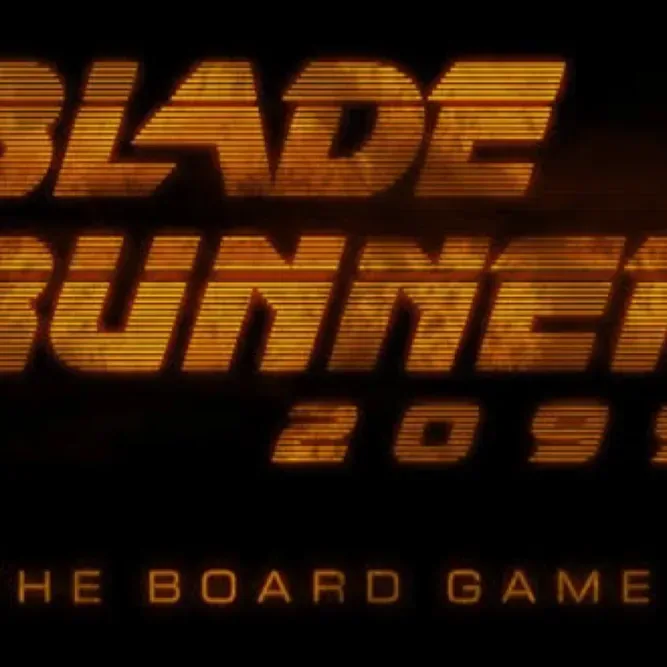
Blade Runner 2099 is expanding into tabletop games, but it will not simply retell the story of the forthcoming television series that shares its name. Lucky Duck Games has revealed its upcoming Blade Runner 2099 board game, confirming that its narrative will be separate from the TV project. The game is planned for a Kickstarter launch next year, while many specifics—including its final contents, characters, and campaign structure—have yet to be detailed.
That separation is important. Two projects carrying the same franchise title can easily imply a direct adaptation, companion chapter, or shared cast. Here, the available information instead points to two different entries set under the wider Blade Runner banner. There is currently no confirmation that characters from the television series will appear in the board game.
The tabletop project was shown publicly at Spiel Essen in Germany, where Lucky Duck Games displayed its box. A Kickstarter notification page is already live, but the campaign itself is not yet underway. For people who closely follow crowdfunded board games, that distinction matters: a pre-launch page signals interest and offers updates, but it is not the same thing as a campaign with a confirmed pledge structure, price, delivery timetable, component list, or stretch-goal plan.
A cooperative detective story in the Blade Runner universe
Lucky Duck Games describes Blade Runner 2099 as a narrative-led, cooperative detective adventure. Players will use a digital app that provides narration and other functions during play. The central setup also reverses a familiar expectation within the franchise: humans are said to be the persecuted group in this story.
For more context, explore VisionQuest Episode 6 Returns the MCU to Madripoor, but the Comics’ Wildest City Still Has Untapped Potential.
That premise gives the game a potentially useful route into the moral unease associated with the setting. Rather than treating the universe as a backdrop for simply chasing suspects or firing futuristic weapons, a detective game can build its tension around incomplete information, competing testimony, hidden motives, and the consequences of deciding whom to trust. Whether the finished design leans into those ideas through branching choices, evidence puzzles, timed events, or another system is not yet known.
“Narrative-driven” generally means that story progression is a major part of a game rather than a light framing device around repeated mechanical rounds. In a tabletop detective game, that could mean cases unfold in chapters, players reveal text only when certain conditions are met, or their decisions change later events. None of those specific mechanics have been confirmed for Blade Runner 2099, but the label establishes that the experience is intended to foreground plot and investigation.
“Cooperative” means participants play together against the game’s challenges rather than trying to defeat one another. This is especially natural for a detective format: a group can compare clues, debate leads, divide tasks, and reach a shared conclusion. It also means the eventual rulebook will need to explain how the game handles group decisions, whether every player has a distinct role, and how failure or success is measured. Those details remain open.
Related coverage includes Blade Runner 2099 Board Game Will Tell a Story Separate From the TV Series.
What the companion app may do—and what has not been confirmed
The app will provide narration along with other, currently unspecified features. App-supported board games use a phone, tablet, or computer to handle information that would otherwise be delivered through cards, booklets, or a human moderator. In a mystery game, that technology can preserve surprises by showing players only the material they have earned, play audio narration, track changing conditions, or direct the group toward the next piece of a case.
For a science-fiction noir property, narration could help establish atmosphere without requiring players to read every dramatic beat aloud. It may also allow the game to introduce leads and consequences at precisely controlled moments. Still, prospective backers should separate those reasonable possibilities from announced facts. There is no confirmed information yet about the app’s supported devices, whether it will be required for every session, whether it will need an internet connection, or how it will manage replayability and saved campaigns.
Those questions are practical rather than trivial. An app can reduce setup and conceal story material effectively, but it can also become a long-term consideration for people who want to keep a board game playable for years. Before backing, players who prefer fully analog games will likely want clarification on the app’s role and whether any alternatives exist. Players who enjoy guided, audio-enhanced investigations may see the same approach as a major attraction.
The story’s independence is a feature, not just a licensing footnote
The upcoming television series has been described as an undercover police story, but the board game will take a separate narrative path. That gives Lucky Duck Games room to tailor its plot to a group tabletop format rather than trying to compress episodes into a sequence of scenarios. A television story can focus tightly on a protagonist’s private perspective; a cooperative game needs reasons for several players to participate in the same inquiry, share discoveries, and make decisions together.
Keeping the stories distinct may also make the tabletop game more approachable. Players may be able to investigate its case without treating the TV series as assigned viewing, while viewers can approach the game without worrying that it is merely a spoiler-filled adaptation. The trade-off is uncertainty: without a shared plot, viewers should not assume that watching one project will explain the other, or that familiar faces will cross between them.
The franchise’s longstanding neo-noir science-fiction identity makes detective fiction an intuitive tabletop direction. Noir is often associated with moral ambiguity, compromised institutions, difficult choices, and investigations where the first apparent answer is not necessarily the correct one. The stated human-persecution angle suggests the game may use that framework to ask players to examine power and vulnerability from a different position than they expect. That is an interpretation of the announced premise, not confirmation of a particular plot or rule system.
What is known, and what prospective backers should wait to learn
- Confirmed: Lucky Duck Games is developing Blade Runner 2099 as a board game.
- Confirmed: It is planned as a narrative-driven cooperative detective adventure.
- Confirmed: A digital app will provide narration and other features.
- Confirmed: The game’s story is separate from the upcoming television series.
- Confirmed: Its Kickstarter campaign is planned for next year, and a notification page is live.
- Not confirmed: The game’s player count, play time, component list, campaign format, price, delivery schedule, and specific app functions.
- Not confirmed: Whether any characters will appear in both the tabletop game and television series.
The publisher has experience in modern tabletop releases, including Unconscious Mind, but prior work should not be read as a promise that this game will use similar systems. The clearest takeaway for now is genre and structure: a group-based investigation with guided digital narration, set in the world of Blade Runner but built around its own story.
For fans deciding whether to follow the project now, the sensible move is to watch for the Kickstarter campaign’s fuller reveal rather than assuming details from the box display alone. The campaign should be where the project’s scope becomes clearer: what players physically receive, how the app is used, how long a case takes, and whether the narrative is designed for a single run or repeated play. A separate report on the project is also available here.
Until then, the standalone-story decision is the defining piece of news. Blade Runner 2099 is positioned as more than branded merchandise attached to a screen release: it is intended to be its own cooperative mystery, with its own human-centered conflict and its own investigation to solve.