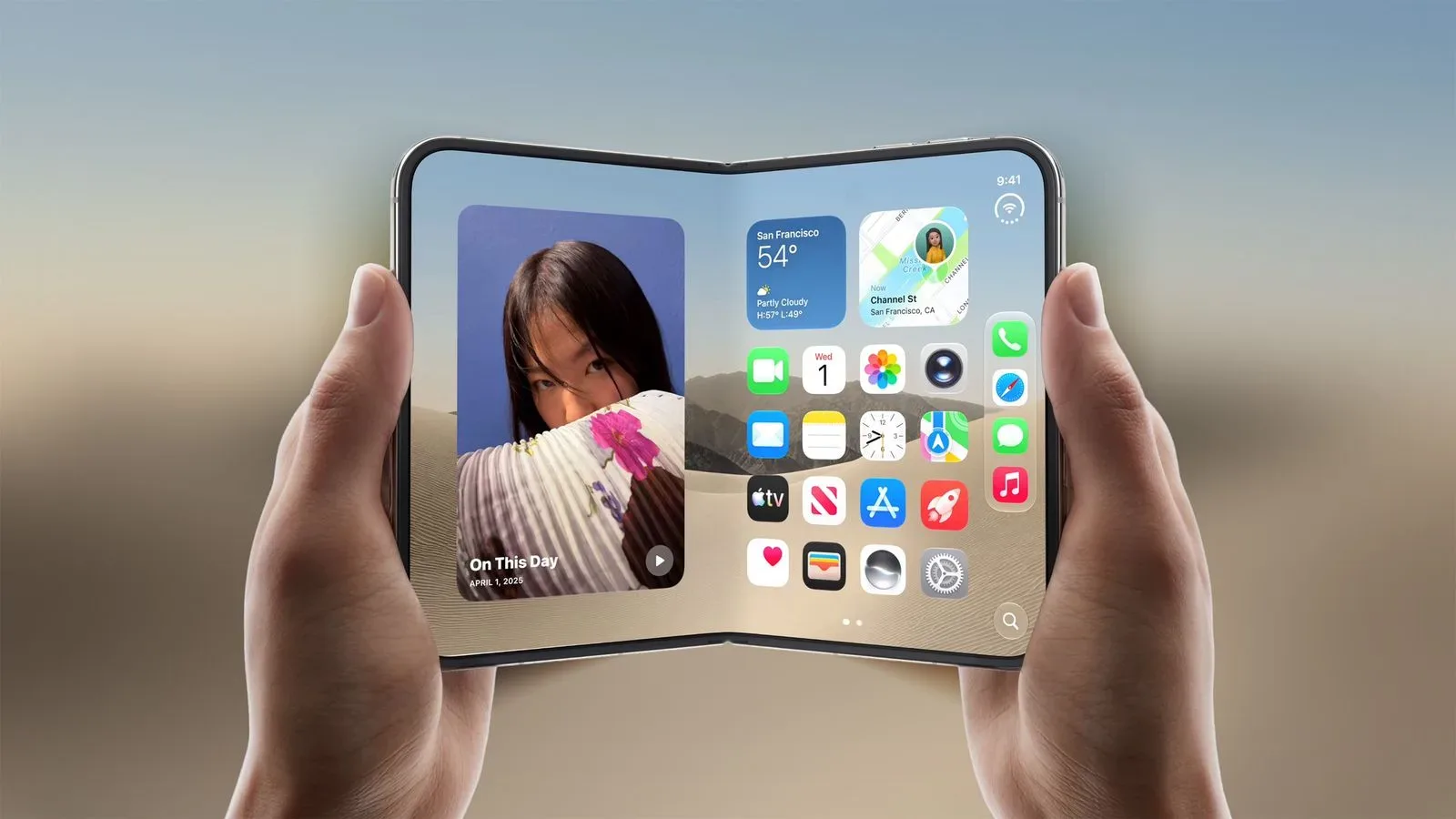

A foldable iPad on the scale reportedly being explored by Apple would not be a conventional tablet with a hinge bolted on. The device, internally referred to as Project J312, is said to target a display of roughly 19 to 20 inches when opened—an enormous canvas by iPad standards—and to have no exterior display. That makes its basic premise unusually ambitious: it would need to move convincingly between a compact folded object and a screen with enough room to challenge the way people think about portable computing, game streaming, touch controls and desktop-style work.
It is also far from a confirmed product. The reported timeline has moved from a hoped-for 2027 announcement to 2028 and now around 2029. Even that later window is uncertain, and the project could remain an unreleased experiment. The reasons are substantial rather than cosmetic: display manufacturing yields, cost, weight, possible awkwardness in everyday use and an unresolved decision about software are all reportedly still in play.
For players, the appeal is easy to picture. A nearly 20-inch screen that folds shut could potentially offer a more generous view for controller-based games, remote play or cloud-streamed titles than a normal tablet. But that is only a potential use case, not an announced feature list. No games support, input arrangement, battery target, processor, accessories, release plan or final name has been established by the reporting. At this stage, the interesting story is not that a gigantic folding iPad is on the way; it is that Apple may still be trying to solve the basic question of whether such a category makes sense at all.
The reported concept: a very large screen, folded inward
The reported design is described as resembling an oversized dual-screen phone concept, except without a usable display on the outside. In practical terms, that suggests the flexible main panel would be protected inside when folded. A device built around that approach would make a different trade-off from a foldable that provides a small external screen for notifications and quick apps: users would presumably have to open it to use the display at all.
That choice could have consequences for gaming. A cover screen can make a device immediately useful for small tasks, but it is not necessarily important for a product aimed at a large unfolded workspace. Conversely, removing it does not automatically make the design simpler. The inner panel, hinge, chassis and the system that manages the fold would still need to deliver an experience worthy of a premium machine. A giant display is only valuable if it is practical to carry, comfortable to hold or easy to prop up.
At 19 to 20 inches, ergonomics may be the make-or-break issue. The larger the unfolded panel becomes, the more its physical mass and balance matter. Holding a heavy screen for long sessions is difficult; putting it on a desk changes the product from a handheld tablet into something closer to a portable display or computer. The report specifically identifies concerns that the iPad could be cumbersome, alongside continuing issues with weight and display technology. Those are central concerns, not minor finishing details.
Why display “yield” matters to buyers
One of the clearest obstacles is display manufacturing yield. Yield is the proportion of manufactured panels that meet the standard required to be used in a finished device. When a panel is large, flexible and expected to survive repeated folding, making enough acceptable units can be challenging. A lower yield means more panels may be discarded or require rework, putting pressure on supply and cost.
That helps explain why the suggested $3,000 to $5,000 price range is so striking. It should not be treated as a final retail price—the device has not been announced, and nothing indicates that it will be—but it frames the level of engineering cost reportedly under consideration. At that level, the device would be difficult to position as a casual media tablet. Its value proposition would need to rely on a distinctive combination of screen size, portability and computing capability.
For a gaming audience, price changes the conversation quickly. An expensive foldable display would have to offer something that an existing TV, monitor, laptop or ordinary tablet cannot provide in the same portable footprint. The ability to fold down a large screen is the obvious answer, but that benefit becomes less persuasive if the item is too heavy to travel with or too fragile-feeling to use freely. This is why the reported concerns about cost, manufacturing and bulk are closely connected: solving one without the others may not create a viable product.
The software question may be larger than the hardware question
The project reportedly has no settled operating-system direction. macOS, iPadOS and a new platform are all still possibilities. This is not a trivial decision. Software defines whether an enormous folding panel behaves primarily as a touch-first tablet, a laptop-style workspace, a desktop-like environment, or something designed around changing layouts as the device opens and closes.
iPadOS would suggest continuity with existing iPad apps and a touch-centered model. That could make familiar tablet games and entertainment apps the natural starting point, while raising questions about how applications would make good use of so much extra space. macOS, by contrast, would imply a more traditional computer environment. That may suit multitasking and desktop applications, but it would have to coexist sensibly with a display that folds and may be used in different physical positions.
A new operating system could be designed around the unusual form factor, but it would also create the challenge of building a compelling app experience from the beginning. None of these paths is confirmed, and the fact that they remain open reinforces how early or unsettled the product appears to be. Hardware and software are not separable here: deciding what the machine is for informs what controls, apps and posture it needs to support.
For games specifically, a large touch display is not automatically a better game screen. Touch controls can cover the action, and a device this size may be more comfortable with an external controller than with hands on the panel. But no controller compatibility, first-party gaming initiative or app strategy has been reported for Project J312. It is more accurate to say the screen could create possibilities than to assume Apple has defined how games would work on it.
A shifting identity: foldable iPad or foldable Mac?
The reporting arrives after a separate September claim that plans for a 16.1- to 18-inch foldable MacBook had been canceled. Earlier accounts had characterized that machine as a large foldable iPad. It remains unclear whether that canceled concept and Project J312 are the same effort, related projects, or entirely separate work. That uncertainty is important, because names such as “foldable iPad” and “foldable MacBook” can imply very different products even when the physical screen sizes overlap.
The distinction matters less than the underlying design problem. A foldable computer-sized display sits between categories. If it is intended to be held and directly touched, it inherits tablet expectations around immediacy and portability. If it is intended to run productivity software with a keyboard and pointer, it faces laptop expectations. If it is mainly a screen for entertainment or gaming, it will be measured against displays that cost much less and do not need hinges or flexible panels.
That leaves Apple with a demanding product-design equation: the fold has to provide a meaningful advantage over a fixed-screen device, while the device must avoid becoming a compromised version of a laptop, a tablet and a portable monitor at once.
What to take from the 2029 target
A possible 2029 timeframe should be read as a sign of uncertainty rather than a countdown to a launch. The target has reportedly slipped more than once, and the project may never reach consumers. Development work can establish that a company is investigating a category without guaranteeing that it has solved the commercial, technical and usability problems necessary to ship it.
There is precedent within this specific report for keeping expectations grounded: Project J312 was previously described as a priority for John Ternus while also carrying the possibility of remaining an experiment. Both parts can be true. A concept may receive serious internal attention precisely because its problems are hard and its potential is large.
For now, the most useful takeaway is simple. Apple is reportedly still considering a vast folding-screen device, but its display production, price, comfort and software identity are unresolved. Until those questions have answers, a $3,000-to-$5,000, 20-inch foldable iPad is best understood as a fascinating possibility—not a product roadmap consumers should plan purchases around. Readers watching Apple’s more immediate retail moves can also distinguish genuine product reporting from routine store activity in this look at Apple Store downtime and Black Friday gift-card changes.