Footage said to be from Project Orca, EA’s cancelled open-world Star Wars game, has surfaced online. The clip is reportedly about three minutes long and appears to show an early-development combat encounter: a quick-talking protagonist in a black vest explores wreckage on a desert world before fighting reptilian enemies.
What makes the apparent footage especially interesting is not merely the familiar Star Wars-adjacent scoundrel energy. It is the emphasis on environmental interaction. In the sequence described, blaster fire tears through metal and cover, the player can shoot an overhead structure to send debris crashing down, and loose material can apparently be picked up as improvised protection. The protagonist also throws sand into an opponent’s face, suggesting a combat design willing to make battlefield opportunism part of the character’s identity.
The material should still be treated carefully. It is presented as footage of Orca rather than a formal release, and an early build cannot establish what the finished game would have been. It can, however, provide a rare window into the direction a cancelled project may have been pursuing—and why its ideas have drawn comparisons to both Uncharted and the later open-world Star Wars game, Outlaws.
What the apparent footage shows
The encounter takes place around wreckage in a desert setting. The central character’s dialogue and presentation point toward a fast-moving, wisecracking antihero rather than a traditional Jedi-led adventure. That fits a long-running Star Wars archetype: the resourceful scoundrel who survives through nerve, improvisation and an ability to turn a bad situation into a slightly more advantageous bad situation.
For more context, explore Superman: The Stranger #4 Sets Up Young Superman’s First Battle With Lex Luthor.
In gameplay terms, the potentially notable feature is how much of the scene seems built around manipulating the immediate space. The reported actions include:
- Blaster shots damaging metal objects or cover.
- Shooting a ceiling or overhead surface to drop metal debris onto enemies.
- Picking up shrapnel and using it as a makeshift shield.
- Throwing sand at an enemy at close range.
Those systems could have given firefights a more reactive feel than encounters where cover is simply fixed scenery. Destructible cover means an object intended to protect a combatant can be damaged or removed. That changes the tactical rhythm: a player who stays behind one safe barrier may be forced to move, while an opponent’s position can become vulnerable after sustained fire.
The ceiling-collapse moment points to a related concept: using the environment as a weapon. Rather than treating shots only as direct attacks against an enemy, the player may be able to identify surrounding objects that create a secondary effect. The improvised shield idea similarly suggests that protection may not always be placed by level designers in advance. A piece of debris becoming defensive equipment would make the player’s relationship with the environment more active, even if the clip alone cannot tell us how often that mechanic would have appeared or how deep it would have become.
The sand throw may be the smallest detail, but it gives the encounter a clear tone. It is not the polished, ceremonial response one might expect from a heroic duelist. It is a desperate, cheeky and practical tactic, in keeping with a lead character whose advantages appear to be personality and opportunism as much as formal combat training.
Why the Uncharted comparison makes sense
The footage’s quipping adventurer has invited comparisons to Nathan Drake. There is a concrete production-history reason that the parallel is more than surface-level speculation.
Before Orca, EA had been developing another single-player Star Wars action game under the codename Ragtag. That project was to be directed by Amy Hennig, the creator of Uncharted, and was associated with Visceral, the studio known for Dead Space. EA closed Visceral in 2017, and Ragtag was cancelled in the process.
Orca was later worked on at EA Vancouver and was said to have inherited elements of Ragtag’s work. If that lineage carried into the apparent clip, a protagonist with an adventurous, rapid-fire style becomes easier to understand. It does not mean Orca would simply have been “Uncharted in Star Wars clothing.” The footage points more specifically to a game seeking a kinetic third-person action tone while making the local environment a bigger part of a fight.
That distinction matters. A comparison can be useful shorthand for mood, pacing or character banter, but it does not prove matching structure, mission design, traversal or narrative format. Orca was described as open world, whereas the visible encounter alone is a narrow slice of gameplay. An open-world game is generally defined by giving players a broad navigable space and greater freedom over exploration or activity order, but the clip does not establish how Orca’s larger world would have been arranged.
Orca’s place among EA’s cancelled Star Wars projects
Orca was cancelled in 2019. It is often discussed as the middle project in a sequence of shelved single-player action games connected to EA’s Star Wars efforts: Ragtag came first, Orca followed, and a later EA Vancouver project codenamed Viking was also cancelled.
That sequence can be confusing, particularly because other cancelled Star Wars games are frequently folded into the same conversation. Orca is not Star Wars 1313. The latter was being developed internally at LucasArts and became caught in uncertainty involving Disney, its parent company. The names may now all occupy the same imaginary museum of games players never received, but they originated from separate teams and circumstances.
Likewise, seeing an apparent early Orca build should not be mistaken for evidence that the game was close to completion or that all its ideas were locked in. Early-development footage often contains experiments, temporary assets, unfinished performance work and mechanics that can change substantially before release. In Orca’s case, cancellation means there is no final retail version against which to measure the clip.
That incompleteness is precisely why footage like this needs context. It can show intent: a team testing destructibility, improvised defense and a particular character voice. It cannot answer whether those mechanics were reliable across a full campaign, whether the open world was fully realized, or whether the story and progression systems were settled. Treating an unfinished scene as a lost finished game risks giving it more certainty than the material supports.
What the clip may say about the game’s intended identity
Based on the reported sequence, Orca appears to have been aiming for a form of Star Wars action rooted in physical problem-solving. The protagonist does not simply exchange blaster fire from static positions. They can potentially alter cover, trigger falling debris, grab a nearby object for defense and exploit the desert itself. The actions all reinforce the same fantasy: winning by noticing what is around you before the other side does.
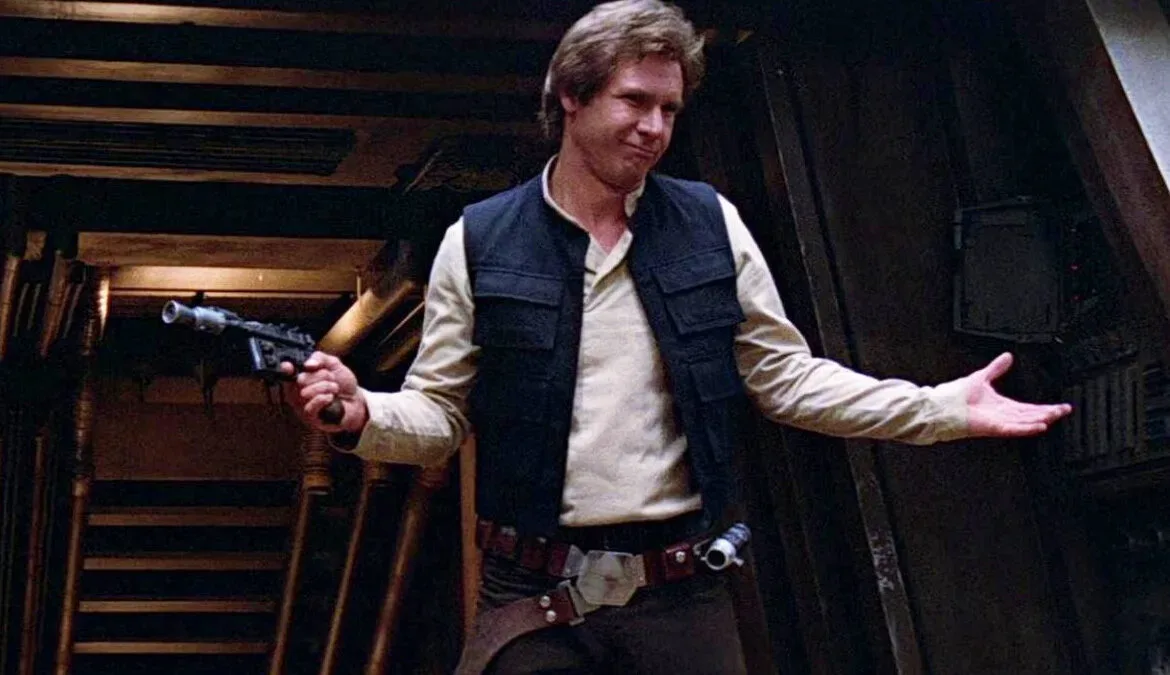
That is a strong fit for a scoundrel-led adventure. A Jedi character is often associated with supernatural powers and lightsaber mastery; this apparent Orca lead instead seems defined by adaptable survival tactics. The black vest, verbal confidence and dirty trick with the sand all support that reading. It is a character type with obvious echoes of Han Solo, but the footage’s combat interactions suggest the game may have wanted the player to participate in that improvisation rather than merely watch it in dialogue scenes.
It also explains why viewers have seen points of resemblance with Ubisoft’s Star Wars Outlaws. Both are associated with a non-Jedi, underworld-adjacent Star Wars perspective rather than a lightsaber-led fantasy. Still, a thematic overlap is not a claim of direct equivalence. Orca was cancelled years before this apparent footage emerged, and the brief clip cannot reveal enough to judge how its open-world structure, systems or story would have compared.
A reminder of what cancellation leaves behind
Cancelled projects are often reduced to a title, a rumour and a few vague descriptions. A short clip can make the loss feel more tangible because it shows work that was once moving: a combat space, animation, dialogue, effects and mechanical ideas all assembled into an active sequence.
For players, the practical takeaway is not that Orca can now be evaluated as though it were a released game. It cannot. The more useful reading is narrower: this material appears to preserve a snapshot of a Star Wars project interested in reactive action and a resourceful antihero, with apparent creative DNA from the earlier Hennig-led Ragtag effort.
It also underlines how many distinct paths Star Wars games can take. This year brought Zero Company and Galactic Racer, neither of which is framed as a single-player open-world adventure. Meanwhile, Hennig is working on Marvel 1943, the Captain America and Black Panther crossover, which has not been cancelled. Orca remains a project defined by what might have been—but the apparent footage gives that unfinished possibility a little more shape.
For readers tracking the reported clip itself, additional coverage of the apparent Project Orca footage is available here.