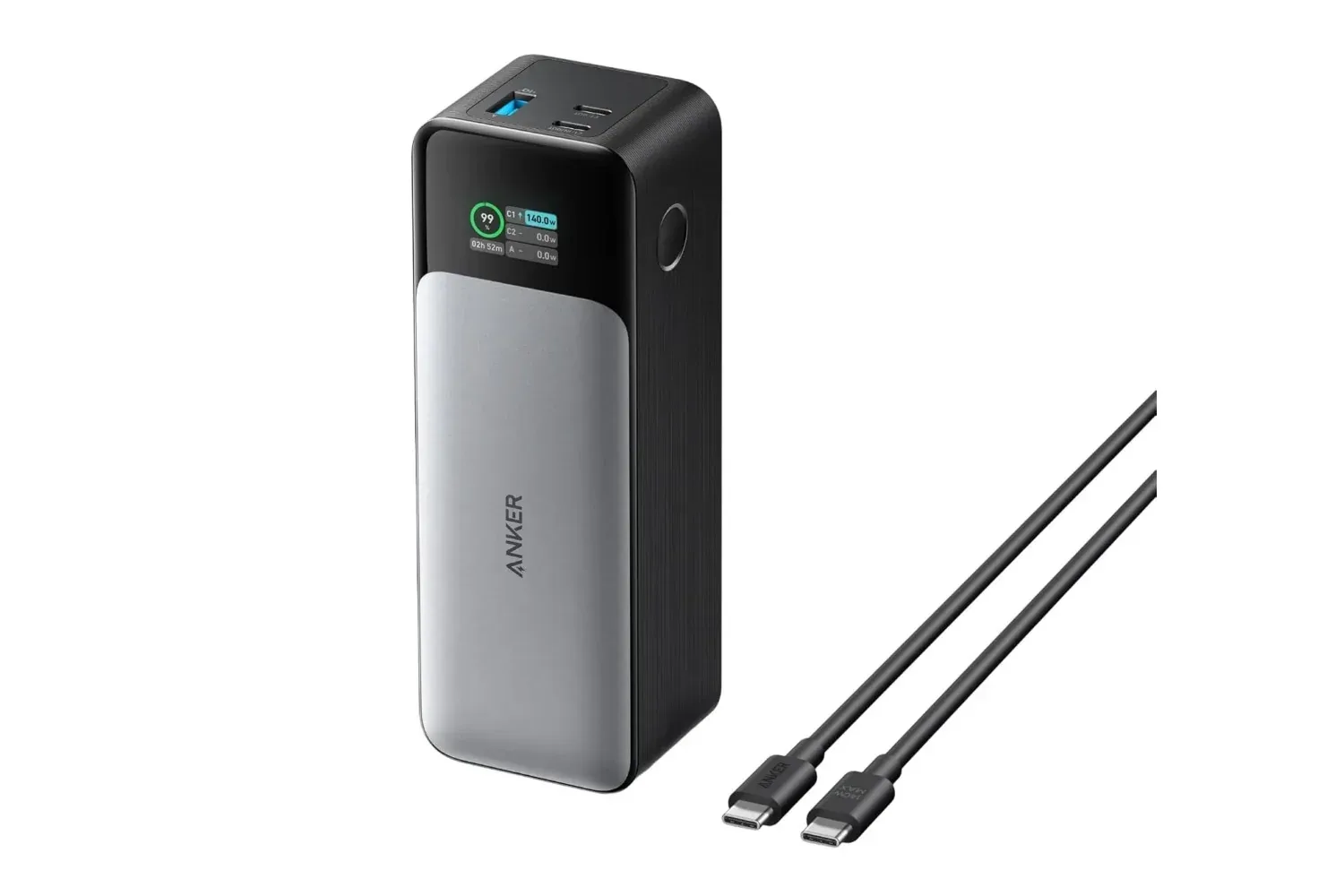
Anker’s 737 power bank is listed at $99, a $11 reduction from its stated $110 regular price. The 10% discount is not an enormous cut, but the underlying product is more substantial than the typical pocket-sized phone battery: it has a 24,000mAh capacity, three charging ports, a claimed maximum output of 140W, and a display intended to show charging activity and estimated recharge time.
For players, remote workers, travelers, and anyone carrying several USB-powered devices, the important part is not simply that this is a battery pack. It is that the Anker 737 is positioned to supply enough power for a laptop alongside smaller hardware, rather than serving only as an emergency phone top-up. The package is also said to include a 140W USB-C-to-USB-C cable, travel pouch, welcome guide, and 24-month warranty.
The listed price and stock status can change, as retail promotions do. A possible larger seasonal reduction is not guaranteed, nor is continued availability at the current price. Buyers deciding whether $99 represents good value should focus on their actual equipment, charging needs, and travel habits rather than treating the percentage discount as the main specification.
Why 140W output is the headline figure
Watts (W) measure power: in charging terms, they describe how quickly energy can potentially be delivered. A 140W maximum makes the 737 notably different from a low-wattage portable battery designed primarily for a phone or small accessory. It puts laptop charging within the product’s stated use case.
The advertised single-port example is a 16-inch MacBook Pro reaching 50% from empty in 33 minutes. That is a manufacturer performance claim and depends on using one port, compatible equipment, and an appropriate cable. Still, it establishes the intended scale of the device: this is meant to be capable of meaningful laptop replenishment away from a wall outlet.
Output is not a promise that every connected device will receive 140W. With three ports available, the total power has to be shared among the attached devices. In practical terms, adding a phone or pair of earbuds while a laptop is connected may be useful, but users should not assume each port delivers the product’s maximum rating simultaneously. The device being charged also controls what it can accept.
That distinction matters particularly in a gaming travel bag. A handheld, phone, wireless headset case, controller, and laptop can all draw power through USB, yet their needs differ widely. The benefit of three ports is flexibility: fewer decisions about which device gets a charge first. The trade-off is that multi-device charging can be less straightforward than the headline single-device number.
Capacity: what 24,000mAh does—and does not—mean
mAh, short for milliamp-hours, is a capacity measurement used for batteries. A larger mAh figure generally signals a larger stored-energy reserve, but it should not be read as a literal count of complete charges for every product. Different devices have different battery sizes and operating demands, and energy conversion during charging means the theoretical figure will not map perfectly to real-world results.
Anker’s cited estimates provide useful reference points. The 24,000mAh 737 is claimed to charge an iPhone 16 Pro more than four times, or a 2024 13-inch iPad Pro roughly 1.3 times, on one full power-bank charge. Those examples show the gap between phone-scale and tablet-scale loads. A phone can receive multiple replenishments; a larger device consumes much more of the bank’s reserve.
For laptop users, capacity is especially important to interpret realistically. The 140W rating concerns possible charging speed, while 24,000mAh concerns how much energy is stored. Fast output can be helpful for a short break in an airport, at an event, or between meetings, but it does not turn the pack into a limitless replacement for mains power. A laptop workload, its existing battery percentage, and any other connected devices all influence how long the power bank remains useful.
That makes the 737 most compelling for people who need to bridge a period without access to an outlet, not necessarily for someone who can charge at a desk, hotel room, or venue every few hours. It may also make more sense for a compact travel setup than for a stationary console setup, where a wall-powered charger is normally the simpler answer.
Three ports can reduce charging-kit clutter
Having three ports addresses a routine problem: a trip often involves more than one device, but packing a separate power bank for each one is impractical. The 737 can charge up to three devices at once, allowing a user to prioritize a larger device while also maintaining a phone and smaller accessory.
- Laptop-focused use: Use a single port when the priority is the fastest claimed charging performance for compatible hardware.
- Travel-day use: Keep a phone and another USB device connected alongside a laptop when convenience matters more than maximizing one device’s speed.
- Shared charging: Three ports can help a small group avoid competing for one outlet or one battery, though power sharing remains a consideration.
The included 140W USB-C-to-USB-C cable is a practical part of the bundle. High-output charging requires a cable suitable for the task, so including one reduces the chance that a buyer immediately needs another purchase to use the pack’s higher-power capability. It does not remove the need to check the cable and port requirements of the devices a buyer already owns, especially where older hardware or different connector types are involved.
Fast recharge helps a power bank earn its place in a bag
A portable battery is only useful when it has been refilled before leaving. The 737 is claimed to recharge from zero to 100% in 52 minutes, described as nearly seven times faster than a standard portable charger. That specification addresses the other half of portable charging: not only how quickly the bank can charge a device, but how quickly the bank itself can return to service.
Fast recharging is most meaningful for people with a short turnaround. Someone preparing for a commute, flight, workday, tournament, or overnight trip may have limited time at an outlet. A lengthy recharge process can undermine the convenience of carrying a large-capacity pack in the first place.
As with the maximum-output claim, reaching the stated recharge result will depend on the charging setup used. The central practical takeaway is not that every outlet will refill it in 52 minutes; it is that the product supports a fast-recharge scenario when paired with suitable charging equipment.
The built-in smart digital display is another quality-of-life feature rather than a reason by itself to buy. It can show input and output information and provide estimated recharge times. That is useful when a battery has to support several devices, because a simple row of status lights may not offer much insight into whether the pack is actively charging, discharging, or nearing a full refill.
Travel suitability and the questions to ask first
The 737 is described as lightweight and TSA-approved, positioning it as a carry-on-friendly option for flights and longer journeys. For travelers, having a substantial battery close at hand can be more useful than locating an available public socket, particularly when a phone, tablet, and laptop all need attention.
Before purchasing, shoppers should verify the requirements of their airline and itinerary, as travel rules can vary. They should also consider whether the 24,000mAh capacity fits their needs better than a smaller, lighter battery. A higher capacity can be valuable, but it is still another piece of gear to carry.
It is also worth separating a portable charger from a general-purpose power solution. The supplied information establishes USB-C charging capability and a 140W USB-C cable; it does not establish support for every console, accessory, or charging standard. Check a device’s charging port and its documented USB power requirements before assuming compatibility. That small step prevents a purchase based solely on capacity or a high-wattage label.
A sensible deal for the right kind of setup
At $99, the stated $11 saving is modest. The stronger case for the Anker 737 is its combination of 24,000mAh capacity, up to 140W output, three ports, rapid claimed recharge, display, included cable, pouch, and 24-month warranty. For a person who only occasionally needs to revive a phone, those capabilities may be more than necessary. For someone who travels with a laptop and several USB devices, they are the features that distinguish it from basic battery packs.
Shopping through Amazon can involve timing uncertainty for both deals and inventory, something gamers have also encountered with high-demand releases and pre-orders, as seen in reports of Ocarina of Time remake pre-orders missing Switch 2 launch day. In this case, the price currently cited is $99, but potential buyers should treat that as a current retail listing rather than a permanent benchmark.
The most useful decision rule is simple: buy a high-capacity, high-output pack when you will genuinely use its laptop-ready power, multi-device ports, and fast refill capability. If those needs are real, the current reduction adds welcome savings to a feature set built for more than a single dying phone.
Shop the products
Check current price, model and availability at the retailer.