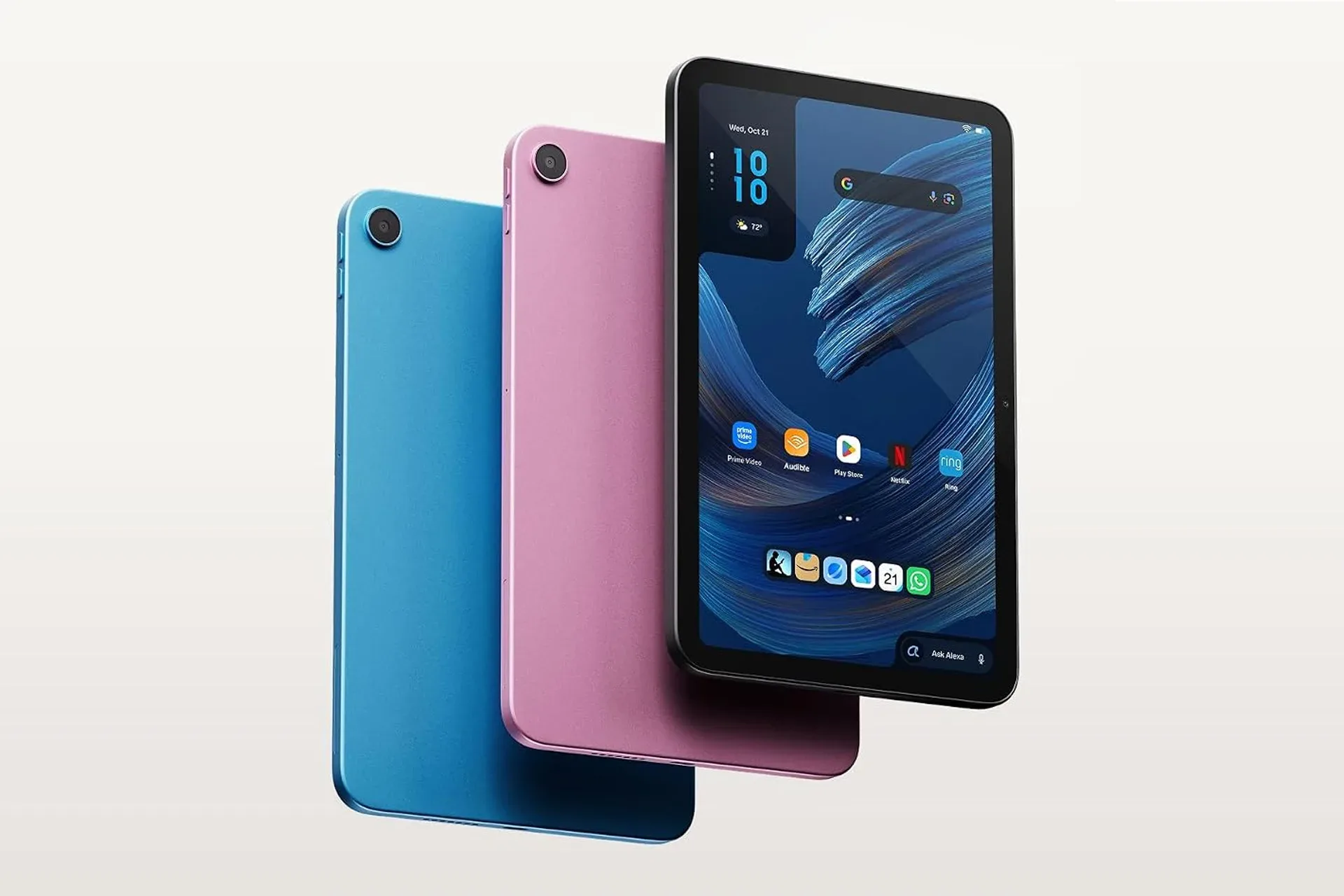
Amazon’s Alexa Tablet 8 is currently listed from $200, positioning the compact Android slate as a markedly less expensive alternative to a foldable phone for people who simply want a separate screen for streaming, reading, browsing and casual gaming. The entry configuration pairs 64GB of storage with 4GB of RAM and is listed at $200, reduced from $230. A 128GB version with the same 4GB of RAM is listed at $250, down from $280. A third configuration combines 128GB of storage and 8GB of RAM for $300, with no reduction noted.
That is a straightforward three-way choice, but the numbers describe two different resources that affect day-to-day use in different ways. Storage determines how much can remain installed or downloaded. RAM, or random-access memory, is the short-term working space used by apps while the tablet is running. Buyers deciding between the models should therefore consider whether their likely constraint is a growing library of downloads or smoother multitasking with several apps open.
The listed Alexa Tablet 8 configurations
- 64GB storage, 4GB RAM: listed at $200, reduced from $230.
- 128GB storage, 4GB RAM: listed at $250, reduced from $280.
- 128GB storage, 8GB RAM: listed at $300, with no listed reduction.
The $50 step from 64GB to 128GB is specifically a capacity upgrade, not a memory upgrade. It may make the most practical difference for someone intending to keep downloaded video, books, apps or games on the device. The $300 model retains the 128GB capacity of the middle tier but doubles RAM from 4GB to 8GB. That model is the one to consider for a user who expects to jump repeatedly between services and applications, rather than merely store more files.
None of those figures alone guarantees a particular game’s performance. Game demands vary, and the supplied specifications do not establish frame rates, graphics settings or compatibility for individual titles. What can be said is that the tablet uses an eight-core chipset and comes in 4GB or 8GB memory configurations. More RAM can give the operating system more room to keep active applications available instead of having to reload them after switching away. That is especially relevant to the everyday tablet pattern of opening a game, checking a message or web page, then returning to the game.
A compact screen built around portable use
The Alexa Tablet 8 has an 8.7-inch display, dual stereo speakers and a quoted battery figure of up to 14 hours of video playback. It also supports Wi-Fi 6, includes an 8MP rear camera and a 5MP front camera. Taken together, the supplied details point toward a compact media device rather than an attempt to replace a laptop or a large television.
Screen size is a personal trade-off. An 8.7-inch panel can be easier to hold while reading a book, watching an episode in bed or carrying a device in a small bag. Conversely, a smaller display leaves less visual space for touch controls, text-heavy interfaces and split-screen multitasking. Anyone shopping chiefly for expansive strategy-game interfaces or work-like multitasking should keep that physical constraint in mind. The source material identifies the screen’s diagonal measurement, but does not provide resolution, refresh rate, brightness or panel technology, so those qualities cannot be inferred from the size alone.
The 14-hour claim is also framed specifically as video playback, not a blanket estimate for every use case. Streaming over Wi-Fi, downloading files, gaming, using cameras and running several apps can all represent different workloads. It is useful as a stated maximum for the described playback scenario, rather than as a promise that every owner will receive the same result under every condition.
Wi-Fi 6 refers to a Wi-Fi generation designed to improve wireless efficiency and performance, particularly in busy network environments. In practical terms, it is a relevant feature for downloading apps, streaming video and using cloud-connected services, provided the wider network setup also supports it. It is not, by itself, a measure of mobile-data connectivity; the supplied information only identifies Wi-Fi 6 support.
Android and Google Play broaden the software picture
The device is described as an Android tablet with Google Play support. That matters because Google Play is the app marketplace through which users can access a wide range of Android software, including social platforms, streaming services, fitness tools, finance apps and games. For a budget-conscious buyer, access to that broader Android ecosystem is a meaningful part of the value proposition: the hardware is only one side of a tablet purchase, and the available apps determine what it can actually become in a household.
Amazon’s own services are part of the experience, too. The listed apps and services include Prime Video, Kindle, Audible, Amazon Music and Amazon Luna. The latter is particularly notable to players because Luna is included among the services mentioned for the tablet; however, the supplied information does not set out game availability, controller support, connection requirements or performance expectations. It should be treated as an available Amazon service in the ecosystem, not as evidence that the tablet has been evaluated as a dedicated gaming machine.
Single sign-on and cross-device synchronization are also described as part of Amazon’s service setup. In plain language, this means a user can sign in once and have relevant shows, films, games or music ready across devices associated with that account. That convenience is most useful for households already using Amazon’s entertainment services. A Prime membership is described as granting access to those services as well as fast, free shipping when shopping with Amazon, but prospective buyers should distinguish between the tablet itself and any separate membership relationship they may choose to maintain.
For readers comparing small-screen options, the wider market has also recently highlighted the appeal of light tablets for games. The OLED iPad Mini’s gaming-friendly form factor, for example, illustrates why portability, display characteristics and price all deserve to be weighed together rather than treating the word “tablet” as a single category.
What Alexa+ adds—and what is not specified
The Alexa Tablet 8 supports Alexa+, described as Amazon’s updated voice assistant. The stated pitch is a more natural style of responses and an assistant that can work across devices as a personal collaborator. That makes voice interaction a central part of the tablet’s feature set, whether it is being used to ask questions, manage an Amazon-centered set of services or move between connected devices.
There are important limits to the information provided. The material does not detail which Alexa+ functions are available on this tablet, whether every capability is enabled in every circumstance, or how particular cross-device tasks work. Buyers with a very specific assistant workflow should not assume more than the stated support. Similarly, “natural” responses describe the intended interaction style, not a guarantee that an assistant will handle every request equally well.
Who each version seems best suited to
Based on the supplied specification list, the $200 64GB/4GB model makes the clearest case for someone whose priorities are a compact Android screen, app access, video playback and Amazon’s services at the lowest listed price. It has the same 8.7-inch display, eight-core chipset, Wi-Fi 6 support, speakers and cameras described for the family, so the lower-priced option is not presented as a different basic device.
The 128GB/4GB model at $250 is a more targeted choice: it preserves the same listed memory while doubling storage. That $50 difference is easier to justify for a person who downloads content or expects their app and game library to expand. It is less compelling for someone who mostly streams and keeps few local files.
The 128GB/8GB option is the step-up model for buyers who value additional working memory as well as the larger capacity. At $300, it costs $100 more than the entry version. The available evidence supports describing it as the configuration with the most RAM, not claiming a specific speed advantage in named games or applications. Still, the extra RAM is the specification most closely connected to keeping multiple active apps in memory, so it is the sensible model to examine for heavier multitasking.
The practical comparison is not just tablet versus foldable
The $200 starting price is framed against Apple’s iPhone Duo, which starts at $1,999 and combines phone and tablet-like roles in a foldable form. The comparison makes the basic economic distinction clear: a foldable phone offers pocketable convergence, while a conventional tablet can cost far less as a dedicated second screen. The Alexa Tablet 8 does not replicate the role of a phone that folds open into a larger display. Instead, it is a separate 8.7-inch Android device designed around its own screen, speakers, Wi-Fi connection and app ecosystem.
For many buyers, that distinction is more useful than attempting to declare one category universally better. A person who needs one device to handle phone duties and provide a larger unfolded display is considering a different proposition from someone who wants an inexpensive screen for entertainment, reading, home use or casual play. The Alexa Tablet 8’s appeal is that its listed configurations begin at a small fraction of the foldable phone’s stated starting price while retaining Android, Google Play, Amazon entertainment services, Wi-Fi 6 and Alexa+ support.
In short, the purchase decision hinges on intended use. Choose capacity if keeping more content locally matters; choose more RAM if app switching and multitasking are the greater concern; and do not fill in unlisted details about display performance, game-specific results or assistant functions. At the currently listed prices, Amazon’s Alexa Tablet 8 presents a compact, Android-based option with a defined set of media, connectivity and voice-assistant features—and a configuration ladder that makes the storage-versus-memory decision unusually easy to see.
Shop the products
Check current price, model and availability at the retailer.