A financing dispute involving Drake’s OVO brand has moved into Ontario Superior Court, where Florida-based investment firm A.R.I. alleges it was cut out of proceeds from a transaction involving OVO intellectual property, Authentic Brands Group and Vince.
The core of the case is not an argument over fan merchandise or brand ownership alone. It concerns convertible notes: a form of financing that can turn a lender’s investment into company equity under agreed circumstances. A.R.I. says its notes contained protections designed to apply if OVO was acquired, yet it received neither equity nor the cash payment it says was contractually required.
Those are allegations in litigation, not established findings. The court process will be important in determining what the financing documents required, whether a qualifying transaction occurred, what notice was owed, and whether A.R.I. was entitled to payment from the transaction proceeds.
What A.R.I. says happened
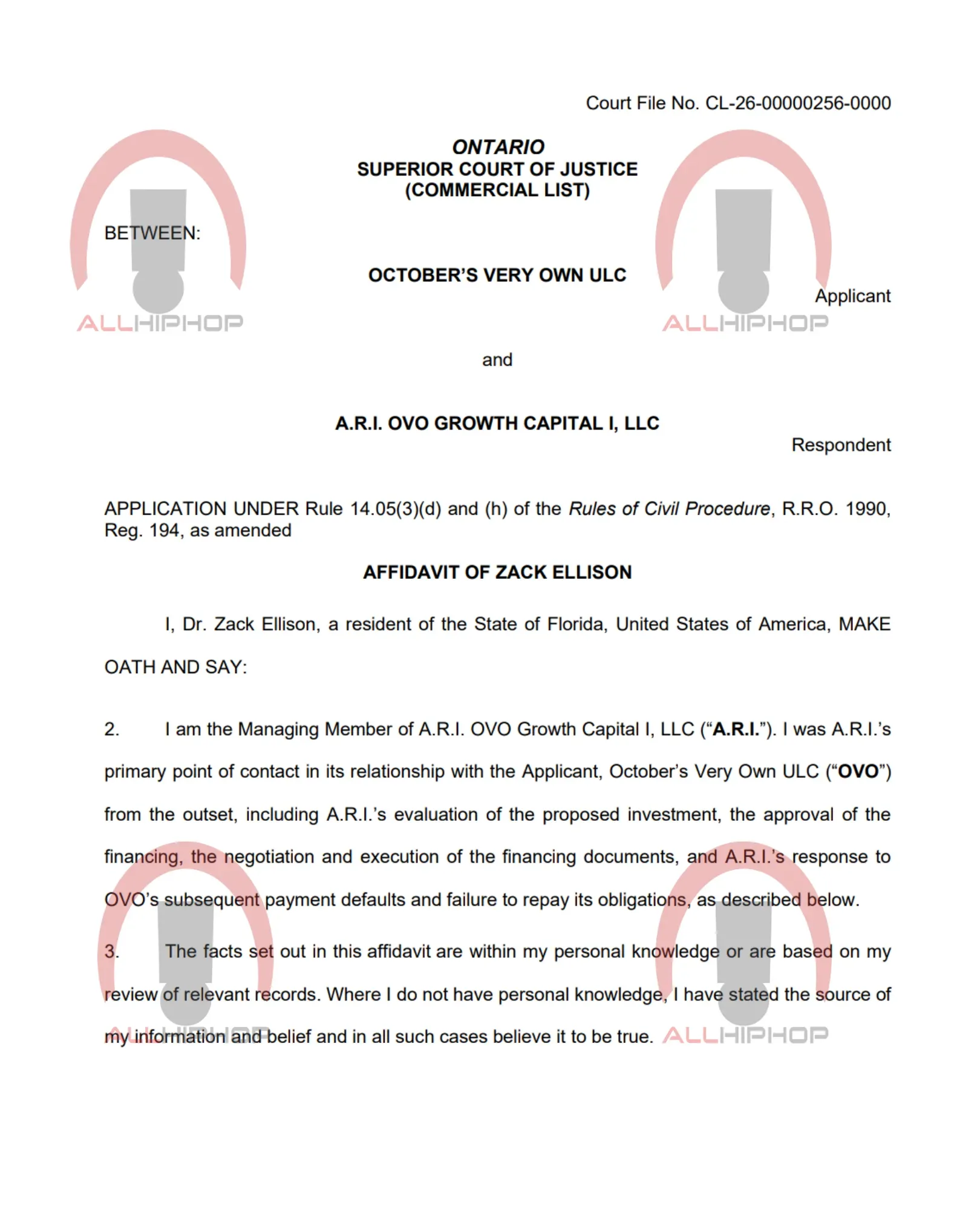
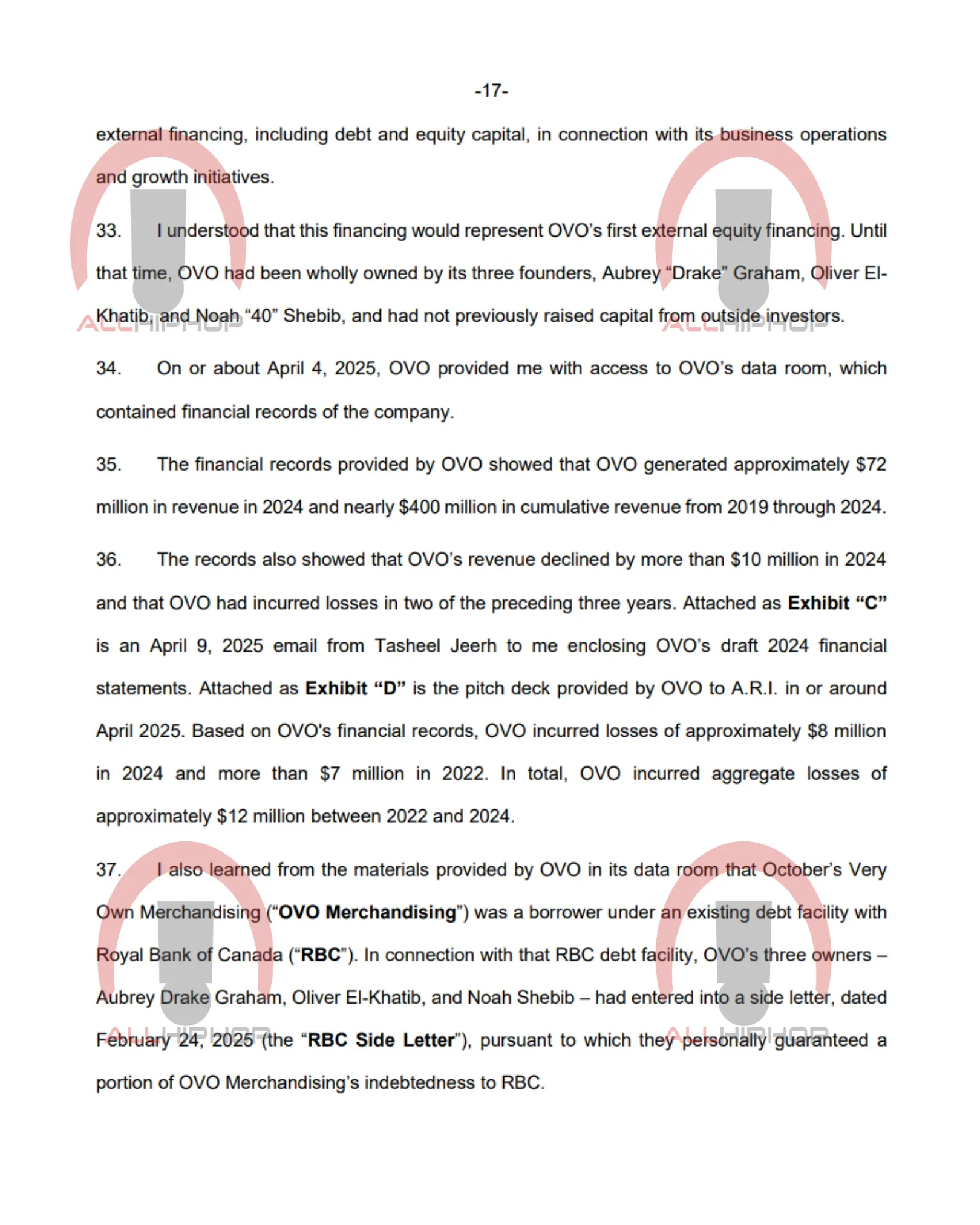
A.R.I. filed a 391-page court document alleging that OVO owes it more than $5 million in unpaid obligations. The firm says it was not notified about negotiations involving Authentic Brands Group and Vince, and that it learned about the completed transaction only through a public announcement three days after the August 24 closing date it identifies.
“We received no portion of the transaction proceeds,” an A.R.I. spokesperson said, adding that the firm intends to seek information through the court process after saying it had made multiple requests to OVO.
The filing describes financing provided to OVO through convertible notes. A.R.I. says the agreements gave it two potential outcomes upon an acquisition: conversion of its investment into equity at a discount, or a cash payment equal to 140% of the original principal. In plain terms, the latter option would mean the principal amount plus an additional 40%.
A.R.I. also alleges that OVO did not provide information it was entitled to receive under the financing agreement. Such information rights are contractual provisions requiring a company to provide specified business or transaction details to an investor or lender. Their precise scope depends on the language of the agreement, which is one reason the underlying documents and court record matter more than broad descriptions of a deal.
The money figures in the dispute
A.R.I. calculated $3.5 million in outstanding obligations as of July 31. That figure, as described in the filing, includes interest, default fees and a Make Whole Fee. The total claim referenced in the Ontario filing is more than $5 million, indicating that the broader requested relief and claimed obligations extend beyond that stated July calculation.
Related coverage includes A.R.I. Claims OVO Sale Left $5M in Convertible-Note Obligations Unpaid.
The terminology matters. A Make Whole Fee is a prearranged payment feature intended to ensure an investor receives a defined return if a note does not convert under the anticipated terms. A.R.I. says its agreement guaranteed a minimum 15% return and that this was built into the original financing structure, rather than imposed later as a new penalty.
A.R.I. says OVO CEO Derek “Drex” Jancar signed the arrangement. It further alleges that it would not have supplied financing without the protections described in the documents.
That does not make the repayment calculation automatic. Disputes over convertible notes can turn on detailed definitions: whether an acquisition fits the agreement’s triggering language, whether an intellectual-property transaction is treated like a sale of the company, how principal and accrued charges are calculated, and whether any release or payoff paperwork was validly delivered. The supplied account does not resolve those legal questions; it establishes the issues A.R.I. is asking the court to examine.
The OVO IP transaction at the center
Authentic Brands Group announced on August 27 that it had acquired 51% of OVO’s intellectual property. The transaction valued that IP at $117,647,058.82. Drake retained 44% ownership, while Vince held 5%.
A.R.I. points to public documents filed with the U.S. Securities and Exchange Commission that state OVO debt was expected to be repaid and convertible-note holders would be paid directly out of the purchase price. A.R.I. alleges that, despite those statements, it received no payoff letter, did not authorize any release of its claims and received no transaction proceeds.
A payoff letter typically identifies the amount required to satisfy an outstanding obligation and sets out how payment will be handled. Depending on the deal and documents, it can also be linked to releases of liens or claims. A.R.I.’s allegation that it did not receive one is therefore central to its argument that its rights were not properly addressed before or at closing.
The distinction between ownership percentages and repayment obligations is also worth keeping clear. The announced 51%, 44% and 5% stakes describe interests in the intellectual property after the transaction. They do not, by themselves, answer whether a prior noteholder had a right to payment, a conversion opportunity, or both. That question depends on the relevant financing terms and transaction structure.
This was already a live legal dispute
The Ontario filing did not emerge from nowhere after the sale announcement. A.R.I. had filed a lawsuit in British Columbia in June seeking $3.2 million. That earlier action means the investment firm says OVO was already on notice of a repayment dispute before the IP transaction closed.
For A.R.I., that timeline supports its position that it should have been considered during the transaction and given information about how its notes would be treated. For the court, the sequence may be relevant to evaluating notice, disclosures, contractual compliance and the effect of any transaction documents. It is not, on its own, a determination that OVO or any other party acted improperly.
Why this matters beyond celebrity-brand headlines
Entertainment brands can be valuable because their names, logos, licensing opportunities and audience recognition can be packaged as intellectual property. But a high valuation does not erase the contractual claims that may sit behind the business. This dispute illustrates how debt and financing rights can become especially consequential when ownership changes hands or valuable assets are sold.
Convertible-note financing is often presented as a bridge between lending and ownership. Investors provide money now, while a later event may determine whether they become equity holders or receive an agreed cash return. That flexibility can be useful, but it makes deal documentation critical: every party needs clarity on what qualifies as a trigger event, when investors must be informed, and where repayment sits in the flow of funds.
Here, A.R.I.’s position is that the OVO IP deal activated those protections. The company’s allegations focus on three practical points: no advance notice of negotiations, no clear payoff process, and no share of the transaction proceeds. The eventual legal outcome will depend on evidence and interpretation rather than the headline valuation alone.
The dispute also arrives amid continued public attention around Drake’s business activity, including a separate report on a reported UFC 331 bet involving Joshua Van. That is unrelated to the OVO financing case, but it underscores the broader interest in the financial side of celebrity-linked ventures.
What to watch next
The immediate question is whether Ontario Superior Court will grant A.R.I. access to the information it says it has been denied and how it will assess the firm’s claimed contractual rights. Documents likely to matter include the convertible-note agreements, any notices related to the transaction, payoff correspondence, closing materials and the SEC filings referenced by A.R.I.
It will also be important to separate the allegations from a ruling. A.R.I. has laid out a detailed claim for payment and transaction information. No outcome is supplied here from OVO, Authentic Brands Group, Vince, Drake, or the court. Until the parties’ positions are fully tested, the case remains a dispute over the treatment of investor rights in a major intellectual-property transaction.