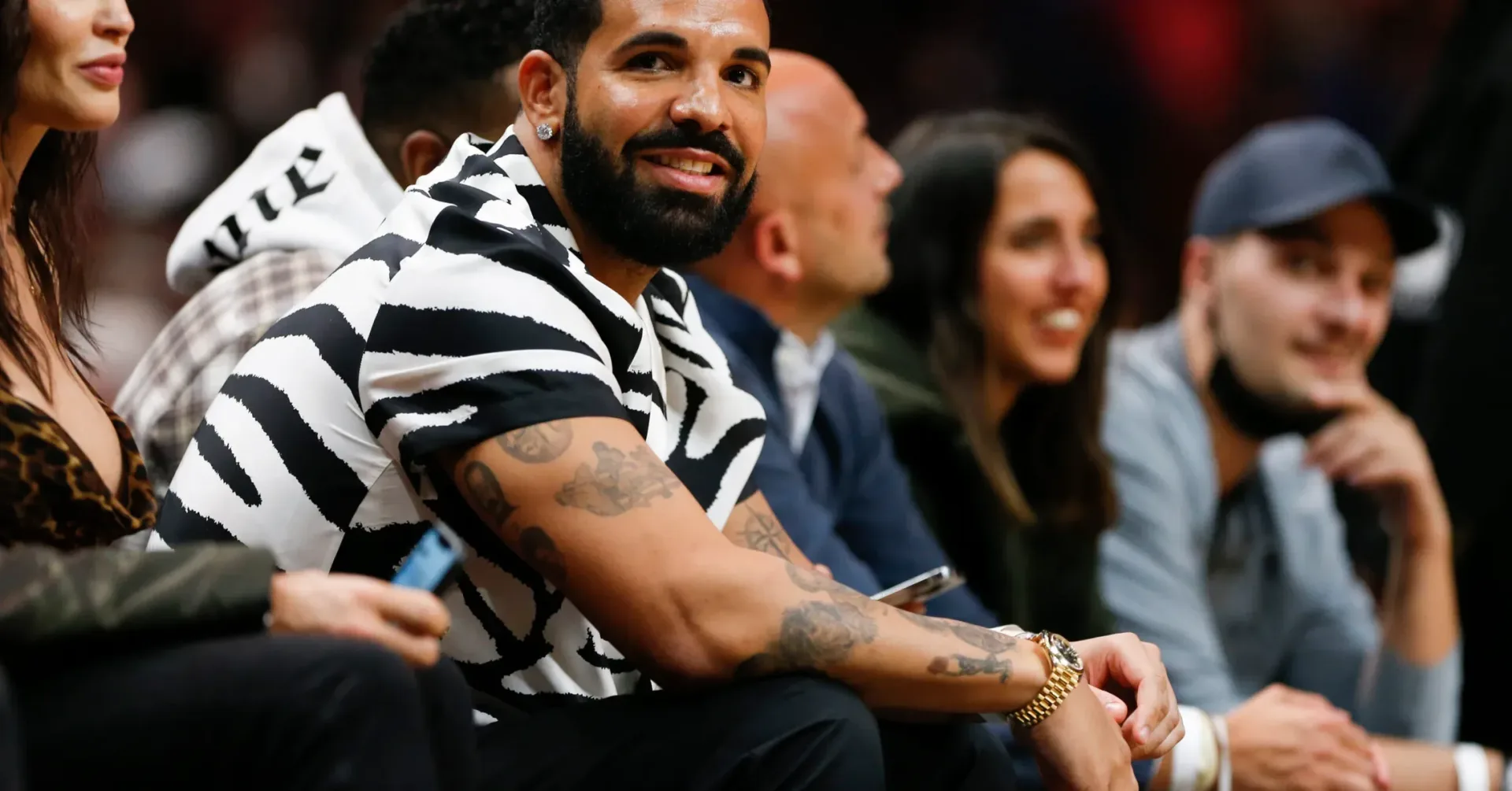
A collection of jewelry associated with Drake’s Take Care era has been listed for $295,000. The group is said to date from 2009 through 2011 and includes a gold pendant visible on the album’s cover art, making it the clearest direct visual link between the lot and a defining chapter of Drake’s career.
The set also includes a gold chain, several diamond rings, two bracelets, an OVO owl piece and a luxury watch. It is a notably broad collection rather than a single standout object: a buyer is being offered a cluster of accessories tied to the same period, with the cover-art pendant functioning as the collection’s centerpiece.
What is included in the Take Care-era collection?
The available description identifies the following pieces:
- A gold pendant seen on the Take Care cover art
- A gold chain
- Several diamond rings
- Two bracelets
- An OVO owl piece
- A luxury watch
That mix matters because celebrity memorabilia is not valued purely as jewelry. Material, maker, design, condition and precious-stone content can all affect an item’s underlying appeal, but the principal point here is provenance: the documented or claimed history linking an object to a particular person, time and cultural moment.
In this case, the stated connection is not simply that the jewelry resembles something from the era. The lot is presented as pieces worn by Drake during the period surrounding Take Care, with the pendant’s appearance on the album cover providing a highly recognizable image association. For a potential collector, an item tied to a widely circulated visual artifact can carry a different kind of appeal than a similar piece with no public-facing connection.
A $295,000 listing is not a completed sale
The collection is listed at $295,000. That is an asking price, not evidence that a buyer has paid that amount. No final sale price, bidding history, reserve, buyer identity or closing date has been provided. The wording around the offering also does not establish the mechanics of an auction, despite the attention-grabbing nature of the listing; what is known is that the set is being offered through Wind Vintage.
That distinction is important in every memorabilia market. A listing signals what a seller believes an item or grouping of items can command. A completed transaction is a clearer measure of what the market actually supported at one specific time. The two can be very different, especially for objects whose value depends heavily on fame, rarity and confidence in their history.
The $295,000 figure should therefore be read as the value sought for the entire group, not as a separately verified valuation for each ring, chain, bracelet or watch. The current information does not break down individual prices or identify which pieces account for the greatest portion of the asking price.
Why the Take Care connection is the central selling point
Take Care remains one of Drake’s most discussed and respected projects more than a decade after its release. That longevity helps turn objects from its surrounding period into potential artifacts of a specific artistic era rather than merely expensive accessories.
For this kind of memorabilia, the connection between object and album is the story. The gold pendant’s cover-art association is especially useful because it gives the listing an immediate, public reference point. A collector can place the item within the visual language of the record without needing the piece to be explained as an isolated luxury good.
The OVO owl piece adds another layer of recognizable branding. OVO has long been connected with Drake, so the owl is more than decorative within the framing of this collection: it attaches the set to a lasting symbol of his wider creative and business identity. Authentic Brands Group has acquired a 51% stake in the OVO brand, while Drake retains creative control, further underscoring the brand’s continuing relevance beyond the original album period.
In practical collecting terms, this is what separates an era lot from a conventional jewelry purchase. The items may have intrinsic luxury value, but their collectible value rests on a narrative: Drake, the Take Care years, the cover image and the OVO identity all meet in one offering.
The recent $500,000 watch sale provides context, not a direct comparison
Earlier this year, a rare watch associated with the same album cover reportedly sold separately for $500,000. That result provides a useful sign that there is active interest in objects connected to this particular phase of Drake’s career.
It should not, however, be treated as an automatic price guide for the current $295,000 collection. A one-off watch and a multi-item jewelry set are different offerings. Their values can depend on details not provided here, including the exact item history, design, brand, condition, documentation and the strength of each item’s public association with Drake or the album artwork.
Still, the prior sale helps explain why a seller might frame a larger Take Care-era group at a substantial price. It suggests that the album-cover connection can carry serious market weight when an item is sufficiently rare and closely tied to a recognizable image.
What collectors should look for beyond the headline price
For anyone evaluating celebrity-owned or celebrity-worn objects, the most useful questions are often more basic than the headline number. The supplied details establish the claimed era, the item categories and the cover-art pendant connection, but they do not describe accompanying paperwork, condition reports, chain-of-custody records or independent authentication.
Authentication concerns whether an item itself is genuine. Provenance concerns its ownership and use history. Both are important, but they are not the same thing. A genuine luxury watch, for example, is not automatically a watch with verified celebrity history; likewise, a claimed celebrity connection needs sufficient support to be meaningful to a careful buyer.
A prospective buyer would also need to determine whether the lot is being acquired as a unified group or whether any individual pieces may have distinct documentation and display value. Because the collection contains objects with different visual roles, the pendant, OVO piece and watch could carry different kinds of interest even before considering their materials or brands.
The market framing also matters. The seller’s price is for a collection built around a shared era, not simply a jewelry inventory. Breaking up such a set could change its storytelling value, while keeping it together preserves the presented connection between the cover-art pendant, OVO branding and the rest of the period-specific accessories. Neither route is inherently better, but the listing’s appeal clearly leans on the strength of the complete narrative.
Music memorabilia increasingly sells the moment as much as the object
Hip-hop memorabilia has become a growing part of the broader market for culture-driven collectibles. Clothing, watches and jewelry can serve as physical anchors for eras that audiences otherwise experience through music, images and memory. The appeal is not limited to scarcity: fans may care about whether an item is connected to a project that shaped their relationship with an artist.
This Take Care grouping illustrates that dynamic cleanly. Its individual components range from jewelry to a luxury watch, but the premium proposition is their shared relationship to an album era still regarded as significant. That is why the pendant seen on the cover is so consequential. It translates an intangible cultural association into an identifiable artifact.
It also arrives during a period when ownership, creative control and value remain major music-business questions. Those issues extend well beyond physical memorabilia, as seen in debates around music rights and technology covered in the continuing dispute over AI music-model training. The jewelry listing is a very different kind of story, but it similarly centers on how cultural work and its associated symbols continue to hold commercial value long after their original release cycle.
Whether this collection reaches its $295,000 asking price remains unknown. What is clear is that the offering is being positioned as more than gold, diamonds and a watch. It is being sold as a concentrated piece of the Take Care period, built around objects that connect Drake’s music, imagery and OVO branding in tangible form.