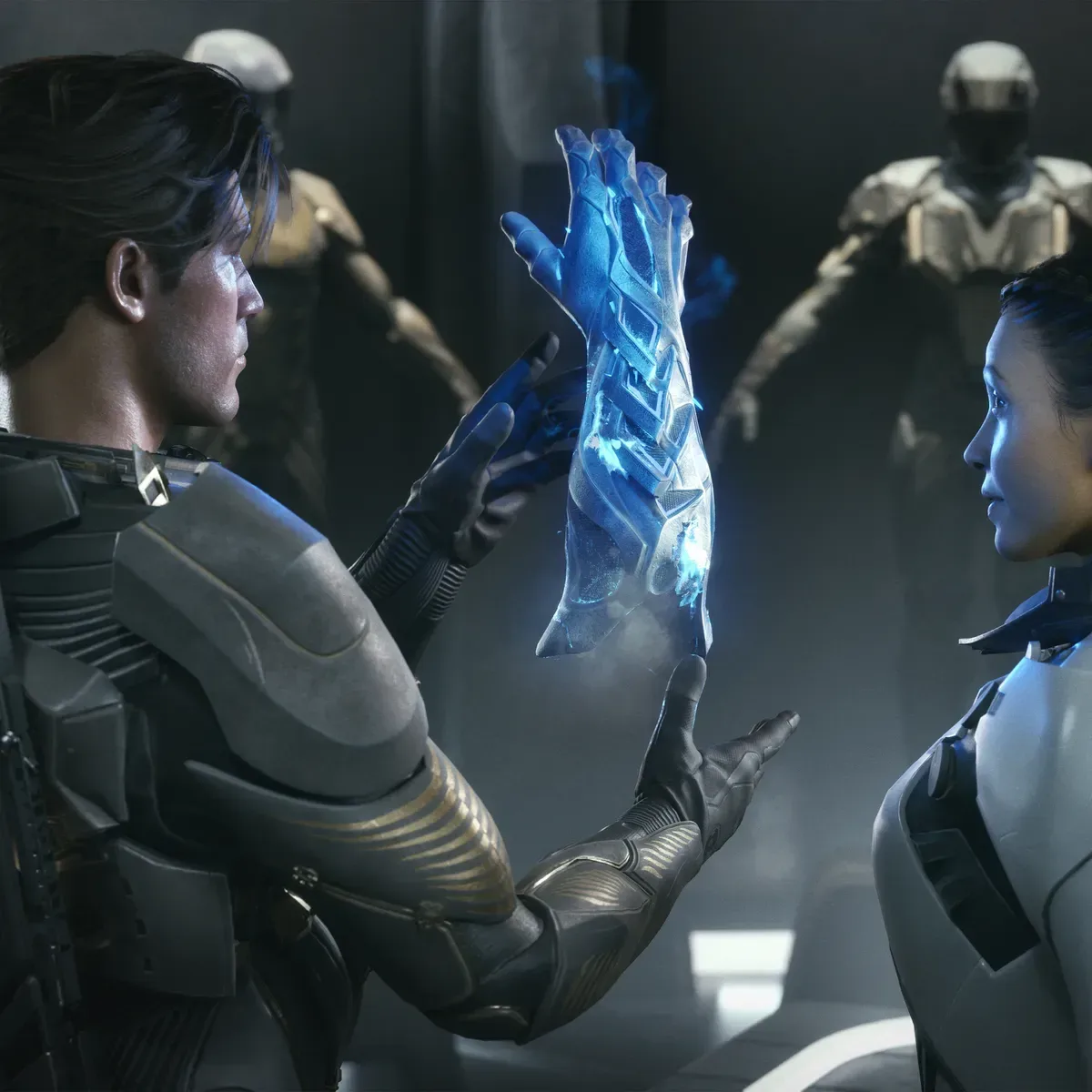
Gundam has spent roughly four decades building one of pop culture’s most recognizable collections of giant robots, rival factions, timelines, tragedies, model kits, manga, and animated battles. That scale is a strength, but it can also be intimidating for someone staring at the franchise from the outside. Gundam Rogue Orbit appears designed to lower that barrier. Rather than asking players to study a mountain of established continuity, the forthcoming Bandai Namco game takes place in a separate, original universe.
It is scheduled to launch on March 5, 2027 for PC, PlayStation 5, and Xbox Series X|S. Its premise centers on Re-X, one of the rare people capable of operating a mech suit at a moment when humanity is close to being wiped out by an alien enemy. That is deliberately a more immediate setup than one built around a long-running web of familiar Gundam political powers and historical conflicts: humanity is losing a war, terrifying invaders are everywhere, and the person inside the huge robot is among the remaining defenses.
The team’s approach does not mean it is abandoning the major ideas associated with Gundam. Producer Yuya Tomiyama has said the project moves away from the series’ usual concept in significant ways, particularly through the alien threat, while retaining the importance of war and human drama. In other words, Rogue Orbit is not positioned as a lore quiz disguised as an action game. It is trying to preserve the emotional and military stakes that define the brand while giving its own conflict room to stand alone.
An original universe, not a continuity exam
New players often encounter Gundam through a favorite series, a kit on a store shelf, a film, or a game that catches their eye. Yet deciding what comes next can get complicated fast, because the franchise encompasses multiple settings as well as a vast catalogue within its best-known continuity. Rogue Orbit’s self-contained setting should offer a clearer route in: players can learn about Re-X, the alien war, and this world’s machines as the game introduces them, rather than feeling behind before a mission begins.
For more context, explore Apple’s Sonera Acquisition Could Point to New Wearable Sensing and Accessibility Possibilities.
That choice could also serve longtime followers who simply want a new battlefield. An alternate setting gives developers flexibility to establish fresh threats, visual designs, and character conflicts without having every development measured against decades of prior fictional history. The result still needs to feel like Gundam, of course. Rogue Orbit’s early details suggest that its route to that feeling is less about repeating a particular conflict and more about delivering the sensation of piloting a towering, customizable combat machine under pressure.
Customization is part of that pitch. Before missions, players can alter the mech suit’s appearance and select a loadout, with the latter carrying meaningful consequences for how combat unfolds. That is a natural fit for a property where machine identity has always mattered. Two players may recognize the same battlefield very differently if one has brought a close-range thrusting tool and another is keeping enemies at range with a more flexible weapon.
Three weapons, very different battle plans
A Gamescom 2026 demonstration featured three weapon types: the Assault Sword, the Whip Sword, and the Sword Lance. The Assault Sword is described as the general-purpose option, likely making it the sensible starting point for players who want a balanced tool while they learn enemy behavior. The Whip Sword emphasizes reach and can strike several foes, while the Sword Lance is built for forceful, close-quarters engagement and quickly closing distance.
Related coverage includes Gundam Rogue Orbit Targets New Players With an Original Mech War.
The difference is more than cosmetic. The Sword Lance supports an aggressive rhythm in which a player manages positioning, commits to a rapid approach, lands a punishing hit, then reassesses. The Whip Sword, meanwhile, can create safer spacing against larger targets and has the potential advantage of connecting with several weak points or limbs at once. That gives Rogue Orbit a useful layer of choice: selecting a weapon may shape not only damage output, but also the pace and risk of a mission.
Importantly, the basic controls are shared between loadouts even as their combos differ. That should make experimentation less daunting. A player who understands the fundamental inputs with one weapon will not be learning an entirely separate game when changing to another. For an action title with multiple equipment styles, consistent controls can be the difference between encouraging variety and quietly telling everyone to stick with their first comfortable choice forever.
Soulslike structure with airborne mech energy
Rogue Orbit takes clear inspiration from Soulslike action design. Combat includes a healing-item equivalent, stamina management, and a separate resource comparable to mana. The stamina system in particular appears central to decision-making, because mobility is tied to the ability to fly across an arena before crashing down on an opponent. Players will need to think about whether they have enough remaining energy to travel, attack, evade, or safely disengage.
That structure creates a potentially compelling contradiction: the player is inside a massive mech, but cannot treat every encounter as a consequence-free power trip. A suit may be huge, armored, and equipped with blades and blasters, yet a reckless pilot can still be caught without the resources needed to respond. The promise is not merely to make a robot feel weighty. It is to make movement, offense, and survival part of the same calculation.
Ranged fire also appears woven into the flow rather than segregated into a separate mode. After moving in for melee pressure, the player can pull out a blaster to harass a target sitting just beyond sword range. This could make encounters feel appropriately animated: closing the gap, using boosters, striking hard, then firing while repositioning. Crucially, the early showing has suggested a game that borrows tension and tactical discipline from Soulslikes without making the player feel perpetually powerless. A skyscraper-sized war machine ought to feel formidable, even when it is facing something much bigger.
Boss limbs are targets, not just scenery
The boss encounters shown so far lean into that scale. Players face enemies towering over their mechs, with rapid combat and blocks that matter because incoming swings can be devastating. One especially notable mechanic lets players target and sever specific boss limbs. A limb begins to glow when it is selected as a target, offering a readable cue in the middle of a hectic fight.
Removing a limb temporarily weakens the boss and opens a chance to inflict additional damage. It is not a permanent solution, however: the lost part can regenerate after several minutes. That detail stops limb cutting from being a one-time shortcut and turns it into a tactical opening. Players may need to decide whether to focus on the arm creating the most danger, take away a movement option, or exploit the chance to damage multiple vulnerable points.
The Whip Sword may be especially interesting in that system because its reach allows it to attack from farther away and connect with multiple limbs. A player facing an enormous creature could use its range to stay out of immediate danger, then retreat when the target begins to close in. The Sword Lance offers the opposite fantasy, rewarding a bold rush toward the most dangerous part of the monster. Both approaches fit the same giant-mech spectacle, but they demand different levels of proximity and commitment.
Co-op is planned after mission completion
Rogue Orbit is not solely a solo undertaking. Director Yoshiyuki Serizawa has indicated that a multiplayer mode will support up to three players at once, becoming available after a mission has been completed. The mode was not part of the Gamescom demonstration, so details such as progression rules, mission selection, difficulty behavior, or the extent of customization in co-op have not yet been outlined.
Still, three-player mech action is an intriguing prospect given the weapon roles already described. A balanced sword user, a lance-focused close-range fighter, and a whip-wielding player controlling space could each have a recognizable job during a large boss battle. Whether the finished game actively supports that kind of team coordination remains to be seen, but its combat systems appear capable of making different loadouts matter in a group.
The larger picture is that Gundam Rogue Orbit is attempting a careful balancing act. It wants the dramatic war themes and oversized machine combat people associate with Gundam, while trading the usual entry barrier for an accessible original setting. It also wants methodical resource management and intimidating bosses without losing the thrill of boosting through an arena in a colossal suit. For more on the game’s early positioning, see this overview of its newcomer-friendly mech war.
There is plenty still unknown before March 2027, including the full range of equipment, the shape of the story, and how co-op will function in practice. But the announced foundation is clear: an alien war, a new protagonist, machine customization, tactical action, and bosses built to test whether players can use every booster, blade, shot, block, and severable weak point at their disposal.