William Gibson has spent decades helping readers imagine digital worlds, hackers, virtual space and the frayed edges where technology meets ordinary life. Yet the author whose work is closely associated with cyberpunk says he has never played a video game.
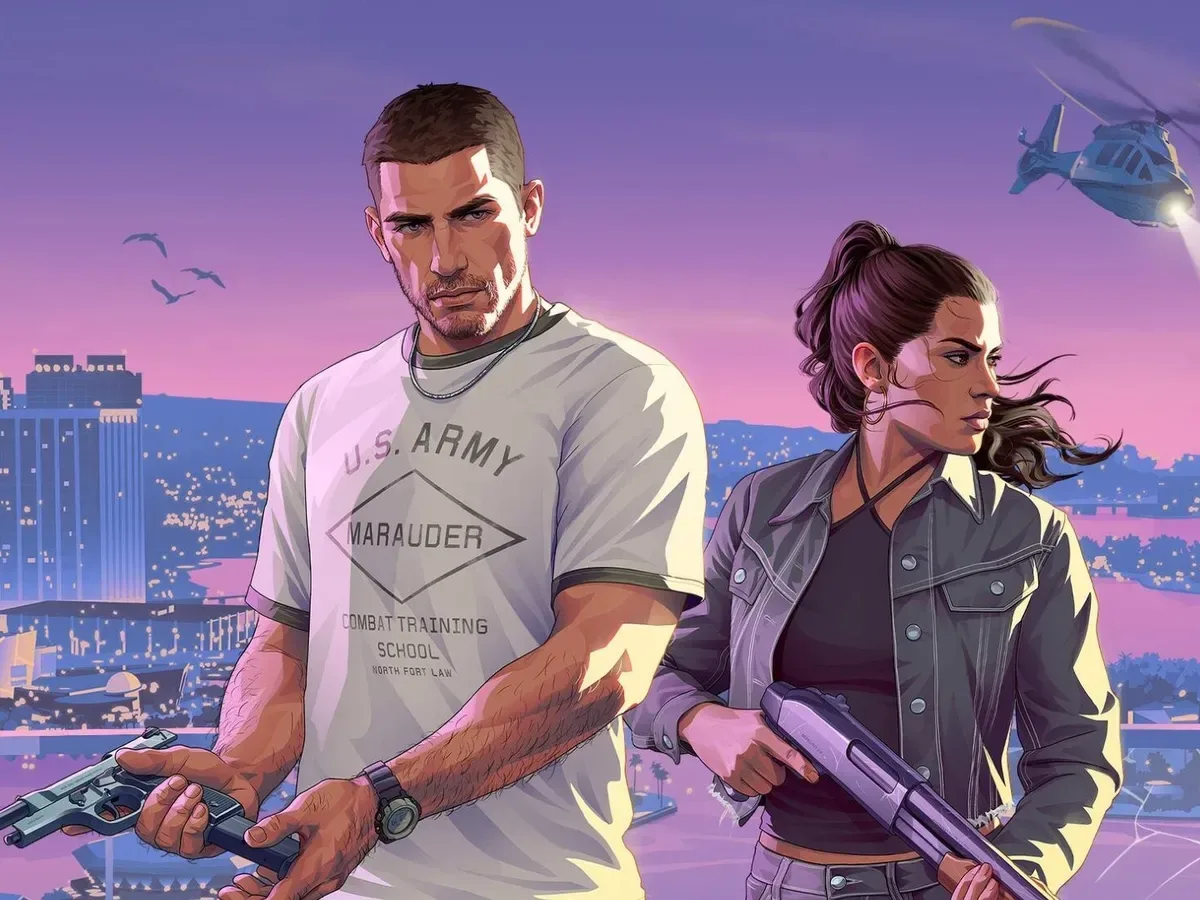
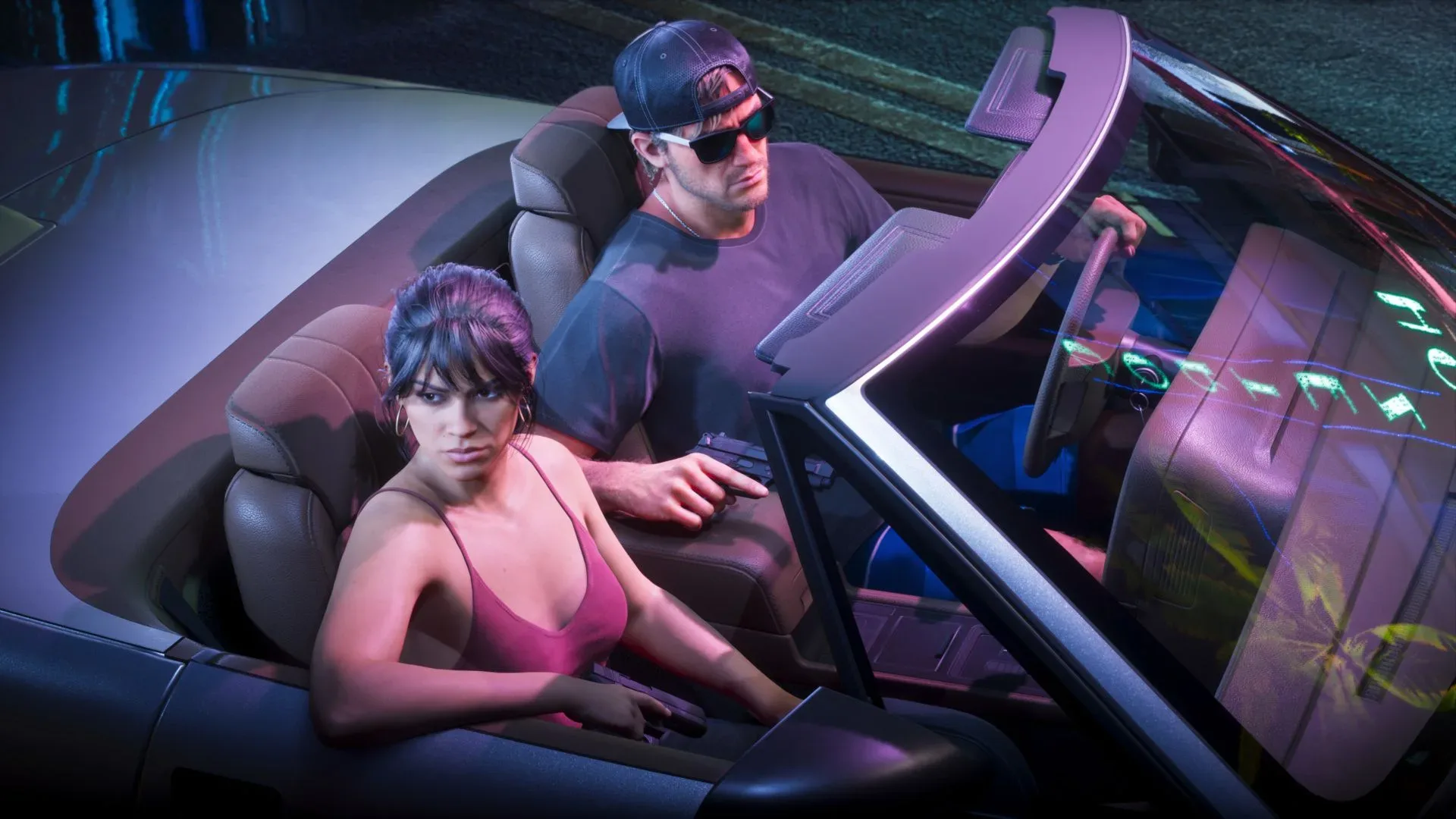
That makes his recent response to Grand Theft Auto VI clips notable—not because he is suddenly preparing to pick up a controller, but because the footage has caught his eye as a cultural and visual object. Gibson said Grand Theft Auto “actually” seems interesting, then clarified that his interest is not the same as a desire to learn to play.
“When I said that I found that clip of the new GTA interesting, I didn’t mean that it made me interested in learning to play it, but interested in what it was that I found intriguing, in some mysterious way, in its…texture?…depth? I don’t know.”
It is a precise distinction. Playing a game is an active, rule-bound experience: the player learns controls, navigates objectives and makes decisions within a system. Watching a game clip can be something else entirely. It can resemble observing a simulation, a comedy sketch, an accidental stunt, or a short glimpse of a place that does not exist but has been built to feel as though it might.
For Gibson, that second experience seems to be the compelling one. A viral Grand Theft Auto VI moment involving a boom barrier launching Jason toward Lucia prompted the discussion. It is the sort of tiny, unscripted-looking collision of objects, physics and character animation that is easy to understand without knowing the controls or broader plot. The joke travels on its own.
A cyberpunk landmark watching from outside the controller
Gibson released Neuromancer, the first novel in his Sprawl series, in the early 1980s. The book follows hackers, mercenaries and “street samurai” through a heist that reaches across cities, planets and virtual realities. Its language and ideas helped establish a vocabulary around digital environments and cyberspace that has been hugely influential far beyond literature.
That influence has long extended into games. But Gibson’s own relationship with the medium, by his account, is unusually distant. When people expressed surprise that he had never played a game, he suggested that he may have tried Pong on a tabletop machine in a bar. He did not present even that as a certainty.
The disconnect is fascinating because his imaginative groundwork was not detached from the physical world. Gibson’s early observations included teenagers and drug dealers around Vancouver arcades in the 1970s, alongside the rapid shift of computers from enormous number-processing machines into desktop workstations. In other words, arcade culture and changing computer technology helped inform the atmosphere from which his fiction emerged, even if gaming never became a personal pastime.
Related coverage includes William Gibson Finds GTA 6’s Texture and Depth Intriguing Despite Never Playing Games.
That background also makes “texture” a revealing word. In this context, it does not need to mean a technical graphics term. In 3D production, a texture can literally mean the visual surface applied to an object: the detail that makes a road, wall, plant or shirt look less like a flat shape. Gibson appears to be reaching for something broader: the accumulated sense of a world’s surfaces, movement, incidental behavior and density.
Depth works similarly. It may refer to visual depth, but it can also describe the impression that a simulated environment continues beyond the immediate action. A short clip does not have to explain every system in a game to create that feeling. A strange accident, an animal encounter or a convincing response from a passerby may suggest that many interacting rules sit behind the moment on screen.
GTA VI is becoming watchable even for non-players
Grand Theft Auto VI’s appeal in this instance is not limited to conventional gameplay highlights. Clips and streams let viewers take a back-seat role: people can watch wilderness wandering, infrastructure-focused exploration, absurd vehicle incidents and the unpredictable consequences of the game’s systems without participating themselves.
That matters because a large open-world game can operate on multiple levels. For one person, it is a mission-driven game. For another, it is a stage for comedy. For another, it is a setting for improvised storytelling or observational streams. The same simulated space can hold a stunt involving a barrier arm, a mock nature documentary in Leonida, or an unexpected rescue involving a dog on a jetski.
The latter examples point to why a spectator might remain engaged despite having no interest in mastering the game. The entertainment is not necessarily about success, competition or completion. It is about seeing what emerges when scripted design meets players who experiment, wander or deliberately create a bit.
That viewing habit has a practical difference from game criticism or a purchasing decision. A compelling 30-second clip cannot tell an audience whether the full game suits their tastes, whether its missions hold up, or whether they would enjoy its controls. What it can communicate is atmosphere: a game’s capacity to produce stories that look immediately legible and entertaining to someone with no investment in its mechanics.
For viewers who prefer that mode, recommendation tools can also shape what reaches them. A guide to YouTube custom feeds and a more focused homepage is a useful reminder that spectators can seek specific kinds of game video—world exploration, technical curiosities, comedy or quiet ambient roaming—rather than relying solely on a default feed.
Why the observation carries cultural weight
Gibson’s reaction should not be overstated. He has not said he intends to play Grand Theft Auto VI, and he has not offered a review of the game. His remarks are more tentative than that: he is trying to identify why clips of it hold his attention.
Still, that uncertainty is part of what makes the observation valuable. It describes a familiar but sometimes overlooked relationship with games. A person can be affected by a game’s world without becoming a player. They may encounter it through short-form clips, streams, memes or conversations. Their response may be to its rhythm, its visual detail, its accidental comedy or the strange plausibility of a virtual place.
Gibson’s use of “mysterious” is apt for this kind of response. The appeal of a densely simulated setting is often hard to reduce to a checklist. Higher-detail assets alone do not guarantee it. Neither does sheer map size. The sensation comes from combinations: environmental detail, believable reactions, animations, player behavior, camera framing and the way a clip captures an event at exactly the right moment.
In that sense, viral Grand Theft Auto footage can function less like an advertisement for a game and more like a demonstration of a digital environment’s expressive range. The person sharing the footage may be showcasing a stunt. The viewer may instead fixate on the traffic, a distant landscape, a character’s physical reaction or the odd logic of a non-player animal. Each is receiving a different version of the same work.
Sales talk remains separate from what clips prove
The broader conversation has also included extraordinary claims about Grand Theft Auto VI’s early commercial performance, including the suggestion that it may be the highest-performing piece of media ever. Those figures are presented as early claims and should be treated separately from the evidence available in a viral clip.
A clip can show cultural reach and the ease with which a moment can circulate. It cannot, by itself, establish sales totals, overall commercial records or the long-term significance of a release. Those are larger questions that require clear figures and context.
What is already apparent from Gibson’s remarks is narrower and more interesting: Grand Theft Auto VI has reached someone who sits outside gaming as a hobby, despite having helped shape many of the ideas that games have explored for decades. He is not describing a conversion to playing. He is describing curiosity about a new kind of mediated world—one encountered through fragments, from the comfort of a phone or home screen.
For an author associated with imagining cyberspace, the response feels fitting. The draw is not simply the action in the clip. It is the sense that there is a world behind it: a system with enough apparent life, friction and possibility to make even a single ridiculous accident feel worth studying.