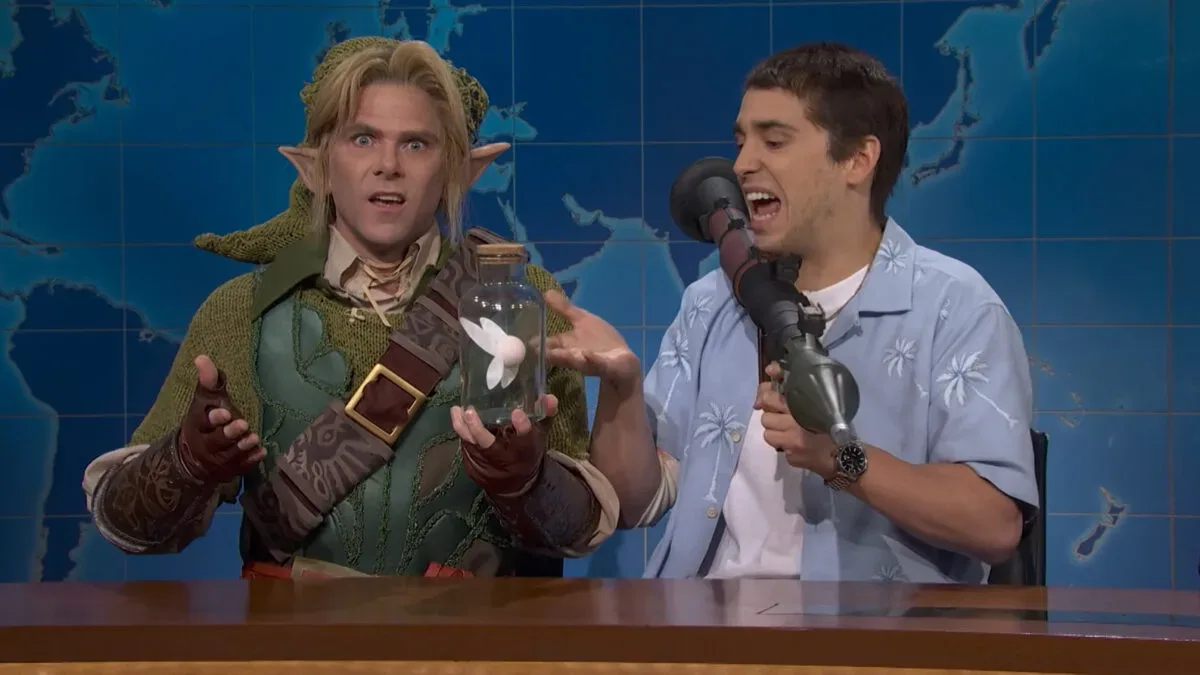
Grand Theft Auto VI and The Legend of Zelda: Ocarina of Time occupied the same late-night comedy desk when Saturday Night Live staged a fictional clash between GTA VI protagonist Jason Duval and Link during Weekend Update. Marcello Hernández appeared as Jason, while Mikey Day played Link, with Colin Jost setting up the encounter as a contest for November’s gaming attention.
The premise was deliberately blunt: GTA VI is positioned as an enormous event release, while a newly announced Ocarina of Time remake is set for the same broad release window. The games may not be available on the same hardware, but the sketch treated the calendar—and the inevitable surrounding conversation—as a battleground anyway. It is the kind of rivalry that works especially cleanly in a comedy format: two instantly recognizable game identities, wildly different tones, and no requirement to explain an elaborate fictional universe before the insults start flying.
A release-window joke built around two very different icons
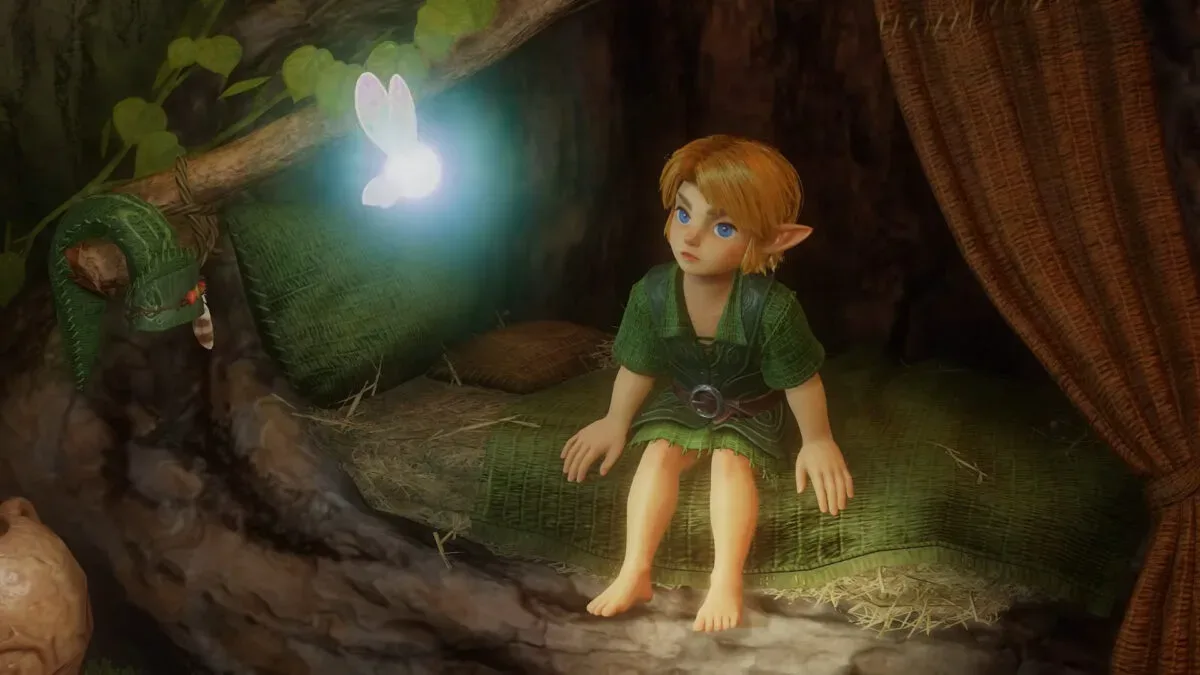
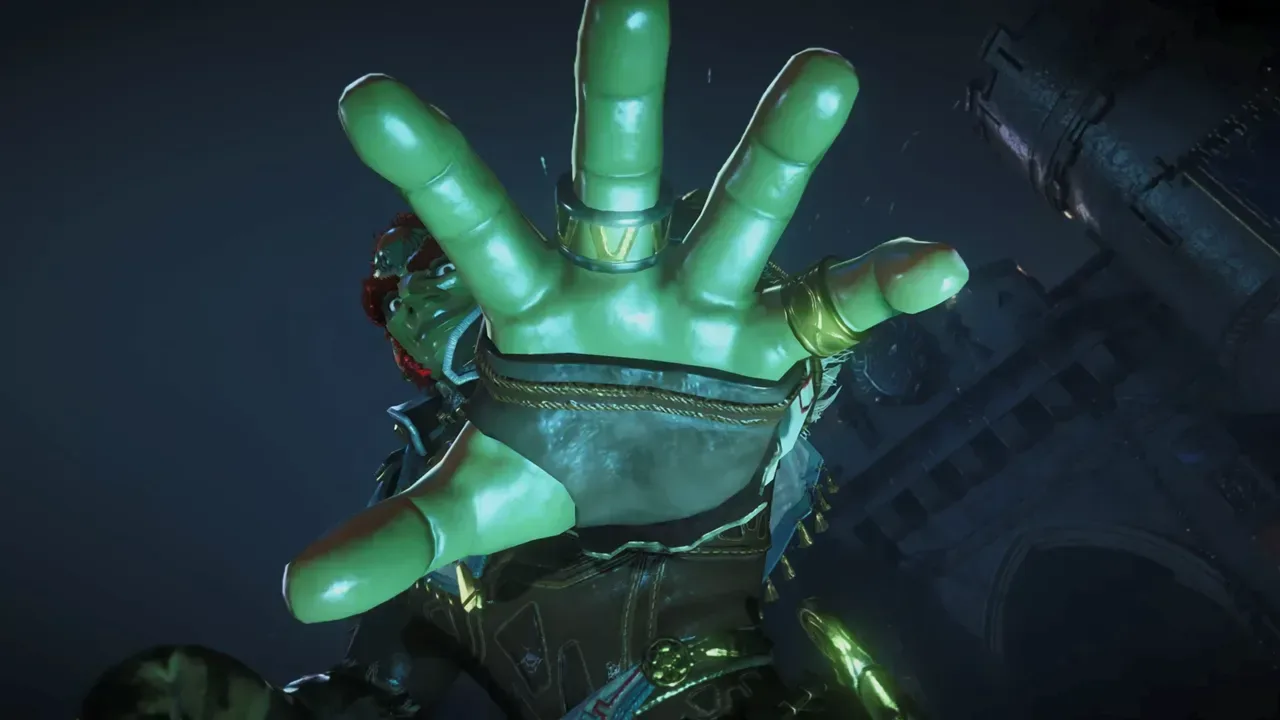
Jost introduced the pair by invoking the anticipation around GTA VI and the idea that other games have tried to avoid its November arrival. Link, as the sketch’s exception, became the counterweight. Jason represents Vice City’s rough-edged criminal-world energy; Link represents Nintendo fantasy and a character whose visual identity has long been built around a tunic, pointed ears, sword and shield. The performers had plenty of broad material to work with before either character needed to say much about an actual game.
Hernández and Day’s characters traded insults for several minutes, with Jason taking aim at Link’s appearance and Link firing back at the dim-witted, excessively macho image associated with Vice City. The escalation culminated in visual-game shorthand rather than any deeper lore exercise: Jason brandished a rocket-launcher prop, while Link had a fairy-bottle prop.
That distinction matters. A fairy bottle is an immediately readable Zelda-style item reference: something magical, portable and recognizably adventurous. A rocket launcher signals GTA’s heightened action and weaponized chaos just as quickly. Neither prop needs a lengthy explanation for a general audience, which is why they are effective visual punctuation for a short live sketch.
The segment’s central gag was not that GTA VI and Ocarina of Time are truly identical competitors. It was that November’s attention economy can make two radically different game worlds look like opponents.
Why the matchup is more media-cycle competition than platform competition
The underlying release conversation is slightly stranger than the comedy version makes it sound. GTA VI and the announced Ocarina of Time remake are not simply two games fighting over the exact same audience on one storefront. The Ocarina of Time remake is headed to a Nintendo console that will not offer Grand Theft Auto, so there is no direct console-library showdown in the narrowest sense.
But “competition” in games is often broader than a shopper choosing between two boxes on the same shelf. Major releases compete for headlines, video coverage, social discussion, retail visibility, word-of-mouth, holiday wish lists and players’ finite time. That is the media cycle: the rolling period in which a launch, trailer, announcement, review discussion, or fan reaction dominates public attention. Two releases can share that cycle even when their platforms differ.
Related coverage includes GTA VI’s Jason Duval and Link Face Off on SNL’s Weekend Update.
In that light, the Weekend Update setup reflects something real about how blockbuster game launches are discussed. GTA VI has become a gravitational point in release planning and public conversation. The sketch turns that industry-scale pressure into a cartoonish face-off because a single desk confrontation is easier to understand than a long explanation of scheduling strategy.
It also gives Link a useful comic role. He is not presented as a plausible Vice City rival in tone, technology, or fictional setting. He is the conspicuous alternative: a fantasy hero arriving in the same general period and refusing to quietly stay outside GTA VI’s shadow. The humor comes from treating that contrast as personal beef.
The costumes do much of the recognition work
Day’s Link costume appears to be the segment’s strongest piece of craft. The outfit faithfully leans into the visual language expected of the character, giving the performance a deliberately polished, remake-era look rather than reducing Link to a green shirt and a generic pointed hat. That fidelity makes the sillier material legible at a glance. A sketch with only a few minutes to establish itself benefits from costumes that communicate character before the dialogue has to do all the work.
Jason’s presentation, by contrast, is designed around recognizability through attitude and weaponry. That imbalance is unsurprising: Link brings decades of instantly codified iconography, while GTA VI’s Jason is attached to a game whose anticipation has made him a highly visible upcoming character. The sketch uses the contrast rather than trying to flatten it. Link is formal fantasy imagery; Jason is an agitated open-world-crime avatar carrying a conspicuously oversized threat.
There is a broader technical point in that approach. In television comedy, especially live comedy, visual shorthand means using costumes, objects, gestures and familiar archetypes to convey information rapidly. It is not the same as an accurate adaptation of a game’s systems or story. The goal is recognition, then exaggeration. Here, the recognizable elements are there primarily to set up a collision between Nintendo-style fantasy and GTA-style mayhem.
Broad gaming jokes can still miss the sharper target
The segment’s construction is closer to an old-school parody than a close reading of either series. Its insults revolve around Link’s femininity-coded design and the lunkheadedness of Jason’s world, then move toward prop-based escalation. That is a valid sketch structure: establish types, make them argue, increase the absurdity. Yet it can feel thin for viewers hoping for jokes that explore why these games have captured attention in such different ways.
There is a difference between referencing games and finding comedy in the way people talk about games. The former needs recognizable clothing, weapons and catch-all stereotypes. The latter might interrogate sequel anticipation, remake culture, platform boundaries, fandom arguments, marketing language, or the strange collective behavior around a release date. This sketch largely chose the first route.
That does not make the segment incomprehensible or inaccessible. In fact, its simplicity is likely why it can function for viewers who know only that GTA involves crime and chaos, while Zelda involves a green-clad hero, magic and fantasy. The trade-off is specificity. Players familiar with both series may see the joke’s mechanics immediately and still wish the writing had a more surprising destination than a familiar “these two things are different” exchange.
What the sketch does capture
- GTA VI’s attention: The game is presented as so large that its launch window becomes a subject beyond dedicated gaming spaces.
- The peculiar force of a remake: Ocarina of Time’s return is framed as a major cultural event, not merely a catalogue release.
- How platform separation does not prevent comparison: Different hardware does not stop audiences and media coverage from treating release windows as competitive terrain.
- The usefulness of gaming iconography in mainstream comedy: A tunic, a fairy bottle and a rocket launcher can carry much of the scene before detailed exposition is needed.
A mainstream stage for a very game-specific November
There is some novelty simply in seeing these two properties turned into a Weekend Update confrontation. GTA VI is an impending blockbuster whose release timing has become part of the industry conversation; Ocarina of Time is a foundational name with enough continued cultural reach to support a surprise remake announcement and a major comedy-sketch appearance. Their overlap provides an unusually easy route for a mainstream program to talk about games without pretending that the audience needs a tutorial first.
The sketch’s framing should not be mistaken for a literal market forecast. It is a comic version of a bigger public narrative: a huge GTA launch is approaching, a Zelda remake has entered the same period, and both will generate attention. Whether that becomes a meaningful collision for individual players depends on their platform, budget, schedule and taste. Someone buying a Nintendo game may not view GTA VI as an alternative purchase at all. Someone following every major release may see the two as part of the same busy month.
That nuance is not especially useful for a desk sketch, where exaggeration is the mechanism. But it is useful for understanding why the premise exists. The two games do not need to share a console, genre, audience profile, or fictional language to share cultural oxygen. November’s conversation is evidently big enough to fit Vice City, Hyrule, a fairy in a bottle, and an entirely unnecessary rocket launcher at the same desk.
For more on the current crop of games being discussed beyond the biggest blockbusters, see Joking Joystick’s look at Stay in Your Lane’s announced one-lane RTS design.