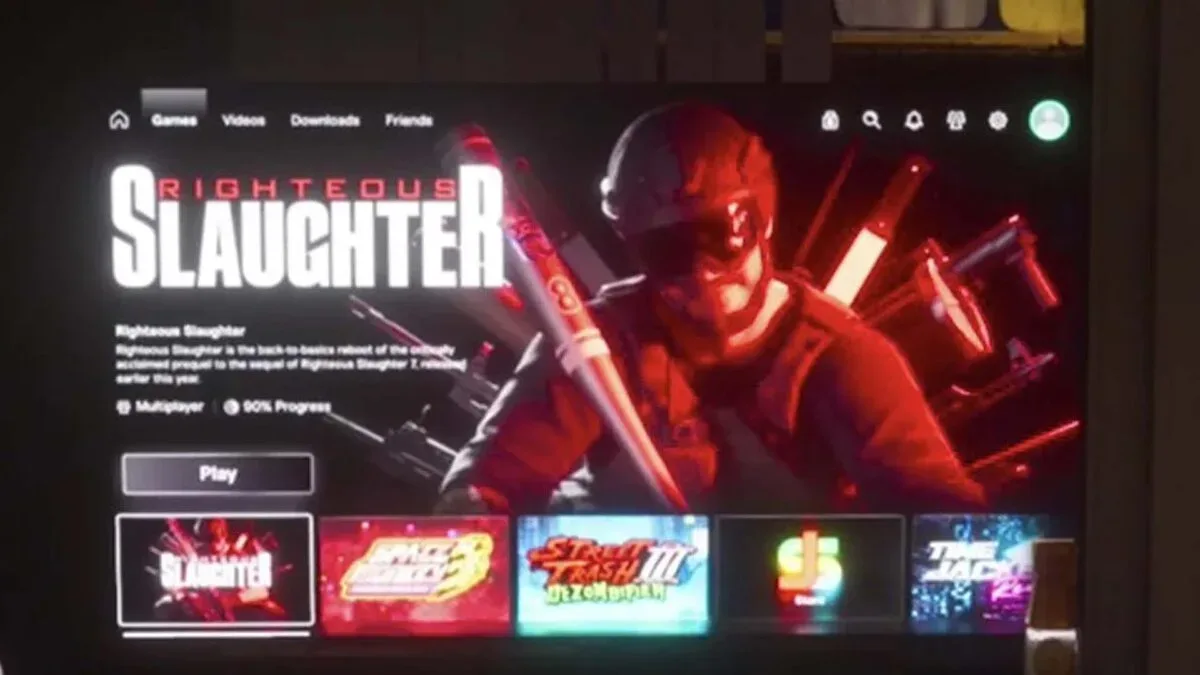
Grand Theft Auto VI’s radio satire has picked a remarkably charged target. Among the music, DJs and fictional commercials on GTA 6’s stations is an advertisement for Righteous Slaughter: Domestic Infection, a made-up AAA military shooter that takes broad aim at Call of Duty-style messaging. Its core gag is deliberately ugly: a supposed national threat is a disease that causes people to have “anti-American” ideas. The commercial identifies concern for fair pay and unions as symptoms.
That is a pointed joke even before its real-world context enters the picture. The ad’s fictional soldiers frame workplace basics—benefits, security and collective representation—as evidence that a comrade has become compromised. Rather than making a general joke about shooting games, it targets a familiar ideological contradiction: rhetoric that celebrates workers, troops and national service while treating workers organizing for better conditions as suspicious.
The detail becomes harder to separate from events around Rockstar itself. Developers are voting on union recognition, while 31 former employees are involved in a UK court dispute over allegations that they were dismissed as part of union-busting activity. Rockstar denies those allegations. Both sides are awaiting a judge’s ruling.
The fake game inside GTA 6
Righteous Slaughter: Domestic Infection is presented as the newest installment in GTA’s in-universe riff on blockbuster military shooters. That framing matters. GTA commercials have long functioned as compressed bits of world-building: they sell a product that does not exist, establish the values of its fictional marketers and give the player a few seconds of satire between songs.
Here, the invented marketing language turns paranoia into the product. The ad says the country is endangered by a contagion that makes people think unacceptable thoughts. One alleged sign of infection is the desire for fair wages and unions. Its absurdity is not subtle, but it does not need to be. The commercial is built around the way loaded political language can recast ordinary material concerns as cultural or national betrayal.
The punchline arrives through a short exchange between two soldiers. One observes that they have been on a mission without benefits or security, then cautiously raises the possibility of unionizing. The other does not engage with the concern; he declares the first soldier infected.
“You know, we’ve been working on this mission with no benefits, no security…”
The joke works because the soldier’s observation is mundane. Benefits and security are not presented as a grand manifesto, just as the practical conditions people consider when they discuss collective representation. The exaggerated reaction is what exposes the commercial’s worldview.
Related coverage includes GTA 6's Call of Duty Spoof Takes Aim at Union Fear During Rockstar's Labor Fight.
What “union recognition” means in this context
A union-recognition vote concerns whether a union will be formally recognized for collective bargaining. Collective bargaining is the process through which workers negotiate as a group with an employer over issues such as wages, conditions and benefits, rather than leaving each employee to negotiate alone.
That is why the commercial’s specific language lands differently than a generic gag about office politics. It names the sort of issues that unionization is commonly intended to address: fair wages, benefits, job security and a collective share in the success workers help create.
Rockstar developer and union member Nestor Uriarte has described that goal in direct terms, arguing that recognized representation could help ensure people across departments receive a fair share of the success to which they contributed. Uriarte has also said the union intends to keep advocating for a studio that works for everyone at Rockstar and for workers elsewhere in the industry, regardless of the ballot’s result.
Those comments should not be confused with a ruling on the separate legal dispute. The court case concerns claims from 31 former employees that their firings were connected to union activity; Rockstar disputes that characterization. Until the judge rules, it remains an unresolved conflict, not an established finding.
Satire with an unusually close target
It would be too simple to treat a fictional GTA advertisement as an official corporate statement on labor relations. A game is made by many people, and a satirical voice inside a game is not the same thing as an employer’s position. Nor does the commercial identify Rockstar, Take-Two Interactive, the court dispute or the union ballot by name.
Still, timing changes interpretation. A joke about a fictional military shooter treating unionization as a disease arrives while the studio behind that joke is confronting a live vote on union recognition and a labor-related court battle. The proximity gives the ad a tension that a similar commercial might not otherwise have.
Read narrowly, it is a send-up of militarized entertainment and reactionary advertising. Read alongside the labor situation, it can also feel like a joke that slips past the gatekeepers and points back toward the production conditions behind a gigantic game. That ambiguity is part of why it is effective. It does not resolve the dispute, but it makes the language around it impossible to ignore.
The broader GTA format helps, too. Radio commercials are not delivered as a speech from outside the game; they are encountered amid driving, music and the city’s ambient noise. A player may initially hear a ridiculous invented slogan, then gradually realize the ad’s target is not merely military-shooter excess. It is the reflex to paint collective workplace demands as dangerous, disloyal or somehow unpatriotic.
Why benefits and security are the key words
The most useful part of the spoof is not its deliberately inflammatory fictional diagnosis. It is the abandoned sentence before the diagnosis: workers have no benefits and no security. Those two terms convert the sketch from abstract culture-war parody into a labor joke.
Benefits generally refers to employment provisions beyond base pay. Job security concerns the stability and predictability of employment. Neither term, on its own, dictates a particular legal outcome or bargaining arrangement. But both explain why workers may seek a formal collective voice.
By making those concerns the evidence of “infection,” the fictional ad demonstrates the satirical mechanism at work. It ridicules a stance that refuses to answer a worker’s substantive complaint and instead attacks the worker for raising it. The second soldier never says benefits or security are unnecessary. He treats the act of asking as proof of contamination.
That is also why the Call of Duty comparison has traction. The commercial uses the visual and rhetorical vocabulary associated with big military shooters—heroism, threat, national emergency and infected enemies—to turn a labor discussion into an overblown battlefield crisis. Its comedy depends on the gap between the dramatic response and the ordinary request.
A GTA joke that invites a closer listen
GTA 6’s stations are full of material designed to create a dense, noisy fictional culture: songs, hosts and ads for imaginary entertainment. Righteous Slaughter: Domestic Infection is one more fake product in that ecosystem, but it is likely to draw attention because its comedy touches a real conflict surrounding the people who make the game.
For players, the practical takeaway is not that the commercial supplies secret evidence about the recognition ballot or court case. It does not. Its value is interpretive: it offers a sharp piece of in-game satire at a moment when questions of wages, conditions, bonuses, benefits and representation are already central to discussion around Rockstar.
It also fits a wider reason GTA radio remains valuable beyond background noise. A well-made fictional ad can deliver character, politics and criticism faster than a cutscene, then leave room for the audience to decide what it means. In this instance, the premise is intentionally ridiculous—thinking about unionizing marks a soldier as infected—but the underlying issues are not. For more on how GTA 6 builds its sense of place through its people, see GTA 6’s NPC design and Leonida’s busy-world ambitions.
The eventual outcome of the recognition vote and UK case will be determined outside GTA 6’s fictional airwaves. But the commercial has already done what pointed satire does best: taken a serious concern, placed it in an exaggerated voice and made the contradiction loud enough that it is difficult to tune out.