
An unofficial effort to make Grand Theft Auto 6 run on PC has run into rapid moderation and copyright enforcement, with Project Leonida’s Discord community removed and a large network of related GitHub repositories taken down. The developments follow reports that an Xbox Series X executable for the game was released online by Cyberleek, a person or group linked in the supplied reporting to earlier GTA 6 leaks.
For players waiting for a PC edition, the story underlines both the intensity of demand and the hazards surrounding unauthorized projects. GTA 6 is currently playable only on PlayStation 5 and Xbox Series X/S, while Rockstar has not outlined PC-release plans. That absence has created a conspicuous gap for people who do not own one of those consoles, but it does not make unofficial code, leaked builds, or community recompilation projects an established or safe substitute for an official release.
There is an important distinction to make here: discussion of a technical possibility is not the same thing as proof that a working PC version exists, that it is lawful, or that it is fit to use. The publicly tracked effort discussed in the supplied material was said to run at below five frames per second. In practical terms, that is far from a usable modern game experience.
What the takedowns covered
Project Leonida had become a prominent hub for people attempting to recompile GTA 6 for PC. Its Discord was removed after a request attributed to Rockstar and Take-Two. The project’s 15-year-old creator subsequently said they were stepping back to concentrate on schoolwork; replies referenced in the reporting also indicated a two-year Discord ban. Some posts were later deleted.
The enforcement did not stop with the chat server. Take-Two also sought the removal of Project Leonida’s central GitHub repository and its forks. A DMCA notice published by GitHub said the affected network was substantial enough that action was applied across 3,007 repositories.
A fork is a copy of a software repository that allows work to proceed separately from the original. In ordinary, legitimate software development, forks can be a routine way to experiment with changes or maintain alternate versions. In this case, the number is notable because it shows how quickly a public code project can duplicate across a hosting platform—and why a takedown can extend beyond a single page.
For a fuller account of the repository removals and the alleged leaked build at the center of the situation, see our coverage of Take-Two’s action against unofficial GTA 6 PC port repositories.
Recompilation is not a magic “port” button
The term recompilation has been used broadly around these efforts, but it describes an extremely difficult technical process rather than a quick conversion. Software is generally written as source code, then transformed into machine-oriented instructions that a particular platform can execute. A console build is designed for its own hardware, operating environment, graphics interfaces, system services, input handling, and security assumptions. A PC release has to work across a much wider range of hardware and software configurations.
Related coverage includes GTA 6 PC Recompilation Projects Face Takedowns After Xbox Executable Leak.
That means an actual PC version is not merely a matter of getting past a title screen. It requires stable rendering, correct controls, sound, memory behavior, storage access, performance, error handling, and compatibility across countless system combinations. Even a project that launches or displays some game output can remain nowhere near a functional release.
The reported sub-five-frames-per-second state is useful context. Frame rate measures how many complete images are displayed each second. At fewer than five frames per second, movement and input feedback would be extremely delayed and choppy. It is best understood as an early technical proof of partial execution, not evidence of a viable PC port.
There is also a legal layer that cannot be reduced to technical jargon. Some community recompile efforts have been described as relying on a user’s own game files for proprietary material such as assets and voice acting. But the alleged release of an Xbox Series X executable changes the practical picture described here: it potentially gives participants access to material without requiring a legitimate copy. That is precisely the kind of escalation likely to draw swift attention from rights holders.
Why AI has become part of the story
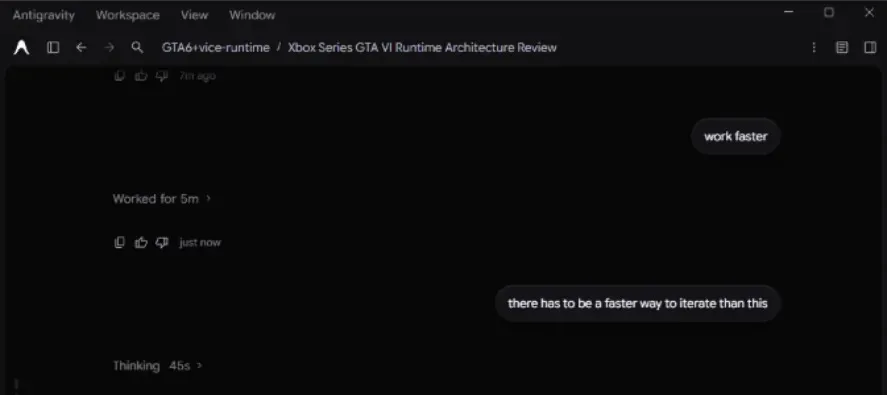
The GTA 6 projects have also become a showcase for what is often called vibe coding: directing an AI coding system in conversational prompts and relying heavily on it to generate or modify software. Streams reportedly showed participants asking tools including Claude and Google Antigravity to solve problems in real time, sometimes with very simple instructions such as advancing past the title screen or working faster.
AI code-generation tools can produce snippets, suggest debugging paths, and help organize repetitive programming work. None of that guarantees that generated code is correct, secure, legal to distribute, or suitable for a complex game project. The larger and less understood a software target is, the more likely it is that apparent progress masks deeper problems. An AI model can generate a plausible answer; plausibility is not the same as compatibility.
That is one reason viewers should be skeptical of progress bars, countdowns, and clips that imply an unofficial build is close to completion. A public tracker called PortWatch VI reportedly listed multiple community efforts and celebrated rapid development after the alleged executable release. Yet public-facing markers cannot independently establish whether the underlying work is stable, legitimate, complete, or reproducible.
Public streams bring a second problem: visibility. They may attract an audience, collaborators, and attention to a project, but that same attention can make it easier for a rights holder to identify the people, repositories, and services involved. The removal of Project Leonida’s Discord and GitHub network demonstrates that the most visible organizing points are vulnerable to enforcement.
What remains uncertain
It is not clear whether Take-Two and Rockstar will pursue every remaining recompilation effort, or whether new projects will emerge after the removal of Project Leonida’s public infrastructure. The reporting raises the possibility that less-public attempts could be harder to spot than projects documenting progress in real time. That remains speculation, not a confirmation that another functional project exists.
It is also unknown whether Rockstar has a future PC version planned, and no timetable should be inferred from the current silence. A demand for a PC release is understandable, particularly for a game with this level of cultural attention, but waiting for official information remains the only reliable route to knowing what platform support, performance standards, distribution, and customer support would look like.
The immediate impact of unofficial projects may also be limited. Finding, configuring, and trusting software circulating through repositories or torrents is a much higher barrier than buying a conventional release. More importantly, unverified downloads present an obvious practical risk: a file can be mislabeled, incomplete, altered, or bundled with unwanted software. The supplied reporting does not establish the safety or authenticity of any files connected to these projects, and players should not assume that a purported port is trustworthy because it appears in a stream, tracker, or code repository.
Why this matters beyond one game
The story is not simply about impatience for GTA 6 on PC. It illustrates how leaked software, easily accessible code-generation tools, public version-control sites, streaming platforms, and social communities can compress the time between an alleged leak and a large-scale effort to build around it. Each element plays a different role: the executable is alleged to provide a technical starting point; AI lowers the barrier to attempting changes; repositories make collaboration and copying simple; streams turn the process into spectacle.
None of those tools independently resolves the hard parts of making a robust game run on a new platform. Nor do they erase intellectual-property concerns. But together they can make unauthorized experiments more visible, faster-moving, and more difficult for companies to contain once information is copied across multiple spaces.
For now, the strongest verified takeaway is straightforward. Public GTA 6 PC recompilation efforts have already faced significant disruption, including a Discord removal and a GitHub action covering thousands of repositories. The best-known tracked effort was reportedly performing far below playable speed, and Rockstar has not provided official PC plans. The desire to play GTA 6 on a preferred platform may be real, but the current unofficial rush offers more uncertainty and risk than a credible alternative to an authorized release.