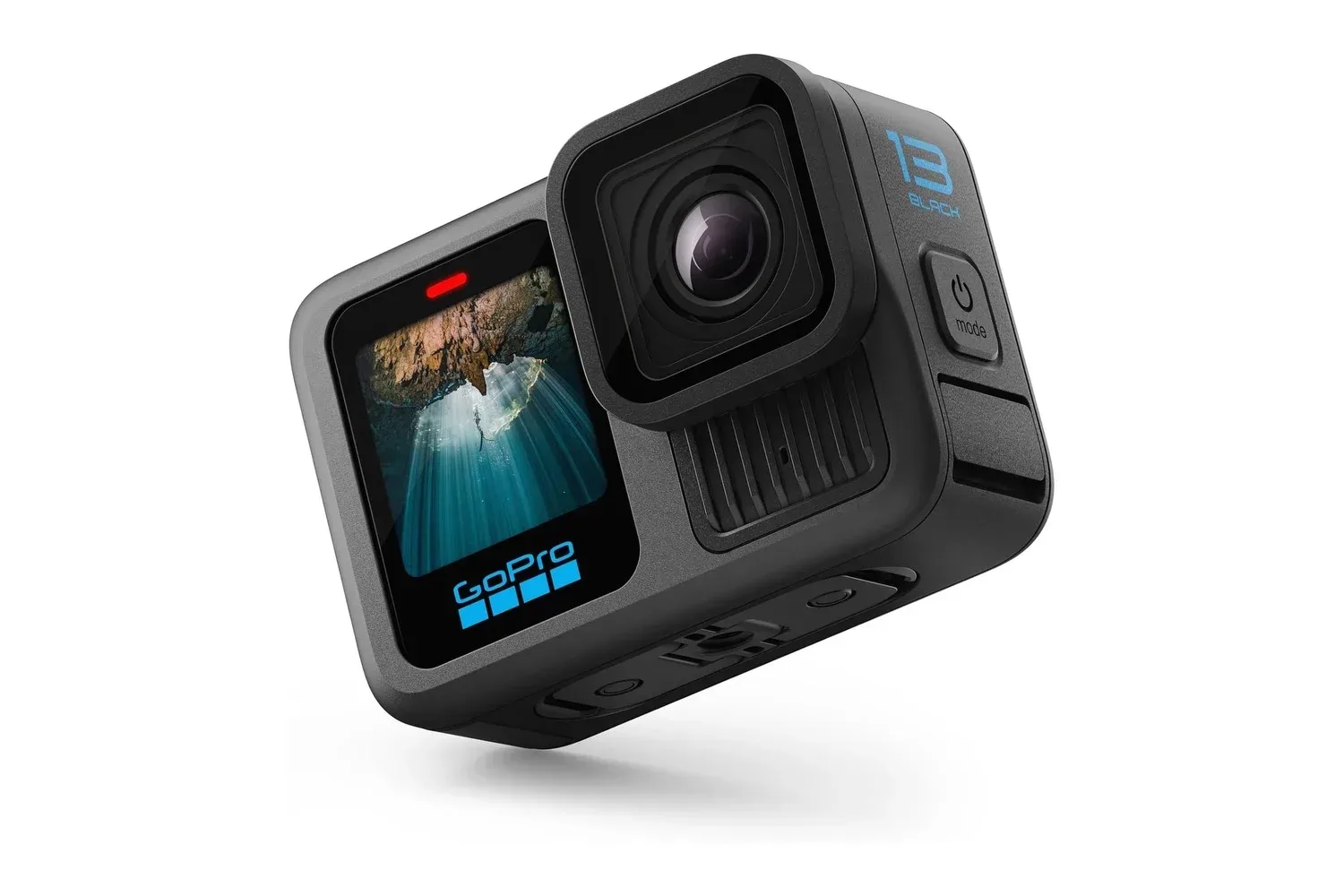
GoPro’s LIT Hero is positioned as a less intimidating route into action cameras, and an Amazon Prime Big Deal offer lists it at $180 for Prime members, reduced from a stated $270 list price. That is a $90 reduction, or 33%, for a camera that combines the expected rugged, mountable design with one unusually practical feature: a small built-in light.
The appeal is straightforward. Plenty of memorable travel, hobby and gaming-adjacent moments happen after daylight has already made a tactical retreat: a late bike ride, a campfire, a dim tent, a rainy walk home, or a tabletop session in a poorly lit room. An action camera cannot make darkness disappear through optimism alone. The LIT Hero instead includes an onboard lamp intended to provide illumination when a scene needs it.
For a first-time buyer, the $180 price matters as much as the headline specification list. Action cameras are often bought for a specific plan—a holiday, an outdoor activity, a helmet-mounted recording setup—and then judged on whether they are simple enough to use again. The LIT Hero’s pared-back controls, touchscreen operation and included basic mounting hardware indicate that it is aimed at people who want to record quickly rather than work through a long menu of advanced settings.
A built-in light is the LIT Hero’s defining difference
The “LIT” part of the name refers to the integrated light. It has three brightness levels and is intended for scenes that are dim or completely dark. GoPro also includes a diffuser, an accessory placed over a light to spread and soften illumination. That matters most for close subjects, where an undiffused small light can produce harsher highlights and more severe shadows on a person’s face.
There are two useful details beyond simply having a light attached to the camera. The light can function while the camera is switched off, and it can also remain usable while the unit is plugged in and charging. In practical terms, that gives the LIT Hero a second role as a compact lamp: enough for locating equipment in a bag, finding a tent zipper, checking a trail map or handling other small tasks where a phone flashlight may be inconvenient.
That does not turn the camera into a substitute for dedicated outdoor lighting, and buyers should not assume a tiny camera light can illuminate a large landscape. Its clearest use is nearer-range footage or personal utility. Still, integrating it into the camera means one fewer separate item to charge, carry and mount—a meaningful convenience on a short trip or for casual creators.
What 4K at 60 frames per second means
The LIT Hero records video at up to 4K resolution and 60 frames per second, often written as 4K/60. Resolution describes the amount of picture detail captured, while frames per second, or fps, describes how many individual images make up each second of video. A 60 fps recording captures twice as many frames as 30 fps footage over the same duration.
That higher frame rate can make fast movement look smoother. It is useful for activities with quick direction changes, jumps, splashes or other action where 30 fps may show more obvious motion judder. It also gives editors the option to play footage back at half speed while maintaining a 30 fps result. In other words, a brief trick, wave or downhill run can be slowed down without becoming a slideshow.
The camera also takes 12-megapixel photos. GoPro’s Quik app can extract still images of up to 11 megapixels from video afterward. This is a handy safety net rather than a replacement for deliberately taking a photo: when the exact peak moment is hard to predict, recording video first can let a user select a frame later. For someone filming a pet, a child on a sled or a single attempt at a jump, that flexibility may prove more useful than trying to hit a shutter button at precisely the right moment.
The touchscreen uses taps and swipes to move between video, photo and slow-motion modes. That limited approach is an important part of the product’s entry-level argument. More manual options are valuable for experienced shooters, but extra controls can also add friction when somebody just wants to attach the camera, choose a mode and start recording.
Rugged convenience, with a clear depth limit
The LIT Hero is waterproof without requiring a separate housing to a depth of 16 feet. That makes it suited to surface-level water activities such as snorkeling, pool use and the occasional kayak mishap. It is not a broad claim of deep-water capability. Buyers planning dives or any activity below that stated limit should treat the 16-foot rating as a hard boundary rather than an invitation to test it.
The camera is also presented as able to handle mud and snow. A small, light body has practical advantages for an action camera because it is easier to place on a helmet or chest strap and less cumbersome to pass around. It also makes the LIT Hero a lower-risk choice than a phone for situations where drops, water and messy terrain are plausible.
That is especially relevant for casual footage. A camera can be clipped to a dog harness, handed to a child on a sled or mounted for an outdoor activity without asking someone to sacrifice their everyday phone to the elements. Of course, the camera itself still deserves careful mounting; “rugged” is not the same thing as indestructible.
Important limits: stabilization, subscription tools and mounts
The attractive price should be considered alongside the product listing’s conditions. Most notably, HyperSmooth stabilization is applied after recording in the GoPro Quik app, rather than being described as an in-camera result. Stabilization is the process of reducing the appearance of shake and vibration in footage. It can make walking, riding or handheld clips easier to watch, but this implementation means users should plan on transferring clips to the app for that result.
That workflow may be perfectly reasonable for a beginner who already edits and shares videos from a phone. It is less ideal for someone who wants finished, stabilized clips immediately from the camera without any post-recording processing. The distinction is worth understanding before purchase, because “stabilization” can sound like a single on/off capability when the timing of that processing changes the experience.
Automatic highlight videos sent to a phone also have requirements: a GoPro subscription and a home Wi-Fi network. A highlight video is an automatically assembled selection of clips intended for quick sharing. Convenient tools are welcome, but a buyer should separate the camera’s core recording ability from subscription-linked services. The LIT Hero can record 4K video and take photos on its own; the automated compilation workflow has additional conditions.
Magnetic Latch mounts, which allow quicker swaps between mounting setups, are sold separately. The box does include the camera, a light diffuser, a curved adhesive mount, a mounting buckle with thumb screw and a USB-C cable. That is enough to begin with a compatible curved surface, but it does not mean every desired placement or quick-switch mounting option is included.
For a broader view of how a compact device can complement rather than replace a phone, see our coverage of the Galaxy S26 Ultra’s mobile-gaming and display-focused deal. The practical distinction remains simple: a phone is an all-purpose device, while a small waterproof camera is made to be mounted, carried into messy conditions and kept focused on recording.
Who the discounted LIT Hero best suits
The LIT Hero makes the most sense for a new action-camera owner whose priorities are straightforward video capture, small size, basic ruggedness and better options after sunset. Its 4K/60 recording, 12-megapixel stills, frame extraction and case-free waterproofing cover a useful set of everyday adventure-camera jobs. The integrated lamp gives it a distinct practical advantage for close-range low-light situations.
It may be less suitable for buyers who place a premium on extensive camera controls, deep-water use, immediate stabilization without app processing, or a mounting ecosystem that works out of the box for every scenario. Those shoppers should budget for accessories where necessary and closely compare the more control-focused HERO12, which is listed at $297 on the same product page.
Buyer feedback is still relatively limited: the listing shows 258 ratings with a 4.2 out of 5 average. That is a useful early signal, not a definitive long-term reliability verdict. The offer also requires Prime membership, so the $180 deal price is not presented as a universal price. Free returns are listed, which can reduce the risk for shoppers deciding whether the compact form factor and app-dependent workflow fit their needs.
At this discount, the LIT Hero’s strongest pitch is not that it does everything. It is that it puts a focused set of capabilities—4K/60 capture, straightforward controls, light water resistance and a genuinely useful built-in light—into a first action camera without asking buyers to start at a flagship-level price.
Shop the products
Check current price, model and availability at the retailer.